
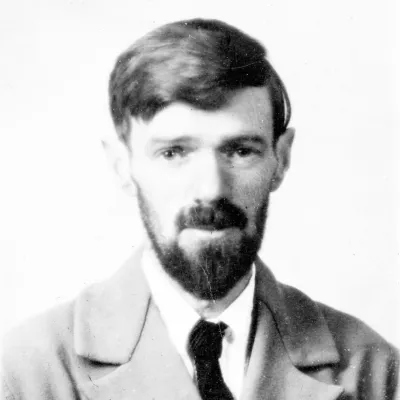
D.H. Lawrence
Human Design Chart
Biography
"Bertie" was the fourth child of an abusive coal miner and a refined mother whom he idolized. After surviving bronchitis at the age of two weeks which left him in permanently delicate health, he grew to be a frail and hyper-sensitive child who was often in tears and was overly dominated by his unhappy mother Lydia. His parents' marriage was disastrous. Lydia, a refined schoolteacher, met Lawrence's father, Arthur, at a local dance, where she fell in love with him. After the wedding, she found that Arthur did not own his own house and did not work in the mining office, as she had been led to believe, but instead labored as a miner himself. Her profound disillusion and subsequent misery is reflected in Lawrence's persistent theme in his novels of the elegant, well-bred woman under the influence of a common, low-bred man. As a child, Lawrence dazzled his family with his ability to copy paintings of the masters, and lioness Lydia demanded that her intelligent, talented and fragile son escape the drudgery of a miner's life and seek higher education.
After graduating a two-year teacher's training course at University College at Nottingham, Lawrence accepted a teaching job in the London suburb of Croydon. Taking up writing at the age of 19, he had four poems published in "The English Review" in 1909, which launched his writing career.
D.H. Lawrence as a Manifesting Generator 2/5 in Human Design
Manifesting Generator 2/5 — Design at a Glance
D.H. Lawrence's design features the hybrid nature of a manifestor with the constant energy source of a generator. He was someone who translated impulses into action swiftly, often skipping intermediate steps or pushing multiple projects forward simultaneously. However, this speed wasn't an end in itself but required continuous validation from his defined Sacral Center – his inner energy source. Only when this center responded to an impulse with a clear 'yes' could the creative power flow sustainably.
Without this reaction to external stimuli and without the confirmation of the Sacral Center, his design tended to overlook important steps or get distracted by too many parallel endeavors. This quickly led to frustration, the typical non-self experience for this type. The balance lay in acting swiftly and seeking variety but always ensuring that the energy behind actions was aligned. In this 'play mode' state, where he responded to impulses and felt deep satisfaction, his ability to multitask did not serve as a source of distraction but rather an expression of his vital creative power. His design challenged him to use this inner resonance as a compass to connect speed with lasting fulfillment instead of fighting against the resistance of lacking validation.
Emotional Authority
D.H. Lawrence's design featured emotional wave movement, often making quick judgments seem deceptive. His inner authority was Emotional Authority, carried by his defined Solar Plexus Center. This mechanism means that feelings are not static but fluctuate in a constant up and down motion. The world was colored by this current mood: A moment of excitement could quickly turn into negative outlook. Since the feeling at any given moment only represented a snapshot, spontaneous decisions from such a state were risky and often flawed.
The strategy involved taking time. D.H. Lawrence needed distance to go through the emotional wave. By sleeping on a decision multiple times, intense feelings subsided, creating emotional distance. Only then did true clarity and calm set in. This process was essential for long-term course corrections with significant influence on life trajectory. Patience and hesitation were not weaknesses here but necessary parts of decision-making to distinguish one's truth from fleeting moods.
The 2/5 Profile — Hermit / Heretic
D.H. Lawrence's design established a tension between the deep need for isolated maturation and external expectations of him as a problem solver and leader. As someone with Profile 2/5, 'Natural Talent / Hero', he faced the challenge of integrating these two poles. Line 2, the Hermit Line, gave him a natural talent for realization and understanding but often projected outward without his own deep introspection. This created inner indecision under pressure: Should his intelligence be used to save others? Simultaneously, Line 5, the Hero or Illusions Line, drew people seeking solutions who respected him as a genetic leader. This projection was the beginning of a maturation process towards sanctity. D.H. Lawrence had to learn to consciously use his withdrawal moments to gain inner clarity about his area of engagement. Instead of impulsively reacting to others' 'Hero' expectations, it was crucial for him to selectively decide what he would commit to and when he would say no. Only in this way could he effectively utilize his leadership qualities – practically and intuitively during crises – without losing himself or being slowed down by constant requests from his environment. This conscious selection was decisive for his development as a respected leader of his 'tribe'.
Split Definition — Defined & Open Centers
D.H. Lawrence's design established a constant internal architecture of mental pressure and available vitality. His defined Head and Ajna centers created a continuous process of inspiration and conception, coupled with reliable communication skills through his defined Throat center. This mental energy flowed into a firm identity and direction (defined G Center) as well as the deep emotional wave of the Solar Plexus and the generative power of the Sacral center. D.H. Lawrence showed himself to be someone who had to respect these internal processes: He waited for emotional clarity before acting, and reacted to life rather than initiating actions to avoid overloading his sacral energy.
At the same time, three open centers shaped his tension field. His open Heart Center lacked consistent willpower; D.H. Lawrence tended to find himself in a cycle of proving things when trying to keep promises or enforce will, which often led to frustration as this energy was not consistently available. His open Spleen Center made him vulnerable to conditioned fears and spontaneous poor decisions; he unconsciously sought security from others to compensate for the feeling of survival deficiency, leading him to cling to unhealthy situations. Additionally, his open Root Center absorbed external stress from the environment. D.H. Lawrence was exposed to other people's pressure and tended to interpret this adrenalized state as his own drive, which could foster hyperactivity or exhaustion if he did not recognize that this pressure originated externally. The contrast between his stable internal structure and his sensitivity towards external stress and conditioned fears significantly determined his behavior: He had to learn to trust the mental and emotional process without getting caught in the traps of proving himself or absorbing stress.
Channels for intimacy, visions, emotional depth and endurance.
D.H. Lawrence's design established a basic tension between the immediate, physical urge for deep connection and the delayed mental necessity to interpret this intensity. This dynamic was primarily shown through Channel Pairing 59-6. It connected the sacral sexuality of Gate 59 with the emotional wave of pleasure and pain in Gate 6. This generated a strong impulse towards merging and intimacy, which however was regulated by the timing of emotions: D.H. Lawrence had to wait for emotional clarity before this connection could unfold sustainably. Simultaneously, Channel Abstraction 47-64 acted as a motor for mental kaleidoscopes. Through the interplay of Gate Confusion (64) in the Head Center and Gate Understanding (47) in the Ajna Center, his mind filtered every experience through a network of images and perspectives. This channel drove him to construct stories and find meaning from the chaos of experiences, even if the mind was often confused and lacked final authority. The Gates 45 (Tribe/Energy), 26 (Innovation/Conviction) in the Cross emphasized his ability to bundle energy and gain new ground for the tribe. Additional gates like 36 (Crisis), 56 (Narration), 25 (Innocence/Mystery), 15 (Collective Rhythm), 23 (Mutation/Otherness), 8 (Contribution) and 20 (Here-and-Now) complemented this profile. They showed a person who used crises as opportunities for development, connected mystical innocence with collective behavior, and spoke to the collective through their uniqueness. The combination of intense emotional availability and constant mental searching for the right narrative form shaped his way of processing relationships and experiences: first feeling, then interpreting.
Collective Circuitry — Circuit Signature
D.H. Lawrence's design established a tendency towards pulsating, emotional expression that was only fully activated in interaction with others – typical for his split definition. In the Knowledge Circuit, he connected Throat and Solar Plexus centers through Channel Openness. This generated an acoustic, wave-like expression of his individual identity, filtered by emotional waves from the Solar Plexus.
Parallel to this, the Meaning Circuit showed a separate mechanism: A connection between Head and Ajna Centers (Abstraction) as well as a separate one between Identity and Sacral Centers (Discovery). These two parts were not directly connected but worked alongside each other. They promoted cyclical visual reflections of the past to draw meaning from earlier experiences and share these insights with the collective.
The Protector Circuit linked Sacral and Solar Plexus centers through Channel Pairing. This brought into play ancient survival energies and care instincts concerning family and genetics. Since D.H. Lawrence's circuits were not all interwoven directly but existed as separate groups, he needed exchange with other people to harmoniously integrate and make effective the different energetic fields – from creative transformation to instinctive preservation.
Right Angle Cross of Rulership 3
D.H. Lawrence's design established a deeply rooted dynamism concerning authority and personal sovereignty. His internal compass was shaped by the archetypal pattern of the Right Authority Cross 3, which does not primarily define political power but rather the ability to create or break order. This configuration pointed towards a fundamental orientation that continuously grappled with principles of leadership—both in dealing with oneself and in interacting with the environment.
The mechanics of this cross described a destiny pattern that propelled transformation through questions of authority. It was less about external control, but rather about the inner legitimacy of decisions and how influence was exerted. D.H. Lawrence emerged as someone whose deeper motivation often unconsciously revolved around the question of how true leadership arises or whether existing structures need to be broken. This pattern shaped his life stance: it spoke of a search for an authentic sovereignty that did not rest on coercion, but rather on clear inner authority. The challenge lay in integrating this capacity for order without falling into rigid hierarchies or being suppressed by external claims of power.
Saturn Return · Uranus Opposition — Life Cycles
D.H. Lawrence's design set a tendency towards structural solidification followed by disruptive re-evaluations later on. This dynamic manifested concretely in two prominent planetary cycles. The first Saturn Return occurred at age 27; this transit signals the transition from an experimental phase to assuming binding life structures and responsibilities. In that year, 1912, Lawrence married Frieda von Richthofen. This union was no mere coincidence but aligned with the archetypal pattern of the first Saturn return: creating a stable foundation through a firm commitment that stabilized and defined his further life path.
Decades later, the Uranus Opposition cycle became active at age 42. This transit typically marks a point of maximal tension between established patterns and the need for individual freedom or recognition beyond conventional boundaries. It is often a moment when one's previous self-image is questioned or radically repositioned. In 1927, E.M. Forster praised Lawrence as “the greatest imaginative novelist of our generation.” This external validation fell precisely during the phase of Uranus opposition and underscores how this cycle often coincides with a public redefinition of one’s status—not through conformity but by the unmistakable assertion of a unique, innovative identity. Both events illustrate how planetary transits in Lawrence's design served as catalysts for fundamental life turning points: first establishing the foundation, then affirming radical uniqueness.
Manifesting Generator · Emotional Authority — Synthesis
D.H. Lawrence lived a process of continuous initiation, characterized by sacral energy (defined Sacral Center) and the ability to quickly ignite things (Manifestor aspects within the Manifesting Generator type). This dynamism was evident in a life deeply influenced by emotional waves (emotional authority) as well as the urge for creative unfolding. Line 2 of his profile pointed towards an inner calling that he had to reconcile with others' expectations—offering solutions and help (Line 5). This oscillation between withdrawal and engagement shaped his decision-making and actions.
A central paradox lay in the combination of a defined Head Center, which propelled him toward constant inspiration and mental activity, and the Channel of Union, which generated deep intimacy and emotional friction. Lawrence seemed torn between the desire for independent thought and the need for connection as well as processing intense emotional experiences. A documented event, the relationship that began in 1912, along with a later success in 1927, confirms this tension between inner drive and external recognition.
4 Defined Channels
Incarnation Cross - Right Angle Cross of Rulership 3
Solar Return
The Solar Return shows the moment when the sun returns to its exact birth position - your personal solar year.
Life Cycles
Discover the life cycles with a detailed triple view (birth chart, cycle chart, composite).
Human Design Profile
- Strategy
- To respond - wait for something to respond to
- Authority
- Emotional Authority
- Profile
- 2/5 - Hermit / Heretic
- Definition
- Split Definition
- Incarnation Cross
- Right Angle Cross of Rulership 3
- Date of Birth
- 11.09.1885 09:45
- Place of Birth
- Eastwood, United Kingdom
Frequently Asked Questions
What was D.H. Lawrence's Human Design type?
What Profile did D.H. Lawrence have in Human Design?
Which Authority guided D.H. Lawrence?
What incarnation cross did D.H. Lawrence have?
Discover your own Human Design
Are you also a Manifesting Generator? Find out in a personal reading how to unfold your multi-talents and direct your energy wisely.
More Personalities
Back to overviewAlain-Fournier

Aldair

Alizée

Angeli

Arletty

Artus
