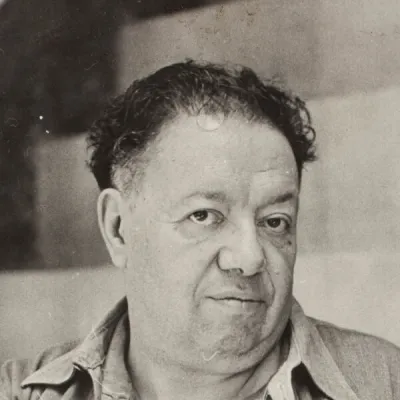
Diego Rivera
Human Design Chart
Biography
Between 1922 and 1953, Rivera painted murals in, among other places, Mexico City, Chapingo, and Cuernavaca in Mexico, and San Francisco, Detroit, and New York City in the United States. In 1931, a retrospective exhibition of his works was held at the Museum of Modern Art in Manhattan, shortly before Rivera's commencement of his 27-mural series known as Detroit Industry Murals the next year.
Rivera had four wives and numerous children, including at least one illegitimate daughter. His first child and only son died at the age of two. His third wife was fellow Mexican artist Frida Kahlo, with whom he had a volatile relationship that continued until her death. His previous two marriages, ending in divorce, were respectively to a fellow artist and a novelist, and his final marriage was to his agent.
Due to his importance in the country's art history, the government of Mexico declared Rivera's works as monumentos históricos. Rivera holds the record for highest price at auction for a work by a Latin American artist. The 1931 painting The Rivals, part of the record-setting collection of Peggy Rockefeller and David Rockefeller, sold for US$9.76 million at a 2018 Christie's auction.
Human Design Analysis: Diego Rivera as Manifesting Generator 6/3
Manifesting Generator 6/3 — Design at a Glance
Diego Riveras design points to a tendency towards hybrid initiative. As an Manifesting Generator, he combined the constant, sacral energy of a Generator with the speed of a Manifestor. This configuration allowed him to skip steps and draw quick results into his life.
However, this type's mechanics carry specific risks. Due to his speed, Diego Rivera tended to juggle multiple projects simultaneously rather than focusing on one thing at a time. He responded to many different impulses all at once. Without strict adherence to his strategy—namely waiting until the sacral center signaled a clear "yes"—this multitasking joy could quickly turn into frustration. This was his non-self theme: dissatisfaction through hasty action or ignoring necessary intermediate steps.
However, when he listened to his inner authority and regularly checked whether an undertaking still resonated with him, this dynamic transformed into deep satisfaction. For him, the advice "finish one thing before starting another" was counterproductive. Instead, he drew his creative power from variety and a playful mode. His energy worked optimally when he tackled various tasks simultaneously, provided each individual impulse had been confirmed by the sacral center beforehand. This way, he could leverage his speed without falling into the trap of overextension or retracting from mistakes.
Emotional Authority
Diego Rivera exhibited an inner decision-making structure that did not solidify in the moment of first enthusiasm or rejection. His design carried emotional authority, meaning his defined Emotional Center always led important life decisions – regardless of which other centers were also defined. This priority was a central mechanism of his system: The emotional wave set the rhythm of his clarity.
Rivera experienced a constant up and down of emotions. The world appeared to him colored by his current mood; something that seemed inspiring in one moment could appear negative in the next. However, his immediate feeling was only a snapshot, an initial impression that did not necessarily reflect his deepest truth yet. Quick, spontaneous decisions made from this emotional heat often would have had negative consequences.
Instead, his inner authority required patience and time. He needed to let decisions mature, sleep on them multiple times, and wait until the intense feelings subsided. Only then could he gain the necessary emotional distance. In this phase, calmness set in and the process was complete. This method served to make long-term decisions that could have a significant impact on his life course by basing them on a broader understanding rather than fleeting moods.
The 6/3 Profile — Role Model / Martyr
Diego Rivera showed himself to be someone who spent his life in a constant tension between the urge for new experimentation and the later role of a wise mentor. His design as a "Role Model / Experimenter" (Profile 6/3) shaped this development: In the first thirty years, he lived primarily as a Three-line, which drove him to countless self-experiments. Although his early adventurous spirit slowed down after Saturn returned around age thirty, it never ended completely because the experimental energy in his profile was permanently anchored.
Rivera often suffered from inner restlessness and a feeling of an eternal search for the extraordinary, far from ordinary standards. He did not simply seek perfection but an unusual life. At the same time, he learned through the sixth line that unforeseen events did not create pressure but strengthened his development as a universal flow. This line taught him to accept uncertainty and led him to the ego as well as the importance of possession and contentment.
On the other hand, he carried the burden of the third line, which was associated with self-blame and martyrdom. Rivera tended to take responsibility for guilt himself and look back into the past. The decisive turning point in his development consisted in gaining the insight that these self-reproaches were unfounded and that he was actually "okay." Only through letting go of immature, self-destructive tendencies could he use his unusual experiences to become a far-sighted, humorous role model who took responsibility and wisdom for granted.
Split Definition — Defined & Open Centers
Diego Rivera's Human Design profile indicated a tendency towards a powerful, self-determined presence driven by immense internal vitality. His defined Sacral Center provided him with a constant energy flow that urged him to action and creation – assuming he responded to external impulses rather than initiating on his own. This generative force was channeled through his defined Heart Center, which gave him the willpower and desire to actively control and acknowledge his resources as well as his own worth. He appeared as someone who gladly took responsibility and stood up for the reward of his work.
His communication wasn't arbitrary but structured by his defined Throat Center; it served as a reliable focal point that translated information from the body into clear messages. At the same time, he had a firm inner identity and direction steered by his defined G Center. This gave him a deep sense for his own mission and the ability to show others new paths without being dependent on their approval. Decisions weren't made impulsively but guided by his emotional authority: The defined Solar Plexus Center required patience. He waited until the emotional wave had clarified before acting, in order to create clarity rather than chaos.
In contrast, his open Head and Ajna Centers revealed a vulnerability to mental pressure and confusion. He tended to be absorbed by the questions and concepts of others, which could pull him into a whirlpool of doubts if he didn't trust his inner authority. His open Spleen Center made him sensitive to the well-being of his surroundings; he was vulnerable to clinging onto people or situations that provided a false sense of security rather than listening to his own intuitive guidance. Additionally, his open Root Center absorbed external stress and adrenaline from the environment. Instead of succumbing to this pressure and falling into hyperactivity, his mechanics required him to recognize this foreign stress and not misinterpret it as his own life impulse in order to prevent burnout.
Channels for inspiration, powerful execution and community.
Diego Rivera exhibited a fundamental stance of exemplary leadership: He lived his unique identity so fully and openly that he inspired others to express their creativity. This effect didn't come from words but from his mere presence and the courage to stand out. The Inspiration Channel 1-8 connected his G Center with his Throat Center. Gate 1 promoted individual, mutative expression while Gate 8 made this as a contribution to the group visible. Rivera was designed to attract attention by living his inner truth and thereby changing the perspective of those around him.
At the same time, he possessed immense physical life force that kept him constantly in motion. The Charisma Channel 34-20 channeled the raw energy of his Sacral Center (Gate 34) directly into his expression through his Throat Center (Gate 20). This created a drive for immediate manifestation through reaction to external stimuli. Rivera could hardly sit still; his speed was so high that it almost bypassed any reflection. This energy served self-empowerment and allowed him to remain active over long periods of time, as long as he responded correctly internally. Without this inner guidance, the energy would have chaotically erupted, but in its proper alignment, it was a source of impressive achievements.
In interpersonal and collective contexts, Rivera sought the right place within a community. The Community Channel 37-40 connected his Solar Plexus Center with his Heart Center. Here, it was about the emotional process of entering into contracts and commitments. Gate 37 sought recognition and belonging while Gate 40 was ready to work but needed breaks and rewards. Rivera understood the necessity of making good agreements based on mutual benefit. He built bridges between individuals to create a structure where everyone had a respected place. This required patience and emotional clarity over time, as such connections couldn't be closed spontaneously.
Additionally, further Gates shaped his rhythm: Gate 5 valued habits and energy accumulation while Gate 35 sought change through interaction. Gate 47 helped him draw meaning from past experiences, and Gate 22 allowed a calm openness for mutations in the social environment.
Individual Circuitry — Circuit Signature
Diego Rivera's Human Design profile indicated a tendency towards impulsive, inspired forms of expression. The Knowledge Circuit connected his Throat with his Identity Center through the Inspiration Channel (Gates 1-8). This generated a pulsating flow of creative flashes that directly translated into expression – an energy that paved new paths and initiated individual transformation.
Parallel to this, the Ego Circuit worked as a separate component. Here, the Community Channel (Gates 37-40) connected his Heart with his Solar Plexus Center. This configuration promoted cooperative dynamics and a balanced give-and-take relationship within a group. Since there was no connection to his Sacral Center, this resource generation required necessary pauses for regeneration of energy.
A third, also isolated area was the Integration. The Charisma Channel (Gates 20-34) connected his Throat with his Sacral Center. This allowed him to draw strength from reacting to life and express it in the present through intuitive knowledge and proper behavior.
Due to his Shared Definition, these three circuits existed as parallel adjacent forces. They were not directly energetically connected: The creative expression (Knowledge), cooperative resource generation (Ego), and charismatic action in the now (Integration) functioned as independent, complementary systems within his design.
Left Angle Cross of Separation 2
Diego Rivera's Human Design indicated a tendency towards deep inner disintegration, manifesting as constant internal conflict between two opposing poles. This configuration is known in Human Design as the left cross of separation. It describes not an external action but a fundamental internal tension field: The necessity to separate or detach from something was perpetually at odds with the need for connection and unity.
For Diego Rivera, this was not a temporary state but a structural aspect of his character. His design dictated that true clarity or insight often only became accessible through the pain of separation or the experience of loss. It was a process of differentiation: Only by detaching from certain identities, bindings, or beliefs could he recognize his true nature. This cross created a dynamic tension that pushed him to set boundaries while simultaneously seeking the lost whole. The mechanics of this pattern meant that his path did not follow a linear progression but was marked by recurring phases of letting go and rediscovery. Each separation served as a catalyst for deeper self-understanding, even if this process remained accompanied by inner unrest.
Saturn Return · Uranus Opposition · Chiron Return · 2nd Saturn Return — Life Cycles
Diego Rivera's design shaped him into someone who anchored his inner truth through tangible connections to the outside world. His life stages followed a clear rhythmic structure where personal and professional milestones aligned with planetary cycles.
At age 28 during his first Saturn return in 1914, he befriended Juan Gris. This cycle often marks the transition from an experimental youth phase to serious engagement with one's role; the connection to Gris signaled a solidification of his artistic identity through a significant reference point.
In 1927 at age 41, while traveling to the Soviet Union for the anniversary of the October Revolution during his Uranus opposition, he was placed in a radically different political and cultural context that profoundly influenced his work. This journey served as a catalyst for career-relevant decisions by forcing him to break away from established structures towards new visions.
In 1935, Rivera experienced his Chiron return with Frida Kahlo during a temporary marriage crisis. This cycle represents the blossoming of one's purpose; here it showed that grappling with intimate tensions was necessary to sharpen his inner alignment and reposition his life's meaning within relationship dynamics.
His second Saturn return culminated in 1943 when he was elected an honorary member of the American Academy of Arts and Letters. At age 57, decades of work condensed into official recognition that affirmed the stability and enduring value of his work.
Manifesting Generator · Emotional Authority — Synthesis
Diego Rivera lived a life driven by an inner urge for creative expression and the articulation of individual perspectives (Channel 1-8, Knowledge Circuit). The connection of sacral energy with the ability to act swiftly (Manifesting Generator) led him not to confine himself to conventional paths. Instead, he continuously experimented (Profile 6/3), often beyond established knowledge boundaries, to create new things and express his visions. This constant search for the extraordinary was reinforced by his defined Throat Center, which served as a voice for transformative ideas.
Simultaneously, an internal tension revealed itself between the desire for free expression and the necessity of emotional maturation (Emotional Authority). Rivera often acted impulsively, possibly skipping important steps in the process (Manifesting Generator), while also seeking the depth and authenticity of his decisions through a longer inner process. This interaction between swift action and the need for emotional clarity shaped his path and was evident in phases of change both professionally and personally.
3 Defined Channels
Incarnation Cross - Left Angle Cross of Separation 2
Solar Return
The Solar Return shows the moment when the sun returns to its exact birth position - your personal solar year.
Life Cycles
Discover the life cycles with a detailed triple view (birth chart, cycle chart, composite).
Human Design Profile
- Strategy
- To respond - wait for something to respond to
- Authority
- Emotional Authority
- Profile
- 6/3 - Role Model / Martyr
- Definition
- Split Definition
- Incarnation Cross
- Left Angle Cross of Separation 2
- Date of Birth
- 08.12.1886 19:30
- Place of Birth
- Guanajuato, Mexico
Frequently Asked Questions
What was Diego Rivera's Human Design type?
What Profile did Diego Rivera have in Human Design?
What Authority did Diego Rivera have?
What incarnation cross did Diego Rivera have?
When was Diego Rivera born?
Discover your own Human Design
Are you also a Manifesting Generator? Find out in a personal reading how to unfold your multi-talents and direct your energy wisely.
More Personalities
Back to overviewAldair

Alizée

Angeli

Arletty

Artus

Baekhyun