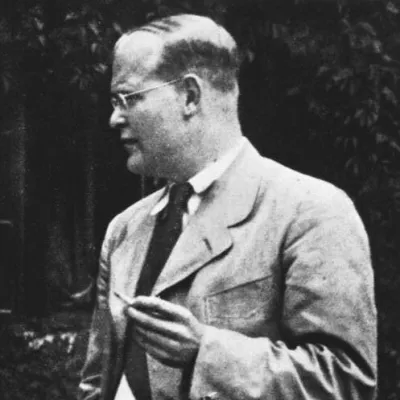
Dietrich Bonhoeffer
Human Design Chart
Biography
He died on 9 April 1945, hanged in a concentration camp at Flossenburg. During the last two years of his life, he wrote many letters, published posthumously by Eberhard Bethge, as "Letters and Papers from Prison." Letters to his fiancee, Maria von Wedermeyer, were published as "Love Letters from Cell92."
The Human Design of Dietrich Bonhoeffer: Manifesting Generator 3/5
Manifesting Generator 3/5 — Design at a Glance
Dietrich Bonhoeffer's design laid a tendency towards a hybrid work style that combined the speed of a Manifestor with the constant energy of a Generator. He was someone who could quickly bring things to life and skip steps, which allowed him to push initiatives forward rapidly. This ability stemmed from his configuration as a Manifesting Generator: Although he belonged to the Generator type and had a defined Sacral Center, he also possessed manifesting qualities through an active connection between Motor Centers and Throat.
His strategy was not to initiate but to respond to inner impulses. Only when his Sacral Center gave a clear "yes" did he invest his energy. This was crucial because there was a risk of frustration if he acted too quickly and skipped important steps or overextended himself through multitasking without internal approval. In such cases, he often had to backtrack to complete missing stages.
Dietrich Bonhoeffer reached his deepest satisfaction when he used his speed in "play mode." Under the condition that strategy and authority were consistent, he enjoyed working on multiple projects simultaneously. The compulsion to finish one thing completely before starting another would have hindered him more than helped. His creative power flourished when there was variety and he applied his energy playfully but reactively, thereby avoiding frustration and generating satisfaction.
Emotional Authority
Dietrich Bonhoeffers Design indicated a tendency towards emotional testing: His inner authority was defined in the Solar Plexus Center. This meant that he could not make decisions immediately but had to let them pass through a cycle of waves – ups and downs of his feelings. The momentary feeling was only a snapshot, not yet his truth. Spontaneous reactions carried risks; clarity emerged only after patience, gaining distance, and "sleeping on" options.
The emotional authority was subject to constant mood swings. In one moment he could be totally enthusiastic, in the next see the same thing negatively. This first impression was still not his inner truth. Quick decisions based on emotion could have negative consequences. The more time he took, the deeper and more comprehensive he could perceive. This required patience and repeatedly reconsidering a decision. He should take his time and ask multiple times. Over time, intense feelings subsided, he gained emotional distance, and clarity and calmness set in. Then he was through with the process. This was especially true for long-term decisions with significant influence on his life course. The emotional authority always took precedence over other defined centers, regardless of what else was defined in the chart. Any type except the Reflector can have an emotional authority. Dietrich Bonhoeffer lived this necessity to ride out emotional waves before acting, following the true inner truth rather than a passing impulse.
The 3/5 Profile — Martyr / Heretic
Dietrich Bonhoeffer's Human Design profile established a fundamental attitude based on radical doubt: He believed nothing without personal scrutiny. This internal mistrust of Line 3 of Profile 3/5 (Explorer/Hero) drove him to test every truth himself and learn from mistakes rather than adhere to abstract dogmas. Satire and pessimism served as protective mechanisms against blind faith; only concrete evidence convinced him.
From these private experiments, his public role developed. Line 5, the Hero line, made him attractive to others because they saw in him someone who offered solutions based on personal practice. Yet this appeal carried a burden: Society projected high expectations onto him and expected heroic action. When he failed or showed himself as human, this became publicly visible – the painful flip side of the 3/5 profile.
Bonhoeffer dealt with this pressure through steadfast ego. Instead of being broken by others' projections, he used his eccentricity and creativity to find practical solutions in times of crisis. His life's task was to endure the tension between the private need for proof and the public demand for heroism. He learned that his value did not lie in perfect infallibility but in the ability to arrive at authentic, useful wisdom through personal experiences and mistakes.
Split Definition — Defined & Open Centers
Dietrich Bonhoeffer's Human Design profile established a firm, reliable identity, coupled with a deep sense of connection and direction. His defined G Center provided this inner stability, while the also defined Sacral Center supplied a constant engine of vital energy. However, this power did not activate through initiation but rather reactivity: Only in response to questions or circumstances could his system give a clear "yes" or "no", making energy available.
His decisions were guided by the emotional authority of the defined Solar Plexus Center. This meant he had to wait for an emotional wave to subside before clarity emerged; spontaneous actions during emotional highs or lows tended to lead to chaos and later regret. His defined Root Pressure also generated a steady impulse for survival and progress, ensuring physical endurance.
Communication occurred through his defined Throat Center, which transformed energy from connected centers into speech or action. This allowed for a consistent yet limited form of expression that always depended on his inner dynamics.
At the same time, Dietrich Bonhoeffer was vulnerable to conditioning due to several open centers. His open Head Center tended to get stuck in mental pressure and doubts by trying to answer others' questions or seeking inspiration from outside sources. The open Ajna Center made him susceptible to foreign concepts and opinions that he could not accept as his own truth. Additionally, lacking consistent willpower in his open Heart Center, there was a risk of wanting to prove himself through promises or competing with others, often resulting in frustration. Also, the open Spleen Center made him sensitive to well-being and fears from the environment, making spontaneous decisions risky since they were not based on stable personal intuition.
Channels for mystical pressure, creative expression and emotional clarity.
Dietrich Bonhoeffer's Human Design profile inclined towards authentic leadership through his role as a model. He demonstrated himself to be someone who lived his uniqueness to inspire others toward self-acceptance without coercion or explanation. This mechanism was marked by the Channel of Inspiration 1-8: Gate 1 (Self-expression) and Gate 8 (Contributing) connected G Center and Throat Center. His contribution did not come through words, but rather through the courageous living of his individual direction, which drew attention and encouraged others to express their own potential.
Central was the Channel of Awakening 10-20, embodying the statement "I am." Through Gate 10 (Presence) and Gate 20 (Now), he lived rooted in the moment. His leadership was based on self-love and trust; simply being himself inspired his environment to embrace their own authenticity. This effect required inner authority, not external recognition.
The Channel of Inquiry 34-10 deepened this stance. Gate 34 (Power) in the Sacral Center provided the energy to hold onto personal convictions while Gate 10 steered self-behavior. Bonhoeffer explored and perfected a behavior of independence. His sacral reaction allowed him to act undeterred by resistance, which encouraged others in their own individuality as his aura demonstrated the benefits of complete self-love.
Additionally, Gates like 25 (Innocence/Self-love) and 13 (Continuity/Reflection) played a role. Gate 25 promoted a mystical stance of centering while Gate 13 collected experiences to reflect within the context of time. This configuration supported his ability to remain grounded in himself while also considering collective memory.
Bonhoeffer's design emphasized that true inspiration stems from genuine self-acceptance. His presence was an example of transforming individual truth into public action. He lived his individuality, which encouraged others to discover their own differentiated selves without imposing it upon them.
Individual Circuitry — Circuit Signature
Dietrich Bonhoeffer's Design points towards a tendency for individual identity formation and emotional processing. The Knowledge Circuit connected two separate segments in him: Inspiration (Throat Identity) promoted the expression of unique paths, while releasing emotions (Solar Plexus Root) utilized emotional waves for transformation. Simultaneously, the Centering Circuit anchored through exploration (Sacral Identity) brave inner convictions and self-worth; however, a direct expression channel was missing here, so this power worked more individually rather than being communicated outwardly. The Meaning Circuit used recognition (Solar Plexus Root) to cyclically reflect past experiences and enable collective learning through emotions. In the Ego Circuit, synthesis (Solar Plexus Root) stood for cooperation and resource management in the context of the trunk; without a Sacral connection, pauses for regeneration were necessary here. Integration tied these energies together: Awakening and charisma linked Throat, Sacral, and Identity, thereby guiding power from reacting to life through proper behavior and intuitive knowledge in the present moment. This configuration showed a strong orientation towards developing a unique identity, connected with processing through emotional cycles. There was a tension field between the strong inner convictions of the Centering Circuit and the missing direct expression channel as well as the need for cooperative support in the Ego area. The shared definition split these energetic fields into two parallel coexisting systems: one for identity and action (Throat, Sacral, Identity) and one for emotional processing and root energy (Solar Plexus, Root).
Right Angle Cross of the Sphinx 1
Dietrich Bonhoeffer's Human Design profile indicated a tendency towards inner stability and unwavering stance. He was someone who provided a steady point in turbulent times, not through external action but by holding a clear position. This fundamental attitude stemmed from the right cross of the Sphinx 1. In Human Design mechanics, this configuration describes a deep connection to one's intuition and internal compass. It grants the ability to remain calm under pressure and make decisions based on a solid inner certainty rather than fear or panic. This is an energy of constancy that can provide orientation for others without needing to speak out loud. Bonhoeffer used his inner strength as a foundation for his actions, choosing to be guided by his deepest convictions instead of external circumstances. This created an anchor that helped him maintain clarity when the environment became chaotic. The mechanics of this cross support not drifting aimlessly but consistently following one's path. It is about flexible constancy oriented towards the truth of the moment. Bonhoeffer lived this quality by listening to and following his inner voice, even if it meant difficult paths. His design thus fostered a kind of courage that stems from inner peace rather than aggressive dominance.
Saturn Return — Life Cycles
Dietrich Bonhoeffer's Human Design profile indicated a tendency towards deep internal anchoring, especially when it came to representing personal values in public. This attitude was significantly strengthened during his first Saturn Return, the period between ages 27 and 30. During this cycle, one primarily takes responsibility for their position and strengthens their identity against the world. It is a time that often reveals whether one is ready to bear the consequences of their stance.
In 1934, at age 28, this process became evident: The Confessing Church was founded when an assembly of evangelical Christians unanimously adopted the Barmen Declaration. For his design, this event marked a typical moment of maturation. Years of internal work and reflection culminated in a solid external outcome. It was not a spontaneous reaction but a clear alignment with a position he now publicly took. The Saturn Return acted as a catalyst that helped him translate his values from private beliefs into binding actions and thus redefine his role within the community.
Manifesting Generator · Emotional Authority — Synthesis
Dietrich Bonhoeffer lived a life marked by the dynamic interplay between inner drive and the need for authentic expression. His design as an Manifesting Generator with emotional authority points to someone who both possesses the ability to act quickly and set things in motion (Sacral Center) and has the necessity to filter decisions through a process of emotional maturation (Solar Plexus Center). This combination led to a deep engagement with principles and values (Switch 16), evident in his actions. The focus on recognizing feelings (Gate 30) and the resulting ability to identify patterns (Channel 41-30) provided a foundation for his involvement within a clearly defined value system.
A central paradox in Bonhoeffer's design lies in the tension between the urge for quick manifestation (Manifesting Generator) and the need for emotional clarity (emotional authority). He was designed to react to impulses and set things in motion, but he also had to wait out the emotional wave to ensure his actions aligned with his deepest convictions. This duality manifested as an internal tension between a drive to act and seeking confirmation through one's own feelings – an ongoing process of weighing options and self-discovery.
7 Defined Channels
Incarnation Cross - Right Angle Cross of the Sphinx 1
Solar Return
The Solar Return shows the moment when the sun returns to its exact birth position - your personal solar year.
Life Cycles
Discover the life cycles with a detailed triple view (birth chart, cycle chart, composite).
Human Design Profile
- Strategy
- To respond - wait for something to respond to
- Authority
- Emotional Authority
- Profile
- 3/5 - Martyr / Heretic
- Definition
- Split Definition
- Incarnation Cross
- Right Angle Cross of the Sphinx 1
- Date of Birth
- 04.02.1906 22:15
- Place of Birth
- Breslau, Poland
Frequently Asked Questions
What is Dietrich Bonhoeffer's Human Design type?
What Profile did Dietrich Bonhoeffer have in Human Design?
What Authority guided Dietrich Bonhoeffer?
What incarnation cross did Dietrich Bonhoeffer carry?
When was Dietrich Bonhoeffer born?
Discover your own Human Design
Are you also a Manifesting Generator? Find out in a personal reading how to unfold your multi-talents and direct your energy wisely.
More Personalities
Back to overviewAldair

Alizée

Angeli

Arletty

Artus

Balthus