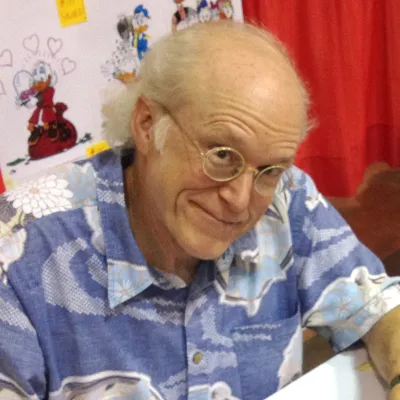
Don Rosa
Human Design Chart
Biography
Many of his stories are built on characters and locations created by Carl Barks, including the story that brought him to fame as a modern Disney artist – the Harvey Award-nominated comic, "The Son of the Sun."
Rosa created about 90 stories between 1987 and 2006. In 1995 he won the Eisner Award for "Best Serialized Story" for his 12-chapter work "The Life and Times of Scrooge McDuck."
Human Design Analysis: Don Rosa as Manifestor 4/6
Manifestor 4/6 — Design at a Glance
Don Rosas design establishes the foundational structure of a Pioneer: someone who does not primarily act through their own physical effort but rather through vision and delegation. Similar to an emperor in ancient Rome sending soldiers out to conquer lands instead of fighting battles himself, this configuration drives the initiation of change through others. However, this role comes with a specific tension: Manifestors often think further ahead than their environment, leading them to be frequently misunderstood or polarizing. Some love and emulate their big dreams, while others reject or even hate them because of these visions.
To minimize resistance and attract the right followers, informing is the central mechanism. It's not about seeking permission but enlightening others in advance about intentions and visions so they can prepare themselves accordingly. If Don Rosa lives by this strategy of informing and follows his inner authority, he will be rewarded with a deep sense of inner peace. Should he deviate from it and act without communication, persistent anger sets in instead. This emotional feedback serves as a compass: peace confirms alignment with the design, while anger signals conflict between personal impulse and external reality.
Emotional Authority
Don Rosas design tends to leave decisions not to immediate mood but to a maturation process. His inner authority stemmed from his defined Emotional Center. This configuration means that his internal compass was shaped by emotional waves – an ongoing up-and-down of feelings coloring perception of the world. What appeared inspiring in one moment could turn negative in another. Thus, his feeling at any given moment was only a snapshot, not a final judgment.
Quick, spontaneous decisions from such an emotional state often risked negative consequences as they were based on fleeting impulses. Instead, his design required patience and time. He had to let himself be properly prepared, rethink decisions multiple times, ideally sleeping on them. Only through this distance could intense feelings subside. Over time, he gained emotional detachment leading to clarity and calmness. This process was especially crucial for long-term life decisions to reach true inner truth rather than being led by passing moods.
The 4/6 Profile — Opportunist / Role Model
Don Rosas design tends towards experimental social learning in the first three decades of life. During this phase, Line 6 still acted like a Line 3, prompting him to experiment extensively in relationships and friendships. This early experimentation served as preparation for later development.
After the first Saturn Return, this dynamic fundamentally changed. Don Rosa then showed himself influenced by an internal conflict between Heart and Head. The Line 4 in his heart brought a desire for belonging coupled with self-discipline and cautious opening to avoid hurt. Simultaneously, Line 6 in his head demanded distance and meaning-making, often symbolized by the image of the lone figure on the mountain. This tension between the need for connection and the role as a wise role model shaped his life task.
In later years, Don Rosa was expected to meet high standards of collective leadership. His self-discipline (Line 4) had to be reconciled with completed succession and leadership (Line 6). Doubts triggered by Jupiter should not be suppressed but shared, as they could be useful for the collective. Thus, Don Rosa evolved from an experimental networker into a trustworthy role model who acts through cooperation and wisdom.
Triple Split Definition — Defined & Open Centers
Don Rosas design points to a tendency towards constant inner activity: an ongoing mental and emotional processing engine. His defined Head Center generates a continuous pressure to ask questions and receive inspiration, coupled with the confusion that arises when this is not yet understood. These impulses flow into his defined Ajna Center, where they are conceptualized – a firm way of thinking that creates concepts and theories but lacks the energy for direct implementation.
This mental work meets his defined Solar Plexus Center, which functions as an emotional authority. Here there was no immediate truth in the present; instead, Don Rosa had to go through the cycle of the emotional wave to gain clarity. His feelings and moods were indicators of correctness but required patience, as impulsive action at the peak or trough of this wave led to chaos. The combination of defined Head, Ajna, and Solar Plexus meant that his inner self constantly generated questions, conceptualized them, and emotionally evaluated them – an intensive internal machine that could put others in his aura under pressure to think along with him or feel emotions.
At the same time, he lacked the defined motors for independent readiness to act and identity. His open G Center meant no fixed identity or direction; he was dependent on being initiated by the environment to know who he is in a specific context. Without this external confirmation, the non-self tended to feel lost and seek a fixed role rather than waiting for initiation from others.
His Heart Center was also open, indicating a lack of consistent willpower. He was not designed to give promises or prove his worth through competition. The non-self could be tempted to overextend himself in search of recognition, which led to frustration as the energy for this did not exist. Finally, his Sacral Center was open, meaning he lacked a constant stream of generative energy. He tended to take on borrowed energy from the environment and overwork rather than trust his own rhythms of work and rest. The challenge lay in not misinterpreting intense internal processing as pressure for immediate action but waiting for external initiations for identity and energy.
Channels for logical doubt, emotional openness and patterns.
Don Rosas design points towards a tendency towards deep, self-imposed pauses to correct patterns and focus on the essentials. This attitude is rooted in his Personality Sun at Gate 52, the Buddha Gate, which without clear goals can easily drift into stress or depression but offers immense powerful clarity when focused.
This inner stillness is supported by the defined Channel of Logic 63-4. This channel connects the Head Center with the Ajna Center and embodies a skeptical mind that sees doubt as essential to truth. It filters constantly for verifiable patterns; unfounded belief has no place here. Only if an answer confirms itself in a consistent, practical pattern is it considered logically correct. This process serves the collective through well-founded predictions and uncovering connections.
The juxtaposed channels – Openness 22-12, Judgment 58-18, and Abstraction 64-47 – are not part of his constant core personality but only come into play situationally due to environmental influences. The channel of Openness 22-12 brings emotional moodiness with it while the Judgment 58-18 nurtures a drive for correction and perfectionism in patterns. Abstraction 64-47 seeks stories and perspectives through mental images but can also cause confusion. These aspects remain in the background as long as the environment does not activate them, shaping Don Rosas basic attitude less than his central combination of focused pause and logical skepticism.
Collective Circuitry — Circuit Signature
Don Rosas design points towards pulsating, acoustic creativity driven by a desire to follow one's own unique path. This configuration shows someone who carries new insights emotionally grounded in the world, with energy that is wave-like and authentic.
This orientation stems from the Knowledge Circuit, whose only active channel at Don Rosa is
Right Angle Cross of Service 2
Don Rosas design shows a tendency towards deep, often quiet dedication to the well-being of others. This is not expressed as loud engagement but rather as an inner attitude that makes service the central point of one's being. The 'Right Cross of Service' describes this configuration precisely: It connects the desire to help with the necessity of maintaining one's own integrity while doing so.
The challenge lies in finding balance. On one hand, there is a drive to sacrifice oneself for others or to put their needs before one's own. On the other hand, there is the risk that this dedication turns into self-denial and that one's identity gets lost in service to others. Don Rosas chart indicates that authentic service can only succeed if it does not stem from duty or a need for recognition but rather from a clear inner alignment.
It's about maintaining boundaries between 'I' and 'Others' so that the service remains an enriching instead of depleting experience. The mechanics of this cross demand integrating care with self-respect. Only when Don Rosa kept his own identity as a firm anchor could he serve others without dissolving himself. This shapes a life path that seeks less external validation but rather internal security, knowing that what is given aligns with one's essence.
Saturn Return · Uranus Opposition · Chiron Return · 2nd Saturn Return — Life Cycles
Don Rosas life followed a clear cyclical structure marked by planetary turning points. In 1980 at the age of 29, he married Ann Payne – a typical moment of his first Saturn return when years of groundwork often condenses into a solid result and connections are strengthened.
The Uranus opposition around the 40th year brings frequent sudden changes or breakthroughs through external impulses. In 1991, Egmont Rosa commissioned the twelve-volume series 'Life and Times of Scrooge McDuck'. This assignment, which as an artist brought him a decisive breakthrough, illustrates this energy: An external trigger opens up new expansive perspectives and sets long-held skills in a new light.
The Chiron return (around 49-51 years) is not a healing process in the traditional sense but a phase of fulfillment where one's incarnation cross unfolds – provided that one lives according to their strategy and authority. In 2002 at age 51, Rosa laid down his work for an extended period because he was dissatisfied with the further processing of his submitted comics. This shows the friction when external circumstances contradict inner alignment; it is a phase of re-evaluating one's purpose and integrity towards their creation.
The second Saturn return around the age of 57 consolidates these experiences into new structures. The publication of volume 14 in the Hall of Fame series in 2008 marks this point: A confirmation of the earned position and the consolidation of work in a new, more mature phase. Each of these cycles served as concrete transitions that structured Don Rosas development.
Manifestor · Emotional Authority — Synthesis
A central red thread runs through the design: the dynamics between inner inspiration and outer action. As a Manifestor, this person is destined to inspire and initiate (Design), yet emotional authority requires a maturing phase where feelings can be fully explored (Authority). The defined Head Center generates constant mental pressure to question and filter patterns (Channels/Gates), which is reinforced by the Profile as Networker/Role Model – someone who both develops their own insights and shares them with others (Profile Role). This combination points towards a life style marked by inner search and the need for authenticity, while simultaneously there is a desire to make an impact through creative impulses (Circuit).
The design harbors a central paradox between the desire for connection and the drive towards individuality. The line 4 in the Profile indicates a deep need to be part of a community and maintain relationships (Profile Role), while line 6 signals a tendency toward withdrawal and reflection on the meaning of life (Profile Role). This tension is supported by the cycles: phases of relationship maintenance alternate with moments of crisis and professional breakthroughs, where both successes and retreats are part of the development process (Cycles).
4 Defined Channels
Incarnation Cross - Right Angle Cross of Service 2
Solar Return
The Solar Return shows the moment when the sun returns to its exact birth position - your personal solar year.
Life Cycles
Discover the life cycles with a detailed triple view (birth chart, cycle chart, composite).
Human Design Profile
- Type
- Manifestor
- Strategy
- To inform others before acting
- Authority
- Emotional Authority
- Profile
- 4/6 - Opportunist / Role Model
- Definition
- Triple Split
- Incarnation Cross
- Right Angle Cross of Service 2
- Date of Birth
- 29.06.1951 15:52
- Place of Birth
- Louisville, KY, United States
Frequently Asked Questions
What is Don Rosa's Human Design type?
What profile does Don Rosa have in Human Design?
What authority does Don Rosa possess?
What incarnation cross does Don Rosa have?
When was Don Rosa born?
Discover your own Human Design
Are you also a Manifestor? Find out in a personal reading how to use your initiation power peacefully and dissolve resistance.
More Personalities
Back to overviewAlain-Fournier

Angeli

Christian-Jaque
Juninho

Kesha

Lucebert