
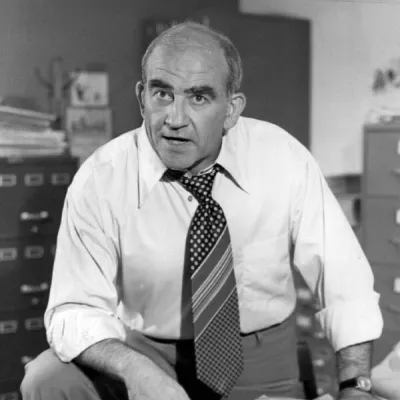
Ed Asner
Human Design Chart
Biography
He is the most honoured male performer in the history of the Primetime Emmy Awards, having won seven – five for portraying Lou Grant (three as Supporting Actor in a Comedy Television Series on The Mary Tyler Moore Show and two as Lead Actor in a Dramatic Television Series on spin-off Lou Grant). His other Emmys were for performances in two television miniseries: Rich Man, Poor Man (1976), where he won for Outstanding Lead Actor for a Single Performance in a TV series, and Roots (1977), for which he won for Outstanding Single Performance by a Supporting Actor in a TV series.
Asner got his start in stage roles at the University of Chicago, and after Army service, joined the Playwrights Theatre in Chicago, eventually moving to New York to play on and off Broadway. He considered himself a solid character actor and was happy with that, knowing that when he grew a paunch and got bald, it did not mean an end to his career. His major popularity began when he was past 40, indeed with a paunch and a comfortable gruffness.
President of the Screen Actors Guild in the '80s, Asner was very liberal and very outspoken on issues and politics.
Married to Nancy Lou Sykes 1959-1988, he had three children including twins born in 1964. They divorced after 28 years of marriage. He had a fourth child, Charles Edward Vogelman, on 5 August 1987 with his girlfriend, Carol Vogelman, for whom he paid $2,100 a month in child support. On 2 August 1998, he married retired movie producer Cindy Gilmore, 58, in Los Angeles, California. She filed for legal separation on 7 November 2007. He filed for divorce in 2015.
Human Design Analysis: Ed Asner as Generator 5/1
Generator 5/1 — Design at a Glance
Ed Asner's design showed a tendency towards great endurance and inner drive, which needed to be specifically directed. As a Generator, he had plenty of sacral energy, comparable to a strong workhorse that provides power when used for its task. His life strategy did not involve taking independent initiatives but responding to signals from life. Only when his sacral center sent a clear 'yes' impulse - an intuitive feeling of letting go - could he use this energy sustainably and satisfactorily.
If Ed Asner acted against this impulse by initiating things without inner desire or ignored the signal despite being full of power, it led to frustration and burnout. The danger lay in wasting energy on tasks that did not fulfill him or allowing himself to be held back from his heart project when there was still strength left. By responding to internal impulses rather than merely initiating, he found the path to deep satisfaction. Living by this design made him unstoppable; deviating from it led to a lack of energy and persistent frustration. His success thus directly depended on his ability to answer from the gut rather than anticipating.
Emotional Authority
Ed Asner displayed an inner decision-making structure that required time and distance. His design carried emotional authority rooted in the defined Emotional Center. This meant that his feelings were subject to constant ups and downs; the world appeared colored by the current momentary mood. What was exciting at one moment could appear negative the next. These fluctuations, however, were only snapshots, not ultimate truth.
Quick, spontaneous reactions to these transient emotional states would often have had negative consequences. Instead, his system required patience and conscious hesitation. Important decisions needed space to mature. The process of 'sleeping on it' was central: Only when the intense feelings subsided and emotional distance was gained did clarity emerge. In this state of calmness, he could recognize his true inner direction. This mechanism applied regardless of other defined centers in his chart; the Emotional Center had priority in decision-making here. It was not about indecision but a necessary filtering to ensure that actions were based on deeper insight and not fleeting mood. Through this waiting period, he navigated through the emotional wave towards more grounded life steps.
The 5/1 Profile — Heretic / Investigator
Ed Asner's design inclined him toward deep, individual knowledge acquisition which he magnetically provided others for problem-solving. As a 5/1 - the Hero and Researcher - he lived the process of learning and challenge. Line 1 anchored him in private research while line 5 gave him almost magnetic power: Others actively sought his solutions. This dynamic carried a risk, however. Without clear boundaries, exhaustion threatened from unbridled willingness to help. His design showed that his knowledge was often only expected as a last resort during crisis times and given then. New insights had conflict potential and needed effective communication. The first line of Gate 29 represented the recruit who adapted to battle but needed time to grow. Here were two poles: Acceptance or trauma through overexertion. Ed Asner had to learn when endurance was necessary and when he should withdraw to maintain balance between private research and public availability. Only by setting boundaries could he optimally utilize his gifts without being drained in a hotel room while his inbox overflowed with further questions. His design demanded a beneficial balance: Depth for himself, targeted sharing for others, always considering the right timing and personal capacity limits.
Split Definition — Defined & Open Centers
Ed Asner's Human Design profile revealed a tendency towards constant reactive power, characterized by emotional wave motion and situational vulnerability. His defined Sacral Center generated vital energy that was only available through reaction to external impulses; initiation led to frustration here. This physical foundation contrasted with his open Head Center (status: open), which lacked a consistent mental focus and was susceptible to external pressure to solve problems not rooted in its own authority.
His defined Ajna Center provided constant mental concepts, while the defined Throat Center reliably translated these thoughts into communication. However, this ability to express was subject to the emotional authority of his defined Solar Plexus Center: truth revealed itself only after waiting for an emotional wave, not in impulsive moments. His defined G Center gave him a firm identity and direction independent of external affirmations.
At the same time, Ed Asner was conditioned by open centers. The open Heart Center (status: open) lacked consistent willpower; it tended to want to prove value through promises, often ending in unhealthy spirals due to the lack of sustainable energy for this purpose. His open Spleen Center (status: open) carried fundamental survival fears and was prone to spontaneous, risky decisions or clinging to unhealthy bonds from a false sense of security. Finally, his open Root Center (status: open) absorbed external stress, leading to cycles of adrenalized pressure and attempts to release it through hyperactivity rather than recognizing it as not its own. Thus, the mechanics showed tension between internal stability in identity, voice, and reactive energy on one hand, and sensitivity to mental, emotional, and stress-induced environmental factors on the other.
Channels for structure, rhythm and intimacy.
Ed Asner radiated a constant presence of mutation and innovation, coupled with deep potential for emotional intimacy. His design allowed him to give new directions through trust in his sacral response while simultaneously needing patience to wait out emotional waves.
This dynamic was marked by Channel 2-10. This individual, tantric channel connected Gate 2 of higher knowledge with Gate 14, which cleverly handled material resources to drive mutation. As a keyholder, Ed Asner had access to essential means to transform mutative impulses into material reality. He could bring innovative, reinforcing new directions by trusting the reaction from his sacral center without knowing in advance where it would lead. This promoted a powerful resource for creative life force and reinforced others through his healthy aura.
Parallel to this, Channel 59-6 of Union connected the Sacral Center with the Solar Plexus. Through Gate 59 of sexuality and Gate 6 of friction, he was rooted in quantum energy of intimacy. His drive was to merge; his availability allowed him to quickly penetrate into others' aura and ease confidentiality. However, since his Solar Plexus was defined, he had to wait for his emotional wave to bring clarity to avoid misunderstandings about his intensity and nurture relationships sustainably.
On a personality level, he carried Channel 43-23 of Conditioning. This connected the Ajna Center with the Throat Center through Gate 43 of insight and Gate 23 of assimilation. His challenge was to let go of control and allow his mind to process knowledge at its own pace. His mutative, metaphorical perspectives were efficient but often misunderstood or felt as outsider when timing didn't match. Recognition came only when his unique insights were expressed at the right time, thereby mutating the collective.
Additionally, Gates like Gate 29 (Saying Yes), Gate 30 (Recognizing Feelings), and Gate 10 (Integration in G Center) shaped his stances on persistence, destiny, and genetically determined behaviors.
Individual Circuitry — Circuit Signature
Ed Asner's design was characterized by two separate but parallel energetic streams. One stream connected the Ajna with the Throat Center and focused on individual identity as well as the expression of new knowledge. This area was pulsating and creative, driven by the need to structure unique ideas rhythmically and express them. The second stream linked the Sacral with the Solar Plexus Center. It worked primordially and instinctively, concentrating on protecting genetics, emotional care, and preserving family bonds.
Since Ed Asner had a split definition, there was no direct energetic connection between these two circuits. Intellectual innovations and instinctive protective needs existed as separate forces side by side. The knowledge circuit promoted transformation through the expression of individuality, while the protector circuit provided timeless energy for pairing and sustenance. This configuration required clear separation: mental clarity in Ajna flowed into verbal expression at Throat without directly merging with emotional waves from Solar Plexus or life force from Sacral Center. Thus, Ed Asner was someone whose intellectual creative power and biological instinct for protection and care formed two distinct, unconnected systems each following its own laws.
Left Angle Cross of Dedication 2
Ed Asner's Human Design profile indicated a tendency towards deep and often calm dedication to certain values or people. This attitude was not expressed through loud declarations but rather as a quiet, constant presence in the background of his life. The left cross of Dedication 2 described this specific energy: a force that worked through patience and loyalty without seeking immediate recognition. It was a kind of loyalty that unfolded over time because it was based on the principle of waiting and trusting the natural process. Ed Asner lived this mechanism as someone who saw his strength in providing others with a stable foundation, without needing to be at the center himself. This configuration shaped his character through a calm aura that conveyed security and invited others to rely on him. The dedication here was not a sacrifice but a conscious choice to invest energy into relationships or projects because it felt right internally. As a result, he presented an image of someone who did not define their identity by external fame but rather by the quality of his connections and the consistency of his character. This quiet strength was the foundation upon which he built his life, setting him apart from those seeking quick validation.
Saturn Return · Uranus Opposition · Chiron Return · 2nd Saturn Return — Life Cycles
Ed Asner's Human Design profile marked pivotal transformation and confirmation points in his life path. In 1971, at age 42, he landed a stable role in 'The Mary Tyler Moore Show'. This coincided with a Uranus opposition, an astrological cycle often bringing sudden changes or new freedoms that here initiated his professional stabilization.
His life purpose further unfolded during the Chiron Return around 1977. At age 48, he received an Emmy Award for his supporting role in the miniseries 'Roots'. This cycle signaled not a healing of old wounds but a bloom phase: His incarnation task became increasingly tangible and his sense of purpose was affirmed through this success.
Another structural point was the second Saturn Return in 1987. At age 58, Charles Edward Vogelman was born. This cycle represents maturity and responsibility; here, deepening commitments and solidifying personal foundations were expressions of his inner development. These events illustrate how astrological cycles shaped concrete life stations: from professional reorientation through confirmation of purpose to deeper personal responsibility.
Generator · Emotional Authority — Synthesis
Ed Asner lived a life deeply influenced by the dynamics between internal reaction and external expression. As a Generator with emotional authority, he needed the signal from life—a sacral response—to act and optimally utilize his immense energy. This ability to react to the present moment was reinforced by a defined G Center, which gave him a clear sense of direction and identity. He was destined to accumulate knowledge (Line 5) and make it available to others, with deep engagement with topics (Line 1) forming a foundation for his work. The connection between sacral energy, emotional depth, and the drive to share his knowledge shaped his path.
Simultaneously, his chart revealed a central paradox: the tension between waiting and reacting as well as the need to express his voice and make an impact. An undefined Ajna Center points to openness for mental impulses, while the defined Throat Center signals a desire to speak these thoughts out loud. This combination may have created an internal struggle between absorbing information and the necessity of filtering it and communicating authentically—a tension that drove him both to think deeply and articulate his convictions powerfully.
3 Defined Channels
Incarnation Cross - Left Angle Cross of Dedication 2
Solar Return
The Solar Return shows the moment when the sun returns to its exact birth position - your personal solar year.
Life Cycles
Discover the life cycles with a detailed triple view (birth chart, cycle chart, composite).
Human Design Profile
- Type
- Generator
- Strategy
- To respond - wait for something to respond to
- Authority
- Emotional Authority
- Profile
- 5/1 - Heretic / Investigator
- Definition
- Split Definition
- Incarnation Cross
- Left Angle Cross of Dedication 2
- Date of Birth
- 15.11.1929 06:00
- Place of Birth
- Kansas City, MO, United States
Frequently Asked Questions
What was Ed Asner's Human Design type?
What profile did Ed Asner have?
Which authority guided Ed Asner's decisions?
What incarnation cross did Ed Asner have?
When was Ed Asner born?
Discover your own Human Design
Are you also a Generator? Find out in a personal reading how to use your sacral energy correctly and discover deep satisfaction.
More Personalities
Back to overviewSissy Spacek

Aaliyah

Alexia

Anémone

Angèle

Ann-Margret
