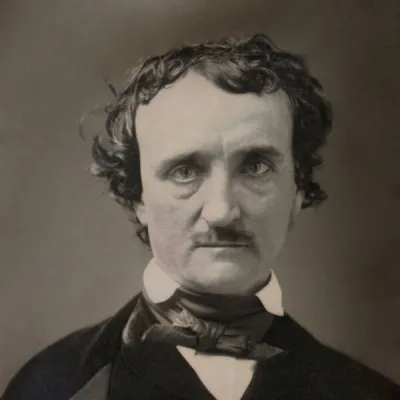
Edgar Allan Poe
Human Design Chart
Biography
Poe was born in Boston. He was the second child of actors David and Elizabeth "Eliza" Poe. His father abandoned the family in 1810, and when Eliza died the following year, Poe was taken in by John and Frances Allan of Richmond, Virginia. They never formally adopted him, but he lived with them well into young adulthood. Poe attended the University of Virginia but left after only a year due to a lack of money. He frequently quarreled with John Allan over the funds needed to continue his education as well as his gambling debts. In 1827, having enlisted in the United States Army under the assumed name of Edgar A.
What does Generator 3/5 mean for Edgar Allan Poe?
Generator 3/5 — Design at a Glance
Edgar Allan Poe's Design indicated a tendency towards great endurance, though it was not limitless. As a Generator, he had plenty of sacral energy, which made him appear like a strong workhorse – provided he received the right impulse. His life force energy was released not through self-initiation but by reacting to signals from his environment. This mechanism created a clear contrast in his experience: when he acted reactively, that is, if his Sacral Center responded with an inner "yes" to an opportunity, he felt fulfilled and powerful. Conversely, attempting to start things independently or being held back from his heart project, even though the energy was still there, quickly led to frustration or burnout. The danger lay in expending energy on tasks that he actually had no interest in or forcing himself against the will of his design. Therefore, his strategy involved waiting for life and then acting from the gut. If he adopted this reactive stance, nothing could stop him; if he did not live by this principle, he encountered a persistent lack of energy. His endurance was thus not blind pushing through but a powerful response to what came his way.
Sacral Authority
Edgar Allan Poe's design inclined him to make decisions not through intellectual analysis but rather through direct physical reactions to external stimuli. As a Generator, his inner authority was identical to his strategy: waiting for this reaction. This greatly simplified his decision-making process. His sacral authority manifested as an intuitive gut feeling or a noticeable surge of energy upon receiving an external stimulus. His bodily sounds – like grunts, hums, or groans – served as signals for a positive response. When his sacral motor engaged with something, he felt vital and alive; then, he had seemingly inexhaustible energy at his disposal. He tackled his work with great enthusiasm, completely free from aimlessness, but purely out of joy in the activity itself.
Another aspect of his design involved the Spleen Center. Since this was activated and possibly directly connected to the Sacral Center, it functioned as a supporting authority. This allowed Edgar Allan Poe particularly quick and spontaneous reactions and decisions. He had immediate access to his physical well-being and instinctive perception. These instincts were reliable and guided him safely through situations requiring an instant response. The combination of primary sacral reaction to external stimuli and secondary, swift spleen intuition shaped the way he navigated life: reactive, energized, and instinctively precise.
The 3/5 Profile — Martyr / Heretic
Edgar Allan Poe's design laid a tendency towards experimental action that was marked by personal failures. His Profile 3/5, the "Experimental Hero," characterized him as someone who stood skeptically against given knowledge and had to try everything himself. Line 3 of The Explorer dictated a learning process through trial and error, coupled with an individual melancholic depression under pressure. Poe learned from these experiences to later offer solutions for others.
Line 5 gives this process universal validity. It represents the fulfillment and discipline of protecting values in crisis times or rebelling against them. Poe's attractiveness did not arise from theoretical knowledge but rather through the richness of practical life experience. Other people sought his authority to learn from his accumulated experiences. This heroic role flattered him, yet it was painful when he failed before an audience. The tension field lay between the need to solve others' problems with his own experiments and the exposure of these failures. The mutation occurred in the space between the pulses when he believed he felt nothing. His disciplined attitude maintained continuity as long as it was successful, but what worked could change. Poe showed himself as a cool storyteller and humorous rebel who presented his practical insights.
Single Definition — Defined & Open Centers
Edgar Allan Poe's design indicated a tendency towards constant physical vitality paired with a strong instinctive protective mechanism. His defined Sacral Center generated a daily energy reserve that manifested as restlessness or the need for active expression. However, this power was only available when there was external approval; mental initiation led to frustration and exhaustion because the sacral response was the sole criterion for energy availability. Additionally, his defined Spleen Center acted as an intuitive authority in the present moment, immediately recognizing what was healthy or harmful without rational analysis. This instinctive alarm never repeated itself and required unconditional trust in the body to ensure well-being. The also defined Root Center provided structural pressure to maintain the life impulse, which remained healthy only if it wasn't distorted by self-imposed stress.
In contrast to these stable pillars stood several open centers that made Edgar Allan Poe vulnerable to external influences. His open Head Center had no consistent way of processing information; it tended to get stuck in doubts and confusion when mental pressure from the environment flowed in. He might have sought inspiration or answers to questions not his own, which distracted him from the correct decision-making process. The open Ajna Center amplified this mental flexibility but also made him susceptible to interpreting foreign opinions as his own truth or pretending to be unsure to gain acceptance. His open G Center meant a lack of fixed identity; he adapted to the environment and sought direction through others, making him vulnerable in relationships because false places or partners could exacerbate his misfortune. Furthermore, lacking consistent willpower in the open Heart Center made him prone to proving his worth through promises he couldn't keep, thus spiraling into self-doubt.
Channels for evolutionary change and individual power.
Edgar Allan Poe was someone who followed a profound melancholic nature. His design indicated a tendency towards cyclical mood swings: a process from chaos to order and back, requiring patience until new impulses matured underground. This fundamental disposition resulted from the Mutation Channel 60-3. This connection between Root and Sacral Centers generated pulsating on/off energy. Gate 60, the Gate of Limitation, required accepting limits as pivotal points for evolutionary possibilities. Gate 3, the Gate of Order, always attempted to realize new potentially valuable options but had to initially endure confusion at the outset. The associated melancholy was not a defect but the chemical perception of internal tension in pauses between impulses. Poe lived with this mechanical moodiness by waiting rather than rationalizing it away.
Parallel to this, the Power Channel 34-57 operated. It connected the Spleen Center with the Sacral Center and promoted intuitive survival intelligence. Gate 57 operated on an inner vibrational level and continuously scanned the environment for dangers while Gate 34, the Gate of Power, generated generative life force to engage in activities. This configuration created a archetype of individual survivability: vigilance, selective listening, and spontaneous reaction to vibrations here and now, free from mental or emotional delay.
Contextually, aspects of further gates came into play. Gate 56 allowed for the abstraction of mental processes into pictorial representations and narratives. Gate 9 stood for detailed work and perfection through repetition. Gate 50 functioned as a conservative protective reflex preserving tribal values. Gate 58 brought pressure and cheerfulness into play, while Gate 59 activated genetic binding strategies without personal preference. Gate 28 demanded decisions here and now through risk-taking readiness. Gate 44 managed resources and transformations through vigilance. These elements shaped Poe's experiential world, yet the dominant dynamic remained the melancholic pulse of mutation compelling him towards adaptation or change.
Individual Circuitry — Circuit Signature
Edgar Allan Poe's design indicated a tendency toward pulsating acoustic energy that carried his unique individuality and creativity. This power was evident through the Knowledge Circuit, which in him specifically worked via Channel 3-60. This channel connected the Sacral Center with the Root Center and promoted mutations – deviations from the known – to enable new expression. The energy flowed directly between these two centers while other aspects of the circuit were inactive in Poe.
Parallel to this, the Integration Circuit ensured his survival through Channel 34-57 (Power). This connected the Sacral Center with the Spleen Center and enabled drawing strength from reactions to life and guiding it through intuitive knowledge. As Poe had a Simple Definition, these connections formed a cohesive energetic flow within the group of Sacral, Root, and Spleen Centers. The mechanics thus described a system that created new identity through emotional transformation while simultaneously providing the necessary power for correct behavior in the present.
Right Angle Cross of Laws 4
Edgar Allan Poe's Design was marked by the right cross of Laws 4. This configuration established an archetypal structure that determined his entire life pattern. It was not a random arrangement of features but a deeply rooted framework that shaped his experiences and reactions to the world.
In Human-Design mechanics, the right cross of Laws 4 defines a specific life task and recurring dynamics. It describes a pattern in which certain energetic qualities condense and set a clear direction. For Poe, this meant that he acted within these archetypal boundaries. His actions and inner state followed a logic prescribed by this cross.
The Design created an internal order that was both stabilizing and determinative. It gave him an identity that went beyond individual decisions. The Laws 4 in the right cross refer to processes of transformation and becoming, embedded in a larger context. Poe lived within this structure. They shaped his way of dealing with challenges and understanding his own existence. This was a firm part of his nature, not an optional feature. This archetypal alignment formed the foundation upon which his characteristic path rested.
Saturn Return · Uranus Opposition — Life Cycles
Edgar Allan Poe's Human Design indicated a tendency towards profound structural shifts marked by planetary cycles. This mechanism was evident in two crucial turning points of his life course.
The first Saturn Return occurred at age 28. In Human Design, this cycle often signals the moment when years of groundwork condenses into a viable outcome and demands new responsibility or structure. For Poe, this period fell in 1837, when he moved with his family to New York. This relocation marked both a physical and existential realignment, signifying the end of one life phase and the beginning of a new, stabilizing stage.
The Uranus Opposition, also known as the "midlife crisis" point in Human Design, took place at age 40. This aspect represents sudden release, radical change, or the end of unsustainable structures. For Poe, this cycle culminated in 1849 in Baltimore with his death. Here, the Uranus Opposition functioned as a definitive conclusion to his life span, allowing no further development within this pattern.
These two events illustrate the cyclical nature of Poe's Human Design: The Saturn Return offered an opportunity for stabilization and new foundation, while the Uranus Opposition signified the final, irreversible break with previous life. The sequence shows how internal design structures manifested through external events – not as coincidence but as expressions of underlying astrological dynamics.
Generator · Sacral Authority — Synthesis
Edgar Allan Poe lived deeply rooted in his sacral energy (Sacral Center defined, Generator Type). This power source shaped his character as an indefatigable experimenter (Line 3 in Profile) and adventurer who was constantly seeking new experiences to expand his knowledge – a process that was amplified by the Channel of Mutation (Gate 3/60). He drew upon this energy to create stories and enrich others with his insights (Line 5 in Profile), while the melancholy inherent in this creative process always resonated (Knowledge Circuit). The ability to respond to inner impulses (sacral authority) determined the course of his activities.
A central paradox in his design lay in the tension between this inexhaustible energy source and the need for expression within the Knowledge Circuit. Poe seemed constantly driven to create new things through experiments (Channel 3-60), yet the accompanying melancholy and acceptance of limitations carried the risk of falling into restlessness or being held back from his heart's project – a dynamic that played out over the course of his life cycles (Saturn Return 1837, Uranus Opposition 1849).
2 Defined Channels
Incarnation Cross - Right Angle Cross of Laws 4
Solar Return
The Solar Return shows the moment when the sun returns to its exact birth position - your personal solar year.
Life Cycles
Discover the life cycles with a detailed triple view (birth chart, cycle chart, composite).
Human Design Profile
- Type
- Generator
- Strategy
- To respond - wait for something to respond to
- Authority
- Sacral Authority
- Profile
- 3/5 - Martyr / Heretic
- Definition
- Single Definition
- Incarnation Cross
- Right Angle Cross of Laws 4
- Date of Birth
- 19.01.1809 01:00
- Place of Birth
- Boston, Massachusetts, United States
Frequently Asked Questions
What was Edgar Allan Poe's Human Design type?
Which Profile did Edgar Allan Poe have?
What Authority did Edgar Allan Poe possess?
What incarnation cross did Edgar Allan Poe have?
When was Edgar Allan Poe born?
Discover your own Human Design
Are you also a Generator? Find out in a personal reading how to use your sacral energy correctly and discover deep satisfaction.
More Personalities
Back to overviewAaliyah

Alain-Fournier
Alexia

Angèle

Angeli
Anne-Marie