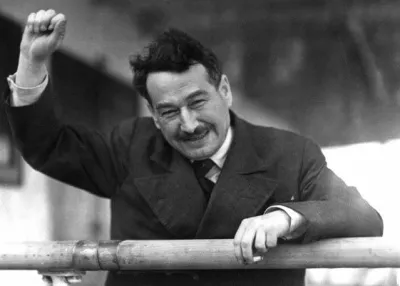
Egon Kisch
Human Design Chart
Biography
He died on 31 March 1948 in Prague.
Egon Kisch as a Manifesting Generator 2/5 in Human Design
Manifesting Generator 2/5 — Design at a Glance
Egon Kisch revealed himself as a person with a hybrid energy structure: He had the constant power of a Generator but also possessed the ability to set actions in motion quickly. This design allowed him to skip steps and bring things into his life rapidly. However, this speed carried risks. Often he was too quick and skipped necessary intermediate steps, leading him to return later to fill gaps. This could cause frustration as his inner satisfaction suffered when the process wasn't right.
Additionally, Egon Kisch tended to pursue multiple projects simultaneously, driven by various impulses. Without clear internal guidance, this complexity threatened to become overwhelming. Crucial for his well-being was the strategy of reacting: He performed best when he responded to external incentives and his Sacral Center – his energy source – gave a clear “yes”. Only then did his deep creative joy ignite. In this state, he fell into a playful mode that sought variety. The advice to finish one thing before starting another didn’t suit his nature; instead, he drew strength from engaging with different tasks simultaneously as long as his inner authority consented and the play remained intact.
Sacral Authority
Egon Kisch revealed himself as someone whose decision-making was characterized by direct physical resonance. As a Generator, he possessed sacral authority, meaning that his strategy and internal guidance were identical: waiting for external stimuli and then responding from the gut. This mechanism greatly simplified his process since he didn’t need to intellectually weigh options but trusted spontaneous impulses.
His inner signals manifested as physical sounds or bursts of energy – a grunt, a hum, or simply an “mmh”. As long as his emotional center remained open, he could clearly hear this sacral voice. When his motor started up, Egon Kisch felt vital and energized; he tackled his tasks with great enthusiasm and immersed himself in them without seeking an external purpose.
Additionally, an activated Spleen Center acted as a supportive instance. This connection gave him quick, instinctive perception and enabled spontaneous reactions. He had immediate access to his physical well-being, which he could reliably rely on. Thus, Egon Kisch lived in a state defined by joy from the activity itself, guided by inexhaustible energy that sprang directly from his sacral reaction to life around him.
The 2/5 Profile — Hermit / Heretic
Egon Kisch's design revealed a tendency towards dialectics between withdrawal and public service. As someone with Profile 2/5, the
Single Definition — Defined & Open Centers
Egon Kisch was someone who possessed a consistent inner direction and a powerful ability to express himself. His defined G Center gave him reliable self-confidence and a clear sense of his life mission; he intuitively knew where his path led without having to deduce it rationally. This inner security flowed into his defined Throat Center, which served as the focal point for communicating these messages to the world. His voice was not a product of momentary thought but an expression of his deep identity and truth.
At the same time, he had a defined Sacral Center, the motor of his energy. This did not mean that he could or should fulfill every demand placed on him, but rather that he carried an enormous vital energy source within himself, which was only correctly activated through reaction to external stimuli. His energy was available for things that found inner resonance; initiating actions without this resonance led to frustration and exhaustion.
This stable interior contrasted strongly with his vulnerability in the open centers. His open Head and Ajna Centers made him receptive to mental inspirations and concepts from the environment, which he did not understand as his own truth. He tended to be distracted by doubts or questions of others when he did not trust his inner authority. Similarly, his open Solar Plexus absorbed the emotions of his surroundings; he felt the emotional climate intensely but had to learn not to personalize these feelings. His open Heart Center lacked consistent competitive willpower; he sought no proof of his value through promises or acts of strength but learned not to get caught in spirals of self-deprecation. Finally, his open Root and Spleen Centers were sensitive to stress and survival fears from the environment, which made him tend to act impulsively or cling to unhealthy situations for a false sense of security. His challenge lay in not interpreting these open fields as personal deficits but using them as mirrors for the world around him while relying on his defined energy and direction.
Channels for inner reflection and persistent discovery.
Egon Kisch was someone who collected experiences to share later with deeper insight. This attitude resulted from Channel 13-33, The Lost Son. It connected the G Center with the Throat Center: Gate 13 actively listened and stored secrets as well as memories, while Gate 33 withdrew to reflect on these data. This created a cyclical process of maturation. Egon Kisch patiently waited for hidden truths beneath the surface to reveal themselves before communicating them. His challenge lay in timing; he had to learn not to prematurely unveil or overly withdraw. Instead, he used this distance to categorize life stories and collective patterns, allowing him to bring continuity and stability to the transmission of knowledge.
Parallel to this, Channel 29-46, Discovery, connected his Sacral Center with his G Center. Through Gate 29, The Well of Endurance, he positively responded to questions and fully immersed himself in processes. Gate 46 secured the connection to the direction of Higher Self so that he was at the right place at the right time. Egon Kisch had to let go of expectations to discover the significance of his experiences. His persistence in the Sacral Center kept him on course, even if the meaning remained hidden during the experience. Only at the end of the process did the discovery become clear, allowing him to communicate new perspectives to the collective.
Additionally, Gates 24 (inner silence, mental mutation) and 44 (awareness, transformation through interaction) shaped his inner landscape. Gate 19 sought resources and safe territory for spiritual growth in the community. On a personal level, Gate 1 promoted creative uniqueness in the here and now, while Gate 27 brought caring warmth for self-preservation. Gate 42 emphasized the need to complete processes before taking on new commitments. Gate 7 projected leadership patterns and future perspectives. Gate 59 followed a genetic strategy of connection without personal preferences, and Gate 45 expressed willful energy from the Heart Center in material life. Gate 23 enabled amoral understanding for mutations, while Gate 20 promoted awakening to authentic uniqueness in the present.
Collective Circuitry — Circuit Signature
Egon Kisch was someone who not only processed past experiences but actively shared them with others. His design was marked by the Meaning Finder Circuit, which brought emotions and feelings from the past into focus. Unlike purely logical processes, his inner processing was wave-like: each emotional cycle had a clear beginning, middle, and end. This energy was often inexplicable or illogical yet followed a natural rhythm of fading and re-emerging.
In him, Throat, Identity, and Sacral Centers were directly connected to one another. This created a continuous flow from inner truth through emotional depth to external communication. The channels 'The Lost Son' (Gates 33, 13) and 'Discovery' (Gates 46, 29) allowed him to gain deep insights and convey them visually and emotionally. His drive was to learn from the past and share these learning experiences with the collective. These felt insights served not only personal clarification but were also used for communal reflection. Thus, a connection emerged between individual emotional waves and collective meaning-making, where the past always served as a source for present understanding.
Right Angle Cross of the Four Ways 1
Egon Kisch's design carried the imprint of the right cross of the four paths. This configuration established a specific life dynamics characterized by the interplay between internal intuition and external action. In Human Design, this pattern marks a path where the ability to perceive hidden connections is directly translated into concrete steps. It was not about passive waiting for inspiration but rather an active structure that immediately put insights into practice.
For Egon Kisch, this meant that his decisions were often guided by a deep intuitive certainty, which he simultaneously combined with the power of action. The right cross of the four paths describes a process in which the individual acts as a bridge between the invisible and the visible. The inner voice was not only heard but served immediately as a compass for external activity. This mechanism created a life span where reflection and action were inseparably intertwined. Egon Kisch thus showed himself to be someone who did not just understand his perceptions, but consistently anchored them in the world. The structure of his design demanded a constant integration of being and doing, thereby imprinting his path with a clear, action-oriented intuition.
Saturn Return · Uranus Opposition · Chiron Return · 2nd Saturn Return — Life Cycles
Egon Kisch was someone whose life journey was marked by clear cycles of professional positioning. His design indicated a tendency to create new structural foundations or redefine existing roles in certain age phases. This became visible in 1925 at the age of 40: his first trip to Soviet Union marked a career-defining step, corresponding with the Uranus opposition – a phase often characterized by unexpected turns or breaks that dissolve old structures and open up new paths.
Ten years later, in 1934, he entered the Chiron Return. At age 49, he landed in Australia and began an ensuing journey. This cycle represents the bloom of one's purpose; if followed, it makes the meaning tangible. Kisch's movement into this distant region was no coincidence but rather an expression of his inner maturation and unfolding of his incarnation purpose within a professional context.
The second Saturn Return completed in 1941. At age 56, he founded the Heinrich-Heine Club in Mexico City and took on the role of Vice President. This cycle demands discipline and the establishment of lasting structures. Kisch's founding activities show how he assumed responsibility during this phase and created stable frameworks that anchored his professional identity in exile. The three events form a line: from disruptive departure through purposeful journey to institutional anchoring.
Manifesting Generator · Sacral Authority — Synthesis
Egon Kisch lived a life marked by constant interplay between inner reflection and external action. His defined sacral motor (design) gave him an inexhaustible energy source, which however always depended on external impulses. This responsiveness was strengthened by the connection to the Throat Center (channels/gates), enabling him to act swiftly and seize opportunities – a hybrid of Manifestor and Generator. At the same time, his profile as a natural talent and hero (profile role) required that he carefully deploy his energy and consciously choose certain paths, creating an internal conflict with his quick responsiveness.
Central for Egon Kisch was the tension field between the need for withdrawal and others' expectations (profile role). The channel of the Lost Son (channels/gates) points to a deep ability for reflection, an inner gathering of experiences. This stood in contrast to his role as someone expected to provide solutions (line 5), which constantly pushed him back into the world to share his insights. The cyclical events – travels and professional new beginnings – reflected this shift between inner retreat and external engagement.
2 Defined Channels
Incarnation Cross - Right Angle Cross of the Four Ways 1
Solar Return
The Solar Return shows the moment when the sun returns to its exact birth position - your personal solar year.
Life Cycles
Discover the life cycles with a detailed triple view (birth chart, cycle chart, composite).
Human Design Profile
- Strategy
- To respond - wait for something to respond to
- Authority
- Sacral Authority
- Profile
- 2/5 - Hermit / Heretic
- Definition
- Single Definition
- Incarnation Cross
- Right Angle Cross of the Four Ways 1
- Date of Birth
- 29.04.1885 16:00
- Place of Birth
- Prague, Czech Republic
Frequently Asked Questions
What was Egon Kisch's Human Design type?
What Profile did Egon Kisch have in Human Design?
What authority did Egon Kisch possess?
What incarnation cross did Egon Kisch have?
When was Egon Kisch born?
Discover your own Human Design
Are you also a Manifesting Generator? Find out in a personal reading how to unfold your multi-talents and direct your energy wisely.
More Personalities
Back to overviewAlain-Fournier

Aldair

Alizée

Angeli

Arletty
Artus