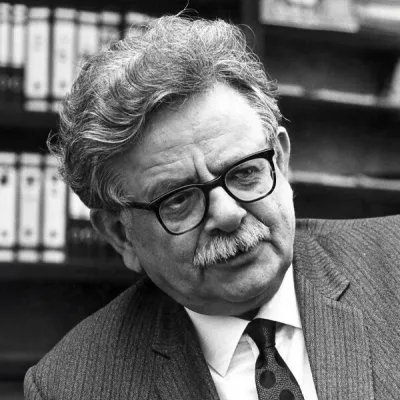
Elias Canetti
Human Design Chart
Biography
Born to Jacques Canetti and Mathilde née Arditti in Ruse, a city on the Danube in Bulgaria, Elias Canetti was the eldest of three sons of a businessman. His ancestors were Sephardi Jews who had been expelled from Spain in 1492. His paternal ancestors had settled in Ruse from Ottoman Adrianople. The original family name was Cañete, named after a village in Spain. In Ruse, Elias' father and grandfather were successful merchants who operated out of a commercial building, which they had built in 1898. Canetti's mother descended from one of the oldest Sephardi families in Bulgaria, Arditti, who were among the founders of the Ruse Jewish colony in the late 18th century. The Ardittis can be traced back to the 14th century, when they were court physicians and astronomers to the Aragonese royal court of Alfonso IV and Pedro IV. Before settling in Ruse, they had lived in Livorno in the 17th century.
Canetti spent his childhood years, from 1905 to 1911, in Ruse until the family moved to Britain. In 1912 his father died suddenly, and his mother moved with their children to first Lausanne, then Vienna in the same year. They lived in Vienna from the time Canetti was aged seven onwards. His mother insisted that he speak German, and taught it to him. By this time Canetti already spoke Ladino (his native language), Bulgarian, English and some French (he studied the latter two in the one year in Britain). Subsequently the family moved first (from 1916 to 1921) to Zürich and then (until 1924) to Frankfurt, where Canetti graduated from high school.
Canetti went back to Vienna in 1924 in order to study chemistry. However, his primary interests during his years in Vienna became philosophy and literature. Introduced into the literary circles of First-Republic-Vienna, he started writing.
Human Design Analysis: Elias Canetti as Projector 6/2
Projector 6/2 — Design at a Glance
Elias Canetti revealed himself as someone who could identify weaknesses in systems and people with unerring sharpness. His Projector design gave him a dense, focused aura, comparable to a bright flashlight that shone directly on dark, non-functioning areas in his surroundings. This ability to immediately pinpoint errors was, however, a double-edged sword: Direct confrontation often led to rejection, as the other person felt attacked, as if being blinded by the light.
Canetti's optimal strategy involved not actively intervening but waiting for an honest invitation from those around him. By radiating his own harmony and clarity, he became attractive; others then sought out his advice of their own accord to bring "light into the darkness" of their own problems. Since his Sacral Center was undefined, he did not have a constant source of life energy. Instead, he experienced phases of high productivity that had to be followed by periods of rest to prevent burnout. If Canetti did not adhere to this strategy of patience and waiting for invitations, the non-self theme of bitterness developed in him. Conversely, if he followed his design, he was rewarded with success, as his specific way of illuminating paths for others was valued and sought after by his environment.
Emotional Authority
Elias Canetti exhibited an inner authority that did not immediately reveal itself but became clear through a process of emotional condensation. His design carried emotional authority, meaning his defined Emotional Center always set the standard for decisions – regardless of which other centers were also defined. This priority rule was central: The emotional wave had precedence over any other internal voice.
Canetti experienced constant ups and downs in his emotions. The world appeared to him through the lens of his current mood; something could be inspiring at one moment and negative the next. However, these immediate impressions were only snapshots and not yet his deep truth. Quick, spontaneous decisions from such an emotional state would often have negative consequences.
Instead, his design required patience and time for maturation. He had to take his time, reconsider decisions multiple times, and sleep on them. Only when the intense emotions subsided and emotional distance was gained did clarity set in. This process of calmness was the path to the right decision, especially for long-term steps that significantly shaped his life course. Emotional authority thus did not call for immediate action but rather waiting for the deep, serene truth beneath the waves of mood.
The 6/2 Profile — Role Model / Hermit
Elias Canetti's design laid a tendency for deep introspection that only unfolded in full force later in life. As a person with the Profile 6/2 – Role Model/Natural Talent – he went through a clear two-phase process. In his younger years, before Saturn returned around age 30, the energy of the second line dominated: experimenting in life, characterized by trial and error as well as necessary setbacks. This phase was about gathering personal experiences and gently dealing with expectations, where mistrust or trust determined the effectiveness of these early years.
After turning 30, the sixth line activated. Canetti metaphorically retreated into a "cave" to reflect on his earlier experiments from a distance. This period of intense reflection was also one of healing and deep self-awareness. The second line projected outward a strong, caring presence that he did not always recognize himself; it attracted others seeking his wisdom. Eventually, Canetti emerged from this withdrawal phase as a wise person. Others recognized his matured life experience and came to him to learn from his ability for deep introspection. His ideas had to be lived out to truly inspire others, underscoring the connection between personal experience and external impact.
Split Definition — Defined & Open Centers
Elias Canetti was characterized by a defined G Center, which gave him a firm internal identity and a clear sense of personal direction. This reliable self-love allowed him to love others without becoming dependent on them, and it gave him the strength to show new paths to other people. Simultaneously, his defined Heart Center provided access to constant willpower. He could make promises and keep them, which strengthened his self-esteem and enabled him to shape his life and resources autonomously. His voice, guided by a defined Throat Center, spoke from these stable sources – whether it was the will of the heart or the identity of the G Center – with a consistent yet limited form of expression.
At the same time, Canetti was open in other areas to external influences. His open Head and Ajna Centers made him free from conditioned mental patterns but also vulnerable to pressure to find answers that were not his own. He tended to identify with others' confusion or avoid intellectual pursuits obsessively to force mental clarity. His open Sacral Center meant he did not have a personal generative energy source, instead absorbing the vitality of his environment and amplifying it. This led him to become easily exhausted if he had not learned to set boundaries and disengage from overwhelming foreign energy. Similarly, his open Spleen Center made him sensitive to the well-being or lack thereof in his surroundings; he unconsciously sought security through others, which posed a risk of unhealthy dependencies if he did not trust his inner authority. Finally, his open Root Center absorbed adrenergic stress from the environment, causing him to constantly try to release this pressure rather than recognize and let it go as foreign.
Channels for awakening, principles and communal connection.
Elias Canetti radiated a profound, wordless clarity simply through his presence. This attitude stemmed from Channel 10-20 in his personality: he lived the principle of 'I am' by translating individual knowledge into concrete action here and now. His survival and self-affirmation resulted from accepting himself in every moment and acting as an authentic voice. Others felt this awareness; they were inspired to be themselves, which brought him genuine invitations and protected him from resistance.
Parallel to this, Channel 37-40 of his design shaped the way he formed relationships. He did not seek spontaneous contacts but waited for the right invitation through personal contact over time. For him, 'tribal business' was central: he built bridges between individuals to create a community where everyone had an honorable place. His willpower guaranteed the depth of these connections, yet he also needed his breaks and rewards for working on cohesion.
Additionally, other Gates influenced him: Gate 56 allowed him to abstract mental processes into figurative storytelling. Gate 60 brought acceptance of limitations as a path to transformation. Gate 28 demanded decisions in the here and now, often accompanied by the risk of questioning his life's meaning. Gate 27 provided genetic care that enriched all activities with warmth. Gate 35 propelled him forward through interaction and new experiences while Gate 1 promoted his unique creative mutation without restrictions at the right time. Gate 55 brought emotional awareness and mood swings, and Gate 45 connected willpower with the expression of tribal level and material abundance.
Individual Circuitry — Circuit Signature
Elias Canetti's design tended towards strategic cooperation paired with a strong inner orientation to the immediate present moment. This configuration arose from his Shared Definition: two energetically separate groups existed parallel without direct flow between them.
The Ego Circuit connected his Heart and Solar Plexus Centers through the Community Channel (37–40). This created a dynamic of give-and-take – 'today I give, tomorrow you give' – based on mutual support. Since this circuit lacked a connection to the Sacral Center, there was no constant life force; instead, pauses were necessary to generate resources for the tribe. The energy was timeless and conservative, marked by emotional waves that built up ratchet-like.
Simultaneously, the Integration Circuit connected his Throat and Identity Centers (Channel 20–10, Awakening). This was about individual self-reinforcement: strength from reacting to life was realized through proper behavior and intuitive knowledge in the present moment. This connection allowed for high individuality, acoustically marked and focused on anchoring oneself in the present.
Both circuits formed separate spheres: one served tribal resource building through exchange, the other individual survival through precise action in the moment. Neither of these energies flowed directly into the other; they existed as parallel, independent fields within his structure.
Left Angle Cross of Distraction 1
Elias Canettis Human-Design leged a tendency towards inner fragmentation, where attention was often diverted from what should have been the focal point. This configuration, known as the left distraction cross 1, described a specific mechanism: Energy did not flow linearly toward a single goal but rather splintered into multiple directions. This did not necessarily mean chaos but a constant inclination to divert focus away from the core issue or scatter attention through secondary interests. For Elias Canetti, this was not merely an interference but a structural feature of his perception. The mechanics were evident in how clear lines often blurred and concentration on the essential was interrupted by a multitude of stimuli. It was a dynamic distraction rooted deeply within his energetic structure. Elias Canetti lived with this inclination towards dispersion that shaped his way of being and acting. Energy constantly sought new points of attachment rather than focusing on one point, leading to the essence often remaining obscured in the haze of many small distractions. Thus, Elias Canettis experiential world was marked by a constant movement between focus and distraction, a state that significantly determined his inner landscape.
Saturn Return · Uranus Opposition · Chiron Return · 2nd Saturn Return — Life Cycles
Elias Canettis Human-Design set a tendency towards cyclical condensation, where internal maturation processes became visible at specific life stations. This structure was evident during his Saturn Return cycles, which acted as phases of stocktaking and consolidation.
The first Saturn Return occurred around the age of 27. In this phase, often marking the foundation for long-term structures, "Die Komödie der Eitelkeit" (1932) emerged. This work represented a success based on years of inner labor now taking stable form. It was a moment of solidification where Canetti condensed his previous experiences into a sustainable result.
The second Saturn Return happened around the age of 58. This cycle often brings profound restructuring, accompanied by letting go of old ties. In 1963, Veza Canetti passed away. This event marked a decisive turning point in Canettis life reflecting the necessary changes of this astrological transition. The death of his partner acted as a catalyst for a new phase of life where his inner stance and outer environment fundamentally changed. Both Saturn Returns shaped Canettis path through clear milestones: once through creative affirmation, another time through the loss of a central figure.
Projector · Emotional Authority — Synthesis
Elias Canetti lived much of his life observing and recognizing patterns in his surroundings. As a Projector with defined Throat (connected to G Center and Gate 10/20), he was designed to recognize the potential and flaws of others – casting light into darkness (Human-Design). This ability, combined with emotional authority, however required time for decision maturation as immediate expressions could quickly lead to rejection. The Profile as Role Model/Natural Talent indicates that after intensive personal experience, he gathered wisdom which he eventually made accessible to others following a phase of withdrawal and reflection.
A central paradox in his design lay in the interplay between projection and emotional wave. He possessed the ability to recognize the unspoken (Gate 10/20), yet his decisions were bound to an emotional dynamic that initially plunged him into highs and lows of feelings. This led to a tension between the need to directly share his knowledge and the necessity to wait until clarity arose through experiencing emotional cycles – an inner distancing that sharpened his observational skills but also resulted in some detachment from immediate involvement.
2 Defined Channels
Incarnation Cross - Left Angle Cross of Distraction 1
Solar Return
The Solar Return shows the moment when the sun returns to its exact birth position - your personal solar year.
Life Cycles
Discover the life cycles with a detailed triple view (birth chart, cycle chart, composite).
Human Design Profile
- Type
- Projector
- Strategy
- Wait for the respectful invitation
- Authority
- Emotional Authority
- Profile
- 6/2 - Role Model / Hermit
- Definition
- Split Definition
- Incarnation Cross
- Left Angle Cross of Distraction 1
- Date of Birth
- 25.07.1905 01:00
- Place of Birth
- Ruse, Bulgaria
Frequently Asked Questions
What was Elias Canetti's Human Design type?
What Profile did Elias Canetti have in Human Design?
Which Authority guided Elias Canetti?
What incarnation cross was active for Elias Canetti?
When was Elias Canetti born?
Discover your own Human Design
Are you also a Projector? Find out in a personal reading how to unfold your leadership qualities and recognize the right invitations.
More Personalities
Back to overviewSissy Spacek

Alain-Fournier

Anémone

Angeli

Ann-Margret

Bourvil