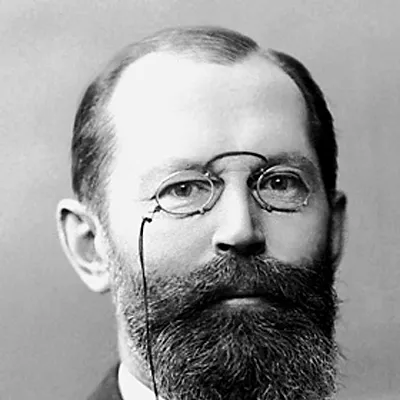
Emil Fischer
Human Design Chart
Biography
The son of a successful business man, Emil was given three years with a private tutor. After attending the local school, he spent two years at school at Wetzlar, and two more at Bonn where he passed his final examination in 1869 with great distinction. His father wished him to enter the family lumber business, but Emil wished to study the natural sciences, especially physics. After an unsuccessful trial of Emil in the family business, his father - who, according to the laureate's autobiography, said that Emil was too stupid to be a business man and had better be a student - sent him in 1871 to the University of Bonn to study chemistry.
In 1872, however, Emil, who still wished to study physics, was persuaded by his cousin to go with him to the newly established University of Strasbourg, where Professor Rose was working on the Bunsen method of analysis. Here Fischer met Adolf von Baeyer, under whose influence he finally decided to devote his life to chemistry. In 1874 he took his PhD at Strasbourg with a thesis on fluorescence and orcin-phthalein. In the same year he was appointed assistant instructor at Strasbourg University and here he began the first of his many remarkable discoveries. The discovery of phenyl hydrazine, reputed to have been accidental, was related to much of Fischer's later work.
Human Design Analysis: Emil Fischer as Projector 2/4
Projector 2/4 — Design at a Glance
Emil Fischer's design tends towards precise system analysis. As a projector, he did not have an intrinsic energy source from the undefined Sacral Center. Instead, his aura acted like a focused beam of light: He immediately identified weaknesses and errors in other people's structures or relationships. This ability was double-edged. Directly addressing these issues often led to defensive reactions as others felt attacked by having the spotlight shone directly on them.
Emil Fischer's optimal strategy involved not actively intervening but waiting for an honest invitation from his environment. Rather than leading the way himself, he should shine – perhaps through demonstrating harmony or competence – so that others would seek him out for advice. This waiting for recognition and inclusion was essential to avoid bitterness as a manifestation of non-self.
Since projectors receive energy in phases, Emil Fischer followed a rhythm of intense activity and necessary rest periods. The conventional system's expectation of constant availability stood against this biological need. Living according to the strategy of patience and waiting for invitations rewarded his design with success. Ignoring this path risked burnout or feelings of injustice. His strength did not lie in self-empowerment but in clearly, gently illuminating connections for others.
Splenic Authority
Emil Fischer's design tends towards immediate, instinctive orientation. He made decisions not through prolonged analysis but on a fine, spontaneous impulse. This stance stemmed from his authority in the Spleen Center. For this inner guidance to work, his Emotional and Sacral Centers were open; a configuration only projectors or manifestors possess. The defined Spleen Center served as his health and alarm system. It provided him with precise survival intelligence: an immediate physical sense of whether a situation, environment, or person was right for him. This first impulse directly served his well-being and allowed him to rigorously distance himself from harmful influences. Since this spleen impulse was very subtle and only appeared once in the moment, its use required high vigilance. He had to learn to trust these fleeting signals before they were drowned out by other voices. Because knowledge of what is right was always available only in the present moment, long-term plans often remained rigid or inappropriate for him. His design therefore demanded much flexibility and freedom; he should not be bound down too much to do justice to his system's spontaneity. A short retreat helped him perceive these fine signals more clearly.
The 2/4 Profile — Hermit / Opportunist
Emil Fischer's design tends towards a constant tension between the need for withdrawal and the desire for community. As someone with Profile 2/4, he constantly oscillated between Line 2, which demands solitude and internal reflection, and Line 4, which seeks contact with the 'community'. This configuration created a dynamic interplay: Emil Fischer needed phases of retreat into his 'cave' to gain inner clarity and test intuitive values – supported by Gate 57, which uses intuition for life-critical ideals. Once this inner need was satisfied, he emerged again to spend time with his favorite people.
His Line 4 (Gate 53) gave him confidence and the certainty that crises have an end. This transpersonal quality helped him reflect on experiences in a collective context. Clear communication of his boundaries was important for Emil Fischer: He had to make it clear when he sought company and when he wanted solitude. Only then could he evaluate the knowledge from his network during solitary times and develop brilliant ideas from them. The structure of his design thus appeared not as a static state but as a rhythmic process of cleansing through inner insight and social embedding.
Single Definition — Defined & Open Centers
Emil Fischers Design laid a tendency towards a deeply rooted, unchangeable self-identity. His defined G Center gave him a clear sense of his own direction and mission; he intuitively knew who he was and where his path led without needing external confirmation. This inner security allowed him to support others in their development by helping them understand the natural evolution of the species rather than directing them. Parallel to this, he possessed a defined Spleen Center, which supported his high bodily intelligence and spontaneous intuition. He acted from the "now", trusted sudden warning signals and instincts for the protection of his health and well-being, instead of making rational considerations over intuitive perceptions.
These stable inner poles contrasted strongly with the vulnerability of his open centers. His open Head and Ajna Centers made him receptive to mental inspirations from the environment; he tended to get entangled in other people's issues or seek answers that were not his own, which could lead to temporary confusion. His open Heart Center lacked consistent willpower in terms of competitive drive; he was vulnerable to the pressure of proving his worth through performance, although his design enabled him to objectively observe others' egos without having to compete himself. Additionally, his open Solar Plexus absorbed foreign emotions, which could cause him to misinterpret emotional waves from the environment as his own instability. His open Sacral Center lacked a constant energy flow; he was dependent on being nourished by the generative power of others and had to learn to respect his own boundaries to avoid exhaustion through "borrowed" energy. Finally, his open Root Center amplified external stress, making him vulnerable to chaos that he did not generate himself but merely reflected.
Channels for intuitive elegance and authentic being.
Emil Fischers design inclines towards intuitive, confident action that reacts less to intellectual analysis and more to immediate perception of the environment. This attitude stems from Channel Perfect Form 57-10, connecting the Spleen Center with the G Center. Through Gate 57, he developed acute sensitivity to the quality of tones and moods; he listened more to the sound than to the words themselves. This gave him spontaneous clarity to act appropriately when something in his environment was amiss. In conjunction with Gate 10, the Self-Behavior Gate, this resulted in behavior guided by deep intuitive awareness. It was the art of survival through self-appreciation and love for oneself. Emil Fischer lived this ability existentially and unburdened in the present, releasing unfounded future anxieties. His behavior was an undisturbed, self-referential process of perfecting his own form. He created something healthy and beautiful by authentically living his self without seeking external recognition. His uniqueness served as a role model for his environment, showing how valuable it is to live life as one's individual truth. Additionally, Gates like 51 (Willpower and Adaptation to Shocks), 53 (Pioneer Spirit for New Cycles) and 54 (Connection of Worldly Success and Mysticism) contributed to his inner dynamics while Gates 15 (Collective Rhythm) and 48 (Pattern Recognition and Correction) shaped his logical side. Yet, the core of his essence remained the intuitive integration of Being and Action in the Here and Now.
Individual Circuitry — Circuit Signature
Emil Fischers design points to a tendency towards precise, intuitive form-making. He showed himself as someone who could translate inner perception into concrete structures without losing touch with immediate reality. This orientation stemmed from his simple definition: the energetic forces flowed directly and coherently between the Identity Center and the Spleen Center.
This specific flow was enabled by the Channel "Perfect Form" (Gates 10 and 57). Gate 57 in the Spleen Center provided intuitive knowledge – a deep, often unconscious insight into the essence of things. This intuition flowed directly into the Identity Center, where Gate 10 channeled it through the power of right action and personal authority. The result was not just thinking but a tangible, individual expression form that was both intuitively grounded and characteristically authentic.
As Emil Fischer had a simple definition, this channel existed as his sole direct connection between defined centers in his chart. There were no shared or more complex group connections; instead, this energy worked as a clear, unshared stream. The integration of intuition (Spleen) and identity (Identity Center) shaped the way he engaged with the world: through constant inner alignment of what felt right with who he truly was. This created high individual coherence in his reactions and decisions.
Right Angle Cross of Penetration 3
Emil Fischer's design indicated a tendency towards a deep, almost fateful connection with his own essence. This configuration, the right cross of penetration 3, did not describe superficial adaptation to the environment but rather an inner process of self-discovery through direct experience and testing. For Emil Fischer, this was no abstract concept but a defining reality of life: he sought no external validations but learned about who he truly was by actually living situations.
This mechanism acted like a filter that helped him distinguish between what authentically belonged to his core and what was merely pretended or expected. It was about integrating knowledge into one's existence – not just through study, but through actual experience and internalization. Emil Fischer often showed himself as someone who strengthened his identity in the face of challenges and relationships. The energy of this cross promoted a kind of spiritual or existential clarity that could only be achieved through personal dedication and reflection.
Without this inner work, he would have easily been distracted by external influences. Instead, he used every encounter as an opportunity to better understand himself. This gave him a certain calm in dealing with uncertainties, knowing that true insight takes time and cannot be forced. His path was thus a constant back-and-forth between doubt and certainty until eventually a clear view of his own self emerged.
Saturn Return · Uranus Opposition · Chiron Return · 2nd Saturn Return — Life Cycles
Emil Fischer's design indicated a tendency towards structural anchoring and institutional responsibility. This orientation manifested concretely in his career development, marked by clear milestones. In 1879, at the age of 27, he became Professor of Chemistry in Munich. This corresponded to his first Saturn Return, a cycle often used to condense years of groundwork into a solid result and establish stable positions.
The dynamics of his design called for expansion and new horizons, which materialized in 1892: at the age of 40, he took over the professorship at Berlin University. This coincided with the Uranus Opposition, a time when the system often seeks greater freedom or a significant change in environment.
The peak of this development occurred in 1901, when Emil Fischer, at the age of 49, completed the first synthesis of Glycylglycin and thereby established peptide chemistry as an independent discipline. This marked his Chiron Return, a fulfillment cycle where one's incarnation cross unfolds and the deeper meaning of life becomes experiential. The institutionalization of this knowledge reached its climax in 1911: at age 59, he was instrumental in founding the Kaiser Wilhelm Society. This second Saturn Return underscored the need to pour acquired knowledge into lasting structures and take responsibility for the community.
Projector · Splenic Authority — Synthesis
He was a projector whose life was marked by a deep ability to recognize potential and flaws in other systems (Gate 57/10). This intuitive insight, fueled by a defined G Center and the associated clear self-identity, projected onto his environment and enabled him to bring 'light into darkness' for others. His repeated professional successes (Professor in Munich, Berlin, pioneering work in peptide chemistry) always manifested at moments of recognition – a spontaneous impulse from the Spleen Center that guided him on the right path and allowed him to grasp the needs of his surroundings.
A central paradox lay in his profile as a natural talent/networker (Lines 2/4). He oscillated between the need for withdrawal and inner clarity, as well as the desire for connection and exchange with others. This tension was also reflected in the integration circuit, where securing one's own survival involved both individual intuition and recognition by others. Thus, he lived in a constant interplay between the desire for autonomy and the longing for community.
1 Defined Channel
Incarnation Cross - Right Angle Cross of Penetration 3
Solar Return
The Solar Return shows the moment when the sun returns to its exact birth position - your personal solar year.
Life Cycles
Discover the life cycles with a detailed triple view (birth chart, cycle chart, composite).
Human Design Profile
- Type
- Projector
- Strategy
- Wait for the respectful invitation
- Authority
- Splenic Authority
- Profile
- 2/4 - Hermit / Opportunist
- Definition
- Single Definition
- Incarnation Cross
- Right Angle Cross of Penetration 3
- Date of Birth
- 09.10.1852 12:00
- Place of Birth
- Euskirchen, Germany
Frequently Asked Questions
What is Emil Fischer's Human Design type?
What profile did Emil Fischer have?
What authority did Emil Fischer have?
What incarnation cross did Emil Fischer have?
When was Emil Fischer born?
Discover your own Human Design
Are you also a Projector? Find out in a personal reading how to unfold your leadership qualities and recognize the right invitations.
More Personalities
Back to overviewSissy Spacek

Alain-Fournier

Anémone

Ann-Margret

Bourvil
Hergé