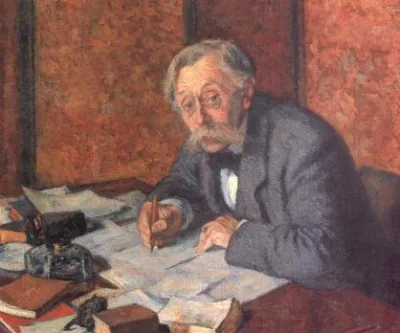
Émile Verhaeren
Human Design Chart
Biography
Émile Verhaeren as a Manifesting Generator 1/3 in Human Design
Manifesting Generator 1/3 — Design at a Glance
Émile Verhaeren revealed himself as a hybrid being, combining the constant energy of a Generator with the lightning-fast effect of a Manifestor. His design allowed him to skip steps and quickly draw things into his life. This speed, however, was a double-edged sword: Often he was too quick, neglecting necessary intermediate steps and had to return later to fill in the gaps. This led to frustration, the specific non-self theme of the manifesting Generator. Additionally, he tended to pursue multiple projects simultaneously, driven by various impulses. Without inner alignment, this creative enthusiasm quickly tipped into overwhelm. The solution lay in the strategy of not initiating himself but responding to external impulses. Only when his Sacral Center said a clear "yes" did he begin to act. Regular checks to see if the projects still resonated were crucial. With the correct application of this strategy, he found deep satisfaction. He needed variety and a playful approach to work. The pressure to focus on one thing until completion before moving on to the next went against his nature. Instead, he thrived in the rotation of activities as long as he listened to his inner energy. His productivity was strongest when he was in "play mode" and experienced work not as a burden but as a living response to life.
Sacral Authority
Émile Verhaeren's decision-making process was characterized by a direct physical resonance. As a Generator, he had sacral authority, which also served as his strategy. This greatly simplified his choice options, as inner guidance and life path aligned identically. A prerequisite for this was his open Emotional Center, ensuring he did not act impulsively but waited for clear physical signals.
These signals appeared as gut feelings or bursts of energy triggered by external stimuli. Émile Verhaeren learned to pay attention to these bodily cues – whether as grunts, hums, or vocal affirmations. When his sacral motor kicked in, he felt vital and energized. He tackled his work with great enthusiasm and immersed himself in his tasks without the need for external purpose. His nature was geared towards living with joy and contentment.
Additionally, his activated Spleen Center acted as a supporting authority. This gave him the ability to react particularly quickly and spontaneously. He had immediate access to his physical well-being and instinctive perception. These instincts could be reliably used as guidance, making his decision-making even more precise and swift. The combination of sacral confirmation and spleen-supported intuition shaped his way of moving through life.
The 1/3 Profile — Investigator / Martyr
Émile Verhaeren revealed himself as someone who not only collected knowledge but also tested it through his own actions and failures. His Design as a Researcher and Experimenter (Profile 1/3) set a life task based on the principle of trial and error. Line 1 drove him to learn theoretically and focus on the essentials, while Line 3 forced him to test these theories in practice.
This interplay meant that he only considered insights valid if he had experienced them himself. When he deemed something correct, he had previously examined it both intellectually and practically, thoroughly. His judgment was therefore trustworthy, as it was based on tested experience.
Sometimes the energy of Line 1 caused him to hesitate, because he felt he did not yet know enough. But Line 3 reminded him that mistakes are part of the learning process and cannot be taken personally as long as the form is correct. Authentic actions from the current mood were crucial for his personal transformation. Through this combination of deep analysis and superficial, quick adaptability in the here and now, he could grasp complex connections and apply them practically.
Single Definition — Defined & Open Centers
Émile Verhaeren was someone whose expressive power and vital endurance rested on a mechanical connection between his defined Throat and Sacral Centers. This configuration gave him a consistent yet limited way to reliably express himself. His voice was not just a product of the mind but transformed information from the entire body into communication and action. As a Generator, he possessed a tremendous power source: a daily generated energy potential that felt like a constant hum. However, this sacral energy was only available when he responded – waiting for a question or invitation before acting. The correct application of this power required patience; impulsive initiation would have broken the connection to the source and led to frustration.
In contrast, his open centers shaped his vulnerability to external influences. His open Head and Ajna Centers meant he lacked a consistent way to process mental information. He tended to take on the mental pressure and questions of others, which could pull him into a whirlpool of confusion and doubt that did not belong to him. Instead of being led by this non-self-understanding, which urged him to find answers he could not give, his task was to remain a detached observer of his thoughts.
Similarly, his open G Center meant he had no fixed identity or direction. He blended with his environment and adapted to the people around him. This made him vulnerable in relationships, as he could draw security from borrowed identity. His path was to not seek love or direction himself but to wait for others to initiate him to the right places. Only at the right place, surrounded by the right people, could he flourish. His open Heart Center also drove him to prove his worth, which could lead to a cycle of promises and disappointments, as he did not have the consistent willpower to keep them. Finally, his open Solar Plexus absorbed the emotions of his surroundings, making him vulnerable to emotional waves that he often personalized, though they did not belong to him.
Channels for powerful, spontaneous manifestation.
Émile Verhaeren was someone whose energy had an insatiable drive for immediate implementation. His design inclined towards persistent activity, making it difficult for him to remain calm. This dynamic stemmed from the Channel of Charisma 34-20. This channel connected the raw, physiological power of the Sacral Center (Gate 34) with the need for immediate expressiveness in the Throat Center (Gate 20). The generative power met manifestation, creating an impressive yet demanding life force. Émile Verhaeren had to learn to use this energy only for things that internally satisfied him, rather than channeling it through external expectations. Only then could his natural vitality and true charisma emerge without ending in obsession or chaotic outbursts.
Alongside this driving force, other mechanisms were at play. Gate 59 in the Sacral Center pursued a genetic strategy of pairing and binding, independent of personal feelings. It was a pure function of union. Simultaneously, Gate 55 at the Solar Plexus brought extreme mood swings and emotional awareness, making his inner landscape appear unstable. On the level of personality, Gate 31, representing the transmission of power and leadership, and Gate 23, promoting the translation of inner sounds into speech and the recognition of otherness, were active. Gate 35 demanded change through interaction and new experiences, while Gate 3 in the design stood for mutations and the creation of new orders from confusion. Gate 16 enabled experimentation and skill learning through identification, and Gate 27 provided genetic care, enriching all activities with warmth and the aim of self-preservation. This constellation shaped a person who was constantly in motion, oscillating between emotional depth and the urge for immediate, powerful action.
Individual Circuitry — Circuit Signature
Émile Verhaeren's design inclined towards a direct, powerful form of expression that drew from an inner reaction to life. As a person with a simple definition, he had a coherent energetic flow connecting his Throat and Sacral Centers. This connection arose through the Channel of Charisma between Gate 34 and Gate 20. The Sacral Center provided the fundamental life energy and the ability to respond to external stimuli. This energy flowed unfiltered into the Throat Center, responsible for articulation and speech. Émile Verhaeren thus emerged as someone who drew his answers and voice directly from this sacral reaction. It was an acoustic form of expression that worked in the present moment. The energy was not filtered or reflected by other centers but flowed as a unified stream from the source of life energy to the external manifestation through the word. This shaped his way of communicating: immediate, powerful, and rooted in the immediate experience of the moment. The integration of these two centers secured him a clear, though reactive, voice that could articulate his individual position in the here and now.
Right Angle Cross of the Sleeping Phoenix 2
Émile Verhaeren's Human Design profile bore the signature of the right cross of the sleeping phoenix. This configuration established a specific, often underestimated internal structure that distinguished itself not through external clamor, but through a profound, silent resonance. In Human Design, this cross describes a rare energetic alignment aimed at making the invisible visible and uncovering hidden truths without direct intervention. It is an energy that is more observed, collected, and provides precise, clear information at the right moment, rather than actively shaping or leading.
For Émile Verhaeren, this meant a tendency to step back and grasp the essence of situations or people. His strength did not lie in combat or assertive enforcement, but in the ability to penetrate complex connections and articulate them in a way that prompted others to reflect. The 'sleeping' element indicates that this power was often latent, only fully unfolding in certain, intense moments. It was an energy of subtle transformation, less focused on dramatic changes and more on the quiet, yet irreversible shift in perspectives. Émile Verhaeren lived this dynamic by using his perceptions to bridge the gap between the hidden and the comprehensible, without overextending his own energy.
Saturn Return · Uranus Opposition · Chiron Return · 2nd Saturn Return — Life Cycles
Émile Verhaeren's life work was marked by clear, cyclical condensation phases, where long-term inner maturation led to tangible, public results. This structure aligned with the mechanics of his Saturn Returns, serving as milestones for the crystallization of identity and professional orientation.
In 1883, at the age of 28, he published 'Les Flamandes', a first collection of realistic and naturalist poems. This first Saturn Return marked the moment when years of groundwork and inner development condensed into a solid, public result. It was the beginning of his established artistic voice, firmly rooted in the perception of reality.
A second, decisive peak occurred in 1914, when he stood at the pinnacle of his fame in Germany, amidst the First World War, at the age of 59. This second Saturn Return confirmed the full unfolding of his life's mission and the peak of his recognition. The mechanics show how such cycles not only signal personal maturity but also the maximum impact in the social field. Verhaeren's design suggested that his greatest resonance lay in these phases of structural affirmation and public validation, where inner substance met outer visibility.
Manifesting Generator · Sacral Authority — Synthesis
Émile Verhaeren lived a life driven by an unstoppable urge to experience and the desire to bring these experiences into the world. His sacral energy (Sacral Center) and connection to the Throat Center (Channel Charisma) led to an immediate reaction to stimuli, which he then communicated with charismatic force. This interplay of pure life energy and the need for expression was reinforced by the profile of the researcher and experimenter, always seeking new insights and validating them through practical application. The ability to act quickly and set things in motion was always accompanied by a deep need to personally verify and refine the results.
Verhaeren embodied a paradox between the impulsive and the thoughtful. As a Manifesting Generator, he possessed the ability to act swiftly, yet the necessity to wait for sacral impulses created tension. The right cross of the sleeping phoenix points to an internal struggle with letting go of old patterns, while Saturn returns in career and success showed that validating his insights and experiences was a central theme. He thus lived in a constant interplay between quick action and thorough scrutiny, letting go and holding on.
1 Defined Channel
Incarnation Cross - Right Angle Cross of the Sleeping Phoenix 2
Solar Return
The Solar Return shows the moment when the sun returns to its exact birth position - your personal solar year.
Life Cycles
Discover the life cycles with a detailed triple view (birth chart, cycle chart, composite).
Human Design Profile
- Strategy
- To respond - wait for something to respond to
- Authority
- Sacral Authority
- Profile
- 1/3 - Investigator / Martyr
- Definition
- Single Definition
- Incarnation Cross
- Right Angle Cross of the Sleeping Phoenix 2
- Date of Birth
- 21.05.1855 21:30
- Place of Birth
- Sint Amands, BEL
Frequently Asked Questions
What was Émile Verhaeren's Human Design type?
What Profile did Émile Verhaeren have in Human Design?
What Authority did Émile Verhaeren have?
What incarnation cross did Émile Verhaeren have?
When was Émile Verhaeren born?
Discover your own Human Design
Are you also a Manifesting Generator? Find out in a personal reading how to unfold your multi-talents and direct your energy wisely.
More Personalities
Back to overviewAlain-Fournier
Aldair

Alizée

Angeli

Arletty

Artus