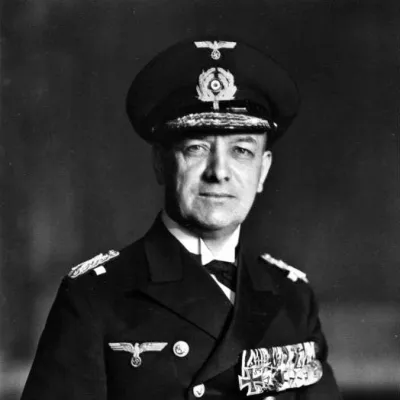
Erich Raeder
Human Design Chart
Biography
Captured in Berlin in 1945 by the Russians, he was found guilty at the Nurnberg trials of having planned war and was sentenced to life in prison, but released in 1955.
He died on 6 November 1960 in Kiel, Germany.
Human Design Analysis: Erich Raeder as Projector 3/6
Projector 3/6 — Design at a Glance
Erich Raeder revealed himself as someone who had an intense and focused aura. As a projector, he did not have a constant internal energy source but acted like a bright flashlight: He directed his beam of light onto weaknesses in the environment and thus brought 'light into darkness' to others. This ability allowed him to immediately recognize flaws in systems.
However, the challenge lay in the nature of communication. When he addressed these shortcomings directly, it often felt like glaring light in the face of the other person, causing resistance. For his design, a more elegant approach was passive radiance: By embodying harmony himself, he attracted others who would seek out his advice on their own. His strategy involved waiting for an honest invitation rather than taking initiative.
Since projectors must alternate phases of high activity with necessary rest periods to avoid burnout, he adapted to these rhythms. If Erich Raeder lived according to this principle, he was rewarded with success. However, if he ignored the necessity of invitations and regeneration, it would sooner or later lead to his non-self theme: Bitterness. Thus, his design shaped a life based on targeted guidance and recognition rather than constant self-production of energy.
Emotional Authority
Erich Raeder displayed a decision-making stance that was marked by strong emotional waves. His inner authority lay in the defined Emotional Center. This meant that his feelings were subject to permanent ups and downs; he saw the world always colored through his current mood. What appeared as exciting at one moment could seem negative in the next. For his design, it was crucial that such intense emotions only represented a snapshot – an initial impression that did not necessarily reflect his deepest truth.
Quick, spontaneous decisions from such an emotional state often had negative consequences for him. The mechanics of his character required patience: He needed to allow time for the strong feelings to subside and emotional distance to be gained. Only then would clarity and calmness set in. This process of 'sleeping on' decisions was essential for him, especially regarding long-term steps with significant influence on his life course. Only through this delay could he recognize the full depth of a situation and make an informed choice rather than being led by passing moods.
The 3/6 Profile — Martyr / Role Model
Erich Raeder's design laid out a development that took place in two clearly distinguishable phases. In the first half of his life, up to the return of Saturn at around 29 years old, he acted as an experimenter (Profile 3/6). This phase was characterized by trial and error, a continuous process of binding and unbinding, and a tendency towards adaptation through direct experience. Often accompanying him was an inner compulsion to possess or achieve more than actually necessary – a dynamic of the second generation that draws strength from abundance.
Only after his 30th year did his internal orientation fundamentally change. Line 6 became active and demanded a withdrawal for reflection on his previous experiences. Raeder now carried both the playful impulse of his younger self as well as the wise, overarching perspective of his older self within him. This combination could lead to inner conflict, as the need for contemplation and control often clashed with the original urge to experiment.
In his later years, around age 50, this tension transformed into a role as an example setter. Through the integration of both perspectives, he developed charm and wisdom that made him a mentor for others. His ability to strategically use secret information or special advantages – an aspect of Pluto dynamics in his configuration – served to maintain his superiority and project it onto his environment, making him appear as a trendsetter.
Split Definition — Defined & Open Centers
Erich Raeder's design showed a tendency towards consistent clarity of expression coupled with a deep sense of inner direction. His defined Throat Center acted as a pivot point, transforming information from the body into reliable communication and action. Simultaneously, his defined G Center provided him with a firm self-identity and a natural compass for his life mission; he knew where he belonged without needing confirmation from others.
This structural security contrasted with his emotional and mental processing. His defined Solar Plexus made emotions the inner authority: truth revealed itself to him only over time as he waited out waves of hope and pain before acting. Additionally, his defined Root Center pushed a constant adrenalized pressure on him, driving him forward in the material world while fostering existential vigilance.
At the same time, Erich Raeder was vulnerable to conditioning through several open centers. His open Head and Ajna Centers meant he lacked a consistent mental focus; he tended to be distracted by doubts or others' inspirations rather than trusting his own conceptual certainty. The absence of a defined Heart Center left him without constant willpower for competition; he wasn't designed to give promises and keep them merely through sheer will, risking getting lost in the cycle of proving himself. Furthermore, his open Sacral Center absorbed vital energy from his environment, making him prone to overexertion as he lacked his own constant generative power to set boundaries. Finally, lacking a defined Spleen Center meant he had no consistent intuitive sense for health and safety; he relied on orienting himself at the well-being frequency of others, increasing the risk of unhealthy dependencies.
Channels for logical leadership and emotional intuition.
Erich Raeder's design showed an architecture of logical collective leadership. The Alpha Animal Channel 7-31 connected his G Center with his Throat Center, relating to the role of Self (Gate 7) and Leadership (Gate 31). This shaped a design based on tested patterns: he sought the logical position to lead societies, where his voice should act as a collective leader. Success here required invitation by the majority; it was less about absolute authority than influence from an acknowledged position that understood trends and provided security.
Parallel to this, the Recognition Channel 30-41 between Root and Solar Plexus Centers worked through Gate of Limitation (Gate 41), creating a drive for new experiences intensified by the emotional wave of Gate of Feeling Recognition (Gate 30). This generated inner restlessness and a strong desire to engage with new situations, where patience was needed to gain clarity.
Additionally, individual gates contributed to orientation: Gate 27 promoted care and self-preservation while Gate 28 emphasized risk in the here and now as well as decision joy. On a personality level, Gate 45 with its tribal energy and hierarchy and Gate 16, which fostered experimentation and mastery, were influential. In his design, Gate 13 supported continuity through memory and reflection. Further influences came from Gate 25 (Innocence), Gate 46 (Commitment to the Process), Gate 37 (Community), and Gate 23 (Understanding). This combination formed a person standing between the drive for new experience and the duty of structured leadership.
Collective Circuitry — Circuit Signature
Erich Raeder's design inclined towards structured, rational analysis that clearly distinguished itself from emotional impulses. This was evident through the Understanding Circuit, which in him connected his Throat Center with his Identity Center. This configuration promoted the ability to formulate logical strategies and future-oriented plans and communicate them precisely – an
Right Angle Cross of the Unexpected 1
Erich Raeder was characterized by a fundamental attitude that integrated the unpredictable as a central life factor. His design indicated a tendency to confront sudden turns and unexpected events, which defined his action spaces. This configuration, known in Human Design as 'The Right Cross of the Unexpected 1', does not describe a passive victim role but rather a specific energetic structure: Life repeatedly presented situations that lay outside any logical planning. For Erich Raeder, this meant that his development and path were not determined by rigid, long-term strategies but by how he reacted to what unfolded without warning. The mechanics of this cross suggested that stability could not be sought in the avoidance of surprises, but rather in the ability to use these moments of the unexpected as driving forces. It was a pattern that led him to continuously adapt to new, often chaotic circumstances, where the source of these impulses was always external and uncontrollable. His experience was thus marked by rhythmic interruptions of the norm, which required him to remain flexible and trust what was revealed in each moment rather than clinging to fixed expectations.
Saturn Return · Uranus Opposition · Chiron Return · 2nd Saturn Return — Life Cycles
Erich Raeder's design showed a clear orientation towards strategic planning and the implementation of long-term visions. This attitude became particularly evident around 1928 when he was appointed Commander-in-Chief of the German Navy at age 52. This period coincided with his Chiron Return – a cycle in which one's incarnation cross unfolds, and personal life purpose becomes increasingly tangible. For Raeder, this phase did not mark the healing of old wounds but rather a flourishing time when his strategic competence came fully into play and he solidified his role within the military context.
This process continued: In 1932, at age 56, Raeder presented the 'Reconstruction Plan', which foresaw an extensive expansion of naval forces. This occurred during his second Saturn Return, a life phase often characterized by consolidation of earlier achievements and assumption of greater responsibility. The Reconstruction Plan was not a spontaneous undertaking but rather the result of years of strategic deliberation that were now cast into concrete, binding form. Raeder's design promoted precisely this ability: to penetrate complex interconnections and translate them into actionable plans that others could implement. His authority did not rest on impulsive decisions but on a deep, thoughtful strategy that developed over years and reached its full effect in these key years.
Projector · Emotional Authority — Synthesis
Erich Raeder was a projector whose life seemed marked by a profound drive to recognize patterns and project them into the world. His emotional nature (emotional authority) required time for decision-making, yet his defined throat (communication and manifestation) linked him with logical leadership ability (Channel of Alpha Animal), which was particularly evident in strategic planning – evidenced by events in his career (Saturn Return, Chiron Return). This interplay between intuitive perception and the need to communicate these insights formed a red thread guiding his actions.
Raeder lived a paradox between the role of observer and that of leader. As a projector, he was geared towards recognizing potential in others and showing them the way, yet his emotional authority required thorough engagement with his own feelings before he could direct this path. His profile as an experimenter/role model points to a process of experimentation and reflection that led him to accumulate personal experiences to later act as an example – a constant oscillation between active exploration and wise leadership.
2 Defined Channels
Incarnation Cross - Right Angle Cross of the Unexpected 1
Solar Return
The Solar Return shows the moment when the sun returns to its exact birth position - your personal solar year.
Life Cycles
Discover the life cycles with a detailed triple view (birth chart, cycle chart, composite).
Human Design Profile
- Type
- Projector
- Strategy
- Wait for the respectful invitation
- Authority
- Emotional Authority
- Profile
- 3/6 - Martyr / Role Model
- Definition
- Split Definition
- Incarnation Cross
- Right Angle Cross of the Unexpected 1
- Date of Birth
- 24.04.1876 09:30
- Place of Birth
- Hamburg, GER
Frequently Asked Questions
What was Erich Raeder's Human Design type?
What Profile did Erich Raeder have in Human Design?
Which Authority determined Erich Raeder's decisions?
Which incarnation cross was assigned to Erich Raeder?
When was Erich Raeder born?
Discover your own Human Design
Are you also a Projector? Find out in a personal reading how to unfold your leadership qualities and recognize the right invitations.
More Personalities
Back to overviewSissy Spacek

Alain-Fournier

Anémone

Ann-Margret

Bourvil
Hergé