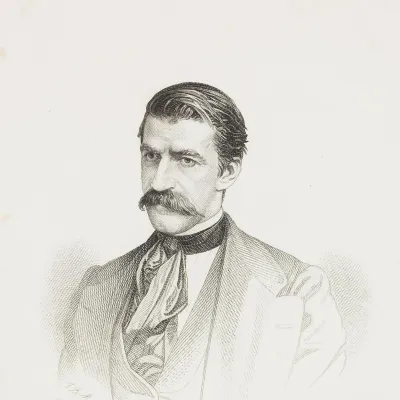
Ernest Quetelet
Human Design Chart
Biography
The Human Design of Ernest Quetelet: Projector 2/4
Projector 2/4 — Design at a Glance
Ernest Quetelet's design inclined towards focused perception. As a projector, he did not have an intrinsic source of life energy like other types but his power was wave-like. This meant that phases of high productivity and rapid workability had to be followed by necessary rest periods to avoid exhaustion. His system was not designed for constant adaptation to external demands as often required by the educational or conventional workplace structures.
Instead, his aura worked like a bright, directed light beam: Ernest Quetelet immediately saw where errors in the system lay or processes were inefficient in his surroundings. However, this ability to 'shed light into darkness' was only effective if he did not impose it. Directly addressing others' deficits often would have provoked resistance. His optimal strategy involved waiting for a respectful and sincere invitation from outside before communicating his insights.
If Ernest Quetelet lived according to this pattern – by conserving his energy and acting only upon invitation – he was rewarded with success. Ignoring this structure and trying to constantly prove himself or fight against the current would sooner or later lead to the non-self theme of bitterness. His design required patience and willingness to act as a guiding figure rather than driving from behind.
Self-Projected Authority
Ernest Quetelet's design inclined towards extreme openness, coupled with the risk of being distracted by external motoric energies. As a projector, his inner truth was anchored in his identity; the greatest trap lay in losing himself in this receptivity and constantly chasing after energy. His decision-making occurred through self-dialogues or stimulated conversations, where listening turned into speaking was crucial. It was important to distinguish spontaneous expressions of true nature from thoughts of the mind. This authentic expression made his uniqueness recognizable to others. Alternatively, a physical feeling acted as a compass, drawing him geographically or thematically in a certain direction – either towards or away from something. By following this inner orientation, he could become a directional guide for others; there lay his specific potential for success. The mechanism of 'authority within' is a rare projector type that relies on identity rather than emotional momentum or logical analysis. Thus, Ernest Quetelet showed himself to be someone whose leadership emerged from the clarity of his own alignment and the familiar expression of his self, not from external validation or intellectual reasoning.
The 2/4 Profile — Hermit / Opportunist
Ernest Quetelet's design inclined towards oscillating between a deep need for withdrawal and the desire for close community. As a person with Profile 2/4, he constantly swung: Line 2, the Hermit, demanded absolute isolation to clarify internal processes and find peace. Simultaneously, Line 4, the Networker, drew him into the circle of his favorite people. This tension shaped his life; he needed a safe environment to communicate clearly when he sought company and when he wanted solitude. Only when his 'me-time' was fulfilled did he emerge from his cave to absorb knowledge from his network. During this alone time, he reflected on received impulses, evaluated them, and developed brilliant ideas from them. Line 2 required leadership skills that were only activated by others – a democratic dynamic where the community chose and provided this energy. At the same time, he was subject to the principles of Line 4: discretion, single-minded actions, and precise timing were crucial. Higher goals stood above recognition; loose talk would have provoked conflicts. Silence and the right moment for direction changes served his spiritual insight. Thus, he combined the introspective depth of the hermit with the relational intelligence of the networker by clearly separating them and living each in turn.
Single Definition — Defined & Open Centers
Ernest Quetelets Human Design profile indicates a tendency towards consistent mental structure and clear expression. His defined Ajna Center provided trustworthy, specific conceptual thinking; his ideas were not easily influenced by others. This mental stability flowed directly into his defined Throat Center, serving as an anchor to reliably communicate and implement these thoughts without internal conflict between thinking and speaking. Thus, his voice articulated what his mind conceptualized without inner dissonance. Additionally, his defined G Center established a firm self-identity and clear sense of direction in life; he knew who he was and could show others new perspectives without being dependent on them.
At the same time, Ernest Quetelet was strongly exposed to several open centers due to his environment. His open Head Center made him vulnerable to mental pressure and questions from others; he tended to get caught up in thought whirlpools when trying to solve problems that were not his own. The lack of consistent willpower in his open Heart Center led him into traps of self-proving: He risked making promises or competing actions just to demonstrate his worth, rather than trusting his inner authority. His open Sacral Center received the vital energy and work demands from the environment, pushing him to overextend himself with borrowed energy until exhaustion due to a lack of consistent boundaries for his own availability. Furthermore, his open Solar Plexus absorbed others' emotions, causing him to oscillate between joy and depression or make emotional decisions he later distanced himself from. His open Spleen Center carried a fundamental fear of survival, leading him to cling to people or situations that gave false feelings of security instead of acting spontaneously and intuitively correctly. Finally, his open Root Center took on the adrenalized stress of the environment, resulting in cycles of overactivity and attempts to rid himself of this foreign pressure through action.
Channels for acceptance, inspiration and logical leadership.
Ernest Quetelets design is characterized by a double leadership dimension that combines individual inspiration with collective logic. The Inspiration Channel 1-8 connects the G Center with the Throat Center, allowing him to influence others as a living example of his authentic existence. Instead of just explaining, he showed through his unique presence how to live creatively and courageously, inspiring others to express their own uniqueness. This effect did not rely on social adaptability but on unconditional commitment to his truth, which brought public attention.
Parallel to this, the Alpha Animal Channel 7-31 served as a structure for logical leadership. Here it was about understanding societal patterns and trends to guide others safely into the future. Ernest Quetelet sought out his own sphere of influence, his 'pack', and exercised authority by gaining trust and being recognized as a competent leader. This form of leadership depended on invitation and consent from the community; it only worked if the majority were willing to follow.
In terms of thinking and expression, the Accepting Channel 17-62 shaped how he processed information. He mentally organized visual patterns and details before verbalizing them. This gave him a sharp analytical ability to translate complex connections into clear theories or formulas. Timing was crucial: He found fulfillment in presenting his opinions in detail when invited to speak, minimizing resistance and creating clarity.
Additionally, Gates like Gate 13 (collective memory), Gate 2 (evolutionary direction) and Gate 4 (formulation of future security) contributed to his ability to establish continuity and logically resolve suspicious patterns. His personality also integrated aspects of humility through adaptation to natural rhythms (Gate 15) as well as deep spiritual innocence and individualization (Gate 25), supporting his action in the here and now (Gate 20).
Collective Circuitry — Circuit Signature
Ernest Quetelets design fosters a tendency towards clear, strategic communication. His defined centers – Ajna, Throat, and Identity Center – form a cohesive flow that translates logical analysis directly into expression. This configuration promotes the ability to communicate rational insights structured and focused, driven by the desire to improve things.
The Understanding Circuit significantly shaped this attitude. Through the Accepting Channel (17-62), it connects Ajna with Throat Center, turning strategic thinking into verbal formulation. The Alpha Animal Channel (31-7) includes identity, enabling authentic, logic-based conviction in communication. Here it's about sharing rational insights free from emotional coloring towards future improvements.
Parallel to this, the Knowledge Circuit works through the Inspiration Channel (1-8). This connects Throat with Identity Center and brings spontaneous acoustic impulses into expression. This energy supports individual voice and helps articulate new knowledge pulsing and creatively. Both circuits work together: The strategic structure of Understanding Circuit provides the foundation while the inspirational power of Knowledge Circuit makes the expression vivid and unique. Ernest Quetelet thus showed himself as someone who not only understood complex connections but carried them into the world through a clear, inspired voice.
Right Angle Cross of the Sphinx 3
Ernest Quetelet's Human Design featured the right Sphinx 3 cross. This configuration shaped a fundamental stance aimed at profound inner transformation, not superficial adaptation but a process of complete metamorphosis where old structures were broken through and transformed into new forms.
The right Sphinx 3 cross in Human Design describes the ability to effect qualitative change through intensive inner work. It's about renewing one's essence, much like how a butterfly emerges from its cocoon. This mechanism often required an inward withdrawal to make necessary energetic shifts before they manifested outwardly as a changed reality.
For Ernest Quetelet, this meant his life was governed by the dynamics of change. He did not use this energy for mere optimization but for a fundamental reconfiguration of his existence. The challenge lay in enduring the often painful phases of dissolution to ultimately emerge in a new, more authentic form. This configuration enabled him to grow beyond his original boundaries and continue developing continuously rather than freezing into rigid patterns. His design thus promoted a way of life that integrated constant renewal as a natural and necessary process.
Saturn Return · Uranus Opposition · Chiron Return — Life Cycles
Ernest Quetelet's Human Design showed a tendency towards structural confirmation followed by later authority assumption. His path was marked by phases where external recognition signified internal developmental steps. In 1855, at age 30, he became corresponding member of the Académie royale des Sciences, des Lettres et des Beaux-Arts de Belgique. For his design, this was a typical moment: The first Saturn return, when years of groundwork often condenses into a solid result and strengthens one's position in social structures.
Further development continued. In 1863, at age 38, he became full member of the same academy. This fell during the Uranus opposition period, a phase of deep upheavals and new freedoms that often leads to more complete integration into established structures after old ties are severed.
The peak of this development line occurred in 1874 when at age 49 he succeeded his father Adolphe Quetelet as director of the observatory. This marked the Chiron return, a fulfillment cycle of blooming. During this period, one's incarnation cross increasingly unfolds in life; meaning and purpose-driven action become experiential. Ernest Quetelet's assumption of this leading role reflects how his design crystallized during a phase of highest maturity and self-determination, far from mere repair or healing but as the culmination of his specific path.
Projector · Self-Projected Authority — Synthesis
Ernest Quetelet was a projector whose ability to recognize patterns and point out errors (Gate 1) naturally inclined him towards analytical thinking. This combined with an inner authority that lay in self-dialogue and listening for spontaneous impulses – a process that helped sharpen his unique perspective. His profile as a natural talent and networker suggests he lived between the need for withdrawal and the desire for exchange, where internal clarity was drawn from solitary phases to then reconnect with others. The defined Ajna Center allowed him consistent conceptual thinking which he used to shape ideas and influence others through his way of thinking.
A central paradox lay in the tension between his projector design – the need to 'shed light into darkness' and point out errors (Channel 1-8) – and the risk of being distracted by external influences. His successes at ages 30 and 38, coinciding with recognition from academic institutions, as well as assuming a directorship position (age 49), attest to his ability to express visions and inspire others while simultaneously seeking inner balance between withdrawal and social interaction.
3 Defined Channels
Incarnation Cross - Right Angle Cross of the Sphinx 3
Solar Return
The Solar Return shows the moment when the sun returns to its exact birth position - your personal solar year.
Life Cycles
Discover the life cycles with a detailed triple view (birth chart, cycle chart, composite).
Human Design Profile
- Type
- Projector
- Strategy
- Wait for the respectful invitation
- Authority
- Self-Projected Authority
- Profile
- 2/4 - Hermit / Opportunist
- Definition
- Single Definition
- Incarnation Cross
- Right Angle Cross of the Sphinx 3
- Date of Birth
- 07.08.1825 07:00
- Place of Birth
- Brussels, BEL
Frequently Asked Questions
What was Ernest Quetelet's Human Design type?
Which Profile did Ernest Quetelet have?
What Authority did Ernest Quetelet possess?
What incarnation cross did Ernest Quetelet have?
When was Ernest Quetelet born?
Discover your own Human Design
Are you also a Projector? Find out in a personal reading how to unfold your leadership qualities and recognize the right invitations.
More Personalities
Back to overviewSissy Spacek
Alain-Fournier
Anémone
Ann-Margret
Bourvil
Hergé