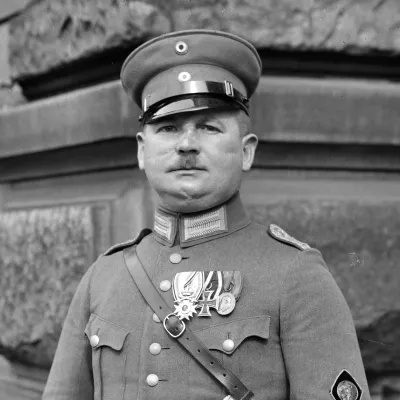
Ernst Röhm
Human Design Chart
Biography
He antagonized dangerous rivals with his loutish indiscretions, drinking bouts and dissolute gay orgies while failing to gain powerful allies.
In early 1934, Hitler and other Nazi leaders became concerned that Röhm, as chief of the S.A., was planning a coup d'état. Hitler decided on 21 June that Röhm and the S.A. leadership had to be eliminated. The purge of the S.A. leadership and other enemies of the state began on 30 June in an action which became known as the Night of the Long Knives.
At dawn on 30 June 1934, Hitler flew to Munich and drove to Bad Wiessee, where he personally arrested Röhm and the other S.A. leaders, who were all consigned to Stadelheim Prison in Munich.
Hitler was hesitant in authorizing Röhm's execution, and gave him the option of suicide. On 1 July, SS-Brigadeführer Theodor Eicke (then Kommandant of the Dachau concentration camp) and SS-Obersturmbannführer Michael Lippert walked into his cell, laid a pistol on the table, told Röhm he had ten minutes to use it and left. He refused, stating, "If I am to be killed, let Adolf do it himself." Having heard nothing in the allotted time, Eicke and Lippert returned to Röhm's cell at about 6 p.m. to find him standing, with his bare chest puffed out in a gesture of defiance. Eicke and Lippert then shot Röhm, killing him.
Ernst Röhm — Manifesting Generator with Profile 6/2
Manifesting Generator 6/2 — Design at a Glance
Ernst Röhm revealed himself as someone who, through a hybrid energy configuration, combined the endurance of a Generator with the lightning-fast initiative power of a Manifestor. His design tended to draw things extremely quickly into his life and skip steps in the process. However, this speed could lead him to miss important phases, forcing him later to backtrack and make up for missing foundations - a process that, if ignored, would quickly turn into frustration.
As a Manifesting Generator, Ernst Röhm had a constant sacral energy source that allowed him to respond to impulses. Unlike pure Generators, he could immediately manifest these reactions through an immediate connection to the Throat Center. This favored parallel action: He often started several projects simultaneously, driven by various impulses. As long as his inner authority and confirmation from the sacral center ("Yes!") approved of these activities, this multi-layered approach led to deep satisfaction and a playful mode of creation. Without this internal resonance, however, his joy in creating could quickly turn into its opposite. His life task was to respond to life rather than force it, and regularly check whether his parallel activities were still supported by his inner energy to avoid frustration through hasty or uncontrolled actions.
Emotional Authority
Ernst Röhm lived with emotional authority, meaning that his defined Emotional Center always took precedence over all other aspects of his design. This configuration marked him by a constant emotional wave that significantly influenced his perception of the world. His feelings were subject to permanent ups and downs; in one moment he could feel totally enthusiastic about something, only for it to seem completely negative in the next. However, this immediate feeling was merely a snapshot, an initial impression that did not necessarily reflect his deepest truth. Quick, spontaneous decisions based on such emotions could therefore have negative consequences. For Ernst Röhm, it was essential to take time to let decisions mature. This process required patience and the repeated consideration of important questions. By hesitating and asking himself repeatedly, intense feelings would eventually subside over time. He gained emotional distance, leading to clarity and calmness. Only then had he completed the decision-making process. This mechanism was particularly crucial for long-term decisions that could significantly impact his life course. Through waiting for this inner peace, he avoided mistakes arising from impulsive reactions.
The 6/2 Profile — Role Model / Hermit
Ernst Röhm showed himself in his early phase to be marked by a strong need for experimentation through trial and error. As a 6/2 Profile, the energetic quality of Three was prominent before the age of thirty, driving him to collect many personal experiences and return after setbacks. This early period was characterized by enthusiasm without deep insight, often leading to complications due to the lack of necessary distance.
With the onset of the second generation, around the age of thirty, this dynamic fundamentally changed. The sixth line became active and promoted a retreat into a metaphorical "cave." During this time, Ernst Röhm sought isolation to look back at his past experiments with great distance. This phase of intense reflection served for healing and deeper self-awareness. He learned that power alone was not enough; instead, common sense gained importance for the integration of his actions.
The second line of his configuration also emphasized decisiveness and a need for solitude to strengthen willpower. Without this preparatory quiet phase, there was a risk of being perceived as a "paper tiger" - weak or unprepared. Only after acquiring this wisdom through introspection did he reappear. Then he could act as a wise person who shared his life experiences and the ability for deep self-reflection with others, authentically without constant pressure to demonstrate power.
Split Definition — Defined & Open Centers
Ernst Röhm revealed himself as someone with a fixed, reliable self-identity and a clear sense of direction. His defined G Center gave him the ability to show others new paths without being dependent on them; he possessed a deep security in his love for himself, which allowed him to lead others from a position of strength rather than neediness. This inner alignment was consistent with his pronounced willpower: Through his defined Heart Center, he liked to determine his life and control his resources himself. He was competitive, enjoyed being successful, and used his ego strength to influence situations. It was important for him to keep promises and receive recognition for them; suppressing this natural energy would have been destructive.
His ability to act was shaped by a defined Throat Center, which served as a pivot point to translate information from the body into clear communication and action. He often spoke from the perspective of the heart ("I want that") or the Sacral center, giving him a consistent way of self-expression. As a Generator, he had a defined Sacral Center, an enormous source of vital energy. His design challenged him not to initiate but to wait and respond with a yes or no tone to questions in order to avoid frustration. At the same time, his Solar Plexus was defined; he needed to wait for the emotional wave until clarity emerged before deciding, rather than acting impulsively in highs or lows of feelings. His defined Spleen Center provided spontaneous intuition and physical well-being in the present moment, while the Root Center delivered a constant pressure to move forward and survive.
In contrast, Head and Ajna Centers were open. Ernst Röhm tended to pick up mental pressures from his environment and deal with questions of others that weren't his own. He could easily slip into a mental monologue, searching for answers or trying to understand things that didn't concern him. This openness made him vulnerable to confusion when he tried to solve intellectual problems through non-self thoughts instead of trusting the inner authority of Solar Plexus and Spleen.
Channels for intuitive power, expression, synthesis, charisma, insight & community.
Ernst Röhm revealed himself as a figure whose design contained a paradoxical tension between individual radiance and tribal pressure. His essence was significantly shaped by the Channel of Inspiration 1-8: He was designed to attract attention through his mere existence and bold, creative self-expression. This channel connected the G Center with the Throat Center, making his identity a public outlet for leadership; he inspired others not primarily through words but by living his unique direction and thus changing the perspective of those around him.
Simultaneously, the Channel of Charisma 34-20 was at work within him: A connection between Sacral Center and Throat Center. This gave him immense physiological life force that propelled him to act in the here and now. However, this energy was quick and direct, often leading him to struggle with staying still or calmly reacting to external stimuli; his manifesting power could impulsively break out if not channeled by inner guidance.
This individual dynamism intersected with the Channel of Synthesis 19-49, which linked Root Center with Solar Plexus. Here lay a deep emotional sensitivity for belonging and tribal loyalty. This channel acted as an emotional glue that determined who belonged to the "we" and who was rejected. For Ernst Röhm, this meant a strong drive to protect the integrity of the tribe and secure resources and territory governed by an emotional wave of acceptance or rejection.
Additionally, the Channel of Power 34-57 supported his survival intelligence. Through the connection between Sacral Center and Spleen Center, he was constantly alert for dangers and intuitively responded to threats, keeping him physically fit and acoustically attentive but also prone to defend against disruptions to his comfort mode. The further gates in his design promoted reflection (Gate 33), care for the tribe (Gate 27) as well as a critical stance towards authority and correction processes (Gate 18).
Individual Circuitry — Circuit Signature
Ernst Röhm revealed himself as someone who acted through spontaneous impulses and intuitive insights. His design connected Throat Center with Identity and Spleen Centers via the Knowledge Circuit, enabling him to immediately express new ideas in words and audibly articulate his unique individuality. The channels for Eureka and Inspiration fostered a pulsating creativity aimed at change.
Parallel to this, separate forces were active in the Ego Circuit. Here, Heart, Solar Plexus, and Root Centers connected each other. This group stood for cooperation, mutual support, and the joint creation of resources. As there was no connection to Sacral Center, rest pauses were necessary to generate energy for the tribe. The channels Community and Synthesis emphasize here a timeless, traditional way of giving and taking.
A third, also separate area was the Integration Circuit. It linked Throat Center with Sacral and Spleen Centers. Through the channels Charisma and Power, Ernst Röhm channeled strength from reactions to life through intuitive knowledge into the present moment. This served the security of his own survival through highest individuality.
Ernst Röhm was a Split Definition. The two main groups – on one side Identity, Throat, and Spleen, on the other Heart, Solar Plexus, and Root – were not directly connected energetically. They existed as separate, parallel fields of power that shaped different life areas without forming an uninterrupted flow.
Left Angle Cross of Duality 2
Ernst Röhm displayed a fundamental disposition aimed at the unification of seemingly opposing poles. His design featured the "Left Cross of Duality," a configuration that describes the drive to integrate opposites. Rather than choosing one path, he always sought after synthesis that included both sides. This structure promoted a way of thinking that saw conflicts not as insurmountable breaks but as necessary elements of a larger whole.
The mechanics of this cross lie in the tension between two different energies or perspectives. For Ernst Röhm, this meant he often acted as a mediator or integrator who tried to bring disparate streams together into a new, coherent model. It was not passive neutrality but an active effort to dissolve duality and transcend it within a higher unity. This process required constant adaptation and growing into complex dynamics, with the focus always on creating wholeness rather than separation or exclusion of one pole.
Saturn Return · Uranus Opposition — Life Cycles
In 1928, at the age of 41, Ernst Röhm left established structures to take up a new role as a military instructor in Bolivia. This step marked the peak of a Uranus opposition, an astronomical cycle often associated with a desire for radical change and breaking free from previous ties. During this period of his life, the energy of Uranus acted as a catalyst for abrupt turning points where old identities or positions were given up to make way for unexpected paths. The decision to go to a foreign land and exercise a specific function there matched the typical pattern of this constellation: A break with the past in favor of a new, often more isolated form of existence. For his design, this did not merely mean a career change but a fundamental realignment of his life environment. The Uranus opposition demanded a departure from the known; Röhm followed this inner dynamic by physically and professionally distancing himself from his previous context. This phase was marked by impulses of independence and experimenting with new roles far from familiar surroundings. The move to Bolivia was thus not an arbitrary action but the concrete manifestation of a cyclical urge towards transformation and renewal at a foreign place.
Manifesting Generator · Emotional Authority — Synthesis
He consistently showed himself as someone driven by an inner dynamic that relied both on quick action and deep reflection. The combination of sacral energy (defined Sacral Center) and manifesting qualities indicates he was capable of swiftly reacting to opportunities and initiating things – yet always with the need to emotionally process these impulses through a longer phase of contemplation (emotional authority). This ability to navigate between swift initiative and thoughtful waiting shaped his actions and path. The profile as role model suggests that after intense experiences, he developed a call for wisdom that attracted others.
A central paradox in his design lay in the interplay of impulsive energy and emotional depth. The channel of inspiration (1-8) allowed him to publicly express creative contributions and attract attention, while emotional authority required careful consideration before decisions could be made. This likely led to an internal tension between a desire for rapid progress and the necessity of taking time for the maturation of ideas and feelings – a dynamic also evident in his career changes (documented event 1928).
6 Defined Channels
Incarnation Cross - Left Angle Cross of Duality 2
Solar Return
The Solar Return shows the moment when the sun returns to its exact birth position - your personal solar year.
Life Cycles
Discover the life cycles with a detailed triple view (birth chart, cycle chart, composite).
Human Design Profile
- Strategy
- To respond - wait for something to respond to
- Authority
- Emotional Authority
- Profile
- 6/2 - Role Model / Hermit
- Definition
- Split Definition
- Incarnation Cross
- Left Angle Cross of Duality 2
- Date of Birth
- 28.11.1887 01:00
- Place of Birth
- München, GER
Frequently Asked Questions
What was Ernst Röhm's Human Design type?
What profile did Ernst Röhm have?
What authority did Ernst Röhm have?
What incarnation cross did Ernst Röhm have?
When was Ernst Röhm born?
Discover your own Human Design
Are you also a Manifesting Generator? Find out in a personal reading how to unfold your multi-talents and direct your energy wisely.
More Personalities
Back to overviewAldair

Alizée

Angeli

Arletty

Artus

Balthus