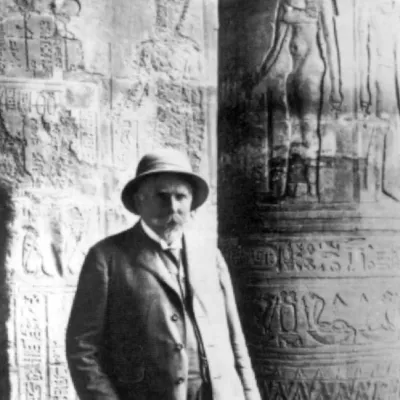
Ernst von Sieglin
Human Design Chart
Biography
Together with an English chemist, Ernst Sieglin developed a powdered soap as a substitute for conventional detergents. Thanks to his fortune, he was able to withdraw from active business life in 1898 and devote himself to his hobbies, archeology and art.
He financed two archaeological expeditions in Egypt and their documentation in scientific publications. He increased the “Greek-Egyptian Ernst von Sieglin Collection” acquired during the expeditions by making additional purchases and gave the collection away to museums in Stuttgart, Leipzig, Dresden and Tübingen.
Ernst von Sieglin married the violinist Alice Borchert (1872–1915) in 1891 in Berlin, and they had five children. He died on 3 October 1927 in Stuttgart at age 79.
The Human Design of Ernst von Sieglin: Generator 6/2
Generator 6/2 — Design at a Glance
Ernst von Sieglin possessed a remarkable, enduring strength that allowed him to pursue tasks with great consistency. As a Generator, he had a lot of sacral energy, comparable to a strong workhorse that only performed optimally when it also had the necessary inner motivation for its task. His design featured two specific pitfalls: he risked exhaustion if he did things that did not bring him joy, or he frustrated himself if he was prevented from pursuing his heart's project, even though he was still full of energy.
The way his energy worked differed fundamentally from other types. Instead of initiating things himself, his strategy was to respond to signals from life. Only when his sacral center gave a clear "yes" did he act. This path of reacting from the gut was the key to his effectiveness. If Ernst von Sieglin lived in harmony with this principle, his design rewarded him with a sense of deep fulfillment. If he, on the other hand, initiated too often on his own, without waiting for inner impulses, he would eventually encounter persistent frustration and a lack of energy. His strength therefore did not lie in pushing forward, but in powerfully responding to what was offered to him from the outside.
Emotional Authority
Ernst von Sieglin revealed himself as someone who did not make decisions based on the first impulse but rather consciously let them rest until a deeper clarity emerged. His design featured emotional authority, meaning that his defined Solar Plexus Center was the central authority for his inner guidance. Regardless of which other centers were defined in his chart, he was subject to a constant emotional wave. His perception of the world was always colored by his current mood; a topic could inspire him in one moment and seem negative in the next. However, this up and down was only a snapshot, not yet his truth. Quick, spontaneous judgments from this emotional heat would often prove misleading. Instead, his system required patience. Ernst von Sieglin used time to let decisions mature, often by sleeping on them multiple times. Only when the intense feelings subsided and he gained emotional distance did calmness set in. This process was crucial for long-term direction setting. By consciously delaying and waiting out the emotional tides, he arrived at a more comprehensive understanding that went beyond the first, often deceptive impression. His strategy was to take his time and let the inner wave subside before acting.
The 6/2 Profile — Role Model / Hermit
Ernst von Sieglin revealed himself in his youth as someone who learned through intense experimentation and the principle of trial and error. Before the return of Saturn, his 6/2 line acted like a 3-line, leading to a lifestyle heavily influenced by personal experiences. Mistakes often led to a temporary withdrawal until the next phase began.
After the age of 30, this dynamic changed fundamentally. The sixth line became active, prompting Ernst von Sieglin to reflect with great distance on his earlier experiments. This period of intense reflection served for healing and deep self-knowledge. From this phase of isolation, metaphorically described as retreating into a cave on a mountain, he developed a particular wisdom.
His configuration also included the ability to recognize when fighting is futile and to surrender to the process. Mutations were accepted as a natural part of life. At the same time, the second line of Gate 41 played a role, characterized by contradictions and projections. While Saturn promoted a conservative nature that did not endanger personal security, Mars emphasized the desire for recognition. This energy initially focused on his own feelings and helped to realize fantasies. He understood order not as a rigid problem but as an ongoing process.
Split Definition — Defined & Open Centers
Ernst von Sieglin revealed himself as someone with a deeply rooted, unshakeable self-identity and a clear sense of his life direction. His defined G Center gave him the ability to lead others and show them new perspectives without being dependent on their approval. This inner security was supported by his defined Heart Center, which provided him with a constant source of willpower and ego strength. He could keep his promises and determine his own resources, allowing him to follow his own inner mechanisms when he worked or rested.
The driving force of his design came from his defined Sacral Center, a motor of immense vital energy. For him, it was essential to wait for external stimuli and then react to them to use this energy correctly. Any initiative he did not take from such a reaction led to frustration and resistance. His emotional depth and authority lay in his defined Solar Plexus Center. Ernst von Sieglin had to wait for the waves of his feelings to gain clarity; impulsive decisions in emotional highs or lows would have plunged him into chaos. Additionally, his defined Root Center created a steady pressure that propelled him forward in the material world and helped him deal with existential stress.
In contrast, his Head, Ajna, and Throat Centers were open. This meant that he did not have a constant mental focus and could easily be absorbed by the inspiration or confusion of others. He tended to engage with questions that were not his own or tried to gain attention by speaking rather than waiting to be invited. His open Spleen Center made him vulnerable to survival fears and the temptation to cling to things that were not good for him, just to simulate a sense of security. These open centers challenged him not to identify with the thoughts or fears of his environment but to trust his inner authority.
Channels for change, pioneering spirit, intuition and emotional depth.
Ernst von Sieglin revealed himself through a profound, often melancholic energy that carried evolutionary change. The Channel of Mutation 60-3 connected his Root with his Sacral Center. This created an unpredictable pulse between limitation and new ordering. His power manifested in sudden outbursts, followed by phases of silence, during which something new formed beneath the surface. This mechanism required patience; the change did not occur on command but as a spontaneous mutation that conditioned him and his environment.
Parallel to this, the Channel of Initiation 51-25 was at work. It connected the Heart Center through the Gate of Shock and the Gate of Self Spirit. Here, a natural competitiveness was evident, but it was not mere striving but an art of initiation. Ernst von Sieglin possessed the ability to encourage others through his authentic expression and individual strength to awaken their potential for individuation. This process was mystical and could not be controlled; it happened when he invited it and brought a shock of self-discovery.
His emotional landscape was shaped by the Channel of Emotion Release 39-55. This channel connected Root and Solar Plexus through provocation and mind. Ernst von Sieglin lived in a pulsating wave of joy and sadness. His moodiness was not a flaw but a creative force that he used to sharpen the perception of the mind in himself and others. He learned to accept these mood swings rather than rationalize them and found his truth in the authenticity of his emotional depth.
The Channel of Recognition 41-30 drove him through a desire for new experiences. The pressure from the Root, combined with emotional expectation, created restlessness that led him searching through life. He sought satisfaction through life itself, with the emotional wave giving him the necessary time to gain clarity before the next leap.
Additionally, Gates like 50 (Protective Reflex, Values), 31 (Leadership, Transmission), and 9 (Detail Work, Perfection) were at work. Gate 50 provided conservative protection and awareness, while Gate 31 gave the ability for energetic transmission of power. Gate 9 allowed him to focus intensely on details with great taming and strive for perfection through repetition, with the risk of depression if this power did not flow. This combination of mutative change, initiatory shock, emotional provocation, and a drive for experience formed his unique design.
Individual Circuitry — Circuit Signature
Ernst von Sieglin revealed himself through separate, parallel functioning energy blocks. One block connected Sacral, Root, and Solar Plexus Centers. Here, the Knowledge Circuit worked through Channel 3-60 (Mutation) and 55-39 (Emotion Release). This promoted the search for new knowledge and the ability to express through emotional waves. The Meaning Circuit used Channel 30-41 (Recognition) between Solar Plexus and Root. This directed the focus on reflecting on past experiences to draw meaning from them.
A second, isolated block connected Identity and Heart Centers. The Centering Circuit worked here through Channel 25-51 (Initiation). This created inner firmness and strong individual convictions. Since there was no connection to the Throat Center, these deep certainties often remained unspoken. The separation of the two groups meant that the emotional dynamics of the first block did not flow directly with the inner stability of the second. Ernst von Sieglin experienced these aspects as coexisting but not energetically linked life areas.
Left Angle Cross of Wishes 1
Ernst von Sieglin carried the left Cross of Desires 1. This configuration established a specific psychological foundation characterized by a deep, often unconscious longing for expressing inner truths and creating order in chaos. For his design, this was not a superficial desire but a central theme that shaped his actions and inner stance.
In Human Design, this cross describes a dynamic tension between the need for individual, authentic expression and the drive to place this expression in a larger, often spiritual or cultural context. It was not about mere self-actualization in the modern sense, but about a near-fated commitment to bring the inner outwards, thereby creating a bridge between the personal and the universal.
This mechanism worked as a constant inner impulse. Ernst von Sieglin showed through this configuration as someone who took his own desires and intuitions seriously, yet did not isolate them. Instead, he always sought ways to transform these inner impulses into something tangible and meaningful. The left Cross of Desires 1 created a certain melancholy or restlessness until this bridge was built. Only through the active shaping of his environment and the communication of his inner images did this energy find its release and expression. It was a process of transformation, where the personal became the source for a more general meaning.
Saturn Return · Uranus Opposition · Chiron Return · 2nd Saturn Return — Life Cycles
Ernst von Sieglin showed a structure aimed at inner stability and long-term anchoring. His design suggested that recognition and status would only come after years of often invisible work as a natural consequence of a solid foundation. This was evident in 1906 when he received an honorary doctorate from the University of Tübingen at the age of 58. The second Saturn Return marks a phase of consolidation in Human Design mechanics, where earlier efforts transform into formal confirmation and societal appreciation. For him, this was not a sudden success but the logical crowning of a life phase based on structure and endurance.
Previously, in 1898 at the age of 50, he withdrew from active business life. This fell during the Chiron Return, a cycle of fulfillment and bloom. Here, the incarnation cross unfolds if one follows their own strategy. For Ernst von Sieglin, this transition did not mean loss but the realization of his purpose: the shift from active business management to cultural and intellectual outreach.
The foundation for this was laid in 1891 when he married the Geigerin Alice Borchert at the age of 43. This Uranus opposition signaled a sudden but profound change in life structure. Through this union, he anchored his creative energy in a stable partnership, which gave him the necessary peace to later deepen his intellectual and artistic interests. His path thus followed a clear sequence: first personal anchoring, then a withdrawal phase for inner clarification, and finally public recognition of his life's work.
Generator · Emotional Authority — Synthesis
Ernst von Sieglin lived a life deeply influenced by the sacral energy of a Generator. The ability to generate endurance and strength was evident in the pursuit of goals as long as they aligned with his inner passion. The defined G-Center gave him a clear identity and direction, inspiring others and showing new paths. The recurring cycles, especially the withdrawal after lived phases (marked by the Chiron Return and the transition after the 30th year of life), pointed to a need to reflect on experiences and gather wisdom to pass on later. This process of self-discovery and subsequent sharing of insights formed a red thread through his life.
At the same time, a central paradox was revealed: the emotional authority that plunged him into a deep emotional wave stood in tension with the Channel of Mutation (3-60). While the emotional wave required time for maturation and deep understanding, the Channel of Mutation demanded unpredictable change and the crossing of boundaries. This led to an inner dynamic between the need for emotional clarity and the urge to take new risks, which was evident in phases of intense activity followed by withdrawal.
4 Defined Channels
Incarnation Cross - Left Angle Cross of Wishes 1
Solar Return
The Solar Return shows the moment when the sun returns to its exact birth position - your personal solar year.
Life Cycles
Discover the life cycles with a detailed triple view (birth chart, cycle chart, composite).
Human Design Profile
- Type
- Generator
- Strategy
- To respond - wait for something to respond to
- Authority
- Emotional Authority
- Profile
- 6/2 - Role Model / Hermit
- Definition
- Split Definition
- Incarnation Cross
- Left Angle Cross of Wishes 1
- Date of Birth
- 21.04.1848 21:30
- Place of Birth
- Stuttgart, GER
Frequently Asked Questions
What was Ernst von Sieglin's Human Design type?
What Profile did Ernst von Sieglin have in Human Design?
Which Authority guided Ernst von Sieglin's decisions?
Which incarnation cross was active for Ernst von Sieglin?
When was Ernst von Sieglin born?
Discover your own Human Design
Are you also a Generator? Find out in a personal reading how to use your sacral energy correctly and discover deep satisfaction.
More Personalities
Back to overviewAaliyah

Alexia

Angèle

Anne-Marie

Arcángel

Arno