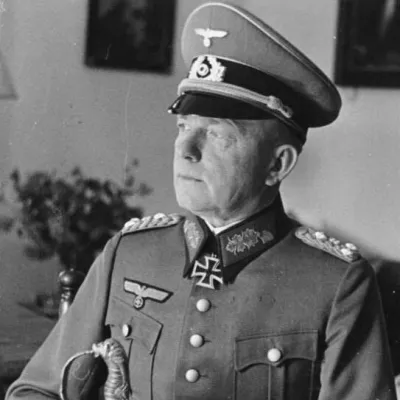
Ewald Von Kleist
Human Design Chart
Biography
Ewald Von Kleist as a Manifesting Generator 4/6 in Human Design
Manifesting Generator 4/6 — Design at a Glance
Ewald Von Kleist revealed himself as someone with a hybrid energy structure: He possessed the constant power of a Generator but also had the ability to skip steps and quickly draw results into his life. This configuration of the Manifesting Generator meant that he had to react to inner impulses – his strategy was not to initiate on his own, but rather to wait until the sacral center signaled a clear "yes" – yet in action, he often moved faster than pure Generators.
This speed brought with it a specific challenge: Ewald Von Kleist tended to pursue multiple projects simultaneously and follow several impulses at once. If he did not listen to his inner authority or overlook important intermediate steps, this quickly led to frustration, his non-self theme. He then had to often backtrack and make up for missed stages.
However, when the strategy was followed – reacting only to true resonance and regularly checking whether his projects were still enjoyable – this versatility transformed into deep satisfaction. For Ewald Von Kleist, it was no problem to switch tasks; on the contrary, a rigid focus on one single thing until completion would have hindered him more. His creative power ignited most strongly when he entered a playful mode and sought variety.
Emotional Authority
Ewald Von Kleist revealed himself as someone who did not make decisions based on the first impulse but subjected them to a necessary maturation period. His design featured Emotional Authority, meaning his defined Emotional Center served as the inner guiding point for all important choices – a rule that always took precedence regardless of other definitions in his chart.
This configuration marked him by a constant emotional wave, an ongoing up and down of feelings. The world appeared to him colored by his current mood: at one moment he could be totally enthusiastic about something, only to negatively assess the same situation moments later. For his system, however, this feeling was just a snapshot, a first impression that did not necessarily represent the truth yet. Spontaneous decisions based on such emotions often had negative consequences.
Instead, Ewald Von Kleist gained clarity and calm by allowing time. The longer he could let a decision mature, the deeper and more comprehensive his understanding became. This process required patience and multiple nights of reflection. By properly taking his time and asking himself repeatedly, intense feelings subsided. Only then, when emotional distance had been achieved, did necessary calmness set in. This approach was particularly important for long-term decisions that could have a significant impact on the course of his life.
The 4/6 Profile — Opportunist / Role Model
Ewald Von Kleist revealed himself as someone whose early years were marked by experimental behavior. His 4/6 Profile acted like a pure Line 3 in the first three decades: He sought connection through diverse relationships and friendships. This phase served to gather experiences before the deeper wisdom of Line 6 awakened.
Later, an internal conflict emerged between his heart's desire for belonging (Line 4) and his head's need for detached reflection on life’s meaning (Line 6). Ewald Von Kleist faced the task of integrating this polarity. His sixth line aimed to grasp the bigger picture, which was often difficult. He had to make decisions: accept or reject mutation.
The fourth line in his design emphasized the necessity of recognized authority. Leadership only made sense for him if it held influence and was supported by the community. Without this resonance, he withdrew to preserve his individuality. Saturn rising showed a strong need for security and material fixation, while Mercury elevated promoted a tendency towards rationalization. Rigidity served as a protective mechanism to safeguard his identity from external influences. Ewald Von Kleist thus developed into an example through cooperation, yet always cautious not to open his heart to the wrong people and get hurt in the process.
Single Definition — Defined & Open Centers
Ewald Von Kleist was marked by a defined G Center, which gave him a firm sense of self-identity and a clear direction for his personal path. This inner security allowed him to love without dependence on others and to show new ways forward. His energy source came from the defined Sacral Center, an engine that generated continuous vitality. This created the basis for persistent action if he waited for his inner response rather than initiating impulsively. Communication occurred through the defined Throat Center, which served as a pivot point to translate these internal impulses into clear expressions and actions.
At the same time, his design revealed specific vulnerabilities through several open centers. The open Head and Ajna Centers meant that he did not have a constant mental mind; he was vulnerable to external inspiration or confusing questions that were not of his own making. Instead of getting lost in endless pondering, he had to learn to accept mental pressure as temporary rather than interpreting it as his own truth. The missing consistent willpower in the open Heart Center meant there was a risk of giving promises to prove worth, often ending in frustration due to unavailable energy for these commitments. Additionally, the open Root Center absorbed external stress and adrenaline from the environment, making him vulnerable to overexertion when trying to follow foreign pressures. Finally, the open Spleen Center reflected the health and fears of his surroundings; spontaneous decisions here were risky as they often relied on conditioned fears rather than true intuition. His challenge lay in using his defined energy and direction without getting drawn into the mental or emotional whirlpool of the open centers.
Channels for rhythm, inspiring expression and emotional change.
Ewald Von Kleist was marked by an inner discipline based on firm habits that bound him to a natural flow of life. This structure came from the Rhythm Channel 5-15, connecting the Sacral Center with the G Center. He followed his own timing, undisturbed by either mind or emotional waves, but rather establishing a deep connection to the biological logic of life.
At the same time, he served as an example that inspired others through his authentic presence. The Inspiration Channel 1-8 connected his G Center with the Throat Center and enabled him to express his unique identity creatively. He did not need long explanations; his mere existence and way of living drew attention and shifted the perspective of those around him – only when he acted from inner authority, not seeking social adaptation.
Another dynamic force in his design was the Transience Channel 35-36, connecting the Solar Plexus Center with the Throat Center. This emotional channel drove him to seek new experiences often to break stagnation or use crises as catalysts for change. He learned through intense living of emotions and later shared this wisdom by encouraging others to make use of the moment.
Additionally, individual Gates shaped his orientation: Gate 7 projected leadership patterns and hierarchies while Gate 13 preserved collective memory and continuity. Gate 2 received mutative directions for evolution, and Gate 56 translated mental processes into vivid narratives. In his design, Gate 45 with its tribal energy and willpower as well as Gate 27 that fostered genetic care and self-preservation also played a role. This combination created a person who was both structured and eager to experience life, capable of influencing through example and stories.
Collective Circuitry — Circuit Signature
Ewald Von Kleist's design showed a clear, coherent energetic structure. As a Simple Defined individual, he had a continuous flow between his Identity, Throat, Solar Plexus, and Sacral Centers. This unity marked him as someone whose inner values, emotional waves, expressive power, and life energy seamlessly intertwined.
The Knowledge Circuit connected his Throat with the Identity Center through the Inspiration Channel. This promoted spontaneous, acoustic impulses that emphasized his unique individuality and enabled new ways of expression. Parallel to this, the Understanding Circuit worked: Here, the Rhythm Channel linked the Sacral with the Identity Center. This connection gave him a focused, rational power to carry logical insights strategically into the future – separate from emotional fluctuations.
A third aspect was the Meaning-Finding Circuit, which connected Throat and Solar Plexus Centers through the Transience Channel. Here it was about sharing past emotional experiences in cyclical waves. Since all these centers were directly linked in Ewald Von Kleist, there was no internal conflict between rational strategy, emotional reflection, and impulsive inspiration. Instead, they worked as an integrated system: His life energy (Sacral) flowed through his identity, colored emotionally or structured rationally, and found its expression through the Throat Center. This created a coherent way of being where thinking, feeling, and acting sprang from a single source.
Right Angle Cross of the Sphinx 3
Ewald Von Kleists Human-Design highlights the 'Right Cross of the Sphinx'. This configuration establishes a specific energetic orientation that aims not just at acquiring knowledge but at applying insights practically for the benefit of all. The cross connects impulses towards deep analysis with the drive to pour these insights into concrete structures. It represents a dynamic tension between seeking hidden truths and the necessity to make them useful for others. Ewald Von Kleist was someone who did not isolate knowledge but always saw it in the context of its impact on the community. The mechanics of this cross fostered an attitude of serving creation: Insights should be understood and implemented to solve collective problems or create new orders. This required discipline and the ability to translate complex connections into manageable models. His design thus supported a path that linked intellectual depth with social responsibility without getting stuck in theoretical ivory towers. Energy flowed where theory met practice, creating something beyond the individual.
Saturn Return · Uranus Opposition · Chiron Return · 2nd Saturn Return — Life Cycles
Ewald Von Kleists Human-Design shows a tendency towards strategic patience and the ability to find structured solutions under pressure. This attitude was particularly evident at age 59 when he received the Knight's Cross of the Iron Cross in 1940. For his Human Design, this marked a typical moment of the second Saturn Return. This cycle often marks a phase of consolidation where years of groundwork and inner maturation condense into visible, sustainable results. The award did not stand alone but reflected a long-term development characterized by discipline and perseverance in complex situations. The second Saturn Return acts like an affirmation of one's structure in Human Design; it is a point at which previously worked patterns stabilize and can carry their impact outward. Ewald Von Kleist lived this phase as the peak of his personal development, where inner order aligned with external demands. The mechanics of this cycle support not sudden shifts but deepening already established paths. Through this slow yet steady integration of experiences, he elevated his specific way of acting and deciding to a new level. The event in 1940 was thus less a random success than the logical consequence of a consistently lived strategy that gained strength over years.
Manifesting Generator · Emotional Authority — Synthesis
He led a life marked by a deep inner drive for expression and transformation. As an Manifesting Generator (with defined Sacral Center), he had a constant energy source, but his emotional authority required a slow maturation process. This combination of quick, initiating power and the need for emotional clarity created a dynamic tension in which he often oscillated between the desire for immediate action and the need to reflect on decisions. The Channel of Inspiration (1-8) gave him the ability to pass creative impulses through his self-expression to others – a role that reinforced his profile as a Networker/Role Model.
A central paradox in his design lay in the interplay between individuality and community. The Knowledge Circuit emphasized his unique identity and desire for innovation, while Line 4 in his profile signaled a deep need for belonging and connection with others. He thus moved between striving for originality and longing for validation through a community, which made him act both as a pioneer and consider the needs of others – a tension that shaped his life and even brought success to him in 1940.
3 Defined Channels
Incarnation Cross - Right Angle Cross of the Sphinx 3
Solar Return
The Solar Return shows the moment when the sun returns to its exact birth position - your personal solar year.
Life Cycles
Discover the life cycles with a detailed triple view (birth chart, cycle chart, composite).
Human Design Profile
- Strategy
- To respond - wait for something to respond to
- Authority
- Emotional Authority
- Profile
- 4/6 - Opportunist / Role Model
- Definition
- Single Definition
- Incarnation Cross
- Right Angle Cross of the Sphinx 3
- Date of Birth
- 08.08.1881 18:00
- Place of Birth
- Braunfels, Germany
Frequently Asked Questions
What was Ewald Von Kleist's Human Design type?
What profile did Ewald Von Kleist have?
What authority did Ewald Von Kleist have?
What incarnation cross did Ewald von Kleist have?
When was Ewald Von Kleist born?
Discover your own Human Design
Are you also a Manifesting Generator? Find out in a personal reading how to unfold your multi-talents and direct your energy wisely.
More Personalities
Back to overviewAldair

Alizée

Angeli

Arletty
Artus

Balthus