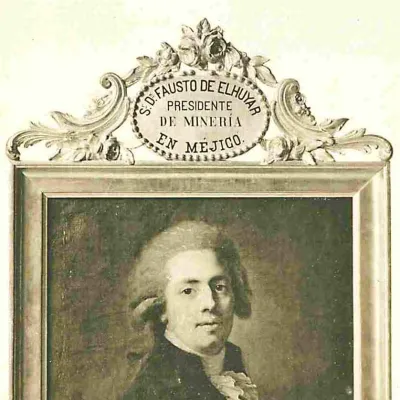
Fausto De Elhuyar
Human Design Chart
Biography
He died 6 February 1833.
Human Design Analysis: Fausto De Elhuyar as Projector 4/6
Projector 4/6 — Design at a Glance
Fausto De Elhuyar appeared as someone with a dense, focused aura that directly engaged his environment. His design showed a tendency to immediately identify flaws in other systems – comparable to a bright flashlight illuminating dark corners. This ability to 'shed light on the dark' could be perceived as unpleasant when he directly addressed these flaws, similar to shining a bright light in someone's face.
As a Projector, Fausto De Elhuyar did not have a defined Sacral Center, meaning he lacked a constant, intrinsic source of life energy. Instead, he experienced phases of high activity followed by necessary rest periods to avoid burnout. The conventional work world, which demands constant productivity, often stood in opposition to this natural rhythm.
The optimal strategy for him was to wait for appreciative and honest invitations from others. Rather than acting independently, he was most effective when he simply 'shone pleasantly' – for example, by setting an example of harmonious relationships. Other people would then come to him of their own accord to seek advice. If Fausto De Elhuyar lived by this principle, he was rewarded with success. Ignoring this dynamic and trying to push against the resistance of his environment led to his non-self theme: bitterness. His design required patience and trust in the invitation as the key to his effectiveness.
Splenic Authority
Fausto De Elhuyar demonstrated intuitive, present-moment decision-making. His inner authority lay in the defined Spleen Center, pointing to open Emotional and Sacral Centers – a configuration seen only in Projectors or Manifestors. The Spleen Center served as his health and alarm system, equipped with a fine survival intelligence. This manifested as spontaneous inner knowledge about whether a situation, environment, or society was healthy for him. His instinct and physical well-being served as reliable indicators for what was right.
Fausto De Elhuyar had to make decisions in the immediate moment. The first, spontaneous impulse was the correct path, directly serving his well-being. This allowed him to effectively take care of himself and rigorously shield himself from harmful influences. However, since this Spleen impulse was very subtle and only occurred once in the moment, there was a risk of ignoring it or having it drowned out by external influences. This required high vigilance; occasional withdrawal for decision-making could be helpful.
Since he could only know what was right in the moment, his plans often changed short-term. Long-term commitments were therefore difficult. He needed a lot of freedom and flexibility to avoid being constrained by rigid obligations that would interfere with his spontaneous intuition. This mechanism shaped his life through constant adaptability and protection of his personal health from unfavorable environments.
The 4/6 Profile — Opportunist / Role Model
Fausto De Elhuyar was someone who intensely experimented in the first three decades of life, particularly in relationships and friendships. His design as a 4/6 Profile established this inclination towards diverse social contacts before the deeper structure unfolded. During this early phase, the sixth line still appeared as a third, leading to learning through trial and error.
With the onset of the second life phase, marked by the return of Saturn, an internal conflict emerged: the desire for community belonging (Line 4) clashed with the need to withdraw and reflect on the meaning of life (Line 6). This tension between heart and head shaped his further development.
In later years, Fausto De Elhuyar was expected to take on the role of a wise role model. His authority was based not on hierarchy, but on the ability to stand out through cooperation with others. The large heart of Line 4 always required caution to avoid opening up to the wrong people and getting hurt. At the same time, he reflected on accumulated experiences to begin new cycles at the right time, driven by the pressure to repeat successful processes. Thus, he combined his transpersonal fixation on relationships with a productive, harmonious orientation that secured his survival in social networks.
Split Definition — Defined & Open Centers
Fausto De Elhuyar lived under a constant, internal mental pressure. His design connected the Head and Ajna Centers, creating a permanent source of inspiration and conceptual thinking. This pressure was not a directive to act but a continuous process of questioning and understanding. Since these centers did not have their own energy to implement ideas, attempting to realize them immediately often led to frustration. Instead, he acted as a catalyst, inspiring others to think.
Parallel to this, he had a defined Spleen Center. This gave him a reliable, intuitive intelligence in the present moment. His body signaled spontaneously what was correct for his well-being and survival. This existential clarity contrasted with his open G Center. Without a fixed identity or direction, he tended to reflect in relationships and environments. He did not actively seek a fixed place but allowed his environment to initiate him. Wrong places made him feel uncomfortable, while the right environments allowed him to merge.
His Heart Center was also open. He was not designed to prove willpower or ego. The attempt to keep promises or assert himself through competitive thinking led to exhaustion and self-doubt. His strength lay not in asserting himself but in letting go of the need to prove himself.
His Root Center was defined and provided a steady, adrenaline-fueled pressure to move forward in the world. However, this stress was not an enemy but the driving force that kept him alive and helped him thrive materially, as long as he did not work against his inner authority.
The open centers – Throat, Sacral, Solar Plexus – made him vulnerable to conditioning. He absorbed the energy, emotions, and expectations of others. In the Throat, he did not seek attention but waited for an invitation to speak. In the Sacral Center, he respected his fluctuating energy and rested rather than overexerting himself. The open Solar Plexus absorbed the moods of the environment, which he clarified through withdrawal into solitude to regain his own emotional neutrality.
Channels for life's meaning in struggle and mental abstraction.
Fausto De Elhuyar showed a stubborn determination to follow his own path, even against resistance. This attitude was rooted in the Life Struggle Channel 38-28, connecting the Root and Spleen Centers. Gate 38 created the pressure to maintain individual integrity and resist external distractions, while Gate 28 created the awareness of the value of struggle. This channel drove him to find meaning in conflicts and to unleash transformative power through individualization in the collective. Regular movement helped to reduce the internal stress that arose.
Parallel to this, mental processes of abstraction shaped him. The Abstraction Channel 64-47 connected the Head and Ajna Centers. Gate 64, the Gate of Confusion, filtered experiences through a kaleidoscope of mental images, often with the feeling of being a "drunken monkey". Gate 47, the Gate of Understanding, sought a narrative perspective. This configuration created an active, experience-based mind that never stopped playing out possibilities. Clarity emerged only through patience, until an inspiring story formed from the mental unrest that he could share. However, the mind was not an inner authority for his own life.
Additionally, Gates like 51 (Willpower, Reaction to Shocks), 53 (Freedom, Pioneer Spirit), and 54 (Connection of worldly success and spirituality) influenced his design. Gate 57 promoted intuitive clarity in the present moment. These elements underscored his ability to push through and forge new paths while also being able to recognize deeper connections without always immediately implementing them. His life purpose was to channel these energetic pressures into meaningful struggles and patient processes of understanding.
Individual Circuitry — Circuit Signature
Fausto De Elhuyar's Human Design shows a tendency towards inner stability in the face of crises, paired with a specific kind of thinking. This structure was revealed through two separate, parallel existing energetic streams that were not connected to each other.
His Knowledge Circuit linked the Spleen and Root Centers through the Channel of Life Struggle. This created a pulsing energy that allowed him to intuitively make the right decisions in stressful or uncertain situations and maintain inner security. It was about finding his own path and overcoming challenges through a deep, instinctive reliability.
Regardless of this, his Meaning Circuit connected the Head Center with the Ajna Center through the Channel of Abstraction. Here, a cyclical, visual way of thinking emerged. This stream served to reflect on past experiences, find meaning in them, and emotionally process these insights. The energy fell in a wave-like pattern, promoting deep reflection on the past to derive learnable impulses for the collective.
Since Fausto De Elhuyar had a split definition, these two systems—the instinctive crisis management and the reflective meaning-making—existed side by side without directly flowing into each other. He had to learn to integrate these different inner rhythms: on the one hand, the auditory, present-oriented power of the Spleen-Root connection, and on the other hand, the visual, past-oriented depth of the Head-Ajna axis.
Right Angle Cross of Penetration 3
Fausto De Elhuyar's Human Design configuration included the right cross of penetration 3. This defined a fundamental stance characterized by a deep, often painful, confrontation with one's own existence. The mechanics of this cross described a path defined not by external validation but by inner clarity. Fausto De Elhuyar was someone who had to learn to accept his own truth, even if it was not understood or recognized by the outside world.
This configuration combined the energies of self-definition with the necessity of breaking free from collective expectations. The focus was on inner integrity and the ability to maintain one's center in difficult moments. It was a life task to understand isolation as a necessary step towards self-discovery. Fausto De Elhuyar lived this dynamic by relying on his own truths rather than seeking external validation. The challenge was to interpret the pain of separation not as failure but as a necessary process of maturation. Through this commitment to his own truth, he found a stability independent of external circumstances. The right cross of penetration 3 demanded radical honesty with oneself, often accompanied by a certain loneliness, but in turn, it provided unshakable inner strength.
Saturn Return · Uranus Opposition · Chiron Return · 2nd Saturn Return — Life Cycles
Fausto De Elhuyar was someone who laid structural foundations and institutionalized knowledge. In 1783, at the age of 28, he discovered the element tungsten together with his brother. This event fell within his first Saturn return, a cycle in which years of groundwork often condenses into a tangible, visible result. The discovery marked not only a professional breakthrough but the solidification of a long-term effort.
Later, in 1792 at the age of 37, he founded the Mining Academy in Mexico City. This event corresponded with his Uranus opposition in his Human Design. This astrological configuration points to a turning point where established structures are questioned or reorganized to enable future developments. The founding of the academy was not just an administrative act but a strategic step that transferred his professional knowledge into a lasting institution. Both events underscore a life path from concrete discovery to systematic knowledge dissemination. Fausto De Elhuyar used the energetic phases of his development to establish both individual insights and collective educational structures. His path connected personal scientific achievement with the building of infrastructures that made knowledge accessible to future generations.
Projector · Splenic Authority — Synthesis
Fausto De Elhuyar lived as a projector, whose energy was focused on recognizing and illuminating potential in others. This ability to identify errors in the system (Gate 11) was always accompanied by the challenge of communicating these insights in a way that was not perceived as intrusive or critical. His defined Head Center generated a constant mental pressure to understand and question things, which enabled him to inspire others but also put him in a constant search for answers. The Spleen Authority reinforced this impulse by giving him a fine, intuitive sense of what was right for him and where he needed to set boundaries.
A central paradox in his design lay in the tension between the desire for belonging (Line 4 in Profile) and the need to share wisdom from a distant, observing position (Line 6). This conflict between heart and head shaped his life, especially in later years when he was expected to act as a role model. The successes he experienced in his cycles – the discovery of tungsten and the founding of the Mining Academy – testified to his ability to create something new and initiate change through the recognition and transformation of knowledge (Knowledge Circuit).
2 Defined Channels
Incarnation Cross - Right Angle Cross of Penetration 3
Solar Return
The Solar Return shows the moment when the sun returns to its exact birth position - your personal solar year.
Life Cycles
Discover the life cycles with a detailed triple view (birth chart, cycle chart, composite).
Human Design Profile
- Type
- Projector
- Strategy
- Wait for the respectful invitation
- Authority
- Splenic Authority
- Profile
- 4/6 - Opportunist / Role Model
- Definition
- Split Definition
- Incarnation Cross
- Right Angle Cross of Penetration 3
- Date of Birth
- 11.10.1755 21:00
- Place of Birth
- Logroño, Spain
Frequently Asked Questions
What was Fausto De Elhuyar's Human Design type?
What profile did Fausto De Elhuyar have?
What authority did Fausto De Elhuyar have?
What incarnation cross was Fausto De Elhuyar assigned to?
When was Fausto De Elhuyar born?
Discover your own Human Design
Are you also a Projector? Find out in a personal reading how to unfold your leadership qualities and recognize the right invitations.
More Personalities
Back to overviewSissy Spacek

Alain-Fournier

Anémone

Ann-Margret

Bourvil
Hergé