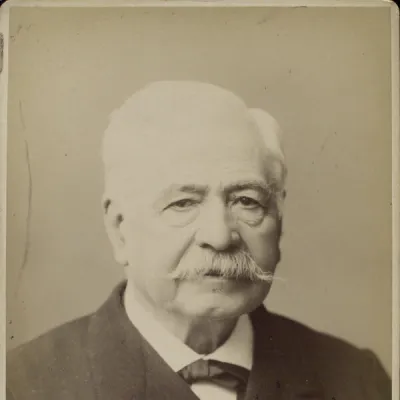
Ferdinand de Lesseps
Human Design Chart
Biography
He attempted to repeat this success with an effort to build a Panama Canal at sea level during the 1880s, but the project was devastated by epidemics of malaria and yellow fever in the area, as well as by financial problems, and the planned Lesseps Panama Canal was never completed. Eventually, the project was bought out by the United States, which solved the medical problems and changed the design to a non-sea- level canal with locks. It was completed in 1914.
What does Generator 3/5 mean for Ferdinand de Lesseps?
Generator 3/5 — Design at a Glance
Ferdinand de Lesseps was someone who possessed immense inner endurance, comparable to a workhorse drawing strength from his sacral energy. This energy source enabled him to push forward projects with great consistency as long as they were based on an inner 'yes'. However, his design required a specific approach: not to take the initiative but to react to signals from the environment. When an impulse came and his inner self confirmed that it was time to act, he responded with active implementation. This strategy of reacting rather than pushing forward was crucial for his effectiveness.
Living in harmony with this principle rewarded him with a deep sense of fulfillment. If he could work on his heart project as long as the energy flowed and was not arbitrarily stopped, this mechanism worked optimally. Conversely, ignoring these inner signals or forcing activities without inner consent led to frustration and energy loss. De Lesseps' strength lay not in sheer will but in his ability to respond instinctively to life impulses and materialize them with his great endurance.
Sacral Authority
Ferdinand de Lesseps lived as a Generator whose decision-making was marked by sacral authority. This inner guidance required an open emotional center, meaning he did not react to fleeting moods but to a deeper, physical truth. His strategy and authority were one: he waited for life to answer him.
This response manifested as a direct physical reaction to external stimuli. A grunt, a hum, or a spontaneous 'Hmm' signaled whether something energized him. When his sacral motor kicked in, he felt vital and alive. He then had inexhaustible energy and tackled his work with great enthusiasm. His design promoted a life without rigid purpose; he moved through the world with joy and satisfaction, fully immersed in his activities.
Additionally, a supportive authority was exerted through an activated spleen center. This gave him the ability to react particularly quickly and spontaneously. He had immediate access to his physical well-being and instinctive perception. These instincts could be reliably used as a compass. The combination of sacral confirmation and spleen-based intuition allowed him to make decisions not only with energy but also with precise, physical intelligence. His process was clear: wait for the stimulus, feel the physical response, and act when the energy flowed.
The 3/5 Profile — Martyr / Heretic
Ferdinand de Lesseps was someone who drew his impulses from a rich treasury of practical life experiences that he presented to others. His design as a 3/5 profile – the experimenter and hero – established a foundational stance that initially had to try everything itself before believing. Through trial and error, he learned to whom he should dedicate his material strength. This selfless promotion of others served to preserve his individuality at the same time.
However, Line 5 brought social expectations and projections. It was expected of him to be persistent and overcommit himself. This ambition could fail if he overreached and exceeded his means. An open ego led to over-stress and possibly the failure of these commitments. The elevation of his line consisted in selflessly promoting others, which fostered his own growth. His design provides strength on the material level but requires a way to convert energy into material goods. The attractiveness that emanated from him made others eager to learn from his experiences. This heroic role flattered him but became painful when he failed in the eyes of all.
Single Definition — Defined & Open Centers
Ferdinand de Lesseps showed himself to be someone who possessed an immense, constant energy source that drove him to persistence. His defined Sacral Center generated daily vital energy, which was only available through reacting to external requests. Initiated actions without such questions led to resistance and exhaustion, as the sacral energy was then not available. This mechanical truth required patience: waiting until life spoke to him to give his yes or no answer.
In addition to this power, he had a defined Spleen Center, which allowed him to make spontaneous, intuitive judgments in the present moment. This instinct was his health and well-being protection mechanism, which did not tolerate rational justification but required immediate action. Furthermore, he had a defined Root Center, which delivered a steady, adrenalized push to advance materially and correct problems. This inner drive provided stability as long as it was guided by his inner authority.
At the same time, Ferdinand de Lesseps was vulnerable to conditioning through several open centers. His open Head Center tended to engage with foreign questions and mental confusion rather than trusting his intuition. The open Ajna Center could lead him to accept other people's concepts and opinions as his own truth, leading to uncertainty. His open Throat Center often sought attention through unpredictable communication rather than waiting for the right timing.
Especially defining was his open G Center, which did not have a fixed identity or direction. This led him to blend with his environment and seek love and orientation rather than having them initiated from the outside. The open Heart Center drove him to prove his worth through promises and competition, which often ended in self-doubt, as he did not possess the constant willpower for it. Finally, his open Solar Plexus absorbed the emotions of others, making him emotionally vulnerable and leading him to interpret foreign moods as his own rather than using them as a barometer for the environment.
Channels for ambitious transformation and intuitive power.
Ferdinand de Lesseps was marked by a deep, instinctive drive for success, which aimed not only at personal achievement but also at the transformation and elevation of the entire "tribe" or community. This attitude resulted from Channel 54-32, which connects the Root Center with the Spleen. Driven by the fear of failure and the desire for continuity, he sought ways to recognize talent and improve social positions through persistent effort. His quest for recognition was inseparably linked to the support of allies; he understood that true transformation could only be sustained through mutual interdependence and service to others.
Parallel to this, Ferdinand de Lesseps possessed a sharp, survival-oriented intuition. Channel 34-57 connected his sacral life force with the existential vigilance of the Spleen. This gave him the ability to recognize dangers immediately and to react spontaneously to threats. He acted not from mental planning but from a direct, bodily resonance that compelled him to preserve his individuality and independence. This defensive intelligence helped him find the right moment to act in complex situations to secure his own survival and that of his projects.
In his personality, Gates pointed towards leadership and structural refinement. Gate 8 challenged him to lead the group through individual contribution and to serve as an example, while Gate 14 called for the graceful handling of power and wealth. In the background, Gates like 58 and 52 supported the process through experiments and the correction of patterns, helping him to transform pressure into levity and minimize errors. His energy followed its own rhythm (Gate 5), which he cultivated through perseverance (Gate 29), enabling him to achieve his goals despite adverse circumstances and the need to set boundaries (Gate 38).
Individual Circuitry — Circuit Signature
Ferdinand de Lesseps showed himself to be someone who drew strength from reacting to life and channeled this through intuitive knowledge. His design connected the Sacral Center with the Spleen Center via the Power Channel (34-57). This allowed him to translate inner intuition into concrete present moment action, thereby strengthening himself and securing his survival. Parallel to this, there was a separate connection between the Spleen Center and the Root Center through the Transformation Channel (32-54). Here, it was about deep transformation processes that were not directly connected to the sacral life force. Since Ferdinand de Lesseps had a Simple Definition, these two segments – on the one hand, individual self-empowerment, on the other hand, transformative power – together with the also defined Sacral Center formed a single, continuous energetic flow. All three centers (Spleen, Root, Sacral) were directly linked to each other. This shaped him as a person who responded both to inner intuition and to transformative impulses, with the constant life energy of the Sacral Center acting as a driving force. There were no separate groups standing as isolated forces next to each other; instead, energy flowed through these three centers, which facilitated an integrated yet reactive approach to challenges.
Right Angle Cross of Contagion 4
Ferdinand de Lesseps had the right infection cross in Human Design. This configuration shaped a specific way of dealing with one's own energy and life circumstances. The infection cross represents the ability to immerse oneself in various roles and situations to understand their essence. It is not about mere adaptation but about a deep, almost intuitive absorption of the energy of other people or environments. Ferdinand de Lesseps used this gift to penetrate complex dynamic situations and move through them effectively. The energy of this cross acts like a catalyst, enabling quick adaptation to new contexts and the recognition of underlying patterns. This created a foundation for high social intelligence and the ability to be accepted in diverse groups. The mechanics show that this person, through their openness and ability to absorb the energy of others, could serve as a bridge. They acted as a medium through which various influences flowed and connected. This property allowed them to navigate social networks by sensing and responding to the moods and needs of the environment. It was less a matter of strategic action than a natural, almost unconscious resonance with the world around them. This resonance determined significantly how Ferdinand de Lesseps interacted and was perceived by others.
Saturn Return · Uranus Opposition · Chiron Return · 2nd Saturn Return — Life Cycles
In his middle age, Ferdinand de Lesseps showed himself to be someone who translated his inner orientation into concrete, far-reaching structures. His design suggested that his personal sense and life mission condensed during this phase. This corresponds to the Chiron Return, a cycle between the ages of 49 and 51, during which the individual's incarnation cross unfolds and the personal purpose becomes tangible. In 1854, at the age of 49, he received the concession from Said Pascha for the construction of the Suez Canal. This event marked the beginning of this flourishing period, in which his strategic positioning became tangible.
Five years later, in 1859, the second Saturn Return occurred. This cycle represents the consolidation of responsibility and the establishment of long-term structures. De Lesseps founded a French-language primary school in Barcelona. This action underscored the tendency not only to initiate large projects but also to create formative foundations that endure. Both events illustrate how his mechanical cycles influenced his life: the Chiron Return enabled the realization of his core purpose through the canal concession, while the Saturn Return demonstrated the ability to establish sustainable institutions. His path was characterized by the gradual anchoring of his visions in the material world, driven by the specific energy flows active during these life phases.
Generator · Sacral Authority — Synthesis
Ferdinand de Lesseps primarily lived through his sacral energy (Sacral Center defined, Generator Type), which drove him to sustained activity and deep engagement. This power was amplified by the channel of transformation (54-32), where the desire to achieve and prove oneself sustained continuous effort and ambition. The profile as an experimenter and hero (3/5) indicates that he learned through his own experiences and then made this knowledge available to others—a pattern that manifested in the assumption of responsibility and the building of something new. The sacral authority, which paid attention to physical reactions, allowed him to intuitively recognize when energy was available for an undertaking.
A central paradox lay in the tension between his Generator nature and the associated need for fulfilling work and the ability to generate resources (Ego Circuit), as well as the inner drive to prove oneself and improve one's position (Channel 54-32). The repeated documented events showing career advancement occurred through active effort, yet the focus was always on pushing forward projects that went beyond the individual. This points to an inner conflict between the need for personal fulfillment and the desire to make a larger contribution.
2 Defined Channels
Incarnation Cross - Right Angle Cross of Contagion 4
Solar Return
The Solar Return shows the moment when the sun returns to its exact birth position - your personal solar year.
Life Cycles
Discover the life cycles with a detailed triple view (birth chart, cycle chart, composite).
Human Design Profile
- Type
- Generator
- Strategy
- To respond - wait for something to respond to
- Authority
- Sacral Authority
- Profile
- 3/5 - Martyr / Heretic
- Definition
- Single Definition
- Incarnation Cross
- Right Angle Cross of Contagion 4
- Date of Birth
- 19.11.1805 15:30
- Place of Birth
- Versailles, France
Frequently Asked Questions
What was Ferdinand de Lesseps' Human Design type?
What Profile did Ferdinand de Lesseps have?
What Authority did Ferdinand de Lesseps have?
What incarnation cross did Ferdinand de Lesseps have?
When was Ferdinand de Lesseps born?
Discover your own Human Design
Are you also a Generator? Find out in a personal reading how to use your sacral energy correctly and discover deep satisfaction.
More Personalities
Back to overviewAaliyah

Alexia

Angèle

Anne-Marie

Arcángel

Arno