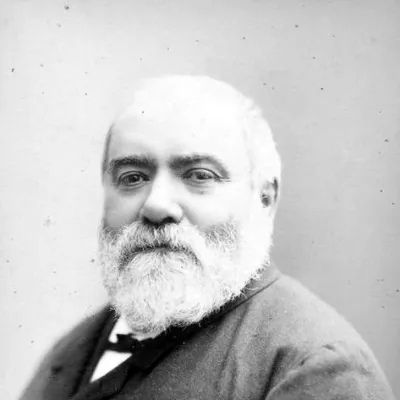
Francisque Sarcey
Human Design Chart
Biography
After some years as schoolmaster, a job for which his temperament was ill-fitted, he entered journalism in 1858. He contributed to Le Figaro, L'Illustration, Le Gaulois, Le XIX' Siècle and other periodicals; but his main interest was dramatic criticism, of which he had his first experience in L'Opinion nationale in 1859. In 1867 he began to contribute to Le Temps the "feuilleton" with which his name was associated till his death. His position as dictator of dramatic criticism was unique. He had the secret of taking the public into his confidence, and his pronouncements upon new plays were accepted as final.
He was a masterly judge of acting and of stage effect; his views as to the drama itself were somewhat narrow and indifferent to artistic progress..
He died in Paris on 16 May 1899.
Francisque Sarcey — Manifestor with Profile 5/1
Manifestor 5/1 — Design at a Glance
Francisque Sarcey was a Manifestor, a type designed to be a pioneer and visionary. His design inclined him to actively lead the world into a new direction, much like an emperor in ancient Rome pursuing a vision of a great empire without personally fighting the battles. Instead, he sent others to achieve his goals. This role, however, came with a specific pain point: Francisque Sarcey was often misunderstood because his thinking often exceeded that of his surroundings. This led to polarization; some followed his great dreams while others rejected or even hated him because of these visions. To find the right followers, it was essential for him to inform others timely and precisely about his plans. This was his strategy. If Francisque Sarcey followed this strategy and held onto his authority, he was rewarded with a sense of inner peace. Living against his design, however, he felt a persistent, deep anger. His nature was thus marked by this dynamic of leadership, misunderstanding, and the need for information to find inner balance.
Splenic Authority
Francisque Sarcey's design inclined him towards spontaneous, instinctive orientation. His inner authority lay in the Spleen, a defined center that functions as a health and alarm system. This configuration required both the Emotional and Sacral centers to be open, typical for Projectors or Manifestors.
His survival intelligence manifested as spontaneous inner knowledge that signaled to him in the moment whether a situation, environment, or society was right for him. This first impulse served directly to his well-being and enabled him to rigorously distance himself from harmful influences. Since the Spleen voice was a very fine, unique impulse that could easily be drowned out by other influences, this required high vigilance from Francisque Sarcey. Often, a short retreat was helpful to clearly hear this fine signal.
Since he only knew what was right for him in the moment, his plans could change short-term. Long-term commitments were therefore difficult; he needed a lot of freedom and flexibility to do justice to this nature. Decisions had to be made in the here and now, with the spontaneous impulse serving as a reliable indicator of his health and well-being.
The 5/1 Profile — Heretic / Investigator
Francisque Sarcey emerged as someone who gathered deep, specialized knowledge to offer others for problem-solving. His Human Design Profile 5/1 combined Line 1, which prioritized learning and experience collection in depth, with Line 5, which carried this knowledge outward. This configuration gave him almost a magnetic presence: others actively sought his solutions and advice.
The mechanics of Line 5 emphasized the ability to 'charm' necessary resources to implement practical experiments and collective solutions in times of crisis. This required energy and timing. At the same time, Line 1 depended on the correct development and completion of learning processes before starting anew. Without clear boundaries, Francisque Sarcey risked being drained by the constant demand from others, similar to an expert exhausted after long conferences. His challenge lay in maintaining the balance between private research (Line 1) and public problem-solving (Line 5). Uncertainty about his own depth could hinder action, while the pressure to start anew often resulted from criticism of the old. His design challenged him to say no when necessary to use his gifts optimally without exhaustion.
Triple Split Definition — Defined & Open Centers
Francisque Sarcey was someone who operated under a constant internal pressure to question and form concepts. His design linked the Head and Ajna Centers, creating a specific, trustworthy form of conceptual thinking. This mental process was permanently active, serving to process data and inspire or prompt others into action through targeted questions. However, since these centers did not have their own energy to implement ideas, it was crucial for him to wait for the right moment rather than prematurely forcing ideas.
This intellectual structure culminated in his defined Throat Center, which served as a pivot point for communication. It allowed him to articulate clearly and reliably what his mind conceptualized. His voice was thus a direct reflection of his mental processes, not impulsive but well-thought-out. This was complemented by his defined Heart Center, which gave him a firm will and the need to determine his own life. He had the energy to keep promises and be recognized for his contributions, which helped him establish a foothold in the material world and control his own resources.
At the same time, Francisque Sarcey was marked by open centers that made him vulnerable to external influences. His open G Center meant he did not have a fixed, unchanging identity but rather blended with his environment. He tended to question who he really was when not in proper relationships or at the right places. His open Sacral Center led to him absorbing and amplifying the vital energy of others, which could easily lead to overexertion and exhaustion as he lacked his own consistent endurance limits. Additionally, his open Solar Plexus absorbed the emotions of his surroundings, prompting him to distinguish between his own feelings and the moods of others to avoid emotional confusion. This combination of strong mental will and emotional and identity openness shaped the way he experienced and shaped the world.
Channels for awareness, struggle, transformation and material line.
Francisque Sarcey was someone who combined material responsibility with a deep, intuitive search for life's meaning. His design inclined him to claim control over his own will while simultaneously using internal struggles as a source of meaning.
This attitude was marked by the Money Line Channel 21-45. This connection between the Heart and Throat Centers conveyed the drive to master the material plane and secure resources through willpower. Francisque Sarcey faced the challenge of exercising authority in a way that served his own interests without neglecting the needs of his environment. He sought independence to follow his natural rhythm, as delegating responsibility was often felt as a burden.
Parallel to this, the Life Struggle Channel 38-28, connecting the Root and Spleen Centers, gave him the resolve to walk his own path and find personal meaning in daily struggles. He resisted external expectations to preserve his integrity and found his energy in this stubborn dedication to the individual.
Mentally, he was marked by the Channel of Awareness 61-24 and Gate 48. The Channel 61-24 linked the Head and Ajna Centers, leading to spontaneous, mutative insights that had to be accepted rather than controlled. Francisque Sarcey sought silence to hear these inner truths. Gate 48 also promoted the ability to recognize deep patterns and connections, though this sometimes led to frustration as implementation was complex.
Additionally, the Channel of Transformation 54-32, linking ambition with awareness of continuity, drove him to work his way up in the social fabric through talent and loyalty, always with the awareness that success depends on the support of the tribe.
Individual Circuitry — Circuit Signature
Francisque Sarcey's design was a configuration of three separate, parallel functioning energetic blocks, as he had a triple definition. This meant that his strengths did not flow in a single continuous stream but existed as independent focal points alongside each other.
One block connected the Heart with the Throat Center. Here, the energy of the Ego Circuit, specifically through the Channels of Resource Accumulation and Transformation, marked Francisque Sarcey with a focus on material values, mutual support, and the ability to bring about concrete changes through words or actions, always in exchange with others.
Two further, isolated segments came from the Knowledge Circuit. One connected the Head with the Ajna Center, fostering spontaneous, innovative flashes of insight and the search for new knowledge. The other connected the Spleen with the Root Center. Here, the energy of the Life Struggle provided a deep, instinctive endurance and the will to survive in crisis situations.
Since these three groups – Heart/Throat, Head/Ajna, and Spleen/Root – were not connected to each other, Francisque Sarcey had to switch his attention between these different fields of demand. He could not access all energies at once but experienced them as alternating impulses, each setting its own focal points in his life.
Left Angle Cross of Endeavour 2
Francisque Sarcey's Human Design profile indicated a tendency towards persistent, often laborious work characterized by recurring obstacles and delays. His character trait was marked by the necessity to achieve results through consistent effort and endurance, where the path rarely followed a linear or simple course. This configuration, known as the left effort cross 2, described a life task where progress was only possible through persistent perseverance despite setbacks. Francisque Sarcey was someone who had to learn that failures or blockages were not signs of defeat but integral parts of the process. The mechanics of this cross emphasized that true fulfillment did not lie in quick success but in the quality and constancy of the effort. Francisque Sarcey lived in a rhythm that required patience and the ability to accept frustrations as necessary parts of growth. His design pointed to the deepest satisfaction only coming after overcoming numerous hurdles, with the focus always on continuous action rather than immediate results. This structure shaped his actions through a quiet but unshakable persistence, enabling him to maintain his course even in difficult phases and to build stable foundations over the long term.
Saturn Return · Uranus Opposition · Chiron Return · 2nd Saturn Return — Life Cycles
Francisque Sarcey's Human Design profile showed a clear tendency to anchor himself in stable structures before embracing new impulses. His life path was marked by two decisive phases that confirmed this mechanical sequence.
First, his inner work condensed during his first Saturn return in 1857, at the age of 30, when he received contact with Le Figaro and began working as a journalist. This marked the transition from preparation to concrete implementation. The Saturn return acts in Human Design as a phase of structuring, where years of groundwork lead to a solid result. For Francisque Sarcey, this meant entering a stable professional identity based on a solid foundation.
Following this, the phase of expansion through the Uranus opposition began. In 1867, at the age of 40, he started writing theater critiques for Le Temps. This configuration often signals a necessary break with the familiar to make room for new horizons. After establishing his position at Le Figaro, Francisque Sarcey opened up to a new area that required change and innovation. The shift to theater critiques at Le Temps illustrates how his design, after securing the base (Saturn), was ready to face new, dynamic challenges (Uranus). Both events follow the logical sequence of his character: first, create structure, then expand.
Manifestor · Splenic Authority — Synthesis
Francisque Sarcey was a Manifestor who, through his design, felt a deep inner urgency to tread new paths and lead others. The connection of defined Head and Ajna Centers (mental pressure) nurtured an insatiable thirst for knowledge and the ability to recognize complex connections. This intellectual fire, coupled with the Channel of the Money Line (21/45), points to a person who felt called to take responsibility and bring their visions into reality – always with an eye on the greater good. The recurring career turning points (career events at Saturn return and Uranus opposition) underscore the need to constantly realign and define one's path.
Central to Sarcey's essence, however, was a paradox: the combination of manifesting authority and the Profile of the Hero/Researcher (5/1). He was destined to initiate and lead, yet simultaneously needed the space to dive deeply into specific knowledge domains and find solutions. This tension between the drive to change the world and the need for introspective research created a dynamic field that propelled him forward but could also lead to inner conflict.
4 Defined Channels
Incarnation Cross - Left Angle Cross of Endeavour 2
Solar Return
The Solar Return shows the moment when the sun returns to its exact birth position - your personal solar year.
Life Cycles
Discover the life cycles with a detailed triple view (birth chart, cycle chart, composite).
Human Design Profile
- Type
- Manifestor
- Strategy
- To inform others before acting
- Authority
- Splenic Authority
- Profile
- 5/1 - Heretic / Investigator
- Definition
- Triple Split
- Incarnation Cross
- Left Angle Cross of Endeavour 2
- Date of Birth
- 08.10.1827 01:00
- Place of Birth
- Dourdan, France
Frequently Asked Questions
What is the Human Design type of Francisque Sarcey?
What Profile did Francisque Sarcey have in Human Design?
What authority did Francisque Sarcey have?
What incarnation cross did Francisque Sarcey have?
When was Francisque Sarcey born?
Discover your own Human Design
Are you also a Manifestor? Find out in a personal reading how to use your initiation power peacefully and dissolve resistance.
More Personalities
Back to overviewAlain-Fournier

Angeli

Christian-Jaque
Juninho

Kesha

Lucebert