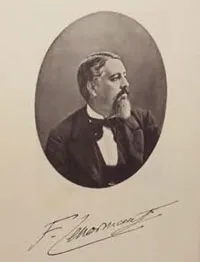
Photo: Wikimedia Commons
François Lenormant
Human Design Chart
Biography
His father, Charles Lenormant (1802-1859), distinguished as an archaeologist, numismatist and Egyptologist, was anxious that his son should follow in his steps. He made him begin Greek at the age of six, and the child responded so well to this precocious scheme of instruction, that when he was only fourteen an essay of his, on the Greek tablets found at Memphis, appeared in the Revue Archéologique.
As early as 1867 he had turned his attention to Assyrian studies; he was among the first to recognize in the cuneiform inscriptions the existence of a non-Semitic language he named Akkadian (today it is known as Sumerian). Lenormant's knowledge was of encyclopaedic extent, ranging over an immense number of subjects, and at the same time thorough, though somewhat lacking perhaps in the strict accuracy of the modern school. Most of his varied studies were directed towards tracing the origins of the two great civilizations of the ancient world, which were to be sought in Mesopotamia and on the shores of the Mediterranean. He had a perfect passion for exploration. Besides his early expeditions to Greece, he visited the south of Italy three times with this object, and it was while exploring in Calabria that he met with an accident which ended fatally in Paris after a long illness on 9 December 1883 at age 46.
What does Generator 1/3 mean for François Lenormant?
Generator 1/3 — Design at a Glance
François Lenormants Design shows a tendency towards great endurance, comparable to a workhorse that possesses immense strength, provided it is used for suitable tasks. As a Generator, he had a lot of sacral energy, which he could release not through independent initiative but by reacting to life impulses. The strategy was to wait for signals from the environment and then act only when his inner center gave a clear "yes" – a process that happened from the gut.
This approach was crucial for his well-being. When François Lenormant acted in harmony with these reactions, his design rewarded him with a sense of deep fulfillment. If he, however, initiated independently without waiting for an external impulse, or was held back from his heart project despite still being full of energy, this led to frustration and energy loss. The danger was wasting energy on things that did not really interest him, which over time led to exhaustion. His success therefore depended closely on learning not to be the first to act, but rather the one who reacted to life and thus effectively channeled his enduring strength.
Sacral Authority
François Lenormant was a Generator whose decision-making was shaped by sacral authority. As the only type, he could unite his strategy and inner authority in a single source, simplifying his process of orientation in life. His inner guidance came from the defined Sacral Center, which manifested as a direct physical reaction to external stimuli. These responses did not appear as intellectual analysis but rather as an immediate gut feeling or a palpable surge of energy. Lenormant learned to pay attention to these physical signals, which could express themselves as grunts, hums, or simple sounds like "Mhm" or "Hm-hm."
When his sacral motor engaged with a topic, he felt vital and alive. Then, an apparently inexhaustible energy was available to him, enabling him to tackle his tasks with great enthusiasm. This design allowed him to move through life with joy and satisfaction, fully immersed in his tasks, without the need for external purpose. The prerequisite for this clear sacral guidance was an open Emotional Center, ensuring that no impulsive emotional waves overlapped the direct physical response. Thus, Lenormant could reliably listen to his inner resonance and act where his body confirmed him.
The 1/3 Profile — Investigator / Martyr
François Lenormant's Design inclined towards exploratory experimentation. As a 1/3 Profile, he was naturally inclined to collect knowledge not just theoretically but through active testing and learning from mistakes. This profile connects the learning-oriented Line 1 with the experimental Line 3, making his life revolve around the process of trial and error.
Line 1, represented by Gate 60, emphasized the ability to maintain inner harmony despite external limitations. This created a foundation of acceptance that was present from birth. However, this side could also lead to restlessness if the feeling arose that he did not know enough to move into implementation.
At the same time, Line 3, here at Gate 50, demanded adaptability and the willingness to rely on support from others. This line showed that laws and structures often had to be broken or changed to release bindings or find new paths. The mental compulsion associated with Mercury in this configuration drove him to constantly adapt.
The combination of these energies meant that François Lenormant only considered insights valid if he had worked them out and practically tested them himself. His judgment was based on testing things both theoretically and in real life. This double testing – the learning of Line 1 and the experimenting of Line 3 – shaped his approach to the world.
Split Definition — Defined & Open Centers
François Lenormant revealed a design that combined mental clarity and vital endurance. His defined Ajna Center provided him with a constant, trustworthy mental function; he thought continuously and could create concepts without being easily influenced by others. This mental structure flowed directly into his defined Throat Center, allowing him to reliably express what he thought and translate it into the world. Thus, his voice was a direct echo of his mind, clear and consistent.
At the same time, he possessed an immense energy source in his defined Sacral Center. As a Generator, he had a constant vital force, but it only became effective through reactive actions. Initiating actions without prior questioning led to exhaustion and frustration, while reactive actions sustained his energy. This sacral power was supported by his defined Root Center, which gave him a fixed way of dealing with stress and pressure to advance in material life. His defined G Center also ensured a stable self-identity and a clear sense of direction, without projecting this onto others.
In contrast, his design revealed specific vulnerabilities. His open Head Center meant he lacked a constant access to inspiration; he tended to absorb mental pressure from the environment and get entangled in questions that were not his own, leading to confusion. His open Heart Center made him vulnerable to the pressure of proving his worth through willpower and promises, despite not having the constant energy for it. Additionally, his open Solar Plexus absorbed the emotions of others, leading him to personalize foreign moods and avoid confrontations to prevent emotional waves. Finally, his undefined Spleen was a source of existential fears; he tended to cling to people or situations that radiated a sense of security and well-being, even if they were not healthy for him, and avoided spontaneous decisions, often made out of conditioned fear.
Channels for curious exploration, evolutionary change and logical leadership.
François Lenormant revealed a fundamental disposition that combined evolutionary change with the necessity of collective leadership. His design inclined towards unexpected, mutative impulses, which only became effective when he patiently waited for an internal reaction. The Mutation Channel 60-3 connected the Root Center with the Sacral Center. This channel brought a powerful, pulsating energy, often accompanied by melancholy when the internal pulse ceased. François Lenormant had to learn to accept limitations and not try to resolve the confusion of a new beginning with arguments. Instead, he delved into his inner journey, while new possibilities grew beneath the surface. This energy also conditioned his environment, as it pushed innovation and renewal into his life and the world around him.
Parallel to this, François Lenormant had the potential for logical, collective leadership. The Alpha Channel 7-31 connected the G Center with the Throat Center. He sought his own 'pack', a community that invited him to lead them. His leadership did not rely on absolute authority but on the trust he gained through understanding current patterns and trends. He could show the way, but only if the majority was willing to follow him. This required patience, as collective leadership depends on the majority principle, and patterns can change constantly.
Additionally, the Channel of Curiosity 11-56 shaped his way of processing information. It connected the Ajna Center with the Throat Center and made him a storyteller. François Lenormant was less interested in dry facts and more in transforming ideas and experiences into magical stories that taught or entertained others. His creativity showed in filling gaps in information and creating parables that appealed to the imagination of listeners.
Individual Gates complemented this picture: Gate 50 fostered a conservative protective reflex and awareness of traditions. Gate 16 promoted experimentation and mastery in the collective. Gate 13 helped reflect experiences in the context of time and establish continuity. Gate 4 developed formulas to clarify suspicious patterns for the future. Gate 1 emphasized individual creativity in the here and now. Gate 25 brought a spiritual stance of innocence and centering. Gate 24 enabled mental mutation and renewal in the rhythm of the pulse. Gate 41 drove evolutionary development through specific experiences and feelings.
Collective Circuitry — Circuit Signature
François Lenormant's design inclined towards parallel, not directly connected energetic fields. His Split Definition separated his powers into two independent groups that existed side by side without a common flow.
The first group connected the Sacral and Root Centers through the Knowledge Circuit. The Mutation Channel (3-60) here worked a pulsating energy aimed at deviations and innovations. This characterized François Lenormant as someone who sought his own unique path and initiated change through innovative impulses. The energy was acoustically rooted in the present, driven by individual identity.
The second group included the Throat, Identity, and Ajna Centers. Here, two separate parts of the Understanding and Meaning Circuit worked. The Alpha Channel (31-7) connected the Throat with the Identity Center and promoted the sharing of logical, rational insights, free from conditioning, focused on the future. Parallel to this, the Curiosity Channel (11-56) connected the Ajna with the Throat Center. This directed attention to reflecting on past experiences and emotions to understand their meaning and share these felt insights visually and cyclically with others.
François Lenormant thus revealed himself through this structure: on one hand, through bold, new impulses from the Root and Sacral Centers, on the other hand, through clear, rational communication of future vision as well as emotional processing of the past, which he carried outward through the Throat Center. These powers worked as separate but equally important aspects of his personality.
Right Angle Cross of Laws 4
François Lenormant's Human Design profile featured the right cross of Law 4. This configuration established a specific life dynamics characterized by a deep connection to the flow of life and the necessity to locate oneself within larger contexts. The right cross of Law 4 is one of the four fundamental cross configurations in Human Design, permeating the entire chart and determining the basic life task as well as the way a person uses their energy in life.
For François Lenormant, this meant that his life was strongly shaped by the dynamics of flow and adaptation. The right cross of Law 4 represents the ability to immerse oneself in the currents of life and develop a deep resonance with the environment and people. It is not about control or enforcement, but about a gentle yet persistent presence aimed at creating harmony and balance.
This configuration grants a special sensitivity to the subtle forces at work in the background. François Lenormant thus appeared as someone who was able to sense and respond to these forces without losing his own identity. His design promoted an attitude of acceptance and trust in the natural course of events, which helped him maintain inner peace even in difficult situations.
The right cross of Law 4 also emphasizes the importance of relationships and connection to others. For François Lenormant, it was important to move within a network of relationships where he felt secure and supported. This support enabled him to use his own energy effectively and enrich both himself and others.
Overall, the right cross of Law 4 shaped François Lenormant's life through a deep connection to the flow of life, a high sensitivity to the subtle forces in the background, and a strong emphasis on relationships and harmony. These qualities helped him lead a life marked by inner peace and balance.
Saturn Return · Uranus Opposition — Life Cycles
François Lenormant's design was characterized by a precise alignment with structural clarity, reflected in his professional milestones. His first Saturn Return, a cycle often bringing the condensation of long-term work into stable results, occurred in 1863. At the age of 26, he published “Essai sur l’organisation politique et économique de la monnaie dans l’antiquité”. This was not a sudden impulse, but the result of a phase where his inner foundation solidified and he was ready to present his knowledge in a solid, recognized form. The Saturn Return marked the transition from preparation to established authority in his field.
Later, at the age of 41, the Uranus Opposition came into effect. This aspect often brings unexpected turns or the urge to break established patterns to open up new perspectives. In 1878, Lenormant published “The Secret Sciences of Asia”. This work showed a clear shift in focus: away from pure economic structure towards the hidden, spiritual dimensions of history. The Uranus energy acted here as a catalyst for an intellectual expansion, leading him to connect his existing knowledge with new, exotic sources. Both events illustrate how his chart-specific cycles shaped his career-relevant steps both temporally and in content, by creating stable foundations and later setting innovative courses.
Generator · Sacral Authority — Synthesis
François Lenormant was a Generator whose life was marked by an unstoppable drive for experience and knowledge. The sacral authority (and thus the constant availability of life energy) in conjunction with the Profile of the Researcher/Experimenter (1/3) points to a person who finds energy through testing and examining ideas. The Channel of Mutation (3-60) reinforced this tendency by placing him in a continuous cycle of limitation, new beginnings, and the search for new possibilities. This combination led to a deep, pulsating energy that drove him to generate and transform knowledge – a process often accompanied by melancholy but ultimately leading to groundbreaking insights.
A central paradox in his design lay in the tension between the need to constantly research and experiment and the potential pitfall of getting lost in aimless ventures. The defined Ajna Center indicated a strong ability to develop concepts, while the sacral energy urged him to also practically implement these ideas. The documented career events showed how he utilized this potential, but also that the process did not come without inner struggle. This shift between mental conception and practical application created a dynamic, yet challenging way of life.
3 Defined Channels
Incarnation Cross - Right Angle Cross of Laws 4
Solar Return
The Solar Return shows the moment when the sun returns to its exact birth position - your personal solar year.
Life Cycles
Discover the life cycles with a detailed triple view (birth chart, cycle chart, composite).
Human Design Profile
- Type
- Generator
- Strategy
- To respond - wait for something to respond to
- Authority
- Sacral Authority
- Profile
- 1/3 - Investigator / Martyr
- Definition
- Split Definition
- Incarnation Cross
- Right Angle Cross of Laws 4
- Date of Birth
- 17.01.1837 08:00
- Place of Birth
- Paris, France
Frequently Asked Questions
What was François Lenormant's Human Design type?
What Profile did François Lenormant have in Human Design?
Which Authority guided François Lenormant in his decisions?
What incarnation cross did François Lenormant have?
When was François Lenormant born?
Discover your own Human Design
Are you also a Generator? Find out in a personal reading how to use your sacral energy correctly and discover deep satisfaction.
More Personalities
Back to overviewAaliyah

Alexia

Angèle

Anne-Marie

Arcángel

Arno