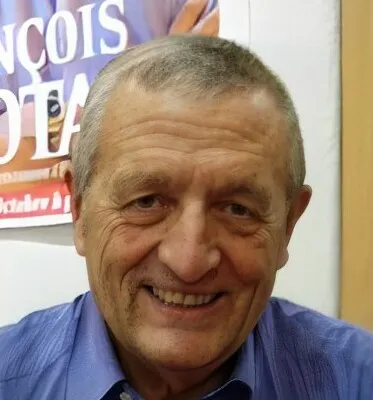
François Léotard
Human Design Chart
Biography
He began as a monk at La Pierre-qi-Vire abbey. He wrote several books including non-fiction and a couple of novels.
Married in 1976 to France Reynier and later divorced, he remarried to Isabelle Duret in 1992. He had four children. He died on 25 April 2023 at the age of 81.
François Léotard — Generator with Profile 1/4
Generator 1/4 — Design at a Glance
François Léotard was someone who possessed immense, enduring strength, comparable to a workhorse that not only had energy but actively generated it. His design suggested that this strength was not activated through self-initiative but through a specific way of acting. As a Generator, his energy source was the sacral center, which was released primarily when he responded to external impulses rather than initiating himself. His motto was therefore: not to start but to respond.
This principle contained two central risks. If François Léotard engaged in activities that did not resonate internally, he wasted his energy and was prone to exhaustion. Conversely, he suffered when he was prevented from working on projects that sparked his enthusiasm and which he wanted to continue. His strategy was to wait for signals from life and then act only when his inner self gave a clear “yes”. Living by this pattern led to deep satisfaction. If he constantly initiated himself without waiting for impulses, he encountered frustration and energy deficiency. His effectiveness thus depended on whether he reacted from the gut or fought against his natural energy flow.
Sacral Authority
François Léotard was a Generator whose decision-making was shaped by sacral authority. This inner guidance is unique to this type and simplifies the process, as strategy and authority are identical. His reactions to external stimuli manifested in a physical “gut feeling” or a noticeable surge of energy. These signals were expressed as grunts, hums, or simple sounds like “Mhm”.
When his sacral motor engaged with something, he felt vital and alive. He had seemingly inexhaustible energy and tackled his tasks with great enthusiasm. His design promoted a life filled with joy and satisfaction, allowing him to immerse himself fully in activities without the need for a sense of purpose.
Additionally, his activated spleen center acted as a supporting authority. This allowed him especially quick and spontaneous reactions. He had immediate access to his physical well-being and instinctive perception. This combination enabled him to reliably be guided by these inner signals, further strengthening his ability to make quick decisions.
The 1/4 Profile — Investigator / Opportunist
François Léotard was a Researcher and Networker whose design was aligned with the connection of deep knowledge with familiar communities. His Profile 1/4 combined the urgent desire for thorough exploration of things with the need to anchor these insights within a close circle of shared values. This configuration created a specific dynamic: While Line 1, represented by Gate 17 (Openness), fostered the ability to integrate various opinions and better perceive reality through inner reflection, Line 4 provided emotional anchoring.
Especially defining was the ambivalence of Line 4. It endowed him with the magnificent ability to network but also brought with it the fear of being exposed as insufficiently knowledgeable before his loved ones. This potential heartache made a loving environment with a deep trust base an essential prerequisite for his authority to come to the fore in his Heart themes. Without this security, the energy remained unstable.
Additionally, Gate 58 (Line 4) with its specialized energy was at play. This was about focus and the externalization of pressure. To stay healthy and effectively use this energy, François Léotard had to remain focused; the receptivity to many impressions, which this configuration facilitated, required a clear orientation to avoid falling into instability. His design thus suggested that true strength arose from the synthesis of intellectual openness and emotional connection within a protected framework.
Single Definition — Defined & Open Centers
François Léotard was someone who was guided by a deep, physical intuition. His defined Spleen Center gave him a spontaneous, existential awareness that allowed him to act in the "now" and instinctively recognize what was correct for his well-being and survival. This intuitive authority worked together with his defined Sacral Center, which provided a constant source of vital energy. For him, it was crucial to react to this inner power rather than initiating actions from the mind; only through this reaction could he sustainably and satisfyingly use his energy. His also defined Root Center provided the necessary pressure and endurance to move forward in the world and transform stress into constructive action.
At the same time, François Léotard was strongly exposed to his environment through several open centers. His open Head Center made him vulnerable to mental confusion and the pressure to find answers to questions that were not his own. He tended to be influenced by others' doubts rather than trusting his inner clarity. The open Ajna Center amplified this mental flexibility, but also put him at risk of adopting concepts and opinions as his own truth. His open Throat Center meant that he did not have a fixed identity or direction, but rather collected these through interaction with others and the right places; he was dependent on being initiated to know who he was in a specific context. Furthermore, his open Solar Plexus absorbed the emotions of his environment, making him emotionally vulnerable and prone to personalizing others' moods. His open Heart Center led him to not be driven by willpower, but often felt the pressure to prove himself, which could lead to a cycle of promises and disappointment. Finally, his open Throat Center was designed to receive attention rather than actively seek it; he spoke most effectively when confronted rather than initiating.
Channels for logical scrutiny and cyclical maturation.
François Léotard showed an unrelenting drive to question and perfect patterns. His design was marked by the Judgment Channel 58-18, connecting the Root Center with the Spleen Center. This configuration generated a logical impulse that constantly sought "better and more," while Gate 18 simultaneously checked what was in balance. It was an inner sentry that assessed whether the perceived reality served the well-being of the collective. Léotard sought solutions that were applicable to society and took pleasure in being asked to analyze, "if something here is not right."
Parallel to this, he underwent a deep maturation process. The Maturation Channel 53-42 connected the Root Center with the Sacral Center and pushed him to fully experience cycles before starting new ones. This channel emphasized the necessity of learning from the past to gain wisdom. Léotard reflected on his paths to translate the gained insights into information for others. He understood that every experience was part of an endless journey and that prematurely ending cycles led to repetition.
Additionally, specific gates influenced him. Gate 17 brought the logic of teaching and following, where true understanding was a prerequisite for organizing the future. Doubt was considered a healthy part of the process here. Gate 52 demanded a self-imposed pause for concentration and pattern correction, similar to the stillness of the Buddha Gate. Without a clear goal, this energy could lead to stress, but it served focused improvement. Gate 38, finally, represented the pressure in the struggle for life's meaning and individual integrity. It set boundaries and showed aggression to defend the identity, activated only when the strategy required it. This combination created a person who acted through logical analysis, cyclical experience, and setting clear boundaries.
Collective Circuitry — Circuit Signature
François Léotard's design showed a clear, bifurcated structure. On one side stood precise, future-oriented logic. The Understanding Circuit connected his Spleen and Root Centers through the Judgment Channel. This created the ability to recognize strategic structures and share rational knowledge, free from emotional coloring. It was about formatting insights for a better future.
Parallel to this, there existed a completely separate energetic stream. The Meaning Circuit connected his Sacral and Root Centers through the Maturation Channel. Here, there was no cool ratio, but a cyclical, emotional intelligence. This energy reflected past experiences to draw meaning from them and share them with others. The emotions ran in waves, with clear beginnings and endings.
Although both circuits touched the Root Center, they did not form a continuous connection in François Léotard's design. The rational strategy of the Spleen and the emotional depth of the Sacral were active as two independent, parallel forces. One aimed at logical improvement, the other at emotional learning from the past. These separate systems shaped his way of processing and sharing information.
Right Angle Cross of Service 1
François Léotard's design was characterized by the presence of the right Service Cross. This specific configuration established an inner structure aimed at profound, often unconscious service to others or larger systems. It was not a matter of randomly chosen dedication, but rather an archetypal life task that arose from the connection of several energetic channels. These channels created a flow that enabled him to engage in situations where he acted as a mediator or supporter, often without full control over the final outcome.
The mechanics of this cross described a dynamic in which true fulfillment lay in serving others by unlocking their own potentials or removing obstacles. François Léotard lived within an energetic logic that propelled him to find relationships or roles that required a form of care or balance. This was not a sign of weakness, but a specific kind of strength that lay in the ability to adapt to others and anticipate their needs. The right Service Cross shaped his interactions such that he often functioned as a silent support, whose contribution was only recognized as crucial in retrospect. His energy flowed where support was needed, securing him a unique, though often underestimated, role in his social environment.
Saturn Return · Uranus Opposition · Chiron Return · 2nd Saturn Return — Life Cycles
François Léotard was someone who sought structural stability and clear hierarchies to define his role in society. This orientation was marked by his first Saturn Return, a life stage that often marks the crystallization of earlier efforts into solid institutional foundations. In 1971, at the age of 29, he graduated from the prestigious École nationale d’administration (ENA). This event underscores how his design aimed to build a solid foundation during this phase, enabling future action opportunities.
Later, another significant cycle emerged: the Chiron Return. In Human Design mechanics, this phase, typically between the ages of 49 and 51, does not signify healing but rather a blooming period. Here, the individual's incarnation cross unfolds increasingly if they have followed their strategy and authority. Purpose and meaning become experiential and concrete. For François Léotard, this deepening was reflected in his professional career. In 1993, at the age of 51, he became Minister of Defense. This assumption of a high office illustrates how the inner clarity and unfolding life design manifested outwardly in a responsible, central position during this age phase – not as mere coincidence, but as an expression of the fulfilling cycle.
Generator · Sacral Authority — Synthesis
François Léotard was a Generator whose life was marked by a deeply rooted, sacral energy. This energy, driving him to sustained activity and engagement, found expression in the thorough exploration of topics (Line 1) and the need to share this knowledge with others (Line 4). The Judgement Channel (Gate 58/18) indicates an unrelenting drive to perfect and correct things, manifesting in a continuous pursuit of improvement and a critical engagement with reality. The defined sacral authority reinforced this tendency by giving him an immediate, physical impulse when a task aligned with his energy. Thus, he lived a life where the pursuit of knowledge and its application were inseparable from his vital force.
Simultaneously, his design revealed a central paradox. On one hand, he possessed the endurance and energy of a Generator, destined to immerse himself in his work and find joy in it. On the other hand, the profile indicated a deep fear of not knowing enough and being exposed to others. This fear, combined with the need for a familiar community, created a tension between the desire for profound exploration and the concern for acceptance by others. The marked events that marked his professional journey could be interpreted as expressions of this tension field.
2 Defined Channels
Incarnation Cross - Right Angle Cross of Service 1
Solar Return
The Solar Return shows the moment when the sun returns to its exact birth position - your personal solar year.
Life Cycles
Discover the life cycles with a detailed triple view (birth chart, cycle chart, composite).
Human Design Profile
- Type
- Generator
- Strategy
- To respond - wait for something to respond to
- Authority
- Sacral Authority
- Profile
- 1/4 - Investigator / Opportunist
- Definition
- Single Definition
- Incarnation Cross
- Right Angle Cross of Service 1
- Date of Birth
- 26.03.1942 03:45
- Place of Birth
- Cannes, France
Frequently Asked Questions
What was François Léotard's Human Design type?
What Profile did François Léotard have in his Human Design?
Which Authority guided François Léotard in decision-making?
What incarnation cross was François Léotard assigned to?
When was François Léotard born?
Discover your own Human Design
Are you also a Generator? Find out in a personal reading how to use your sacral energy correctly and discover deep satisfaction.
More Personalities
Back to overviewAaliyah

Alexia

Angèle

Anne-Marie

Arcángel

Arno