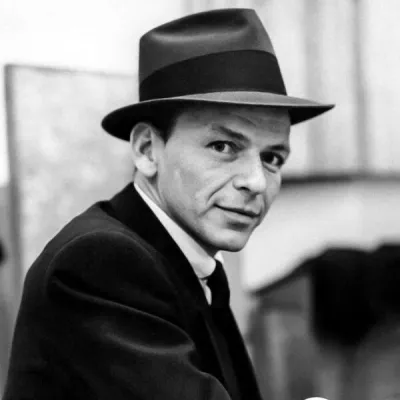
Photo: Wikimedia Commons
Frank Sinatra
Human Design Chart
Biography
Born to Italian immigrants in Hoboken, New Jersey, Sinatra began his musical career in the swing era. He joined the Harry James band as the vocalist in 1939 before finding success as a solo artist after signing with Columbia Records four years later, becoming the idol of the "bobby soxers". In 1946, Sinatra released his debut album, The Voice of Frank Sinatra. He then signed with Capitol Records and released several albums with arrangements by Nelson Riddle, notably In the Wee Small Hours (1955) and Songs for Swingin' Lovers! (1956). In 1960, Sinatra left Capitol Records to start his own record label, Reprise Records, releasing a string of successful albums. He collaborated with Count Basie on Sinatra-Basie: An Historic Musical First (1962) and It Might as Well Be Swing (1964). In 1965, he recorded September of My Years and starred in the Emmy-winning television special Frank Sinatra: A Man and His Music. After releasing Sinatra at the Sands the following year, Sinatra recorded one of his most famous collaborations with Tom Jobim, Francis Albert Sinatra & Antonio Carlos Jobim. It was followed by 1968's Francis A. & Edward K. with Duke Ellington. Sinatra retired in 1971 following the release of "My Way" but came out of retirement two years later.
The Human Design of Frank Sinatra: Projector 3/5
Projector 3/5 — Design at a Glance
Frank Sinatra had a dense, focusing aura that immediately identified systemic errors in his environment. His design acted like a bright flashlight, shining directly on areas that were dark or not functioning properly. This ability to pinpoint system failures was central to his nature as a Projector.
However, addressing these flaws head-on would often provoke defensive reactions, akin to light blinding someone's eyes. Instead, his most effective strategy lay in passive attraction: By radiating harmony himself, he drew others who then sought his advice on their own accord. His design required him to wait for a respectful and honest invitation before offering his knowledge or leadership.
Physiologically, the undefined Sacral Center left him without a constant energy source. Instead, he experienced cyclical phases of high activity that had to be followed by rest periods to avoid burnout. Living in harmony with this structure and waiting for invitations rewarded him successfully. Acting without confirmation or ignoring his energy cycles led to bitterness, his non-self theme. Thus, his design leaned towards focused observation and strategic restraint to remain effective long-term.
Emotional Authority
Frank Sinatra possessed emotional authority, meaning that his defined Emotional Center served as his inner decision-making hub. This configuration was subject to a permanent emotional wave with characteristic ups and downs. The world appeared colored by the current mood; excitement could quickly turn into deep negativity. His immediate feeling was only a fleeting snapshot, not necessarily his deeper truth. Decisions made spontaneously from this transient emotion often proved disadvantageous.
The mechanics required patience: The longer Frank Sinatra allowed a decision to mature, the clearer the true recognition became. It was essential to take time and consciously 'sleep on' important steps. Through waiting, intense feelings subsided, emotional distance grew, and calmness set in. Only then was the process complete and true clarity achieved. This strategy of waiting was crucial for long-term decisions that significantly influenced his life path. Emotional authority always took precedence over other defined centers in his chart, regardless of further configurations. It dictated a rhythm based on deeper understanding and navigating emotional phases rather than speed.
The 3/5 Profile — Martyr / Heretic
Frank Sinatra was characterized by an archetypal stance that made him appear as a heroic adventurer and charming storyteller. His design was based on the Profile 3/5, establishing a specific dynamic between independent experimentation and the role of helper.
Line 3 of his configuration required him not to accept prescribed knowledge blindly but to test everything through trial and error himself. This process was essential for overcoming vulnerability and developing genuine understanding of influence. He had to endure rejection to gain wisdom from it. These accumulated practical experiences formed the core of his attractiveness: Others were drawn to his rich treasure trove of life experience and actively sought his perspectives.
Line 5 built on this foundation, offering practical solutions in crisis situations. Sinatra acted as a rescuer, helping others by drawing on his own lessons. This role flattered his ego, confirming him as a competent expert. At the same time, this profile carried a risk: Failing before an audience could be painful, breaking the facade of the infallible hero. His mechanics thus showed a constant oscillation between private negotiation of boundaries through mistakes and public presentation of these results as valuable assistance to others.
Split Definition — Defined & Open Centers
Frank Sinatra was characterized by a constant emotional wave that served as his inner authority for decision-making. His design featured defined centers: The Throat provided him with reliable communication skills and the will to manifest; the G Center created a firm self-identity and direction; the Solar Plexus determined his emotional consciousness, while the Root generated a steady stress pressure for forward movement. This configuration allowed him to speak from his identity and act through emotional clarity gained by waiting for the wave motion.
In contrast, situational receptivity was revealed in his undefined centers. The open Head Center meant a dependence on external mental inspiration; he tended to be guided by doubts or questions of others rather than relying on consistent mental clarity. The open Ajna Center lacked its own logical structure for concepts, making him susceptible to interpreting answers as personal truth. His open Heart Center showed an avoidance of promises and willpower; he did not seek competition or prove his worth through performance but was receptive to the willpower of his environment.
The open Sacral energy led to fluctuating energy levels; he needed rest phases since he lacked a consistent vital force and could easily be overwhelmed by others' energy. Finally, the open Spleen Center revealed situational dependence on the environment for intuitive security and health signals. Instead of trusting spontaneous gut feelings, he relied on perceiving the well-being frequencies of his surroundings to make decisions about his physical integrity. These opennesses made him a mirror of his environment in mental, willing, and energetic questions while his defined centers provided him with an unshakeable emotional and identity foundation.
Channels for leadership, reflection and emotional release.
Frank Sinatra was someone who exercised leadership not through coercion but by the ability to recognize logical patterns and invite a community to follow him. His design tended towards influence from a position rather than claiming absolute authority. This was effectively achieved through Channel of the Alpha Animal 7-31, connecting the G Center with the Throat Center: Gate 7 provides the logical role for guiding society, while Gate 31 as a collective leader possesses the voice that must earn trust. Success depended on being chosen by the majority and correctly interpreting trends, as this leadership is based on tested patterns offering security.
Parallel to this, Frank Sinatra gathered experiences to reflectively pass them forward later. Channel of the Lost Son 13-33 connected listening (Gate 13) with withdrawal (Gate 33). He listened, stored secrets, and withdrew to think about these information before sharing it as wisdom or history. This process required patience since deeper truths only became clear retrospectively.
Emotionally, Frank Sinatra moved in a pulsating wave between joy and melancholy. Channel of Emotions Released 39-55 connected the Root Center with the Solar Plexus: Gate 79 provokes to strengthen the mind while Gate 55 carries emotional mood. He could infect others through his mood and had to learn to live authentically in this wave rather than rationalizing it.
Additionally, individual gates were at work: Gate 26 in the Heart Center enabled introducing innovations to prevent genetic retardation; Gate 45 gathered energy and represented blood hierarchy. Gate 47 sought meaning in collective past experiences. Gate 22 showed openness for mutations in social environments through calm listening. On a personal level, Gate 38 set boundaries to defend individual integrity while Gate 53 as a pioneer blazed new trails and left old ones behind. Gate 36 used crises as movement towards new experiences, and Gate 56 told collective stories through vivid representation. Gate 19 sought resources and spiritual partners in a safe environment, while Gate 15 organized collective behavior and adapted to natural rhythms.
Collective Circuitry — Circuit Signature
Frank Sinatra showed a split structure: two independent energy blocks existed parallel without direct exchange. On one hand, the Throat Center connected with the Identity Center to express personal essence. On the other hand, Root and Solar Plexus Centers acted as a closed system for emotional tension. This separation required inner synchronization so that rational clarity and felt depth could work together.
In the Understanding Circuit, Channel 31-7 ("The Alpha Animal") connected Throat and Identity Center. This promoted a focused, future-oriented expression of logical strategies free from emotional influence. Parallel to this, the Meaning Finding Circuit led through Channel 33-13 ("The Lost Son") also connecting Throat and Identity Center. Here, cyclic reflection on past experiences was in focus; insights were shared to learn from history. Both channels utilized the same expression gate but carried different temporal qualities: cool ratio versus emotional past.
The Knowledge Circuit formed the second block. Channel 55-39 ("Emotions Released") directly connected Solar Plexus and Root Center. This connection generated a pulsating, acoustic energy from emotional waves and innate drive. It stood for transformation through individual identity and new insights but isolated from the rational expression of other circuits. Sinatra's design thus required balance between this deep, root-based emotionality and the clear, strategic or reflective language use of his defined identity.
Right Angle Cross of Rulership 4
Frank Sinatra carried the Right Authority Cross IV in his Human Design. This configuration established a specific and often paradoxical dynamic in dealing with power and leadership. It described an internal conflict between a deep desire for control and simultaneous fear of actually exercising or misusing this power.
This cross combined the energy of enforcement with the necessity of self-reflection. It was not about linear authority but rather a complex process where Frank Sinatra had to learn to accept his own authority without slipping into tyranny or helplessness. The mechanics of this design challenged him to take responsibility for his life and decisions while struggling with fear over the consequences of that power.
It was an architecture showing that true leadership is not just about commanding but in the ability to acknowledge one's shadows. Frank Sinatra faced the task of integrating his inner authority rather than blindly exercising it or completely rejecting it. This configuration shaped his life as a constant balance between the will for dominance and necessary humility towards personal limits. It was not a static state, but an ongoing process of self-discovery in the context of power and responsibility.
Saturn Return · Uranus Opposition · Chiron Return · 2nd Saturn Return — Life Cycles
Frank Sinatra's life followed a clear cyclical structure where astrological transits served as structural milestones for maturation and reorientation. His design indicated phases of intense public affirmation marked by these recurring cycles.
At age 25, in 1940, his first Saturn Return occurred. This cycle often condensed years of groundwork into solid results; Sinatra achieved his first number-one hit with "I'll Never Smile Again". Public recognition here was the visible result of this internal consolidation.
At age 38, in 1953, he faced the Uranus Opposition. This transit often demands a radical redefinition of one's role in the world. Sinatra won an Oscar for Best Supporting Actor for "The Man with the Golden Arm". The success confirmed his ability to establish himself in a new artistic dimension and transform what was already there.
Around age 50, during his Chiron Return, the inner sense increasingly unfolds as part of a fulfillment cycle. In 1965, Sinatra performed at the Newport Jazz Festival with Count Basie. This wasn't a moment of healing old wounds but rather a blooming phase where his artistic essence fully came to light and his life purpose became tangible.
His second Saturn Return around age 56 marked the phase of final structuring and conclusion. In 1971, Sinatra announced his retirement from stage and show business. This step was not a defeat but the logical consequence of a cycle that transforms fullness into rest and strengthens one's authority through withdrawal.
Projector · Emotional Authority — Synthesis
He was a Projector who recognized the dynamics of others with sharp precision (Communication & Manifestation, Gate 7/31). This focus on recognizing patterns and potential improvements shaped his work; he saw where things were lacking and could convey this through his voice. The Profile of the Experimenter and Helper (Profile 3/5) reinforced this impulse as he gathered experiences to then guide others – a constant testing, adapting, followed by sharing the knowledge gained. Emotional authority, however, challenged him not to make hasty decisions but to wait for his emotional wave, requiring an internal process of maturation.
A central paradox lay in the tension between his ability for logical leadership (Channel of the Alpha) and the need for emotional clarity. He could effectively guide and influence others, yet the emotional wave demanded that he filter these impulses before expressing them. This led to an inner dynamic where the urge for expression clashed with the necessity of patience and deliberation – a dance between casting light into darkness directly and waiting for the right moment to share his insights. Certain successes (Oscar, hit songs) coincided with cycles when this tension particularly erupted.
3 Defined Channels
Incarnation Cross - Right Angle Cross of Rulership 4
Solar Return
The Solar Return shows the moment when the sun returns to its exact birth position - your personal solar year.
Life Cycles
Discover the life cycles with a detailed triple view (birth chart, cycle chart, composite).
Human Design Profile
- Type
- Projector
- Strategy
- Wait for the respectful invitation
- Authority
- Emotional Authority
- Profile
- 3/5 - Martyr / Heretic
- Definition
- Split Definition
- Incarnation Cross
- Right Angle Cross of Rulership 4
- Date of Birth
- 12.12.1915 03:00
- Place of Birth
- Hoboken, New Jersey, United States
Frequently Asked Questions
What Human Design type was Frank Sinatra?
Which Profile did Frank Sinatra have in Human Design?
Which Authority guided Frank Sinatra's decisions?
What incarnation cross did Frank Sinatra have?
When was Frank Sinatra born?
Discover your own Human Design
Are you also a Projector? Find out in a personal reading how to unfold your leadership qualities and recognize the right invitations.
More Personalities
Back to overviewSissy Spacek
Aaliyah

Alain-Fournier
Alexia

Alizée

Anémone