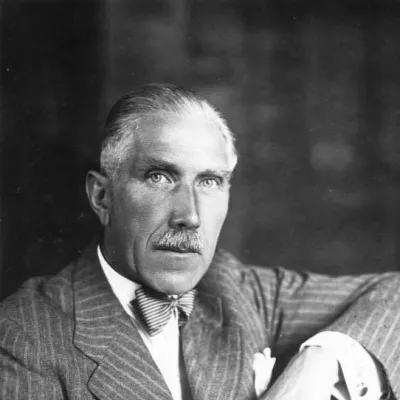
Franz Von Papen
Human Design Chart
Biography
Papen died on 22 May 1969, Obersasbach, Germany.
Franz Von Papen as a Generator 5/1 in Human Design
Generator 5/1 — Design at a Glance
Franz von Papen possessed enormous endurance and was capable of tackling tasks with great strength, comparable to that of a workhorse. This trait stemmed from his nature as a Generator, a configuration characterized by abundant sacral energy. However, what was crucial for his functioning was not the initiative but rather the reaction to external impulses. His energy was primarily released when he responded to signals in life rather than taking the first step himself.
This design carried two specific risks. When Franz von Papen engaged in activities that did not stir inner enthusiasm within him, he wasted his strength and tended towards exhaustion. Conversely, he suffered when prevented from pursuing projects where he still felt full of drive. The most successful strategy for him was to wait for a life signal and then act as soon as his inner self confirmed it positively. Living by this principle of reacting from the gut earned him profound feelings of fulfillment and made him almost unstoppable. If he constantly initiated himself or acted against his inner resonance, however, this led sooner or later to persistent frustration and a noticeable lack of energy. His design thus required a clear distinction between personal drive and external call to efficiently use his strength.
Emotional Authority
Franz von Papen exhibited a decision-making stance characterized by emotional wave movements. His internal authority carried the defined Emotional Center, meaning he was always subject to fluctuations between enthusiasm and rejection. The world appeared colored by his current mood; an event experienced as positive just moments ago could suddenly seem negative. This emotional intensity was only a momentary perception, not necessarily the deeper truth.
Quick, spontaneous decisions stemming directly from such a feeling state often proved problematic for his design and could generate negative consequences. The mechanics of his emotional authority required patience: he had to give himself time to let decisions mature. Only through repeatedly sleeping on things and consciously delaying did the intense feelings subside. This process created the necessary emotional distance that ultimately gave him clarity and calmness. Only when he took this path – hesitating and asking questions – could he navigate the decision-making process and make a well-founded choice. This was especially true for long-term steps with significant influence on his life course. Emotional authority always had priority over other defined centers in his chart, regardless of further configurations. Franz von Papen's path to clarity thus was not an immediate act of insight but rather a temporal process of fading and distancing.
The 5/1 Profile — Heretic / Investigator
Franz von Papen's design tended towards being perceived as an expert who offered deep insights from withdrawal for others' problem-solving. As a 5/1 – Hero and Researcher – he possessed the magnetic quality that made others seek his knowledge treasures. This, however, created a constant danger: without clear boundaries, overloading through environmental demands threatened him similarly to how a scientist might feel exhausted after intense consultation.
His mechanics linked Gate 28 with Gate 33. Gate 28 addressed life struggle, alliances, and the risk of misusing trust by sending others into conflict. It was about whether the fight was worth it and how intuitive alliances were dissolved or strengthened. In contrast, Gate 33 stood with its themes of withdrawal, reflection, and survival in a weak position. Here, unreflective courage was sheer foolishness; communication should only occur after an inner process was completed.
The tension lay in the fact that Line 5 (Gate 28) acted outwardly to seek or dissolve alliances while Line 1 (Gate 33) required the necessary withdrawal for finding meaning. Franz von Papen showed himself balancing between the pressure to deliver solutions for others and the necessity of withdrawing to gain clarity. The challenge was saying no when requests endangered his survival, rather than blindly reacting to provocations or conflicts in the collective. His design demanded completing the inner process of Gate 33 before applying his expertise from Gate 28.
Triple Split Definition — Defined & Open Centers
Franz von Papens Human Design shows a tendency towards constant mental pressure combined with strong inner vitality and emotional depth. As a Generator, he had a defined Sacral Center, providing him with a constant source of energy that could only be correctly utilized through reactions to external stimuli. His inner authority lay in the Solar Plexus; therefore, decisions required patience to follow the emotional wave and wait for clarity instead of acting impulsively.
Between Head and Ajna Centers there was a defined connection, creating permanent mental pressure to ask questions and form concepts. Since these centers do not have their own motoric function, he could not directly implement his thoughts into action; fighting against this timing often led to frustration or hasty misjudgments when trying to relieve the mental pressure through immediate action. Instead, his mental activity served to inspire others or put them under pressure to think for themselves.
Alongside the willpower from the defined Root Center and intuitive protection of the Spleen Center, open centers shaped his vulnerabilities. The undefined Heart Center lacked a constant energy source for promises; he tended to want to prove himself through overcompensation, ending in cycles of failure and self-doubt when trying to simulate willpower. Additionally, the open G Center suffered from searching for identity and direction; without a firm inner orientation, he was prone to adapting to his environment or taking false paths because he did not know who he truly was. The undefined Throat Center led him often to try to force attention through inappropriate speaking instead of waiting for natural timing for his voice.
Channels for intimacy, clarity and meaningful struggle.
Franz von Papen's configuration combined profound intimacy with sudden mental insights. Channel Pairing 59-6 rooted his essence in a powerful Quantum Sacral energy, uniting sexuality (Gate 59) and emotional wave movement (Gate 6). This created a strong desire for merging; his availability for intimacy allowed him to quickly penetrate the aura of others and ease confidentiality. The emotional wave determined the timing of each release, requiring patience to gain clarity about the depth of connection.
Parallel to this, Channel Awareness 61-24 shaped his mental structure. Inspired by the Gate of Secrets (61) in Head Center and processed through the Gate of Rationalizing (24) in Ajna Center, he experienced knowledge not as logical deduction but as spontaneous mutation or Satori. His mind sought silence to accept these unbidden insights that broke old abstract cycles. He was dependent on accepting that knowledge happens at his own pace and cannot be controlled.
Channel Life Struggle 38-28 drove him to find meaning in resistance. Through the Gate of Fighter (38) in Root Center and the Gate of Player (28) in Spleen, he stubbornly defended his individual integrity against external distractions. This struggle was essential for him to discover life's purpose; he risked security to stand up for values that seemed important.
Additionally, Gates like 33 (Reflection), 19 (Resources/Territory) and 27 (Care) in the Cross indicated a process of active withdrawal for strengthening before new cycles as well as a genetic role of care. In Personality, Gates like 54 (Ambition/Spirituality), 53 (Freedom/Pioneer Spirit) and 3 (Mutation/Order) emphasized the drive towards worldly enlightenment as a prerequisite for spiritual development and readiness to change in the survival struggle.
Individual Circuitry — Circuit Signature
Franz von Papens design is characterized by three separate, non-interconnected energetic blocks. This triple definition created parallel power fields that worked independently of each other with no direct permeability between them.
In the Knowledge Circuit, there were two isolated segments. The first connected Head to Ajna Center through Awareness Channel (Gates 24–61), promoting innovative and creative flashes of insight and the ability to transform new knowledge. The second segment linked Spleen and Root Centers via Life Struggle Channel (Gates 28–38), favoring instinctive reactions to challenges. Both areas remained energetically separate; creativity did not directly flow into stress management but existed as an independent dimension of individual identity and mutation.
The Protector Circuit formed a third, distinct block. Here, the Pairing Channel (Gates 6–59) connected Sacral with Solar Plexus Center. This connection utilized the vital life force of Sacral to guide it through emotional waves in Solar Plexus. It dealt with primal themes like protection, defense and preservation of genetics as well as care and nutrition. Since this circuit was separated from the other two, its instinctive, emotional protective function acted as an independent impulse, unaffected by creative or stress-induced energies of the Knowledge Circuit. Franz von Papen thus moved in these three distinct fields: creative transformation, instinct-driven struggle and emotional protection of the base.
Left Angle Cross of Alignment 2
Franz von Papen exhibited a fundamental disposition aimed at inner stability and finding a firm position. His design was marked by the left alignment cross, a configuration that does not seek external expansion or constant change but rather seeks to establish itself in a protected space. This means his focus lay on creating a foundation from which he could act safely, instead of impulsively reacting to external stimuli. The energy of this cross promoted the ability to resist and separate oneself from pressure, thereby maintaining a clear personal line. It was less about actively shaping the world or informing others but rather about vigilantly guarding one's own boundaries and finding order and stability within these limits. This orientation gave him a certain rigidity that also served as a protective mechanism to shield him from being overwhelmed by external demands. Franz von Papen lived in a dynamic of defense: He sought the safe harbor instead of navigating the open sea. His challenge was to prevent this inner solidity from turning into isolation, but rather use it as a foundation for a consistent presence that could withstand pressure.
Saturn Return · Uranus Opposition · Chiron Return · 2nd Saturn Return — Life Cycles
Franz von Papen's design was characterized by an acute ability to seek and establish structural stability during times of crisis. This fundamental disposition was evident early on: In 1905, at the age of 26 during his first Saturn Return, he married Martha von Boch-Galhau. This cycle marked the beginning of a phase of consolidation in which personal bonds served as a foundation for future responsibility.
When Uranus Opposition entered in 1919, this stability broke down. At 40 years old, Papen left the military – a radical break with established structures typical of this planetary cycle that dissolves old orders to make way for new paths. The following period was marked by this necessary detachment before a new direction could crystallize.
The Chiron Return in 1930 at the age of 51 ushered in a phase of bloom and fulfillment. Papen returned as a member of parliament to the Prussian Landtag. Here his life's mission found concrete realization: The ability to manage complex political tensions and build bridges became his central task.
This path led him in 1934, at age 55 during his second Saturn Return, to diplomatic missions as Hitler's special envoy to Vienna. This cycle demands proof of reliability in long-term commitments. Papen's design showed its strength: He did not use the tense situation for chaos but tried to smooth diplomatic waves through negotiation and structuring – a classic example of how his chart sought stability during turbulent times.
Generator · Emotional Authority — Synthesis
He was a Generator whose life was marked by deeply rooted sacral energy (Sacral Center) and the need to invest this in sustainable work. The profile as Hero/Researcher (Line 5/1) points towards a natural aptitude for gathering knowledge that he could provide to others – a process enhanced by the defined connection between Head and Ajna Centers, generating constant mental pressure toward inspiration and understanding. This ability to gain deep insights and share them seemed innate but required careful consideration through emotional authority to avoid unproductive zeal.
A central paradox lay in his energy source – the Sacral Center – being connected with the emotional wave (emotional authority). This meant that while he had immense endurance, decisions and actions always had to run through the filter of his fluctuating emotions. The career events documented show how this process influenced him: waiting for clarity often stood in tension with the need to apply acquired knowledge and transform it (Knowledge Circuit).
3 Defined Channels
Incarnation Cross - Left Angle Cross of Alignment 2
Solar Return
The Solar Return shows the moment when the sun returns to its exact birth position - your personal solar year.
Life Cycles
Discover the life cycles with a detailed triple view (birth chart, cycle chart, composite).
Human Design Profile
- Type
- Generator
- Strategy
- To respond - wait for something to respond to
- Authority
- Emotional Authority
- Profile
- 5/1 - Heretic / Investigator
- Definition
- Triple Split
- Incarnation Cross
- Left Angle Cross of Alignment 2
- Date of Birth
- 29.10.1879 15:00
- Place of Birth
- Werl, GER
Frequently Asked Questions
What was Franz Von Papen's Human Design type?
What profile did Franz Von Papen have?
What authority did Franz Von Papen have?
What incarnation cross did Franz von Papen have?
When was Franz von Papen born?
Discover your own Human Design
Are you also a Generator? Find out in a personal reading how to use your sacral energy correctly and discover deep satisfaction.
More Personalities
Back to overviewAaliyah

Alexia

Angèle

Anne-Marie

Arcángel

Arno