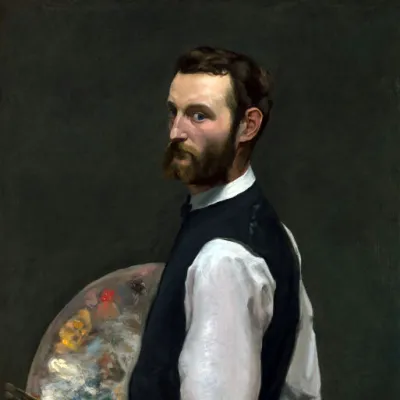
Frédéric Bazille
Human Design Chart
Biography
Frédéric Bazille — Manifesting Generator with Profile 4/6
Manifesting Generator 4/6 — Design at a Glance
Frédéric Bazille revealed himself as someone who possessed hybrid energy: the constant power of a Generator paired with the lightning-fast impact of a Manifestor. His design suggested that he could skip steps and quickly draw things into his life. This speed, however, was a double-edged sword. Often, he acted too quickly and left out important intermediate steps, which inevitably led him to return later and fill these gaps. This process of backtracking was the primary source of frustration, his specific non-self theme.
Furthermore, Frédéric Bazille tended to pursue multiple projects simultaneously, driven by various impulses from his environment. Without inner consent, his creative drive quickly turned into dissatisfaction. The path to deep satisfaction for him did not lie in linearly completing task lists but rather in the „play mode“. Here he could work on different things at once with variety and fun without feeling distracted.
His design strategy consisted of not initiating but reacting to life. He had to wait until his sacral center – his source of constant energy – gave a clear “yes”. Only when this inner resonance was present and he regularly checked if the projects still received this approval could he effectively utilize his immense creative power. Thus, potential frustration turned into deep satisfaction through creation itself.
Sacral Authority
Frédéric Bazille did not seek answers in his head but listened to the immediate reaction of his body. His decision-making occurred through inner resonance: a noticeable surge of energy or somatic confirmation signaled the right choice. This mechanism stemmed from his sacral authority, which served as the primary source for his actions. As a Generator, this authority was identical to his strategy, simplifying his process. A prerequisite was an open emotional center; thus, his reaction remained clear and unclouded by transient moods.
Frédéric Bazille's sacral authority manifested as gut feelings or energy surges in response to external stimuli. He learned to pay attention to these bodily signals – whether a subtle grunting sound, an affirming “Mhm” or a perceptible sigh. When his inner engine kicked in, he felt vital and alive. It seemed that he had access to inexhaustible energy, enabling him to tackle tasks with great enthusiasm. He did not proceed in a goal-oriented manner but found joy and satisfaction in the activity itself.
This internal voice was supported by his active spleen center, which gave him quick, instinctive reaction capability and direct access to physical well-being. This combination allowed Frédéric Bazille to trust his intuitive perception spontaneously and reliably without prolonged thinking or planning. His vitality thus was no coincidence but the direct result of a finely tuned internal mechanism that carried him through life.
The 4/6 Profile — Opportunist / Role Model
Frédéric Bazille's design indicated a tendency towards experimental behavior in youth, driven by the need for belonging. As a Profile 4/6 person, he acted before his thirtieth year under the dominant line 3, which encouraged him to experiment with relationships and friendships. This phase was characterized by seeking connection, where the “big heart” of line 4 always carried the risk of opening up to the wrong people and getting hurt.
His inner conflict lay in balancing the emotional need for belonging of line 4 against the intellectual desire of line 6 for detached reflection on life's meaning – a retreat to the “mountain peak”. The heart sought community, while the mind yearned for distance. This contradiction between head and heart could be confusing.
The mechanics described a transformation: after Saturn’s return, a maturation phase should set in where vigilance and stock-taking became important to avoid getting lost in intellectual enthusiasm. Frédéric Bazille never showed the full integration of this later phase. His design demanded a cautious balance, protecting his heart without closing himself off from the world – a process interrupted by his early death before the wisdom of the role model could fully take effect.
Single Definition — Defined & Open Centers
Frédéric Bazille had a constant inner foundation of four defined centers: Ajna, Throat, G Center, and Sacral. This gave him a steady mind, a reliable voice, as well as a clear identity and direction, supported by a generative energy source. His thinking was specific and trustworthy; he processed data continuously and spoke reliably from this mental process. His actions did not spring impulsively but rather from the sacral response to external stimuli, which allowed him deep satisfaction in correctly integrating his vitality.
In contrast to this stable infrastructure were five open centers: Head, Heart, Solar Plexus, Spleen, and Root. These served as windows to the environment. Without their own constant inspiration, Frédéric Bazille tended to absorb mental pressure or questions from others rather than generating them himself. He did not seek continuous willpower to prove himself but was vulnerable to cycles of promise and failure when trying to meet expectations. Emotions in his surroundings he absorbed like a barometer; often reflecting them without identifying them as his own, which could protect him from emotional overload if he recognized the source.
His open Spleen Center made him sensitive to well-being and fears in the environment. He tended to cling to people with defined Spleens to feel secure, carrying the risk of unhealthy dependencies. Ideally, he avoided spontaneous decisions as his instinct could be skewed by conditioning. Additionally, he took on the adrenalized stress and pressure from his surroundings through his open Root Center. Instead of mistaking this pressure for personal drive, it was crucial for him to recognize when this external push did not belong to him to avoid exhaustion or hyperactivity. This configuration shaped a life between inner mechanical stability and wide openness to the world's energetic and emotional currents.
Channels for rhythm, self-acceptance, curiosity and reflection.
Frédéric Bazille showed himself through a deeply rooted internal rhythm that allowed him to act independently of external pressure. His design inclined towards natural synchronization with the flow of life, coupled with radical acceptance of his own identity.
This attitude stemmed from two central connections between his Sacral and G Centers. The Channel Rhythm 5-15 connected Gate Fixed Rhythms (5) with Gate Extremes (15). This created a magnetic life flow based on firm habits while integrating the diversity of society into his personal rhythm. Bazille was closely tied to biological processes through this configuration; his timing was not driven by intellect or emotional waves but by universal love for humanity, propelling him forward. When he listened to this inner rhythm, everything seemed effortless and drew others into his energy flow.
Parallel to this, the Channel Exploration 34-10 shaped his essence. It connected Gate Power (34) with Gate Self Behavior (10). This mechanism promoted radical self-love and the ability to hold onto individual beliefs as long as they stemmed from an authentic reaction. Bazille served as a living example of how to honor oneself without controlling others. His aura encouraged those around him to accept their own uniqueness.
Additionally, individual gates influenced his perception. Gate 35 drove him towards change through interaction, while Gate 64 contributed to mentally processing past experiences for clarity on temporal sequences. Doubt from Gate 63 served as a catalyst for mental improvements. On the personality side, Gate 46 fostered devoted presence in the here and now and the care of his body as a temple, while Gate 43 prompted spontaneous insights he needed to communicate to gain recognition. Finally, Gate 31 supported the transmission of these inner forces into the collective.
Collective Circuitry — Circuit Signature
Frédéric Bazille exhibited a fortified, courageous individuality with strong internal convictions. His design connected the Sacral Center (Life Energy) directly to the Identity Center via Channel 10-34 in the Focusing Circuit. This coupling created an inward-focused, individualistic power stabilizing his self-worth. Since this circuit did not connect to the Throat Center, it was often difficult for him to verbally articulate these firm internal certainties; his convictions remained more silent than expressed.
Parallel to this, the Understanding Circuit worked through Channel 15-5 (Rhythm). While the general description of this circuit emphasizes logic and strategy, Frédéric Bazille specifically connected only the Identity Center with the Sacral Center here – the same centers as in the first circuit. This underscored his focused, rhythmic way of improving things free from emotional influence by the unconnected Solar Plexus Center.
A third aspect was the Meaning Circuit. Here he linked the Ajna Center to the Throat Center (Channel 11-56) and the Identity Center to the Throat Center (Channel 33-13). This configuration allowed him to reflect on emotional waves and past experiences, sharing these insights visually or through actions with others. The energy was cyclical, serving to learn collectively from the past. Together, these three circuits shaped his essence: a quiet inner strength combined with the drive to translate past experiences into present communication.
Right Angle Cross of Consciousness 4
Frédéric Bazille's Human Design profile included the configuration of the right cross of consciousness. Since there was no specific mechanical description or energetic impact provided, it wasn't possible to derive a clear behavior pattern from this aspect of his chart. This configuration represented a particular archetypal structure within his inner landscape, but its concrete manifestation in daily life could not be defined by the given data. It was an integral part of his energetic map that did not prescribe any specific direction or predefined strategy. Without further mechanical details, this component remained purely structural without leading to specific action impulses or character tendencies. It formed a backdrop against which other more clearly defined aspects of his design operated but carried no definitive narrative weight itself. For Frédéric Bazille, this was part of his individual constellation whose significance did not manifest in concrete life events or behaviors due to the underlying mechanics remaining undefined.
Saturn Return — Life Cycles
Frédéric Bazille's life abruptly ended at the age of 29 when he fell in battle during the Siege of Beaune-la-Rolande in 1870. This marked a sudden conclusion to his first Saturn return cycle, which typically begins around ages 27-30 and often signals the condensation of years of inner work and confrontation with personal creative or identity boundaries. For Frédéric Bazille, this phase did not unfold gradually but rather as an abrupt end. His death in this specific timeframe interrupted the natural maturation process that such a cycle usually facilitates. Instead of a gradual integration of gained experiences, there was an immediate halt. The mechanics here illustrate how external circumstances can overlay the inner rhythm of the Saturn return cycle. While others might build structure or solidify results from previous work during this period, Frédéric Bazille's potential was extinguished by the violent event. It remains an example that the cycle does not always lead to visible maturity but can also manifest as a sudden stop before the typical condensation of the first Saturn return is complete.
Manifesting Generator · Sacral Authority — Synthesis
Frédéric Bazille lived a life profoundly marked by inner dynamics. The combination of his manifesting generator strategy and sacral authority points to someone who had constant energy available yet was not destined to initiate things. Instead, he responded to life, finding satisfaction in playing with various possibilities and variety – as long as his inner authority agreed. This responsiveness, coupled with the defined Ajna Center, indicated a strong ability to develop concepts and express them, always filtered through sacral reactions. The profile of networker and role model underscores this oscillation between experimenting in relationships and later seeking deeper meaning, an ongoing balance between heart and mind.
A central paradox lay in the connection of quick responsiveness – typical for the manifesting component – with the necessity to listen to the sacral center and not make decisions from the head. This tension likely caused Frédéric Bazille to constantly oscillate between a drive to act quickly and the inner wisdom to reconsider steps and maintain his own rhythm. The open centers amplified this dynamic by making him receptive to external influences and emphasizing the need to free himself from conditioning to act authentically.
4 Defined Channels
Incarnation Cross - Right Angle Cross of Consciousness 4
Solar Return
The Solar Return shows the moment when the sun returns to its exact birth position - your personal solar year.
Life Cycles
Discover the life cycles with a detailed triple view (birth chart, cycle chart, composite).
Human Design Profile
- Strategy
- To respond - wait for something to respond to
- Authority
- Sacral Authority
- Profile
- 4/6 - Opportunist / Role Model
- Definition
- Single Definition
- Incarnation Cross
- Right Angle Cross of Consciousness 4
- Date of Birth
- 06.12.1841 21:00
- Place of Birth
- Montpellier, France
Frequently Asked Questions
What is Frédéric Bazille's Human Design type?
What Profile did Frédéric Bazille have in Human Design?
What Authority guided Frédéric Bazille?
What incarnation cross did Frédéric Bazille have?
When was Frédéric Bazille born?
Discover your own Human Design
Are you also a Manifesting Generator? Find out in a personal reading how to unfold your multi-talents and direct your energy wisely.
More Personalities
Back to overviewAldair
Alizée

Angeli
Arletty
Artus

Baekhyun