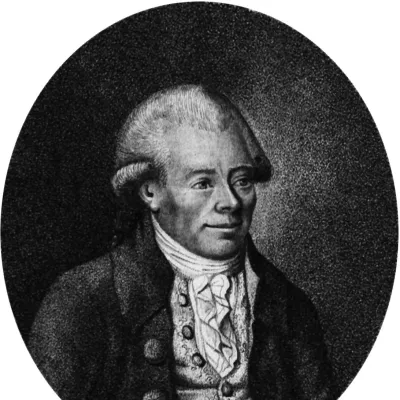
Georg Christoph Lichtenberg
Human Design Chart
Biography
Lichtenberg was the 17th child of a Protestant pastor, who taught him mathematics and natural sciences.
Lichtenberg did research in a wide variety of fields—including geophysics, volcanology, meteorology, chemistry, astronomy, and mathematics—but most important were his investigations into physics.
In 1777 he discovered the basic principle of modern xerographic copying; the images that he reproduced are still called “Lichtenberg figures.”
Lichtenberg was a most popular and respected figure in the European intellectual circles of his time.
He died 24 February 1799, Gottingen.
What does Generator 6/3 mean for Georg Christoph Lichtenberg?
Generator 6/3 — Design at a Glance
Georg Christoph Lichtenberg revealed himself as someone with immense inner endurance. His Generator design endowed him with a great sacral energy source that made him strong and resilient like a workhorse – provided he used this power for tasks that truly mattered to him. However, this energy was not available through sheer will alone. It only became effective when his system responded to external impulses. The motto was clear: Do not initiate but wait until life sends a signal and the sacral center responds with an inner 'yes'.
If he reacted in this way, it led to deep satisfaction and fulfillment. If he initiated out of his own drive or forced himself to work on things without internal resonance, he quickly fell into frustration. Two stumbling blocks shaped his potential: Either he wasted his strength on unwanted duties, leading to exhaustion, or he was prevented from pursuing his heart's project despite still having full energy available. His success thus did not depend on constant activity but rather on learning to respond intuitively to genuine opportunities.
Sacral Authority
Georg Christoph Lichtenberg revealed himself as a Generator whose decision-making was shaped by Sacral Authority. This inner leadership formed both his strategy and simplified the process of orientation in life. A prerequisite for this clear line was an open emotional center that ensured decisions were not made based on fleeting moods.
Sacral Authority responded to external stimuli with an immediate physical reaction. Lichtenberg felt this response as a gut feeling or surge of energy. Externally, it manifested in bodily sounds like grunts, hums, or a confirming 'mm-hm'. When his sacral motor engaged on a topic, he felt vital and alive. This allowed him access to virtually inexhaustible energy that enabled him to tackle tasks with great enthusiasm.
This configuration predisposed him for living through life with joy and satisfaction. He immersed himself in his activities without the need for strict purposefulness. The work itself was sufficient as motivation. Additionally, an activated spleen center supported quick, spontaneous reactions and decisions. Lichtenberg had immediate access to his physical well-being and instinctive perception, guided by this reliable inner voice that helped him find the right path at every moment.
The 6/3 Profile — Role Model / Martyr
Georg Christoph Lichtenberg revealed himself as someone seeking an extraordinary life far from standards, driven by internal restlessness. His Profile 6/3 determined: In the first three decades of his life, he lived as an experimenter (Line 3), conducting numerous self-experiments and confronting superior forces. This phase was marked by trial and error and the desire to avoid dependencies to counteract experiences of helplessness.
After his first Saturn return, around age 30, this dynamic changed. While experimentation slowed down, it never fully ended due to Line 3's permanent presence in his profile. Lichtenberg used his unusual experiences to become a wise and humorous role model. Responsibility and wisdom became natural for him.
At the same time, he sought inner peace (Gate 52, Line 6). This spiritual dimension went beyond earthly logic. He realized, however, that true stillness only arrived when the entire circuit was fulfilled. Neptune brought the risk of self-deception, which could serve as a substitute for genuine inner calm. Lichtenberg lived this tension between the adventurer's drive to experiment and the longing for peaceful serenity without ever losing the feeling of searching for something perfect he couldn't fully find.
Split Definition — Defined & Open Centers
Georg Christoph Lichtenberg was characterized by a reliable inner direction and identity. His defined G Center provided him with a stable self-understanding as well as a clear sense of his life mission, without being dependent on others. This inner strength worked together with the energy available to him as a Generator: The defined Sacral Center generated continuous vital force, which was only activated through reactions to external impulses. Lichtenberg thus had immense endurance for tasks that received his approval, which manifested in a persistent work ethic.
His communication was determined by his also defined Throat Center. It functioned as a steady channel for the expression of his inner truth, combined with the intuitive spontaneity of his defined Spleen Center. This allowed him to speak from the moment and trust existential intuitions rather than getting lost in considered concepts. The pressure of his defined Root Center drove him forward materially and ensured focused action capability in everyday life.
At the same time, Lichtenberg was vulnerable to conditioning through several open centers. His undefined Head and Ajna Centers meant that he absorbed mental inspirations and concepts from outside. He tended to identify with foreign ideas or feel the pressure to find answers that actually belonged to others. His open Heart Center lacked consistent willpower; therefore, he avoided making promises or proving his worth through competition. Additionally, his undefined Solar Plexus absorbed the emotions of the environment. Lichtenberg had to learn not to personalize these taken-on feelings in order to remain emotionally stable and avoid being drawn into conflicts that he actually wanted to avoid.
Channels for inspiration, leadership, focus and intuitive mastery.
Georg Christoph Lichtenberg was someone who influenced by example. The Channel of Inspiration 1-8 connected his G Center with the Throat Center, creating an effect through bold self-expression and leading by creative example rather than mere explanation. He lived out his individual direction to inspire others.
Parallel to this, he possessed collective leadership logic. The Alpha Animal Channel 7-31 also connected G with Throat Centers. This was not about sole rule but gaining trust and being invited from the majority to understand patterns. He sought his sphere of influence to show the way from a position of power without taking responsibility away from others.
His work style was characterized by intense focus. The Channel of Concentration 52-9 connected Root with Sacral Centers, creating a quiet pressure to stay still and keep distractions at bay. He evaluated details meticulously to perfect or correct patterns. This formative energy held his attention in one place until an inner signal prompted a reaction.
Furthermore, he combined intuitive depth with technical mastery. The Channel of Wavelength 48-16 connected Spleen with Throat Centers. Gate 48 sought life-critical information while Gate 16 perfected skill through repetition. He transformed pure ability into talent by deeply identifying and practicing a subject. This required recognition and resources to continue perfecting.
Additionally, Gates like 58 (Experiment), 21 (Control of Material Things), and 15 (Collective Behavior) were influential. Gate 20 promoted acting in the here and now as well as uniqueness. Gate 39 brought analytical provocation while Gate 44 showed vigilance in relationships. Gate 13 collected experiences for continuity, and Gate 25 introduced a mystical stance of innocence. These configurations shaped his work as an observer who recognized patterns, experimented, and inspired others to question and refine their own perspectives through precise expression and logical leadership.
Collective Circuitry — Circuit Signature
Georg Christoph Lichtenberg was marked by two separate but parallel energetic streams. The Knowledge Circuit connected his Throat with the Identity Center, promoting the expression of a unique individuality supported by the inspirational flashes of Channel 1-8. New insights should be formulated to highlight his own, unmistakable identity.
Parallel to this, the Understanding Circuit worked in two independent parts. A connection between Throat, Identity, and Spleen Centers enabled the sharing of logical, rational insights. Channels like 'The Wavelength' (48-16), 'The Alpha Animal' (31-7), and 'Concentration' (9-52) helped focus structures and develop strategies for the future – free from emotional influence.
A second isolated part of this circuit connected the Sacral with the Root Center. This direct connection provided a constant rhythmic energy base, but did not directly merge with the intellectual or linguistic processes of the other group. Georg Christoph Lichtenberg experienced these areas as coexisting forces: on one hand, creative individual articulation of new ideas; on the other, sober strategic analysis and a separate stable energy source in the lower body. This divided definition meant that he did not have a single continuous flow but carried various independent functional methods simultaneously.
Left Angle Cross of Demands 1
Georg Christoph Lichtenberg's design set a tendency towards internal tensions that resulted from the interplay of authority and submission. This configuration was referred to as 'the left cross of demands.' It described a characteristic rhythm: phases in which he wanted to assert his own impulses alternated with times when he submitted to external expectations or requirements. This pattern did not shape his life's path as an arbitrary back-and-forth but rather as a structural necessity of his system. The mechanics of this cross showed that his actions were often driven by the need either to exercise control or withdraw from it, in order to regulate internal pressure. It was not about a lack of determination, but rather a specific way of energy distribution that combined separation and adaptation within an ongoing, repeating cycle. Georg Christoph Lichtenberg lived out this dynamic by oscillating between the urge for self-determination and readiness for cooperation. This interaction significantly determined how he responded to demands from his environment and what role he took on in social or professional contexts. The design thus dictated a lifestyle defined by this polar experience of demands - both towards himself and others.
Saturn Return · Uranus Opposition · Chiron Return — Life Cycles
Georg Christoph Lichtenberg's design set a tendency toward structured advancement followed by later confirmation. In 1770, at the age of 28, he was appointed extraordinary professor for philosophy. This marked his first Saturn Return, a cycle in which years of groundwork often condenses into a solid result and strengthens one's position.
At the age of 40, another turning point occurred: In 1782, he became a member of the Natural Research Society in Danzig. This coincided with his Uranus Opposition, a phase that is often characterized by unexpected opportunities or necessary adaptations to changed external circumstances in Human Design. Here, the ability to utilize new networks and expand one's horizon was evident.
The peak of this development came in 1793 when he became a member of the Royal Society in London at age 51. This corresponded with his Chiron Return, the fulfillment cycle between the ages of 49 and 51. During this phase, one's incarnation cross increasingly unfolds in life; meaning and purpose become experiential if one has lived according to strategy and authority. For Georg Christoph Lichtenberg, this was not a moment of healing old wounds but rather the bloom of his life task: International recognition confirmed the effectiveness of his path and anchored his contribution within a broader community. This sequence illustrated how inner structure and external confirmation can work together throughout the design.
Generator · Sacral Authority — Synthesis
Georg Christoph Lichtenberg was a Generator whose life was marked by a constant flow of sacral energy (Generator Type). This energy sought expression through the Throat Center, which was fed from various centers and enabled him to communicate in an unmistakable way (defined Throat Center). The profile as a role model and experimenter (6/3) points to someone who developed both wisdom and responsibility while continuously seeking new experiences and forms of expression - a pattern that manifested in his professional stations (Saturn Return, Uranus Opposition, Chiron Return). The Knowledge Circuit amplified this drive towards individuality and transformation by encouraging him to always develop new perspectives and carry them outward through his voice (Channel 1-8).
Lichtenberg lived out the paradox of seeking deep, sacral satisfaction in work (sacral authority) and an inner restlessness that constantly drove him to new explorations (Line 3 in the profile). He found energy in activities that truly resonated with him, yet seemed never fully satisfied with the ordinary. This oscillation between the pursuit of perfection and the drive for innovation shaped his character and led him to always tread new paths and transform knowledge (Knowledge Circuit).
4 Defined Channels
Incarnation Cross - Left Angle Cross of Demands 1
Solar Return
The Solar Return shows the moment when the sun returns to its exact birth position - your personal solar year.
Life Cycles
Discover the life cycles with a detailed triple view (birth chart, cycle chart, composite).
Human Design Profile
- Type
- Generator
- Strategy
- To respond - wait for something to respond to
- Authority
- Sacral Authority
- Profile
- 6/3 - Role Model / Martyr
- Definition
- Split Definition
- Incarnation Cross
- Left Angle Cross of Demands 1
- Date of Birth
- 01.07.1742 17:00
- Place of Birth
- Ober-Ramstadt, Germany
Frequently Asked Questions
What was Georg Christoph Lichtenberg's Human Design type?
What profile did Georg Christoph Lichtenberg have in Human Design?
Which authority guided Georg Christoph Lichtenberg?
What incarnation cross did Georg Christoph Lichtenberg carry?
When was Georg Christoph Lichtenberg born?
Discover your own Human Design
Are you also a Generator? Find out in a personal reading how to use your sacral energy correctly and discover deep satisfaction.
More Personalities
Back to overviewAaliyah

Alexia

Angèle

Anne-Marie

Arcángel

Arno