
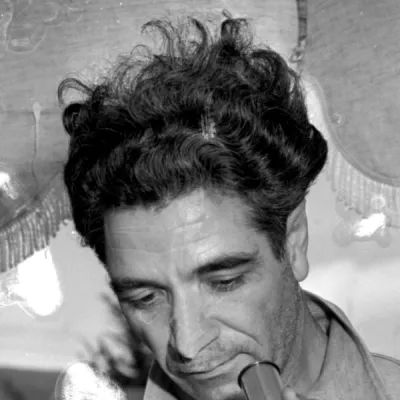
George Adamski
Human Design Chart
Biography
He died February 26, 1965 of a heart attack in Silver Spring, Maryland at age 73
The Human Design of George Adamski: Manifesting Generator 1/3
Manifesting Generator 1/3 — Design at a Glance
George Adamski was a blend of Manifestor speed and Generator energy. His design allowed him to skip steps and achieve results quickly, paired with the need to respond to impulses rather than initiating independently. As a manifesting generator, he had constant sacral energy, which required reacting to life impulses. Unlike pure generators, however, he could take shortcuts when acting and draw things into his life rapidly.
This speed carried risks, though. Sometimes George Adamski acted too quickly and skipped important steps, leading him to backtrack to complete missing stages. This caused frustration, the central non-self theme of his type. Additionally, through his dynamics, he tended to pursue multiple projects simultaneously by responding to various impulses. When strategy and inner authority did not align, his creative drive could swiftly turn into dissatisfaction.
The solution for him lay in the 'play mode' and constant verification of sacral resonance. Only when his center gave a clear yes after testing could he draw deep satisfaction from his work. Under these conditions, parallel working was no obstacle but rather a source of his creative power as long as variety and fun were prioritized.
Emotional Authority
George Adamski was subject to an emotional wave that manifested in constant ups and downs of his feelings. His inner authority lay in the defined Emotional Center; this instance always took precedence over all other defined centers of his design. The world appeared colored by his current mood: at one moment, he was totally enthusiastic about something, only to see it completely negatively the next. This immediate feeling, however, was just a snapshot, a first impression that did not yet represent his truth. Quick, spontaneous decisions based on this emotion could therefore have very negative consequences.
For George Adamski, it was crucial to take time and patience in decision-making processes. This process required multiple nights of reflection as well as allowing oneself to hesitate and be asked repeatedly. Over time, intense feelings subsided, creating emotional distance and clarity along with calmness. Only then had he completed the decision-making process. This mechanism was primarily relevant for long-term life-defining decisions, enabling him to gain deeper and more comprehensive insights beyond the transient emotional coloring of the moment.
The 1/3 Profile — Investigator / Martyr
George Adamski emerged as a person whose judgments were based on a unique synthesis of theoretical knowledge and hard practice. His design, with Profile 1/3 (Researcher/Experimenter), shaped a life task that oscillated between the drive for deeper understanding and the necessity of experimentation. The energy of Line 1 propelled him to learn more constantly, occasionally leading him to hesitate because he felt he did not know enough yet. This theoretical demand stood in tension with Line 3, which called for a direct path through trial and error.
This configuration meant that George Adamski only considered insights valid if they were both intellectually and empirically tested. Line 3 brought the potential of pressure or melancholic depression if no transformation occurred; this state was, however, transformed by his active experimental drive. He learned from mistakes and untangled himself to find order. The result was a high degree of credibility in his statements: when he deemed something correct, he had previously tested it both mentally and practically thoroughly. His design suggested that true understanding for him could only arise through the resolution of this cyclical process of planning and practical verification.
Split Definition — Defined & Open Centers
George Adamski revealed himself as someone with a steady, inner energy and expression mechanism. His defined Sacral Center provided a constant vital power source that he utilized through reactions to life rather than initiating actions. This energy flowed through his also defined Heart Center, giving him willpower and the desire to determine his own resources and fulfill promises. His communication was characterized by a defined Throat Center: He spoke not from mental speculation but from the reliable source of his motor and will centers.
Additionally, his defined Solar Plexus acted as an emotional authority; he needed time to move through the emotional wave before clarity emerged. His defined Root Center generated a constant pressure to maintain the life impulse and cope with stress.
In contrast, his Head, Ajna, and G Centers were open. This meant no fixed mental inspiration or identity of his own. Instead, he tended to adopt others' mental questions or seek a "borrowed" identity in relationships due to the open G Center lacking a set direction. The open Spleen Center made him vulnerable to conditioned survival fears and the temptation to act spontaneously for a sense of security – a trap that often led to unhealthy dependencies through impulsivity. His mechanism required patience: waiting for the sacral response, allowing the emotional wave to pass, and refraining from mental or identity-based initiatives to avoid resistance and express his inner truth.
Channel 40-37: Community — Channels & Gates
George Adamski revealed himself through a fundamental frequency that oscillated between inner tension and sudden impulses. The Channel of Mutation 60-3 connected his Root Center with the Sacral Center. This energy was pulsing and often marked by melancholy. George Adamski had to accept limitation (Gate 60) and go beyond the confusion of a new beginning (Gate 3) to enable evolutionary change. He did not act through forced effort but reacted from the Sacral Center to the right impulse. Patience was his key, as change would unexpectedly occur, like music in the pauses between notes.
Parallelly, the Channel of Transience 35-36 connected his Solar Plexus Center with the Throat Center. This emotional channel drove him to seek new experiences, often motivated by the unconscious desire of Gate 35 ("I was there already"). Gate 36 perceived inexperience as inadequacy, creating crises to set things in motion. George Adamski learned through this emotional depth and wisdom from experience, yet he fluctuated between enthusiasm and disappointment when new experiences did not meet expectations.
In the background stood the Personality Channel of Community 37-40, connecting his Solar Plexus Center with the Heart Center. This concerned the strategy of entering into agreements. Gate 40 sought reward and pauses in serving others, while Gate 37 searched for recognition as a whole. George Adamski needed direct personal contacts to join a community and understood the necessity of solid contracts ("I do this for you if you do that for me"). This configuration promoted an understanding of practical cooperation without rigid hierarchies, where he functioned as a bridge between individuals.
Tribal Circuitry — Circuit Signature
George Adamski revealed himself through his split definition as someone in whom two parallel, not directly connected energetic systems were at work. One system linked the Sacral with the Root Center via the Knowledge Circuit. Here, Channel 3-60 activated the energy of Mutation – a deviation from the known. This shaped a drive for individual transformation and new knowledge, driven by the pulsating life force of the Sacral.
The second system encompassed the Throat, Solar Plexus, and Heart Centers. The Meaning Circuit linked the Throat and Solar Plexus Centers via Channel 35-36 (Transience). This promoted a cyclical, emotional reflection on the past. Insights were expressed in waves from the Solar Plexus through the Throat Center to be shared with the collective. Parallel to this, the Ego Circuit connected Heart and Solar Plexus Centers via Channel 37-40 (Community). This emphasized cooperation and a balance between giving and taking for resource building within the group. Since this circuit did not connect to the Sacral Center, rest periods were necessary to regenerate energy.
The tension lay in the interplay of these separate groups: The mutating drive for individual innovation (Sacral/Root) stood alongside the necessity to process past emotions and share them in community (Throat/Solar Plexus/Heart). George Adamski lived this duality – on one hand as a driving force for new things, on the other hand as a reflective participant in social structures.
Right Angle Cross of Laws 1
George Adamski was marked by the right cross of Law 1. This configuration described an inner compass directed towards seeking universal principles and understanding the order behind chaos. It wasn't an intellectual exercise but a deep existential necessity to recognize and understand the underlying laws governing life.
This design inclined him to discover patterns in seemingly random events. George Adamski was someone who sought the structure that connects everything. The mechanics of this cross acted like a filter: it helped him distinguish what is essential from what isn't by focusing on fundamental truths applicable to all.
It was about decoding the rules by which life and consciousness align themselves. George Adamski lived with this orientation, always looking beyond the surface. His path was driven by the desire not just to see these laws but also to embody them in his own existence. The energy of this cross created an inner stability based on the realization that everything follows a higher law. This shaped how he perceived and moved through the world – always with an eye towards the big picture and connecting forces.
Saturn Return · Uranus Opposition · Chiron Return · 2nd Saturn Return — Life Cycles
Throughout his life, George Adamski experienced four significant structural turning points that defined his design. The first Saturn return cycle served as a fundamental phase of self-definition and building personal responsibility. During this time, early experiences coalesced into a sturdy internal structure.
The Uranus opposition acted as a disruptive impulse. It demanded breaking free from outdated patterns and often forced a realignment to honor one's true essence. This cycle brought turmoil that was necessary to break rigid stances.
Then came the Chiron return cycle, marking a phase of profound fulfillment. Here it showed that life found meaning and purpose if George Adamski had acted in accordance with his strategy and authority beforehand. It wasn't healing in a medical sense but rather the unfolding of the incarnation cross into tangible reality.
Finally, the second Saturn return cycle concluded this developmental sequence by serving to consolidate and transfer the gained wisdom to the next generation or level. These four major cycles formed the archetypal framework within which George Adamski's inner development unfolded and his outer structuring took place. They created conditions for maturation without specifying life dates but purely mechanically.
Manifesting Generator · Emotional Authority — Synthesis
George Adamski lived a life marked by the dynamic interplay of initiation and reaction. His design as a Manifesting Generator with emotional authority points to someone who both had the ability to set things in motion and the necessity to wait for external impulses. This combination manifested in a personality characterized by swift action and deep reflection – an ongoing balance between the urge to manifest and the emotional wave requiring clarity. The connection of his defined heart with the Throat Center amplified this expression, giving him strong willpower that had to be channeled through his emotional authority. With his open G Center, he constantly sought validation and direction from the community while his undefined Root Center made him sensitive to others' needs.
A central paradox in Adamski's design lies in the interplay of spontaneity and emotional depth. On one hand, he was destined for quick action and initiating things; on the other, his emotional authority required careful consideration and waiting for the emotional wave to gain clarity. This tension between the impulsive and reflective shaped his character, leading him both to bravely forge new paths and value the wisdom of pausing. The combination of sacral energy and emotional depth points to a person capable of profound experiences and sharing them with others.
3 Defined Channels
Incarnation Cross - Right Angle Cross of Laws 1
Solar Return
The Solar Return shows the moment when the sun returns to its exact birth position - your personal solar year.
Life Cycles
Discover the life cycles with a detailed triple view (birth chart, cycle chart, composite).
Human Design Profile
- Strategy
- To respond - wait for something to respond to
- Authority
- Emotional Authority
- Profile
- 1/3 - Investigator / Martyr
- Definition
- Split Definition
- Incarnation Cross
- Right Angle Cross of Laws 1
- Date of Birth
- 17.04.1891 02:07
- Place of Birth
- Bromberg, Poland
Frequently Asked Questions
What is the Human Design type of George Adamski?
What Profile did George Adamski have in Human Design?
What Authority did George Adamski have?
What incarnation cross did George Adamski have?
When was George Adamski born?
Discover your own Human Design
Are you also a Manifesting Generator? Find out in a personal reading how to unfold your multi-talents and direct your energy wisely.
More Personalities
Back to overviewAlain-Fournier

Aldair

Alizée

Angeli

Arletty

Artus
