
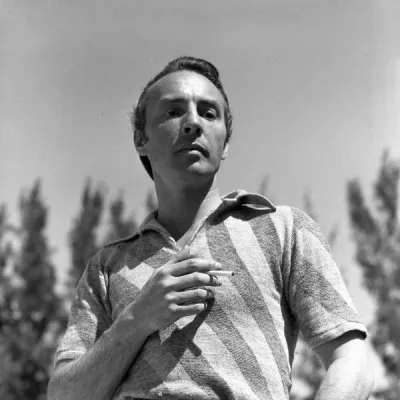
George Balanchine
Human Design Chart
Biography
Born Georgi Melitonovich Balanchivadze in Saint Petersburg, Russia, he was exposed to music during his childhood by his father, a composer. As a result, he gained knowledge of music that was far superior to that of his fellow choreographers. At the age of five, he was already studying the piano, and by nine, he was studying dance at the St. Petersburg Academy. His debut came at the age of ten when he danced the role of a cupid in the Mariinsky Theatre Ballet Company’s production of "The Sleeping Beauty." In 1921, following his graduation from the Imperial Ballet School, he enrolled in the State Conservatory of Music where, for three years, he intensively studied musical theory, including composition, harmony and counterpoint, along with undertaking further piano instruction. By 17, he joined the Mariinsky Company as a member of the corps de ballet, and staged one work for them, called "Enigmas."
Most of his energy during the early 1920s was concentrated on choreographic experimentation. The vastness of his musical training made it possible for him to achieve phenomenal communication with the composers of the day, as well as endowing him with the ability to reduce orchestral scores on the piano; this skill proved an invaluable aid when he translated music into dance.
George Balanchine as a Projector 5/2 in Human Design
Projector 5/2 — Design at a Glance
George Balanchine appeared as someone who could immediately identify problems in other people's systems. His Human-Design type, Projector, gave him an aura that functioned like a bright flashlight: it shone light directly on areas in his surroundings that were still in the dark or not functioning optimally. However, this ability to see flaws in the system instantly could be off-putting when he addressed these shortcomings directly – similar to shining a bright light in someone's face and openly criticizing their relationship issues.
Instead, his most effective approach was to serve as a harmonious role model himself. By simply glowing pleasantly, he naturally attracted others who then sought advice from him. His central strategy therefore involved waiting for an appreciative and sincerely meant invitation from other people. This was crucial in order to avoid bitterness – the non-self theme of Projectors – and instead be rewarded with success.
Furthermore, George Balanchine suffered from the absence of a constant energy source due to his undefined Sacral Center. Unlike Generators who have a steady life force, he experienced phases of high activity followed by mandatory rest periods to prevent burnout. Traditional work systems often did not take this need for regeneration into account, which challenged his energy management.
No Inner Authority
George Balanchine had no inner authority, a rare configuration of the mental projector. His decision-making ability did not arise from an internal compass but was exclusively through external exchange and resonance in his open centers. In dialogue with others, dormant potentials were activated; these energetic interactions provided him with information that would otherwise be inaccessible to him. Through this high resonance capability, he could examine issues from many perspectives and express them differently.
This process of information filtering was complex and required time. After the active exchange, George Balanchine withdrew to evaluate in isolation. In this quiet period, he identified the red thread, distinguished what made sense and belonged to him, and structured the essential elements out of a mass of data. This ability to develop specific intelligence through filtering formed his capital for success.
A key factor for him was choosing the environment. He sought places where he felt comfortable and could exchange ideas confidently with the right people. Over time, this secure framework deepened his sense of what was right for him. Without this protective space, the necessary evaluation of collected impulses would have been hardly possible. His openness was not a lack but an instrument to gain clarity through resonance and unfold his unique intelligence.
The 5/2 Profile — Heretic / Hermit
George Balanchine's Design created a fundamental inner conflict: the drive for public leadership and admiration clashed with the need to withdraw. As a Hero/Natural Talent (5/2), he carried the tension between wanting to offer practical solutions to others and the impulse to retreat into his "cave" to work undisturbed.
The mechanics of Line 5 required him to act as an example and set boundaries to enable mutations. Yet, until he was discovered, he used the time in isolation to prepare for this role. Passive waiting for discovery would have led to frustration; being a Hero did not function as a "lone wolf." Instead, he had to actively learn to step onto the stage despite his inclination towards withdrawal.
Simultaneously, Line 2 shaped his behavior through an unconditional pursuit of personal victory. Here intuition was crucial and the willingness to take risks or even violate principles if it served the purpose. There was no guarantee of success, but the risk was calculable and formed the core of his personal life's meaning. George Balanchine therefore had to find a balance: not only develop his gifts in secret but also trust himself to use them publicly to avoid confusion through poor timing. Once he was out there, his presence was valued, provided he maintained sufficient space for necessary alone time and clear boundaries.
Single Definition — Defined & Open Centers
George Balanchine's Human Design profile indicated a tendency towards stubborn, intellect-driven decision-making. His architecture was characterized by two strong poles: the defined Ajna Center and the defined Throat Center. This configuration created a persistent mental function; he always thought in specific ways and directly expressed these concepts. The connection between Mental Consciousness and Communication allowed him to articulate what he conceptualized, making his thoughts reliably manifest in the world.
However, this structure also brought a danger: identifying the mind as the sole authority. When Balanchine was overly dependent on Ajna, he tended to waste energy clinging obsessively to incomplete actions or decisions that could no longer be completed. This led to internal tension and the feeling of incapacity when what was said could not be fulfilled.
This defined mental approach contrasted with his open centers. The open Head Center made him vulnerable to mental pressure and confusion from the environment; he tended to engage with others' questions or seek inspiration to silence his own mental monologue. His open G Center meant no fixed identity; he relied on relationships and places to initiate direction rather than setting a personal course. The open Heart Center led to not being designed for consistent willpower or keeping promises, which could entangle him in spirals of self-proving when trying to demonstrate value through performance.
Additionally, his Sacral, Solar Plexus, Spleen, and Root Centers were open. This made him extremely sensitive to foreign energies: he absorbed the stress of the environment (Root), emotions from others (Solar Plexus), and the vital energy of others (Sacral), which could lead to exhaustion if boundaries were not set. The open Spleen Center made him vulnerable to fears and clinging to unhealthy situations out of a false sense of security. Balanchine's design required deep trust in his inner authority to avoid overloading these open fields through conditioning.
Channels for insatiable search and new perspectives.
George Balanchine's Human Design profile indicated an insatiable search, driven by the need to transform abstract ideas into influential stories. This configuration marked him as a storyteller who was less interested in dry facts than in how narrative parables could teach and entertain others.
Central to this mechanism was Channel of Curiosity 11-56. It connected the Ajna Center with the Throat Center through Gate 11 (Ideas) and Gate 56 (Inspiration). This connection created an energy that constantly sought new perspectives, not to fixate on final truths but to share discoveries socially. The creativity lay in magically linking concepts: Balanchine took individual pieces of information, filled gaps with imagination, and formed stories that engaged the audience's emotions and fantasy. It was about showing what he had discovered rather than finding definitive answers. His stories served to enable others to test new belief systems for their usefulness in their own lives.
This narrative power was reinforced by additional gates in his design. Gate 28 (The Player) promoted the ability to take risks in the present moment and hear personal meaning in the current moment, giving his performances an immediate, risk-taking quality. Simultaneously, Gate 27 (Care), which enriched activities with altruistic warmth and concern for the collective, endowed his stories with a deep human resonance.
In the background, gates like 60 (Accepting Limitations) and 17 (Logical Teaching/Succession) shaped the structure of his messages. Gate 60 brought a melancholic depth that was transformed through creativity, while Gate 17 focused on logically organizing for the future and understanding fundamental rights. Gate 47 (Understanding) helped draw collective meaning from past experiences rather than getting lost in personal confusion. Finally, Gate 45 (Tribe Level) conveyed a royal hierarchy and willpower, which endowed his narratives with an authoritative energy that connected the collective. Together, these elements created a style that worked through emotional intelligence and narrative magic.
Collective Circuitry — Circuit Signature
George Balanchine exhibited a cyclical, emotional processing of the past. His energy followed wave-like movements with clear beginnings, middles, and ends, driven by deep curiosity. This configuration directly linked his Ajna Center (inner vision) to his Throat Center (expression).
The Meaning-Making Circuit directed his attention away from cool logic towards feelings and past experiences. As this energy flowed in waves, it was subject to natural fluctuations. The right side of the chart focused on reflecting earlier events to decipher underlying meaning. These felt insights served not only for personal clarity but were meant to be shared with the collective. Through this sharing, the mechanism enabled a communal learning from the past. The specific connection between Ajna and Throat through Channel of Curiosity (Gate 11/56) structured this process: inner visual or emotional insights were translated into words or actions to make them accessible for others. It was an energetic dynamic that did not view the past as closed but rather as a source for current, shared significance.
Left Angle Cross of Distraction 2
George Balanchine's design carried the signature of the left Deviation Cross 2. This configuration shaped a fundamental disposition in which attention could easily be diverted from central goals. The left Deviation Cross 2 describes a specific energetic pattern complex in Human Design. It marks a tendency to be swayed off course by external stimuli or internal doubts. For George Balanchine, this meant that his inner compass was susceptible to disturbances. The mechanics of this cross show how energy flows into lateral channels rather than moving forward directly. This often resulted in moments of dissonance or hesitation. George Balanchine had to learn to recognize these deviations to not lose sight of his own direction. The structure of this cross acts like a filter that complicates clarity by generating additional options or concerns. Without specific Gate or Channel indicators, the impact remains general: an ongoing challenge to maintain focus. Thus, George Balanchine's chart revealed a person whose energy flow was characterized by this particular Cross configuration. It was not a lack of will but rather a mechanical property of his design. This deviation tendency was an integral part of his inner dynamics. It shaped his way of dealing with decisions and priorities. The left Deviation Cross 2 thus created the backdrop on which George Balanchine operated. It determined the quality of his attention and his reactions to complex situations.
Saturn Return · Uranus Opposition · Chiron Return · 2nd Saturn Return — Life Cycles
George Balanchine's professional development was structured by two prominent planetary cycles: the first Saturn return and the Uranus opposition. These mechanisms shaped the path from personal establishment to institutional foundation. In 1933, at age 29, the first Saturn return occurred. This cycle often condenses years of groundwork into a solid result. Balanchine used this moment for the founding of Les Ballets 1933 and met Lincoln Kirstein. It was a phase of consolidation where his artistic vision could be set on stable ground.
Later came the Uranus opposition, a cycle that demands profound changes and breaking with old structures to enable something new. In 1946, at age 42, Balanchine founded the Ballet Society, which later became the New York City Ballet. This corresponded to the characteristic drive of this mechanism to break existing boundaries and create innovative forms. The Uranus opposition pushed him not only to dance but also to establish his own institution that permanently anchored his visionary approach. Both cycles showed themselves catalytically for his career: Saturn provided the necessary structure and validation, while Uranus enabled the bold step towards an independent, pioneering organization. His design laid this tendency to connect personal milestones with major structural innovations.
Projector · No Inner Authority — Synthesis
George Balanchine was a Projector whose life was marked by a deep ability to recognize patterns and uncover flaws in systems (Gate 11). This gift manifested not through direct speech or correction but in a subtle glow – a presence that attracted others to seek solutions themselves. His open design, particularly the undefined centers below the Throat Center, made him receptive to the energies of his environment, enhancing his ability to grasp dynamics in relationships and groups. He did not live from an internal, constant energy source but required stimulation and exchange with others to be successful.
A central paradox in Balanchine's design lay in the interplay between his need for recognition (Line 5) and his tendency towards isolation (Line 2). He was a Hero who first perfected his gifts in silence before presenting them to the world. This tension led to an ongoing search for the right moment – the time when his contribution did not seem intrusive but as a natural extension of the existing whole. The connection between Ajna and Throat Center (Channel of Curiosity) suggests that he shared his insights through stories and presentations that inspired others and prompted reflection.
1 Defined Channel
Incarnation Cross - Left Angle Cross of Distraction 2
Solar Return
The Solar Return shows the moment when the sun returns to its exact birth position - your personal solar year.
Life Cycles
Discover the life cycles with a detailed triple view (birth chart, cycle chart, composite).
Human Design Profile
- Type
- Projector
- Strategy
- Wait for the respectful invitation
- Authority
- No inner authority - learn more
- Profile
- 5/2 - Heretic / Hermit
- Definition
- Single Definition
- Incarnation Cross
- Left Angle Cross of Distraction 2
- Date of Birth
- 22.01.1904 12:58
- Place of Birth
- St.Petersburg, Russia
Frequently Asked Questions
What was George Balanchine's Human Design type?
What profile did George Balanchine have?
What authority did George Balanchine have?
What incarnation cross did George Balanchine have?
When was George Balanchine born?
Discover your own Human Design
Are you also a Projector? Find out in a personal reading how to unfold your leadership qualities and recognize the right invitations.
More Personalities
Back to overviewSissy Spacek

Aaliyah

Alain-Fournier

Alexia

Alizée

Anémone
