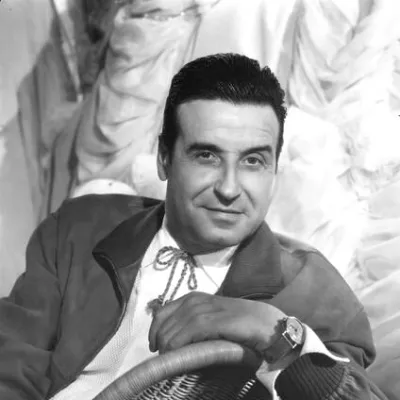
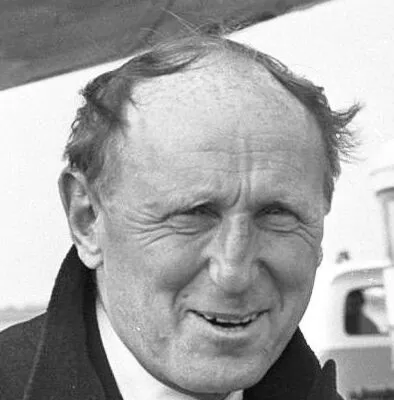
Photo: Wikimedia Commons
George Nader
Human Design Chart
Biography
In the mid 1960s, news of Nader’s private life reached the editors of scandal sheet Confidential, which threatened to publish the details of Nader’s supposed relationship with Rock Hudson. According to many Hollywood whispers, the studio cut a deal and agreed to fire Nader if the information about Hudson was suppressed. Nader then moved to Europe, where he appeared in a number of films, including a series of German-made adventures in which he played FBI agent Jerry Cotton.
Nader’s lifetime companion was Mark Miller, whom he had met in 1947 and they remained together since. The couple had met Rock Hudson in early 1951 and became good friends: neither was involved with Rock sexually. Hudson later named Nader one of the heirs to his estate.
After retiring from acting in 1973, Nader took up writing. His books include the 1978 science-fiction novel "Chrome" and "The Perils of Paul," a novel about gays in Hollywood that he co-wrote with Miller and did not want published until after his death. Nader came out of the closet in 1986.
A longtime resident of Palm Springs, he had developed a bacterial infection in September 2001 following a trip to Hawaii. He died at 80 of cardio-pulmonary failure, on 4 February 2002 in Woodland Hills, California. Tony Curtis called Nader "one of the kindest and most generous men I've ever known." "George has filled my life with happiness that knows no bounds," said Miller, Nader's partner of 55 years. "He is the most loyal and faithful friend and partner anyone could have.
The Human Design of George Nader: Projector 6/2
Projector 6/2 — Design at a Glance
George Nader appeared as someone with a focused, penetrating presence. His design as a Projector inclined him to illuminate systems and people with a clear, almost cutting sharpness. He had the ability to instantly recognize where in the environment or in other people connections were not functioning or were in the dark. However, this perception was not available as a constant, personal life energy, as his Sacral Center was undefined. Instead, he acted like an intense light source that could be directed specifically at weaknesses.
This mechanism meant that a direct, unmitigated addressing of errors in his environment often met resistance, as the intensity of his gaze could be perceived as unpleasant. The most effective expression for George Nader, therefore, did not lie in actively enforcing analyses, but in waiting for an honest invitation. When other people sought his clarity and asked for advice, he could effectively bring his insights to bear. Without this recognition, his design tended to express itself as bitterness, as his specific gift was not valued. His success depended largely on utilizing this dynamic interaction of invitation and guidance, rather than fighting against the resistance of the environment.
Splenic Authority
George Nader showed a decision-making process based on a fine, spontaneous inner impulse. His inner authority lay in the defined Spleen Center, meaning he possessed a pronounced survival intelligence. This intuition functioned as a reliable indicator of health and well-being; his first impulse was always the right path to shield himself from harmful influences and protect himself.
For the Spleen Center to act as authority, both the Emotional and the Sacral Center were open in his design. This configuration is specific to Projectors or Manifestors. Since the Spleen voice was a very subtle impulse that only appeared once in the immediate moment, it required George Nader to be highly vigilant, not to ignore it or have it drowned out by external influences. A brief retreat could be helpful in decision-making to perceive this fine sound.
Since he only knew what was right for him in the moment, his plans often changed at the last minute. Long-term commitments were therefore difficult; he needed a lot of freedom and flexibility in his life to react spontaneously. This structure shaped his lifestyle, guiding him to not commit himself much and instead trust the immediate moment to preserve his health and well-being.
The 6/2 Profile — Role Model / Hermit
George Nader's design was characterized by a clear two-phase life path, structured around the Profile 6/2, the Role model, and the Nature Talent. In his youth, before the age of 30, the energy of the 3-line dominated. This led to a phase of intense experimentation, marked by trial and error. Errors here did not serve as an endpoint, but as necessary retreat moments that allowed him to learn from his own experiences and reorient himself.
With the entry into the third decade of life, the 6-line was activated, marking a fundamental shift in his inner stance. George Nader increasingly withdrew to look at his earlier experiments from a distance. This phase was characterized by deep introspection, healing, and self-awareness. The themes of the 6-line, especially the acceptance of impermanence and transformation, became central. Instead of fighting against change, he sought inner calm, even if the fear of material failure or depressive tendencies threatened when impermanence was perceived as unstable.
At the same time, the Gate 56 was active in him, which stands for connection and an inspiring, almost genius-like aura. Originally appearing isolated, this energy found continuity through recognition and collaboration. After years of reflection, George Nader finally emerged as a wise person from his inner 'cave'. His ability for deep introspection and the life wisdom gained from it became visible to others, who now came to him to share in this insight and learn from his transformed stance.
Split Definition — Defined & Open Centers
George Nader was characterized by a persistent mental drive to question and understand connections. His defined Head and Ajna Centers created a constant pressure of inspiration, driving him to develop concepts. These thoughts flowed through his defined Throat Center into clear communication, while his defined G Center provided a firm inner identity and direction. His defined Spleen Center gave him a spontaneous intuition for the momentary well-being.
At the same time, George Nader was vulnerable to external influences through his open centers. His open Heart Center tended to feel the pressure to prove himself, which could lead to a cycle of promises and disappointment. His open Sacral Center absorbed foreign energy, often leading to overloading and exhaustion as he did not have a constant internal power source. His open Solar Plexus absorbed the emotions of the environment, making him appear emotionally unstable if he did not recognize these as foreign. Additionally, his open Root Center amplified external stress, leading to a feeling of constant hustle and an attempt to escape this pressure through action. George Nader's design challenged him to accept mental pressure without prematurely exhausting it and to trust his inner authority rather than being led by the energy and emotions of others.
Channels for intuitive clarity, reflection and mental abstraction.
George Nader was someone who collected experiences to later transform them into a coherent narrative. His design inclined him towards deep reflection and uncovering hidden truths.
This trait was marked by the Channel of the Lost Son 13-33, connecting the G Center with the Throat Center: Gate 13 listened and stored secrets, while Gate 33 withdrew to sort these information. George Nader used this patience to form a personal biography or collective lesson from collected memories before communicating it.
Simultaneously, he possessed the ability for spontaneous, intuitive insight. The Channel of the Brainwave 57-20 connected the Spleen Center with the Throat Center. Gate 57 provided deep, instinctive knowledge, which Gate 20 articulated in the here and now. This allowed George Nader to express existential truths directly and without prolonged thought, thereby reinforcing others in their own survival intelligence.
His mind was also influenced by the Channel of Abstraction 64-47. This connected the Head Center with the Ajna Center. Gate 64 generated mental confusion through many possibilities, while Gate 47 tried to understand these. George Nader filtered his experiences through this kaleidoscope until an inspiring image or new perspective emerged, which he could then tell.
Additionally, Gates like 56 (pictorial narrative), 60 (acceptance of limitations), and 32 (continuity) affected his mental pattern. His personality was complemented by Gates like 1 (uniqueness), 46 (devotion), and 7 (leadership), shaping his individual expression and focus on the here and now.
Collective Circuitry — Circuit Signature
George Nader was someone who brought innovative ideas into the world through his unique identity. His design connected the Throat Center with the Spleen, enabling sudden, creative flashes of insight. This energy from the Knowledge Circuit promoted the expression of new, individual insights, often manifesting as acoustic or pulsating impulses.
Parallel to this, there was a separate but equally powerful force: the connection between the Head and Ajna Centers drove mental processing, while another independent channel linked the Throat Center with the Identity Center. This part of the Meaning Circuit allowed reflection on abstract concepts and emotional experiences from the past and sharing these insights with others. As George Nader had a split definition, these two energy systems existed side by side without directly flowing into each other. One side focused on creative, innovative expression in the present, the other on reflective processing of past experiences and their communicative transmission. This structure characterized his work through a blend of spontaneous creativity and deep, community-oriented reflection, with both aspects clearly distinct yet equally effective.
Left Angle Cross of Limitation 2
George Nader's design revealed a tendency towards strict self-limitation. He was someone who did not spread his energy and attention infinitely, but consciously drew boundaries to maintain clarity and focus. This attitude stemmed from the configuration of the left cross of limitation.
In Human Design, this cross describes a specific life task: learning the art of saying no and limiting oneself to avoid sinking into the overwhelm of infinite possibilities. It is not about lack or deprivation, but about the conscious decision to concentrate on what is essential. Those who carry this structure learn that true freedom often arises through discipline and the rejection of the superfluous.
George Nader lived this mechanism by not letting himself be driven by every impulse or external expectation. Instead, he sought the inner structure that helped him to focus his strength. The challenge lay in overcoming the fear of loss that comes with every limitation. Yet, by focusing on what was truly important, he created space for deeper understanding and more sustainable results. His design challenged him to not fear infinity but to make it useful through clear boundaries. This shaped his way of dealing with challenges: not through expansive power, but through precise, limited action.
Saturn Return · Uranus Opposition · Chiron Return · 2nd Saturn Return — Life Cycles
George Nader's design revealed a tendency towards structural anchoring and public arrival. His life path was marked by phases in which inner maturity condensed into concrete, recognized results. This is evident in the second Saturn return, a cycle often associated with the consolidation of life's work. In 1978, at the age of 57, his book 'Chrome' was published. This step not only marked a career milestone but also aligned with the mechanical logic of his design: the long-term work found its formal confirmation and lasting structure.
Parallel to this, the Chiron return acted as a fulfillment cycle. During this phase, roughly between the ages of 49 and 51, the incarnation cross unfolds increasingly if the personal strategy is observed. Meaning and purpose become experiential. In 1969, shortly before this peak at the age of 48, George Nader received the Bronze Bravo Otto. This success was no coincidence but an indicator of the beginning bloom of his design. The recognition by the public reflected that he was increasingly realizing himself in his specific expression form. Both events underscore that his design was geared towards a development towards visible, structured impact, which gained weight and clarity in later life years.
Projector · Splenic Authority — Synthesis
George Nader was a projector whose life was marked by a deep drive for insight and the need to share these insights. His defined Head Center (with the Channel of the Lost Son) points to a capacity to gather information, reflect, and return it in deeper truth – a process amplified by Line 6 in the Profile. This line indicates a long phase of experimentation, followed by a time of intense reflection, and ultimately the sharing of wisdom. Thus, he lived a cycle of experience, withdrawal, and the sharing of knowledge, which made him a kind of silent lighthouse for others.
A central paradox in his design lay in the combination of the projector strategy, projecting onto others, and the inner authority of the Spleen. While he was destined to recognize and highlight the potential in others, his authority required an instinctive, spontaneous knowledge of what was right for him. This pointed to a tension between the need to connect with others and serve them, and the simultaneous protection of his own energy and health through clear, intuitive boundaries.
3 Defined Channels
Incarnation Cross - Left Angle Cross of Limitation 2
Solar Return
The Solar Return shows the moment when the sun returns to its exact birth position - your personal solar year.
Life Cycles
Discover the life cycles with a detailed triple view (birth chart, cycle chart, composite).
Human Design Profile
- Type
- Projector
- Strategy
- Wait for the respectful invitation
- Authority
- Splenic Authority
- Profile
- 6/2 - Role Model / Hermit
- Definition
- Split Definition
- Incarnation Cross
- Left Angle Cross of Limitation 2
- Date of Birth
- 19.10.1921 18:20
- Place of Birth
- Pasadena, CA, United States
Frequently Asked Questions
What was George Nader's Human Design type?
What profile did George Nader have?
What authority did George Nader have?
What incarnation cross did George Nader have?
When was George Nader born?
Discover your own Human Design
Are you also a Projector? Find out in a personal reading how to unfold your leadership qualities and recognize the right invitations.
More Personalities
Back to overviewSissy Spacek
Alain-Fournier
Anémone
Ann-Margret

Bourvil
Christian-Jaque