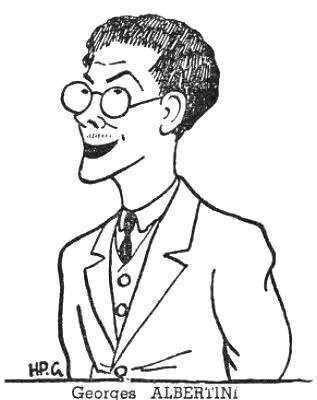
Georges Albertini
Human Design Chart
Biography
In 1949, he met Boris Souvarine, who becomes his associate. From 1949 to 1983 he edited and published the "Bulletin d'études et d'informations politiques internationales," which in 1956 becomes "Est-Ouest."
He was amnestied by the French government in 1951, and from 1969 to 1974 served as Advisor to French president Georges Pompidou.
He died on 30 March 1983.
The Human Design of Georges Albertini: Generator 3/6
Generator 3/6 — Design at a Glance
Georges Albertini had a design with a lot of sacral energy, which made him a person of great endurance. He seemed like a workhorse: strong and resilient as long as he had the energy for his task. His Human Design type was the Generator. This type generates energy that is mainly released when responding to impulses. The central motto therefore was: do not initiate but react.
The most successful strategy for Georges Albertini was to respond to signals from life. When his sacral center sent out the inner signal 'Yes! Let's get started!', he should act on it. This led to deep satisfaction and a feeling of fulfillment.
However, two stumbling blocks shaped his dynamics. The first occurred when he did things for long periods that didn't spark intrinsic interest. Then he wasted energy and tended towards burnout despite his high potential for productivity. The second danger was being prevented from working on his heart project while still full of power to continue. Such interruptions often led to frustration or a lack of energy. If Georges Albertini did not live according to this design and constantly tried to initiate, he sooner or later encountered the feeling of exhaustion. However, in harmony with his nature, no one could stop him.
Sacral Authority
Georges Albertini oriented himself in his decisions towards a clear inner instance: sacral authority. As a Generator, this authority was also his strategy, simplifying the decision-making process and directly linking it to his life energy. His internal guidance did not show through intellectual deliberation but rather through physical signals as reactions to external stimuli. He learned to listen to this 'gut feeling' – often audible as grunting, humming or a nodding hmm – in order to distinguish between true resonance and mere impulses.
When his sacral motor kicked in, he felt vital and alive. A surge of energy signaled that something was right. In these moments, almost inexhaustible energy was available to him, enabling him to complete his work with great enthusiasm. Georges Albertini was born to go through life with joy and satisfaction, fully immersed in activities without them needing to serve an external purpose. The distinction between this true sacral response and other impulses was crucial for his vitality. Only by trusting this physical resonance test could he maintain his natural rhythm and act with the endurance that was characteristic of him. This mechanism ensured that he did not swim against the current but rather unfolded energy where his design supported him.
The 3/6 Profile — Martyr / Role Model
Georges Albertini showed himself in the first three decades of life as someone who learned through active experimentation. His design strongly shaped him until about 29.5 years old according to the pattern of Line 3: He sought his individuality through trial and error, boldly and often playfully. This phase was characterized by a need to simply do things, make mistakes and draw conclusions from them without having an immediate big picture.
With the return of Saturn, this dynamic fundamentally changed. From around age 30, Georges Albertini tended to withdraw to reflect on accumulated experiences. Line 6 became effective and demanded principles, justice, and a long-term perspective. Here emerged an inner tension: The childlike need for play and freedom stood against the adult desire for control and wise leadership. He carried both the eight-year-old and the eighty-year-old within him, which often led to a feeling of being torn – between the urge to experiment and the need for deeper meaning.
This integration of both aspects formed the core of his development. By learning to channel the impulsive energies of Line 3 through the reflective wisdom of Line 6, he increasingly found clarity. In his later years, around age 50, this synthesis manifested as a charismatic role model function. His life task was to enable transformation through personal example and show others the path from blind experimentation to conscious, principled action.
Split Definition — Defined & Open Centers
Georges Albertini revealed himself through constant mental activity and a clear sense of direction, fuelled by a reliable energy source. His defined Head and Ajna Centers generated a perpetual urge to question and form concepts; he always thought in specific patterns that served as an inspiration but which he could not directly implement. This was combined with a defined Throat Center, giving him a firm self-identity and inner direction, as well as a defined Sacral Center, providing vital energy for reactive action – provided he waited for the right question rather than initiating on his own. His defined Root Center also supplied constant pressure to move forward in daily life.
In contrast, his open centers acted as mirrors reflecting the environment. The open Heart Center lacked consistent willpower; Georges Albertini tended to prove himself through promises, often ending up in a cycle of disappointment because he did not have the energy to maintain them long-term. His open Solar Plexus absorbed others' emotions, putting him at risk of identifying with their moods and making emotional decisions that later regretted. Additionally, his open Spleen Center made him vulnerable to spontaneous impulses from the environment; he could tend to act impulsively out of fear or false security, or cling to unhealthy situations rather than trusting his inner authority. This configuration shaped a life focused on mental clarity and reactive energy while learning to free himself from emotional conditioning and the urge to prove himself.
Channels for structure, rhythm, change and critical logic.
Georges Albertini revealed himself as someone who translated unique insights into understandable structures to provoke evolutionary change in others' thinking. His design was marked by Channel of Structuring 43-23, connecting the Ajna Center (Insight) with the Throat Center (Expression). This created the "individual mind," generating innovative perspectives through spontaneous breakthroughs. The challenge lay in timing: his knowledge needed to be clearly communicated but required patience as it was often perceived as too forward-thinking—he felt like an "outsider at the door." Success only came when the expression of strategy and inner authority guided him, not mental planning.
This structuring ability worked together with Channel of Beats 14-2, connecting the Sacral Center (generative energy) with the G Center (Identity/Direction). This tantric channel gave him the strength to reinforce new directions through mutation impulses by trusting reactions from his Sacral. It was complemented by Channel of Mutation 60-3 between Root and Sacral, enabling evolutionary change through accepting limitation (Gate 60) and organizing new possibilities (Gate 3). This process was unpredictable and melancholic; Georges Albertini had to learn to accept the pressure without rationalizing moods while waiting for the pulse of mutation.
Channel of Logic 63-4 between Head and Ajna fostered an active, skeptical mind. It constantly filtered patterns (Gate 63: Doubt) and sought consistent answers (Gate 4: Formulation). This skepticism was essential as logic without proof can be wrong. His thinking often felt light-years ahead; recognition opened the way for his knowledge to enter the collective only when the timing was right. Individual gates like Gate 49 (Revolution/Sacrifice) and Gate 24 (mental mutation/rhythm) underscored his ability to renew himself in the rhythm of the pulse and respect principles, while Gate 15 (collective behavior/humility) bound him to natural rhythms of society. His creativity (Gate 1) expressed itself freely from limitations when the timing was right.
Individual Circuitry — Circuit Signature
Georges Albertini revealed himself through two separate, parallel energetic systems: the Knowledge and the Mind circuit. This Split Definition created a tension between emotional creativity and focused logic without these areas directly flowing into each other.
In the Knowledge circuit, two independent segments were at work. The first connected the Ajna Center with the Throat Center via structuring (Channel 43-23). This allowed him to formulate and express thoughts clearly. The second, fully separate segment included Identity, Sacral Center, and Root Center. Here, the Beat (Channel 2-14) drove rhythmic life energy forward while Mutations (Channel 3-60) promoted innovative deviations from old knowledge. This energy was pulsing and emotionally tinged but did not originate in the Solar Plexus Center, which is thematically relevant in this circuit but appears only as part of a general description here – indeed, according to 'connected_centers' for Georges Albertini's Knowledge Circuit, only the mentioned centers are active: `[[Ajna, "Throat Center"], ["Identity", "Sacral", "Root Center"]]`. I must name exactly these centers.
In the Mind circuit, the Channel of Logic (63-4) connected the Head Center with the Ajna Center. This created a focused, visual and rational thought process free from emotional influence. Since the Solar Plexus Center is not included in this circuit, it was pure logic.
These two circuits – one for structured expression and vital innovation, the other for logical strategy – existed side by side. Georges Albertini had to switch between the pulsing flow of his identity and clear, future-oriented logic without a direct energetic bridge connecting these worlds.
Right Angle Cross of Explanation 2
Georges Albertini's Human Design profile indicated a tendency towards clear self-definition. He was someone who did not live his life randomly but with the intention of understanding and expressing the underlying logic of his existence. This attitude stemmed from the mechanics of the right cross in his design, which describes a life task where one seeks to understand their path and role within the whole and articulate this insight verbally. It wasn't mere introspection but rather a process of clarification: Georges Albertini sought the clear statement power of his being. The structure of this cross promoted an attitude that replaced confusion with understanding. His life was characterized by the attempt to articulate his identity and mission as precisely as possible, both for himself and those around him. It was about transparency in one's nature. Through this mechanism, his experience wasn't perceived as a chaotic sequence of events but rather as a coherent narrative that needed to be deciphered and shared. The clarity about his path thus formed the central foundation of his inner orientation. Georges Albertini lived this dynamic of explanation by striving to bring the hidden connections in his design into a comprehensible form, creating a basis for authentic action and deeper awareness of his specific function in life.
Saturn Return · Uranus Opposition · Chiron Return · 2nd Saturn Return — Life Cycles
Georges Albertini experienced major turning points in clear cyclical phases that marked structural consolidations. This dynamics was evident in 1951: at age 40, he received a pardon from the French government. This moment coincided exactly with an Uranus opposition. In Human Design mechanics, this aspect often signals a sudden break or liberal opening that explodes old structures and allows new freedoms – here visible in his political rehabilitation.
The second major turning point occurred in 1969 when Albertini, at age 58, became advisor to the French President Georges Pompidou. This marked his second Saturn return. While the first return often solidifies personal identity, the second demands a test of maturity: previous achievements must be cast into a more stable and responsible structure. His entry into the highest political advisory role was not a random career development but the logical condensation of decades of work and experience.
These two events illustrate how external planetary cycles reflect internal maturation processes. The Uranus opposition brought the necessary liberation from past burdens; the second Saturn return crowned this phase with institutional recognition and stable authority. Albertini's path was marked by the interplay of sudden release and long-term anchoring, where each cycle set a specific task for consolidating his life work.
Generator · Sacral Authority — Synthesis
Georges Albertini lived a life defined by the dynamic tension between inner reaction and outer expression. As a Generator with sacral authority, he found his energy primarily in responding to impulses – a natural readiness to give way to the flow of life as long as it fulfilled him. This responsiveness was reinforced by the defined connection between Head Center and Ajna Center, giving him a constant need for understanding and mental clarity. The combination of sacral drive and mental precision led to a deep ability to pour creative energy into concrete forms, especially when fueled by the pulsating mutation of Channel 3-60. His life showed that he was most fulfilled when he could bring his unique perspective and push innovations forward.
A central paradox in Albertini's design lay in the interplay between defined inner authority and open solar plexus. While the Sacral Center provided him with a clear compass for decisions, he simultaneously absorbed emotions from his environment. This led to an ongoing challenge of distinguishing between his own perception and external influences – a sensitivity that made him both strong and vulnerable to conditioning. The ability to balance this tension and find his authentic voice was key to his success and inner satisfaction.
4 Defined Channels
Incarnation Cross - Right Angle Cross of Explanation 2
Solar Return
The Solar Return shows the moment when the sun returns to its exact birth position - your personal solar year.
Life Cycles
Discover the life cycles with a detailed triple view (birth chart, cycle chart, composite).
Human Design Profile
- Type
- Generator
- Strategy
- To respond - wait for something to respond to
- Authority
- Sacral Authority
- Profile
- 3/6 - Martyr / Role Model
- Definition
- Split Definition
- Incarnation Cross
- Right Angle Cross of Explanation 2
- Date of Birth
- 13.05.1911 13:00
- Place of Birth
- Chalon sur Saône, France
Frequently Asked Questions
What is Georges Albertini's Human Design type?
Which Profile did Georges Albertini have?
What Authority guided Georges Albertini?
What incarnation cross did Georges Albertini have?
When was Georges Albertini born?
Discover your own Human Design
Are you also a Generator? Find out in a personal reading how to use your sacral energy correctly and discover deep satisfaction.
More Personalities
Back to overviewAaliyah

Alexia

Angèle

Anne-Marie

Arcángel

Arno