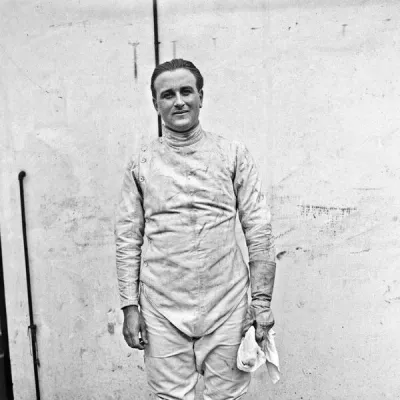
Georges Buchard
Human Design Chart
Biography
The Human Design of Georges Buchard: Manifestor 2/4
Manifestor 2/4 — Design at a Glance
Georges Buchard revealed himself as someone who naturally led the way and guided others into new directions. His design as a Manifestor marked him as a pioneer and visionary, whose task was to actively move the world forward. Similar to a king who does not fight in the battle himself but sends his troops, Georges Buchard used his inner strength to turn plans into reality without having to fight personally.
This kind of action inevitably polarized him. Because his thinking often went beyond that of his surroundings, he was not understood by everyone. While some people loved his big dreams and followed him, he encountered rejection or even hatred from others. This pain point of being misunderstood was an integral part of his configuration.
To find the right followers and minimize friction, it was crucial for Georges Buchard to inform others about his intentions in a timely and precise manner. This strategy of informing was the key to his success. If he followed this strategy, his design rewarded him with a deep sense of inner peace. Living against this nature, however, he felt persistent, deep anger. His life was thus marked by the tension between his leading vision and the necessity to communicate it clearly to find peace.
Splenic Authority
Georges Buchard's design inclined towards spontaneous, intuitive decision-making. His inner authority stemmed from the defined Spleen Center, signifying a pronounced survival intelligence. This mechanism acted as an internal alarm system, immediately informing him whether a situation or environment was healthy and right for him. With the Emotional and Sacral Centers open, this Spleen authority could be effective, a trait only Projectors or Manifestors exhibit.
For Georges Buchard, the first, spontaneous impulse was the reliable indicator. This impulse served his immediate health and allowed him to rigorously distance himself from harmful influences. The Spleen voice, however, was a fine impulse that appeared only once in the moment and could easily be drowned out by other influences. This required high vigilance from him; withdrawing to make a decision could be helpful.
Since he could only know what was right in the moment, his plans often changed at the last minute. Long-term commitments were difficult, so he needed a lot of freedom and flexibility. He should commit as little as possible and rather act spontaneously, using his inner intuition and physical well-being as guides.
The 2/4 Profile — Hermit / Opportunist
Georges Buchard showed himself as someone constantly swinging between two fundamental needs: the urge to withdraw and the desire to connect. His design as a 2/4 Profile, the 'Natural Talent/Networker', established an internal tension. On one hand, he sought solitude to develop independent mental activity and avoid conditioning from the outside world. This withdrawal served to clarify and protect his autonomy. On the other hand, he was deeply embedded in his social network, where he exerted influence and sought recognition.
This configuration required clear communication of his boundaries. Georges Buchard had to signal to the outside world when he needed company and when he wanted to be left alone. Only by maintaining this balance could he effectively process knowledge from his network during his alone time. Line 2 promoted his independence through isolation, while Line 4 pushed him towards success and social fixation. Without this structured boundary, he risked either suffocating in solitude or being overwhelmed by the expectations of his environment. His strength lay in reflecting collected impressions from the community in silence and developing brilliant ideas from them. This interplay between cave and network shaped his way of dealing with the world.
Single Definition — Defined & Open Centers
Georges Buchard lived with a constant, trustworthy mental function. His defined Ajna Center ensured that he created concepts and theories in the same way, unaffected by the opinions of others. This mind served as an external authority that conditioned his mental field in his aura. His thoughts flowed directly into his actions, as his defined Throat Center ensured that he spoke what he thought. This gave his communication a constant, though limited, clarity.
His actions were marked by a firm sense of self-identity. The defined G Center gave him a clear sense of his own direction and love for himself, without being dependent on others. He knew his worth and his willpower, supported by the defined Heart Center. This allowed him to keep promises and determine his life, often as his own boss, following his inner mechanisms. His intuition, rooted in the defined Spleen Center, guided him in the here and now, allowing him to make spontaneous judgments about health and well-being without having to rationalize them.
Despite this inner strength, Georges Buchard was vulnerable to external influences in certain areas. His open Head Center let him absorb mental pressure and questions from others, which could lead to confusion when he tried to solve problems that were not his own. He tended to wonder if he was inspiring enough or had the right answers, rather than trusting his inner authority. His open Sacral Center made him sensitive to the energy of his environment; he could easily overextend himself by using "borrowed" energy and did not always know when to stop. Additionally, his open Solar Plexus absorbed the emotions of others, which could lead him to personalize foreign moods and avoid confrontations out of fear of rejection. Finally, his open Root Center amplified the stress of the environment, leading to a feeling of restlessness when he tried to escape this pressure, rather than recognizing that it was not his own.
Channels for structure, presence, intuition, experiment, clarity and love.
Georges Buchard stood out for his deep, intuitive connection to the present moment, which allowed him to live his existence as a living expression of self-love and trust. This attitude was significantly shaped by the Awakening Channel 10-20, which connected the G Center with the Throat Center. Here, the Gate of Appearance (10) merged with the Gate of Now (20), enabling Georges Buchard to transform personal knowledge into immediate, appropriate action. He did not just speak but embodied the truth of "I am," which helped him to bypass resistance and inspire others through his mere presence.
This spontaneous authenticity was further reinforced by the Channel of the Perfected Form 10-57. By linking the Spleen Center with the G Center, Georges Buchard combined the intuitive insight of Gate 57 with the self-determined behavior of Gate 10. This gave him a rare clarity to let go of unfounded future fears and move through the world existentially. His behavior was guided by a profound, acoustic sensitivity that allowed him to respond to the quality of the environment, thereby perfecting both his survival and uniqueness.
Additionally, Georges Buchard demonstrated the ability to transform intuitive depth into concrete talent. The Channel of the Wave Length 16-48 connected the Spleen Center with the Throat Center, uniting the search for life-critical information (Gate 48) with the skill of experimenting (Gate 16). This drove him to master skills through repeated practice and develop his own unique wavelength. This was complemented by the Channel of the Brain Wave 20-57, which directly translated intuitive insight into communication. Georges Buchard could thus express his inner truth in the present and encourage others to activate their own survival intelligence. His design promoted a life in full presence, where self-acceptance and spontaneous intuition were the driving forces.
Individual Circuitry — Circuit Signature
Georges Buchards design points to a tendency towards structured, individual expression coupled with a deep inner centering. As a person with a simple definition, his energy worked as a continuous, flowing stream. The Mental Circuit connected his Ajna Center, Throat Center, and Spleen Center directly, allowing him to immediately translate innovative flashes of insight (Channel 20-57) and structured concepts (Channel 43-23) into the world. His creativity was pulsating and acoustic, driven by the need to walk his unique path and transform new knowledge. Parallel to this, the Projecting Circuit, which in Georges Buchard connected the Identity Center with the Heart Center (Channel 25-51), gave him a solid, courageous personality with strong convictions. However, since this circuit did not connect to the Throat Center, these deep convictions often remained internal, less outwardly directed than the creative impulses of the Mental Circuit. The Understanding Circuit contributed through Channel 16-48 (Throat Center and Spleen Center) to sharing logical insights and strategies, free from emotional coloring, to rationally improve society. Finally, the Manifesting Circuit secured his survival by connecting the Throat Center, Identity Center, and Spleen Center. Through Channels 20-10 and 10-57, Georges Buchard responded to life, channeled power through appropriate behavior and intuitive knowledge, and manifested this energy in the present moment. All these circuits did not work in him in isolation but as an integrated whole, as all defined centers were connected through channels.
Right Angle Cross of the Vessel of Love 4
Georges Buchard's design points to a deep, almost fated commitment to interpersonal bonds. His chart features the "right cross of the Love Vessel 4." This specific configuration describes a life task defined not by superficial contacts but by intense, often passionate relationships. It describes an energy aimed at using the heart as the central organ of experience to connect and deepen.
For Georges Buchard, this meant diving into relationships to learn and grow through them. The "Vessel" symbolized the capacity to absorb, store, and transform emotions and experiences. The number 4 refers to a cyclical nature of these experiences, where each phase of love or loss fosters a new level of maturity. He understood the power of love not just as a feeling but as a transformative force that shaped him.
This mechanism influenced his actions: he sought authenticity in closeness to others, often willing to show vulnerability to enable true connection. It was not a passive stance but an active engagement to fill and empty the vessel of love, thereby grasping the essence of human kinship. Georges Buchard lived this dynamic by using relationships as mirrors for his own growth, always exploring and integrating the depth of emotional experience.
Saturn Return · Uranus Opposition · Chiron Return · 2nd Saturn Return — Life Cycles
Georges Buchard's design was characterized by a clear focus on structural validation and the building of recognition through concrete achievements. His energy was directed towards demonstrating excellence in defined fields, where success was not an end in itself but rather a validation of his competence. This orientation was particularly evident during his Saturn Returns, which in Human Design are cycles of maturation and the condensation of responsibility.
In 1924, at the age of 31, during his first Saturn Return, Georges Buchard won the gold medal with the team at the Olympic Games in Paris. This event marked the moment when years of groundwork and discipline culminated in a solid, publicly visible result. The Saturn energy here demanded the integration of duty consciousness and performance capability, which was evident in this collective triumph.
Later, in 1932, at the age of 39, the Uranus opposition hit his design. This cycle often brings sudden changes or the necessity to reassess established structures. Georges Buchard won gold again with the team and defended his silver medal in the individual event at the Olympic Games in Los Angeles. Here, it was shown how his design handled the challenge of maintaining or surpassing existing standards under pressure and in change. The combination of structural stability (Saturn) and adaptive flexibility (Uranus) allowed him to achieve peak performances in both phases, carrying his inner architecture outward.
Manifestor · Splenic Authority — Synthesis
Georges Buchard was a Manifestor whose life was marked by an inner drive towards initiation and an unconventional path. His defined Ajna Channel (Awakening) points to a consistent, conceptual way of thinking that allowed him to develop ideas and inspire others. This ability, coupled with the authority in the Spleen, indicates a person who instinctively knew which paths were right for him and could distance himself accordingly to maintain his health. The Profile as a Natural Talent and Networker revealed a balance between the need for withdrawal and the desire for connection, with the ability to gain clarity in isolation laying the foundation for authentic relationships.
A central paradox in his design lay in the combination of manifesting energy and the need for inner peace. He was destined to initiate things and bring about changes, but he also needed phases of solitude to hear his inner voice and sharpen his visions. This led to a tension between the desire to shape the world and the need to protect himself from external influences – a dynamic that was evident in his documented successes at the Olympic Games, which required both teamwork and individual performance.
6 Defined Channels
Incarnation Cross - Right Angle Cross of the Vessel of Love 4
Solar Return
The Solar Return shows the moment when the sun returns to its exact birth position - your personal solar year.
Life Cycles
Discover the life cycles with a detailed triple view (birth chart, cycle chart, composite).
Human Design Profile
- Type
- Manifestor
- Strategy
- To inform others before acting
- Authority
- Splenic Authority
- Profile
- 2/4 - Hermit / Opportunist
- Definition
- Single Definition
- Incarnation Cross
- Right Angle Cross of the Vessel of Love 4
- Date of Birth
- 21.12.1893 06:00
- Place of Birth
- Harfleur, France
Frequently Asked Questions
What was Georges Buchard's Human Design type?
What Profile did Georges Buchard have in Human Design?
What Authority did Georges Buchard have?
What incarnation cross did Georges Buchard have?
When was Georges Buchard born?
Discover your own Human Design
Are you also a Manifestor? Find out in a personal reading how to use your initiation power peacefully and dissolve resistance.
More Personalities
Back to overviewAldair

Cafu
Christian-Jaque
Joelinton

Kaká

Kesha