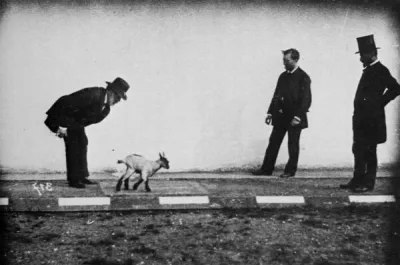
Georges Demenÿ
Human Design Chart
Biography
The Human Design of Georges Demenÿ: Generator 5/1
Generator 5/1 — Design at a Glance
George Demenÿ's design inclines towards great endurance and inner strength, which must be specifically directed. As a Generator, he possesses a lot of sacral energy, driving him like a strong workhorse—provided he has energy for his task. This energy, however, is not released through his own initiative but primarily when he reacts to impulses from his environment. His motto, therefore, is: not to initiate, but to react.
His most successful strategy involved waiting for signals from life and responding to them only when his sacral center gave a clear "yes." Living by this principle rewarded him with deep satisfaction and a sense of fulfillment. Deviating from this path, however, led to two serious pitfalls. Either he wasted his energy on things that did not interest him, leading to burnout, or he was prevented from working on his heart project, even though he still had plenty of power to continue. In such cases, especially when he constantly wanted to initiate himself, he eventually encountered a feeling of persistent frustration and a lack of energy. His design thus required a reaction from the gut to effectively and satisfyingly deploy his immense creative power.
Sacral Authority
Georges Demenÿ's design inclines towards intuitive, physical decision-making. As a Generator, his strategy to react was identical to his inner authority, the Sacral Authority. This simplified his process: he didn't need complex analysis but rather a direct response from his body.
This authority manifested as a "gut feeling" or surge of energy in response to external stimuli. Georges Demenÿ learned to pay attention to physical signals like grunting, humming, or an affirming "mm-hmm." Such reactions signalled that his sacral motor had kicked in. In these moments, he felt vital and alive, with inexhaustible energy and great enthusiasm. His life task was to go through life with joy and satisfaction, fully immersed in activities without constant purposefulness.
A crucial mechanism in his chart was the requirement that the Emotional Center be open. This protected the Sacral Authority from impulsive, emotionally driven misjudgments. Additionally, his activated Spleen Center acted as a supportive authority. Perhaps directly connected to the Sacral Center, it enabled Georges Demenÿ to react especially quickly and spontaneously. He had immediate access to his physical well-being and instinctive perception. These instincts could reliably guide him, shaping his ability to act swiftly and accurately in everyday situations.
The 5/1 Profile — Heretic / Investigator
Georges Demenÿ's design is characterized by the 5/1 Profile, which establishes a specific dynamic between a deep, personal urge to research and the external role of problem-solver for others. As a 5-line, he acted like a master, sought after by others due to his magnetic presence and vast knowledge, to find solutions for their crises. This line of "guidance" endowed him with the trait of a genetic leader, providing practical answers in critical moments and earning respect through intuitive intellect and innovations.
At the same time, the 1-line anchored him in the deep, individual exploration of connections. Here, dealing with resistance and uncertainty as the foundation for every progress was key. For Georges Demenÿ, this created a constant tension: while he studied internally the crisis and resistance to change to strengthen the foundation, he was perceived externally as an authority that had to provide immediate answers. Without clear boundaries, there was a risk that this dual demand—the quiet research and the loud leadership—would lead to exhaustion. His design thus described the path to finding the beneficial balance between withdrawing into his own knowledge base and being publicly available as a problem-solver, by learning to protect his capacities.
Split Definition — Defined & Open Centers
Georges Demenÿ's design showed a tendency towards constant mental pressure to ask questions and seek answers. The definition between the Head and Ajna Centers created a trustworthy but insatiable intellectual activity. This pressure was not an instruction to act, but an impulse towards conceptualization. Since the Head and Ajna Centers did not have their own energy source, the attempt to immediately realize these thoughts often led to frustration. Instead, his mental clarity served to inspire others to think. His defined Throat Center allowed him to express these concepts reliably, while the defined Sacral Center provided the vital energy to master tasks with persistence – provided he responded to external requests rather than initiating them. The defined Root Center provided the necessary stress to advance in the material world.
At the same time, Georges Demenÿ appeared as someone who did not have a fixed inner identity or direction. His open G Center made him susceptible to reflecting in relationships and environments, which led him to question whether he was in the right place or who he actually was. This was not a biographical fact, but a mechanical suspension: he adopted the identities of others rather than generating his own. Similarly, his open Heart Center did not equip him with consistent willpower. He tended to prove himself or make promises to demonstrate his worth, which led to exhaustion as he could not sustain this energy. His open Solar Plexus absorbed the emotions of his surroundings, leading him to experience foreign moods as his own and make emotional decisions that he later regretted. Additionally, his open Spleen Center was prone to survival fears and the temptation to make spontaneous decisions to gain a sense of security that was often illusory. These open centers required him to be mindful of conditioning and not to act impulsively.
Channels for mental order, cyclical growth and abstract comprehension.
Georges Demenÿ's mind was constantly engaged in organizing details within his own mental system. This inclination stemmed from the Accepting Channel 17-62, which connected the Ajna Center with the Throat Center. Gate 17 visualized patterns, while Gate 62 translated these into language. Demenÿ had to logically organize information to understand it; what did not fit into his worldview remained incomprehensible. This created a pressure to explain his opinions and what he had understood in detail.
Parallel to this, the Maturity Channel 53-42 drove him to complete experiences fully. This channel connected the Root Center with the Sacral Center and required Demenÿ to enter new cycles, complete them, and then reflect to gain wisdom. Without this reflection, he could not meaningfully begin new experiences. His life thus followed a cyclical pattern of beginning, middle, and end, with each experience building on the previous one.
Furthermore, his mind was under the pressure of the Abstraction Channel 64-47, which connected the Head Center with the Ajna Center. Here, he sought a story that made sense by filtering experiences through a kaleidoscope of mental images. This process could be confusing but often led to moments of sudden clarity that he could share.
Individual gates complemented this picture: Gate 45 in the Throat Center expressed tribal energy and hierarchy, while Gate 26 in the Heart Center promoted innovation within conservative structures. Gate 36 brought emotional crises as necessary transformation, Gate 6 provided the friction for further development, Gate 4 developed formulas for future security, and Gate 3 in the Sacral Center stood for mutation and adaptation to changes.
Collective Circuitry — Circuit Signature
Georges Demenÿ's design set a tendency towards structured analysis and emotional empathy, which, however, worked as separate, parallel forces. His Split Definition meant that these areas did not flow into each other directly but existed as independent systems alongside each other.
One system connected the Ajna with the Throat Center through the Accepting Channel. This allowed Georges Demenÿ to clearly formulate and share logical strategies and visually oriented future perspectives. The Understanding Circuit promoted an emotionless ratio aimed at guiding societies towards a better future through focused insight.
The second, independent system comprised two separate segments. On one hand, the Abstraction Channel connected the Head with the Ajna Center, translating abstract ideas into concrete thoughts. On the other hand, the Maturity Channel linked the Sacral with the Root Center, using a cyclical, wave-like energy from the past to learn from past experiences and share these emotions with the collective. These two circuits – the cool mind and the emotional quest for meaning – shaped Georges Demenÿ's experiential world as distinct, non-fusing poles.
Left Angle Cross of Confrontation 1
Georges Demenÿ's design indicated a tendency towards direct confrontation, driven by the left cross of confrontation. This configuration marked him as someone who did not avoid obstacles but actively attacked them to move forward. The mechanics of this cross describe an impulse that breaks through resistance; it is not about destructive conflict but about the necessity to identify and overcome barriers to unleash one's potential. In his life, Georges Demenÿ demonstrated this dynamic energy, which propelled him to engage with challenges rather than ignore them. The underlying structure promoted an attitude where conflicts served as a means of clarification and further development. He used this inner strength to test boundaries and pave new paths, with confrontation functioning as a tool of self-assertion and growth. This kind of interaction with the world was characteristic of his design, which favored active confrontation over passive adaptation. The energy of the left cross of confrontation acted as a driving force, urging him to place himself in situations where he had to prove his abilities to achieve his goals.
Saturn Return · Uranus Opposition · Chiron Return · 2nd Saturn Return — Life Cycles
Georges Demenÿ's design indicated a tendency towards radical change, often triggered by external provocations. This energy pushed him to question established structures and forge new paths rather than move along conventional lines.
In 1892, at the age of 42, he exhibited his Photophone at the Exposition Internationale de Photographie. This coincided with the Uranus Opposition, a cyclical point requiring profound transformations and a break with the past. Here, the necessity to leave old forms behind to make space for innovative ideas was evident.
Later, in 1896 at the age of 46, he brought the Chronophotographe, Système Démény to market. This fell during the Chiron Return, a fulfillment cycle where one's life work condenses and the inner purpose becomes tangible. It was not a moment of healing but of bloom: years of work found its concrete, visible form. His design demanded that he not only have ideas but translate them into tangible reality that touched the world. The mechanics of his chart described a path from disruptive change to the concrete realization of his unique contribution.
Generator · Sacral Authority — Synthesis
Georges Demenÿ was a Generator, whose life was marked by a deeply rooted drive to set energy in motion and materialize things. His sacral authority, combined with the profile of a hero and researcher, points to a person who gained insight through action and shared this knowledge willingly. The definition in the Head and Ajna Centers further strengthened this process by generating a constant mental pressure to understand and explain things – an inspiration he passed on to others. Through Gate 17 and 62 of the Accepting Channel, he organized and named his experiences to make them accessible to others. Evidence of exhibitions and the market introduction of a system show how this inner dynamism expressed itself in concrete, creative actions.
At the same time, the design reveals a paradox: Demenÿ's deep thirst for knowledge and his need to offer solutions (Line 5) stood in tension with the risk of getting lost in endless questions and detail work, without finding rest. The left cross of confrontation underscored this tendency to face challenges, while the cycles of Uranus Oppositions and Chiron Returns point to a life marked by constant change and breaking old patterns – a dance between the urge to create and the need to constantly reorient oneself.
3 Defined Channels
Incarnation Cross - Left Angle Cross of Confrontation 1
Solar Return
The Solar Return shows the moment when the sun returns to its exact birth position - your personal solar year.
Life Cycles
Discover the life cycles with a detailed triple view (birth chart, cycle chart, composite).
Human Design Profile
- Type
- Generator
- Strategy
- To respond - wait for something to respond to
- Authority
- Sacral Authority
- Profile
- 5/1 - Heretic / Investigator
- Definition
- Split Definition
- Incarnation Cross
- Left Angle Cross of Confrontation 1
- Date of Birth
- 12.06.1850 11:30
- Place of Birth
- Douai, France
Frequently Asked Questions
What is Georges Demenþy's Human Design type?
What profile did Georges Demenþy have?
What authority did Georges Demenþy have?
What incarnation cross did Georges Demenþy have?
When was Georges Demenþy born?
Discover your own Human Design
Are you also a Generator? Find out in a personal reading how to use your sacral energy correctly and discover deep satisfaction.
More Personalities
Back to overviewAaliyah

Alexia

Angèle

Anne-Marie

Arcángel

Arno