
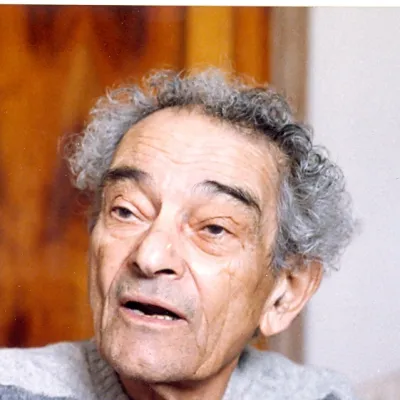
Georges Rouquier
Human Design Chart
Biography
Rouquier’s mother owned a small convenience store in Montpellier and had very little time to spend with her son. His father, the manager of a local dairy, also had little time to devote to his child, and as a result, the youngster spent much of his time daydreaming. Whenever he had enough money, he would go to the movies and immerse himself in the stories he saw. At the onset of the war, his father enlisted, and in February 1915, he was killed at Verdun. His mother was forced to sell her store and take a job as a house cleaner, and Georges was sent to live with his uncle on a farm in Goutrens. His cousins treated him as a brother, and he ended up staying for six months before returning to Montpellier and beginning school. Feeling a need to help his mother, he quit school when he was 14 and got a job as an apprentice at a local print shop. Two years later he moved to Paris and found a job as a typesetter. Still filled with an immense passion for the movies, he read everything he could about film.
Eventually Rouquier decided to make his own film and saved the necessary 2,500 francs. He traveled to the south of France where he shot "Vendanges," 1929, which received good reviews. The onset of the ‘talkies’ temporarily stopped his foray into movie-making, however, due to the added expense. In 1942, he met Etienne Lallier, who agreed to fund the making of "Le Tonnelier," and in 1943, this film was awarded the grand prize at the Congrès du Film Documentaire.
Rouquier decided to pursue movie making fulltime and began working on commission, a plan that resulted in the completion of three short films during 1943.
The Human Design of Georges Rouquier: Manifesting Generator 4/6
Manifesting Generator 4/6 — Design at a Glance
Georges Rouquier revealed himself as someone who possessed a hybrid energy: the constant power of a Generator paired with the lightning-fast projection of a Manifestor. His design tended towards great speed, allowing him to skip steps and quickly draw things into his life. This ability, however, came with risks. Often, he was too quick and skipped necessary intermediate steps, leading him to have to go back later and fill in the gaps. This could lead to frustration as he felt he was not in flow.
Furthermore, Georges Rouquier tended to pursue multiple projects simultaneously, driven by various impulses. If he did not listen to his inner consent, his creative drive quickly turned into overwhelm. His strategy was to not initiate things himself but to react to life. Only when his sacral center gave a clear "yes" should he act. Regular checks to see if the projects were still enjoyable were crucial. With the correct application of this strategy, he could draw deep satisfaction from his creations. The compulsion to finish one thing before starting the next did not suit him. Instead, his creativity flourished in play mode, where variety and parallel work served as a source of his energy, as long as he listened to his inner signals.
Emotional Authority
Georges Rouquier revealed himself as someone whose inner decision-making was marked by the defined Solar Plexus Center. This determined his emotional authority, which always took precedence regardless of other defined centers. His perception of the world was characterized by a constant emotional wave, showing in a continuous up and down of feelings. At one moment, he could be totally enthusiastic about something, and in the next, view the same thing negatively. However, his immediate feeling was only a snapshot, not a final judgment. Quick, spontaneous decisions made in this emotional heat often had negative consequences.
The mechanics of his authority required patience. The more time Georges Rouquier took to let a decision mature, the deeper and more comprehensive he could understand the situation. This meant reconsidering and sleeping on decisions multiple times. He should allow himself to be delayed and ask himself multiple times. Over time, the intense feelings subsided, he gained emotional distance, and clarity and calmness set in. This process was particularly important for long-term decisions that could have a significant impact on his life course. Only when the emotional wave had subsided could he recognize his true truth and act.
The 4/6 Profile — Opportunist / Role Model
Georges Rouquier revealed himself in his first thirty years of life as someone who enjoyed and frequently experimented, particularly in the areas of relationships and friendships. His Profile 4/6 was still strongly influenced by Line 3 during this early phase, which fostered this inclination towards experimentation. With the activation of Line 6, that is, after the return of Saturn, a fundamental tension emerged: the conflict between the deep desire to belong to a community and the simultaneous need to withdraw to contemplate the meaning of life. This inner dynamic led to a constant oscillation between heart and head.
Line 4 shaped a stance of humility that served as a protective mechanism against feelings of inadequacy and an outsider status. At the same time, Line 6, influenced by the planet Uranus, brought a tendency towards inappropriate action, which could be understood as a spiritual mutation. Georges Rouquier often observed and judged the actions of others while learning to accept his own lack of knowledge. In his later years, he was expected to meet the high standards of a wise role model. His big heart remained cautiously open, to avoid opening up to the wrong people and getting hurt. Cooperation with others became the central feature of his work, embedded in this complex balance between belonging and spiritual distance.
Split Definition — Defined & Open Centers
George Rouquier revealed himself through a reliable inner identity and a clear sense of direction in life, supported by his defined G Center. This firm self-love allowed him to love others without dependency and to open up new perspectives for them. His energy source came from his defined Sacral Center, which gave him a constant vital force. He relied on responding to questions rather than initiating to use his energy efficiently and avoid frustration.
His defined Heart Center provided willpower and the need to keep promises. He sought recognition for his work and preferred self-responsibility to follow his inner rhythms. At the same time, his defined Solar Plexus Center shaped his emotional authority. George Rouquier had to wait out the waves of his feelings to gain clarity; impulsive decisions in emotional highs or lows often led to regret later. His defined Throat Center channeled these inner processes into a steady, though limited, form of communication and action.
In contrast, his Head, Ajna, and Spleen Centers were open. The open Head Center made him vulnerable to mental confusion and the pressure to find answers to foreign questions. He tended to get caught in intellectual whirlpools rather than trusting his inner authority. The open Ajna Center gave him a flexible mind, but it also carried the risk of holding foreign opinions as his own truths or pretending uncertainty. The open Spleen Center led to a fundamental survival fear and a tendency to cling to people with defined Spleen Centers to gain a false sense of security. Spontaneous decisions from this center were risky and often driven by conditioned fears rather than true intuition.
Channels for rhythm, maturation, emotional depth and community.
George Rouquier lived in a deep, biological flow that connected him to the collective pulse of humanity. His design was marked by the Channel of Rhythm 5-15, linking his Sacral Center to his G Center. This connection bound him to firm habits (Gate 5) while also magnetically drawing him into the diversity and extremes of society (Gate 15). He moved not by whim but through a natural, universal life rhythm that carried him forward and offered others an unconscious timing to fit into.
Alongside this stable undercurrent, George Rouquier showed a multifaceted emotional and social dynamic. The Channel of Openness 22-12 connected his Solar Plexus to his Throat Center. Here, his emotional wave determined when he raised his voice; he spoke only when the mood was right, making his words a mutative, transformative effect on his environment. Parallel to this, the Channel of Transience 36-35 drove him to seek new experiences, often through crisis or change, to gain emotional depth and wisdom.
In the realm of will and material structure, the Channel of the Money Line 21-45 was evident. It linked his Heart Center to his Throat Center and pushed him to take responsibility for resources. He sought control over his work to provide for his clan, balancing the tension between the Hunter (Gate 21) and the Gatherer (Gate 45).
Social bonds were shaped by the Channel of Community 37-40, linking his Solar Plexus to his Heart Center. He sought his place in the whole and built bridges between individuals based on mutual recognition and emotional clarity. Finally, he traversed the Channel of Maturation 53-42, connecting his Root Center to his Sacral Center. This channel challenged him to complete each cycle and reflect before entering the next experience to extract collective wisdom.
Individual Gates like Gate 10 (Integration), Gate 25 (Innocence), and Gate 46 (Devotion) rounded out his profile, supporting his genetically fixed behaviors and spiritual centering, while Gates like 26, 2, 39, and 54 provided specific impulses for innovation, receptivity, provocation, and worldly success.
Collective Circuitry — Circuit Signature
George Rouquier revealed himself as someone whose expression and emotional intuition were closely intertwined. The Knowledge Circuit connected his Throat to his Solar Plexus Center in him. This promoted open, emotional communication based on his unique path.
Parallel to this, the Understanding Circuit worked. Here, the Channel 'Rhythm' connected the Identity with the Sacral Center. This gave him a focused, rational power that directed logical structures and strategic improvements into the future – independent of his emotional waves.
The Meaning Circuit consisted of two separate areas. On one hand, it connected Throat and Solar Plexus Centers through the Channels 'Transience' and 'Maturation', allowing reflection on past experiences. On the other hand, it connected Sacral and Root Centers, generating a cyclical, emotional energy that did not flow directly with the first part.
In the Ego Circuit, the Throat, Heart, and Solar Plexus Centers shared a common power. Through the Channels 'The Money Line' and 'Community', this was about cooperation, giving and taking, and the joint creation of resources. This connection supported him in social exchange but also required pauses, as there was no direct connection to the Sacral Center.
As a person with split definition, George Rouquier lived with two parallel, not directly connected energies: on one side, the connection of Sacral, Identity, and Root, on the other side, that of Throat, Solar Plexus, and Heart. These separate systems shaped his life as coexisting forces, each setting its own focus without forming a single, continuous flow.
Right Angle Cross of the Vessel of Love 2
George Rouquiers design revealed a tendency towards profound emotional devotion, which often manifested as a central theme in his life's journey. This configuration, known as the right cross of the vessel of love, describes a life task where the ability to love and be loved was not only understood privately but as a universal principle. It was an energy aimed at bridging people through one's own emotional experiences, thereby deepening the understanding of the power of love in the world.
For George Rouquier, love was not just a feeling but an active, formative force. The design promoted an attitude where emotional openness and vulnerability were seen as strengths to touch and connect with others. It was about living one's experience of affection and attachment authentically so that it could serve as an example or inspiration. This mechanism required courage, as it exposed one's soul, but it also offered the opportunity to establish a deeper connection with humanity through genuine emotional presence. George Rouquier lived this dynamic by focusing on the quality of his relationships and experiencing love as a transcendent experience, without falling into superficial romance, but rather acknowledging the serious, transformative power of this feeling.
Saturn Return · Uranus Opposition · Chiron Return · 2nd Saturn Return — Life Cycles
George Rouquier was someone who often faced unexpected, disruptive forces in later life stages, breaking down old structures. This dynamic resulted from the Uranus opposition in his design, an aspect typically associated with sudden changes, rebellion against established norms, and breaking through boundaries. Rather than binding himself to existing rules, his character tended to force new perspectives through individual, often unconventional paths.
This mechanism became concrete in 1946, at the age of 37, when he received the Grand Prix of the International Film Critics for his film “Farrebique”. This success was not merely a confirmation of the status quo but a moment of radical reassessment. The Uranus energy here promoted the recognition of a unique, deviating artistic voice that did not conform to the conventions of the time. The prize marked the point where this disruptive force was validated from the outside, allowing Rouquier to bring his visionary, often isolated work into broader cultural discourse. The opposition always signaled the tension between the individual and the collective, with Rouquier maintaining his integrity by staying true to his specific, challenging perception rather than conforming.
Manifesting Generator · Emotional Authority — Synthesis
George Rouquier was a Manifesting Generator, whose life was marked by an inner dynamic between quick action and deep emotional processing. The active connection between Sacral and Throat centers (Channel Rhythm) gave him an immediate, almost impulsive energy that enabled him to initiate and set things in motion quickly. This ability, coupled with emotional authority, points to a person who, while initially swept away by feelings, directed them through a longer process of reflection and weighing. The profile as a Networker/Role Model underscored this process by encouraging him to gather experiences and later share them as a wise advisor.
A central paradox in his design lay in the tension between the need for community (Line 4) and the desire for individual reflection (Line 6). He seemed to constantly oscillate between the desire to connect with others and be part of a larger whole and the urge to withdraw and ponder deeper questions of life. This inner conflict, amplified by the emotional wave, led him to not rush decisions but give them time to develop and mature – a process that ultimately led him to an authentic and profound expression of his individuality.
6 Defined Channels
Incarnation Cross - Right Angle Cross of the Vessel of Love 2
Solar Return
The Solar Return shows the moment when the sun returns to its exact birth position - your personal solar year.
Life Cycles
Discover the life cycles with a detailed triple view (birth chart, cycle chart, composite).
Human Design Profile
- Strategy
- To respond - wait for something to respond to
- Authority
- Emotional Authority
- Profile
- 4/6 - Opportunist / Role Model
- Definition
- Split Definition
- Incarnation Cross
- Right Angle Cross of the Vessel of Love 2
- Date of Birth
- 23.06.1909 20:51
- Place of Birth
- Lunel, France
Frequently Asked Questions
What was Georges Rouquier's Human Design type?
What Profile did Georges Rouquier have in Human Design?
Which Authority guided Georges Rouquier?
What incarnation cross did Georges Rouquier have?
When was Georges Rouquier born?
Discover your own Human Design
Are you also a Manifesting Generator? Find out in a personal reading how to unfold your multi-talents and direct your energy wisely.
More Personalities
Back to overviewSissy Spacek

Aldair

Alizée

Anémone

Angeli

Ann-Margret
