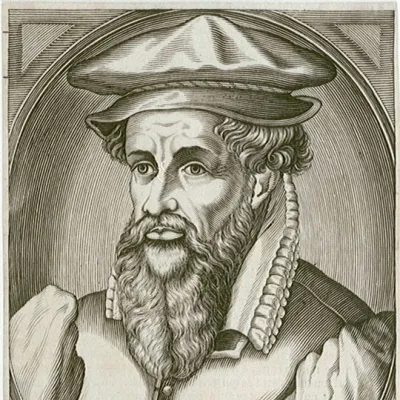
Gerhardus Mercator
Human Design Chart
Biography
Mercator’s father was a poor shoemaker; however, he, the last of seven children, was raised by an uncle who was an affluent ecclesiastic. His uncle, Gisbert Mercator, sent him to a religious school, probably in preparation to enter the priesthood. In 1530 he entered the University of Louvain in what is now Belgium, where his main studies were philosophy and theology. After graduating from the University of Louvain in 1532 with an M.A., Mercator studied mathematics and astronomy privately under Gemma Grisius and learned engraving. Concerned with the problem of reconciling the account of the origin of the universe given in the Bible with that given by Aristotle, he traveled to numerous places. Although doing little for his personal dilemma, his travels gave him a deep interest in geography. He became a maker of instruments for drawing maps and making field surveys. He produced his first map in 1537, and in 1541 he completed a terrestrial globe.
In 1544 he was accused of heresy and imprisoned several months before being released for lack of evidence. Mercator and his family moved to Duisburg, Duchy of Cleve (now Germany), in 1552 to escape religious persecution for their Protestant beliefs. He opened a cartographic workshop there and from 1559 to 1562 also taught mathematics at grammar school in Duisburg.
Mercator's famous map of the world, drawn on the projection that carries his name, was published in Duisburg in 1569 and was dedicated to William, Duke of Cleve.
The Human Design of Gerhardus Mercator: Generator 4/6
Generator 4/6 — Design at a Glance
Gerhardus Mercator's Human Design shows a tendency towards great endurance and strength, which is not expressed through self-initiated action but rather through quick responses to external impulses. His essential nature is that of a Generator, a configuration with much sacral energy. This energy source functions less like an engine running constantly on its own, and more like a resonant body: it becomes active when it encounters signals from the environment and internally confirms them.
The central life strategy consists in reacting rather than initiating. When Gerhardus Mercator encountered an impulse that his Sacral Center responded to with a clear "Yes," he could unleash his tremendous work capacity. In these moments of resonance, his true strength and endurance were revealed. Conversely, ignoring these internal signals or compulsively undertaking tasks without inner consent led to frustration and a noticeable energy deficit. Similarly, suppressing the urge to continue working on heart projects when the energy was still present had negative effects.
Living in harmony with this mechanism – that is, waiting for a signal and then acting upon it – rewarded him with a deep sense of satisfaction and fulfillment. The danger always lay in the temptation to act against this rhythm: either by constantly initiating actions without inner confirmation or by neglecting actions that were actually needed. His success thus depended directly on how accurately he listened to these "gut feelings" and acted accordingly.
Emotional Authority
Gerhardus Mercator's inner compass was the defined emotional center. His inner authority followed a clear rule: emotions were never immediate truths but waves that needed time to settle. He moved in a constant up and down of feelings; what appeared as an inspiring revelation in one moment could be felt as negative or irrelevant in the next. This mood was merely a snapshot, a first impression that did not yet represent his deeper truth.
Spontaneous reactions from this emotional heat were therefore misleading and often counterproductive. His mechanics required patience and conscious abstention from immediate action. Decisions had to be "slept on" to distinguish between temporary emotional states and lasting clarity. Only through this emotional distance, which came with time, did the intense impulses subside. Then a calmness set in that allowed him to truly recognize the core of a situation. This process of waiting and deliberation was not an obstacle but the essential tool of his inner guidance, especially when setting long-term directions for his life path.
The 4/6 Profile — Opportunist / Role Model
Gerhardus Mercator's Design inclined towards precise documentation and detailed questioning to clear internal doubts through exchange with others. This attitude stemmed from his Solar Energy in Gate 63, Line 4, which fostered a strong memory and fixation on comparisons. Through this configuration, he externalized uncertainties to seek answers – a process that required precise question formulation to create security for the future.
As Profile 4/6, the Networker and Role Model, Gerhardus Mercator was experimental in his first thirty years since Line 6 then still acted like a third line. This led to much experimentation in relationships and friendships. Later, a conflict arose between the heart's need for belonging (Line 4) and the head's desire for wise distance (Line 6). While the big heart had to remain cautious not to open up to the wrong people, Line 6 learned to accept unforeseen events as growth factors. He was expected to set an example of wisdom through cooperation with others while always living in the tension between community and individual overview.
Triple Split Definition — Defined & Open Centers
Gerhardus Mercator's Human Design profile indicated a tendency towards an unshakable inner identity and autonomous willpower. His defined G Center gave him a clear sense of direction, while his defined Heart Center secured control over resources and promises. This firm structure contrasted with his open Head, Ajna, and Throat Centers.
With his open Head and Ajna Centers, he lacked consistent mental processing. He tended to be influenced by doubts or the confusion of others rather than generating constant answers himself. Instead, he was receptive to inspirations from the environment without needing to hold them as personal truth. His open Throat Center meant that he did not communicate consistently; he did not force attention but spoke spontaneously when invited or when the situation required it.
The power of his design showed in the combination of defined Sacral, Solar Plexus, and Spleen Centers. As a Generator, he had a constant vital energy source, yet one dependent on reaction. He was most effective when waiting for life to speak to him before responding with his sacral strength. His defined Solar Plexus served as an emotional authority; truth revealed itself only after the emotional wave subsided. He avoided impulsive decisions at its peaks and troughs in favor of clarity that came with time.
Furthermore, through his defined Spleen Center, he had an intuitive existence in the present moment. His instincts protected him and guided him towards well-being, second by second. The pressure from his defined Root Center propelled him forward to material survival and transformed stress into constructive movement. This mechanism allowed him to remain stable despite lacking mental consistency, through inner authority – feeling, intuition, and reaction – without exhausting himself in the search for external answers or constant communication.
Channels for synthesis, pioneering spirit and intuitive power.
Gerhardus Mercator's Human Design profile indicated a tendency towards deep tribal cohesion paired with sharper individual competitiveness and instinctive survival intelligence. This configuration shaped his internal experience through loyalty, initiation, and immediate reaction.
The Synthesis Channel 19-49 connected the Root Center to the Solar Plexus via the Gate of Claims (19) and the Gate of Principles (49). It created an emotional frequency acting as glue: it determined who belonged to the tribe and who did not. This energy was based on loyalty, honor, and protection of shared resources rather than logical abstraction. Gerhardus Mercator sought balance between feasibility and fairness, driven by the need to feel belonging and have basic needs met.
Simultaneously, the Initiation Channel 51-25 linked his Heart Center through the Gate of Shock (51) with the Gate of Self Spirit (25). Here a natural competitiveness and drive to be first or win was evident. This energy served not only material success but also catalyzed individualization. Through shock experiences – whether self-chosen or imposed by life – he unfolded potential to recognize higher self and affirm others in their uniqueness, provided the initiation came from an authentic invitation.
Completing this picture was the Power Channel 34-57, connecting his Sacral Center (Gate of Power, 19) with his Spleen Center (Gate of Intuitive Insight, 57). This endowed him with instinctive survival intelligence: the ability to react immediately and effectively based on sacral reaction and spleen intuition. This energy kept watch for threats in the immediate environment and enabled quick decisions for self-preservation, independent of mental deliberation.
Together these channels created a profile that united tribal loyalty with individual distinction and instinctual clarity. Gerhardus Mercator lived in the tension between the need for emotional connection within the collective and the powerful, often shocking experience of his own individuality, supported by constant intuitive vigilance.
Individual Circuitry — Circuit Signature
Gerhardus Mercator's Human Design profile indicated a tendency towards fortified, courageous individuality. His Centering Circuit directly connected Identity and Heart Centers, strengthening self-worth and identity ("I am who I am"). However, lacking a connection to the Throat Center, these firm inner convictions often remained hard to articulate; they acted inwardly rather than through clear expression.
Parallel to this was a tribal dynamic without constant drive. His Ego Circuit connected Solar Plexus and Root Centers in Gerhardus Mercator, promoting cooperation and mutual support in resource areas. This circuit's lack of inclusion of the Sacral Center meant a steady life force flow was absent; rest periods were necessary to regenerate energy for social interactions.
Furthermore, his design ensured individual survival through reaction and intuition. The Integration Channels connected his Sacral and Spleen Centers, enabling him to channel strength from reacting to life (Sacral) with intuitive knowledge (Spleen) and act effectively in the present moment.
As a person with Triple Definition, Gerhardus Mercator's energy consisted of three separate groups: Root-Solar Plexus, Heart-Identity as well as Sacral-Spleen. These centers were not directly connected but worked as parallel, independent fields alongside each other.
Right Angle Cross of Consciousness 1
Gerhardus Mercator's Human Design revealed a tendency towards strategic orientation and awareness. His chart unveiled the configuration 'The Right Cross of Consciousness 1'. This structure marked him as someone who sought inner clarity to make decisions not impulsively but from a position of deeper insight.
The mechanics of this pattern describe a process where consciousness and strategy are closely linked. It's about sharpening one's perception before acting or reacting. Gerhardus Mercator was shown through this alignment as a person valuing mental presence. He tended to view situations from multiple perspectives to gain a more comprehensive understanding. This ability helped him penetrate complex connections and make well-founded judgments.
In everyday life, this often meant a certain restraint. Instead of acting immediately, Gerhardus Mercator took the time to assess the situation. This approach was not a sign of hesitation but an expression of conscious strategy. He sought the right timing and appropriate approach to effectively achieve his goals. The integration of consciousness into every action became a central feature of his design. Through this attitude, he avoided superficial reactions and aimed for solutions that were sustainable and well-thought-out. His way of seeing the world was characterized by this pursuit of clarity and strategic depth.
Saturn Return · Uranus Opposition · Chiron Return · 2nd Saturn Return — Life Cycles
Gerhardus Mercator's professional career followed a clear rhythmic structure, with astrological cycles marking structural turning points. His first Saturn Return around age 28 condensed years of groundwork into a solid result: in 1540 he published the map of Flanders, which marked the decisive start of his career. This cycle established his professional authority and laid the foundation for future developments.
With the Uranus Opposition at age 40, a phase of necessary change began. In 1552 Mercator moved to Duisburg, a step that required new perspectives and fundamentally changed his professional context. This move was not merely a relocation but a structuring impulse for his further work.
The Chiron Return, a fulfillment cycle in which one's incarnation cross unfolds, appeared in 1558. In this year, his son Arnold Mercator published the map of Iceland, considered a masterpiece. This marked a phase of flourishing where Mercator's life work and meaning became palpable.
His second Saturn Return around age 57 crowned this development. In 1569 the reforming world map was created. This cycle confirmed his long-term efforts and solidified his place in cartography history as one who sustainably changed existing structures.
Generator · Emotional Authority — Synthesis
Gerhardus Mercator was a Generator whose life was marked by deep sacral energy and endurance. He lived his authority over emotional waves that gave him time for the maturation of his decisions – a necessity to find his inner compass (defined G Center). His profile as Networker/Role Model suggests he oscillated throughout his life between the desire for community and the search for deeper meaning (Line 4/6), with connecting others always being of central importance (Synthesis Channel 19/49). This ability to connect was reflected in his professional cycles, where through his work he continually pointed out new directions and created connections.
A central paradox shaped Mercator's life: the interplay between inner clarity and the need for external validation. His defined G Center gave him a firm identity and direction, yet simultaneously he sought connection to the 'tribe' (Synthesis Channel) through his work, revealing his deeply rooted yearning for belonging. This tension was particularly evident in his career phases, where one event followed another – always striving to create something new while also finding a place within a larger order.
3 Defined Channels
Incarnation Cross - Right Angle Cross of Consciousness 1
Solar Return
The Solar Return shows the moment when the sun returns to its exact birth position - your personal solar year.
Life Cycles
Discover the life cycles with a detailed triple view (birth chart, cycle chart, composite).
Human Design Profile
- Type
- Generator
- Strategy
- To respond - wait for something to respond to
- Authority
- Emotional Authority
- Profile
- 4/6 - Opportunist / Role Model
- Definition
- Triple Split
- Incarnation Cross
- Right Angle Cross of Consciousness 1
- Date of Birth
- 05.03.1512 05:09
- Place of Birth
- Rupelmonde, Belgium
Frequently Asked Questions
What was Gerhardus Mercator's Human Design type?
What profile did Gerhardus Mercator have in Human Design?
Which authority guided Gerhardus Mercator?
Which incarnation cross was active for Gerhardus Mercator?
When was Gerhardus Mercator born?
Discover your own Human Design
Are you also a Generator? Find out in a personal reading how to use your sacral energy correctly and discover deep satisfaction.
More Personalities
Back to overviewAaliyah

Alexia

Angèle

Anne-Marie

Arcángel

Arno