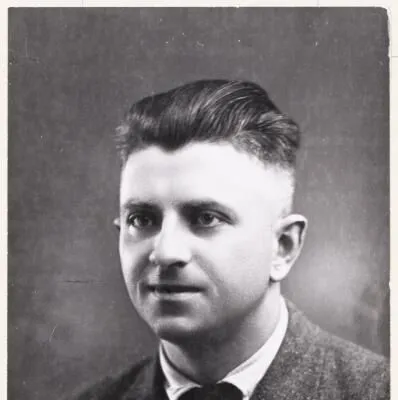
Gerrit Achterberg
Human Design Chart
Biography
Achterberg was raised in a poor Calvinist family as the third child of nine children. He father was the coach man of count Lynden van Sandenburg, but later with the advent of the automobile became a farmer. Achterberg was born in the coach house of Sandenburg castle.
On 1 April 1911 he went to the elementary school, where he excelled in all subjects except behaviour and diligence. He visited the Normal School in Wijk bij Duurstede and Utrecht, staying with an uncle who was a pipefitter (Ballad of the gas fitter). On 19 June 1924 he did exam and in the same year he became a primary school teacher in the small village Opheusden.
In Opheusden he met Arie Jacobus Dekker (b.1901) who acquainted him with literature and stimulated him writing poetry. In 1924 they conjointly published "De zangen van twee twintigers" (The songs of two persons in the twenties), a poetry bundle that he later considered an innocent youth sin.
In september 1924 Achterberg met his later wife Johanna Catharina van Baak (1908). They fell in love and engaged. The name Catharina, from the Greek "katharos" means pure and Achterberg would call her "the pure one" in the bundle Morendo (1944), named after a musical term that refers to decrescendo and dying. In November 1924 Achterberg was called to arms, but he got delay as he was still studying to become a school master. In a quarrel with the father of Catharina, he drew a pistol, threatened to shoot himself and thus ended his first engagement. From now on, the theme sexuality changed in lost love and death, but in his real life he would remain an impulsive and emotionally immature stalker of woman.
In 1925 he sent his poems to the Protestant poet, writer and editor of "Opwaartsche Wegen" Roel Houwink (Breda, 17 jan 1899 - Zeist, 3 june 1987), who would become his mentor. In January 1927 he was again called to military services, but a month later he was rejected for military service because of "sickness of the soul".
Gerrit Achterberg as a Manifesting Generator 5/1 in Human Design
Manifesting Generator 5/1 — Design at a Glance
Gerrit Achterberg revealed himself as someone who combined constant inner strength with remarkable speed. His design as a manifesting generator suggested a hybrid nature: He possessed the inexhaustible energy of a generator through his defined Sacral Center, yet also had the ability to accelerate processes and skip steps. This allowed him to quickly draw results into his reality.
However, this configuration carried specific risks. The tendency towards high speed could lead to necessary intermediate steps being neglected, often forcing him to backtrack later to fill in gaps – a potential source of frustration. Additionally, his design tended to respond simultaneously to numerous impulses and pursue multiple projects at once. Without constant internal resonance checks, this creative drive easily turned into dissatisfaction.
The key to his satisfaction lay in not initiating himself but responding to life. Only when his Sacral Center gave a clear "yes" was the path open. Through regular checking of this inner approval and entering a playful mode, he could use variety without getting scattered. Thus, his hybrid energy transformed from a potential source of frustration into a means of deep satisfaction as long as he stayed in the flow of response and did not act against his internal rhythm.
Emotional Authority
Gerrit Achterberg demonstrated a decision-making ability that only emerged after a maturation process. His design indicated that he did not react to the first emotional impulse but instead exercised patience to gain clarity. This resulted from his Emotional Authority: his defined Emotions Center determined his inner guidance, independent of other defined centers in his chart.
This configuration generated a wave dynamics of feelings. Gerrit Achterberg saw the world always colored by his current mood; enthusiasm could quickly turn into doubt. An immediate impression was therefore not a reliable truth but merely a snapshot. Quick decisions based on this fleeting emotion would often have negative consequences.
Instead, his mechanism required time. He let decisions mature, slept on them multiple times, and sought emotional distance. As time passed, the intense feelings subsided. Only then did calmness set in and enable him to gain deeper, more comprehensive insight. This process was particularly central for long-term life decisions. By consciously waiting for the emotional wave to subside, he avoided impulsive actions and made decisions from a position of inner peace, not momentary excitement.
The 5/1 Profile — Heretic / Investigator
Gerrit Achterberg revealed himself as someone torn between a deep, private urge to research and a magnetic presence. His design as a 5/1 – Hero/Researcher – defined this tension: Line 5 projected a contribution that others often demanded uninvited, while Line 1 served the need for withdrawal into knowledge gathering. Without clear boundaries, this expectation from others quickly led to exhaustion, as he felt like an all-knowing expert who had to be constantly available.
The challenge lay in learning to say "no." His design required him to limit his contribution temporally and only offer it upon request. Only then could he maintain the balance between serving the community and the necessary isolation for his own development. Line 1 also emphasized the essential nature of collaborating with stronger forces for his spiritual growth; without this connection, he sank into an inner emptiness. Gerrit Achterberg therefore had to learn to withdraw in order to gain new perspectives, and use his influence only when explicitly asked – much like a taxi driver who goes only where they are called, not aimlessly driving around the city. This protected his energy and allowed him to optimally utilize his gifts without sacrificing himself.
Split Definition — Defined & Open Centers
Gerrit Achterberg revealed himself as someone who possessed a constant and reliable presence: Willpower (Heart), vital energy (Sacral), and emotional depth (Solar Plexus) formed his stable foundation. These defined centers gave him a clear identity and direction (G Center) as well as the ability to express himself distinctly through his voice (Throat). His Throat served as a pivot point, transforming messages from these inner sources into the world; he did not just speak thoughts but manifested his will and emotions directly.
This firm interior stood in contrast to his open centers: Head, Ajna, Spleen, and Root were undefined. Here Achterberg was situationally activated and susceptible to external influences. His open Head Center tended to absorb mental pressure from the environment; he could get stuck in doubts or questions that belonged to others rather than being driven by a constant inspiration of his own. Similarly, his open Ajna Center reflected concepts and opinions from his surroundings, leading him to hold ideas as his own truth when they were merely temporary.
His open Spleen Center made him sensitive to health and well-being in his environment. He was vulnerable to clinging to people or situations that gave a false sense of security, driven by the deep fear of not being equipped to survive alone. Spontaneous decisions here were risky as they often stemmed from conditioned fears. Finally, his open Root Center absorbed stress from the environment. He could suffer under the pressure of others and misinterpret this adrenalized state as his own drive, leading to a cycle of overactivity to rid himself of foreign stress. His mechanics therefore required him not to use these open areas as authorities but to trust in the clarity of his defined centers.
Channels for resources, inspired expression and community.
Gerrit Achterberg revealed himself as someone who inspired others through authentic presence and trust in his own beat, without explaining it. His impact did not come from social adaptability but rather from co-creation with an environment that acknowledged his individuality. This resulted from the Channel of Inspiration 1-8, which connected the G Center with the Throat Center. Gate 1 enabled the bold expression of his unique perspective, while Gate 8 made this contribution public. He exemplified this identity; his presence alone was enough to change others' viewpoints, much like a pianist inspiring listeners through their performance. This process required patience in timing and recognition from others, as there was no automatic social adaptation.
This inspirational force was driven by the Channel of the Beat 14-2, which linked the Sacral Center with the G Center. Gate 14 provided access to material resources for promoting mutations, while Gate 2 acted as a driver directing higher direction and movement through space and time. As one of the tantric channels, it promoted innovation and mutative directional shifts. Gerrit Achterberg responded to impulses from his Sacral Center, enabling him to initiate new perspectives without foreseeing the goal. His destiny lay in honestly following his own direction; by remaining open to life and reacting accordingly, he mechanically encouraged others in their search for personal meaning. The combination of exemplary living (Channel 1-8) and the energetic ability to change direction (Channel 14-2) defined his role as an "Aura-Breaker," who inspired changes through his existence rather than verbalizing them.
Individual Circuitry — Circuit Signature
Gerrit Achterbergs Design presented itself as a tension field of two separate, parallel operating energy fields. On one hand, he was driven by a pulsing urge for individual reinvention; on the other hand, his system required timeless, conservative care of communal resources and regular periods of rest.
This contrast resulted from his split definition: Two independent groups of centers worked alongside each other without being directly connected. The first group linked the Throat, Identity, and Sacral Centers through the Knowledge Circuit. Here, the Inspiration Channel (Gates 1-8) and the Beat Channel (Gates 2-14) were active. This configuration promoted acoustic creativity, emotional waves, and the expression of a unique individuality. The drive was to transform new knowledge and carry it into the world through emotional resonance – an energy that pulsed in the here and now.
The second, isolated group included Heart and Solar Plexus Centers, connected by the Ego Circuit. Active here was the Community Channel (Gates 37-40), which established a reciprocal relationship of give and take: "Today I give to you, tomorrow you give to me." This circuit belonged to the Clan Dynamics and focused on cooperation as well as mutual support. Since there was no connection to the Sacral Center – the source of constant life force – the infinite energy for continuous action was lacking. Instead, this field required mandatory rest periods to regenerate the necessary resources for the clan.
Gerrit Achterberg thus moved between the impulsive creative drive of the first group and the traditional, rest-seeking duty of communal care in the second. These two poles did not form a cohesive experience but existed as separate, sometimes competing demands on his essence.
Left Angle Cross of Uncertainty 1
Gerrit Achterberg revealed himself through a fundamental disposition marked by a deep engagement with the unknown. His design contained the left cross of uncertainty, indicating an existential confrontation with insecurity and the limits of knowledge. This archetypal imprint suggested that he did not seek simple answers but moved within a field primarily raising questions.
The left cross of uncertainty describes a life task where constant encounters with non-knowledge are central. It is not about mere confusion but rather an intensive search for truth or meaning in a space without clear guidelines. This configuration promoted skepticism towards obvious explanations and simultaneously strengthened intuition as a tool to navigate the unclear. Gerrit Achterberg thus lived in a continuous tension between the need for clarity and the acceptance that some knowledge remains hidden. This dynamic shaped his inner disposition and directed his gaze toward what lies beyond visible structures.
Saturn Return · Uranus Opposition · Chiron Return — Life Cycles
Gerrit Achterbergs Human-Design chart did not offer specific activations in the context of life cycles. This meant that his design did not provide a mechanical basis for analyzing cyclical patterns. Without this data, it was impossible to classify his development into recurring phases or energy waves. His chart thus lacked the typical markings often used to interpret specific life stages such as Chiron returns or Saturn returns. There were no indications of predetermined bloom times or specific fulfillment cycles that could be derived from his configuration. This did not preclude a fulfilling life but simply stated that his design did not activate these particular cyclical mechanisms. The absence of this data prevented a deeper mechanical analysis of how his energy might have condensed or unfolded at regular intervals over the years. His path was therefore not shaped by these specific temporal structures but followed other patterns not captured here. There were no events that could be interpreted as expressions of such cycles, leaving his design neutral and open in this area without the typical anchor points often used to explain life turning points.
Manifesting Generator · Emotional Authority — Synthesis
Gerrit Achterberg lived a life marked by profound inner dynamics. Through the combination of manifesting generator energy and emotional authority, he developed a unique ability to respond to impulses and transform them into creative expressions – yet always after a phase of internal maturation. His defined G Center and Throat Center indicated a clear sense of identity and the necessity to express himself authentically, while his Sacral Center provided a constant source of energy. This configuration allowed him to act in a steady flow between inner reflection and external action, with the knowledge circuit driving innovation and transformation.
Central to his essence was a paradox of speed and the need for emotional clarity. The manifesting generator component gave him the ability to tackle things swiftly, while his emotional authority compelled him to make decisions only after an internal struggle. This tension between impulsive action and waiting for emotional certainty shaped his path and revealed the necessity of setting boundaries and consciously using his energy to avoid frustration or overextension.
3 Defined Channels
Incarnation Cross - Left Angle Cross of Uncertainty 1
Solar Return
The Solar Return shows the moment when the sun returns to its exact birth position - your personal solar year.
Life Cycles
Discover the life cycles with a detailed triple view (birth chart, cycle chart, composite).
Human Design Profile
- Strategy
- To respond - wait for something to respond to
- Authority
- Emotional Authority
- Profile
- 5/1 - Heretic / Investigator
- Definition
- Split Definition
- Incarnation Cross
- Left Angle Cross of Uncertainty 1
- Date of Birth
- 20.05.1905 00:30
- Place of Birth
- Langbroek, Netherlands
Frequently Asked Questions
What was Gerrit Achterberg's Human Design type?
What Profile did Gerrit Achterberg have in Human Design?
What authority did Gerrit Achterberg possess?
What incarnation cross did Gerrit Achterberg have?
When was Gerrit Achterberg born?
Discover your own Human Design
Are you also a Manifesting Generator? Find out in a personal reading how to unfold your multi-talents and direct your energy wisely.
More Personalities
Back to overviewAlain-Fournier

Aldair
Alizée

Angeli

Arletty
Artus