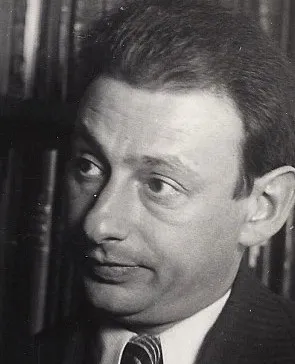
Gershom Scholem
Human Design Chart
Biography
He died on 21 February 1982.
Gershom Scholem — Generator with Profile 2/5
Generator 2/5 — Design at a Glance
Gershom Scholem was someone with immense inner stamina who unleashed his strength not through self-driven initiative but by responding to external impulses. As a Generator, he had a lot of sacral energy - a kind of motoric basic tension that made him extremely resilient if used for tasks that resonated internally. This configuration suggested that his work depended on a specific strategy: not initiating but waiting until life sent a signal he could respond to from the gut.
This design carried two significant risks. On one hand, frustration and energy loss threatened when he did things without inner resonance or initiated against his will instead of reacting. On the other hand, there was the danger of being prevented from working on his heart project even though his strength remained intact. If Gershom Scholem lived in harmony with this mechanism - by waiting for impulses and then acting - it was rewarded with a deep sense of fulfillment. Deviations tended to lead to persistent frustration. His life energy thus materialized less through planned initiative but rather through consistently following those signals that activated his sacral energy, allowing him to work sustainably and contentedly.
Sacral Authority
Gershom Scholem's design inclined towards direct, body-based decision-making. As a Generator, he possessed the sacral authority that also represented his strategy and simplified his process of orientation. This inner guidance did not manifest through intellectual deliberation but as an immediate reaction to external stimuli in the form of gut feelings or bursts of energy. His responses often manifested as short vocalizations like grunts or affirmations signaling whether something received energy.
A prerequisite for this clear guidance was an open emotional center; Scholem had to wait until emotional waves subsided to hear his sacral response clearly. When his Sacral Center was activated, he felt vital and alive with inexhaustible energy and great enthusiasm for his tasks. He was born to immerse himself fully in his work without pursuing a strict utilitarian background. The joy of the work itself took precedence. Additionally, an active Spleen Center served as a supportive instance enabling him to react particularly quickly and spontaneously. This immediate access to his instinctive perception and physical well-being acted as a reliable compass he could trust in his decisions.
The 2/5 Profile — Hermit / Heretic
Gershom Scholem navigated between a deep need for withdrawal and the expectation of others that he would stand by them as a problem solver. His Profile 2/5, the 'Natural Talent', shaped this dynamic: Line 2 called for seclusion and time alone to gain inner clarity while Line 5 brought others to him seeking help with their problems. This created tension between the desire for inner peace through self-control and composure - core aspects of the second generation in Gate 5 - and his external role as a helper.
The fifth line in Gate 64 emphasized hope and the promise of practical solutions during crises. Gershom Scholem had to learn to consciously conserve his energy and maintain his steady rhythm, avoiding misunderstanding inner peace as stagnation or being drained by others' pressure. His task was to precisely define for whom and when he would offer support during withdrawal phases. Only then could he fulfill the promise of clarity without endangering his own harmony and necessary relationships justifying his efforts. Seeking support from others helped him resolve old confusions about values and relationships.
Split Definition — Defined & Open Centers
Gershom Scholem's Human Design configuration tended towards uninterrupted intellectual work, driven by a defined Head and Ajna Center. This setup created a constant mental pressure to ask questions and form concepts without the direct energy needed for implementation. He was someone who communicated these thoughts authoritatively through his defined Throat Center, with the source of his statements always rooted in the mind.
His life force came from his defined Sacral and Root Centers. As a Generator, he had constant vital energy that could only be correctly activated by reacting to external impulses. The defined Root Center provided the necessary pressure to maintain this life impulse. The challenge was not to initiate out of mental impatience but to wait until the Sacral responded in order to avoid frustration and exhaustion.
At the same time, his design revealed specific vulnerabilities through open centers. His open G Center meant a lack of stable identity; he tended to reflect himself in relationships and environments rather than possessing a stable inner core. This could lead to uncertainty when not at the "right place," where the correct direction was initiated from outside. The open Heart Center made him vulnerable to trying to prove his worth through performance or making promises that overtaxed his energy. Additionally, his open Solar Plexus Center absorbed emotional moods from the environment, leading to identifying foreign emotions as his own and feeling emotionally unstable. His open Spleen Center lacked spontaneous well-being; he was prone to survival fears and tended to cling to uncertain situations in order to gain a false sense of security. His wisdom lay in not using these open areas as his authority but allowing them to be filled through reaction and correct environments.
Channels for insatiable curiosity, evolutionary change and mental abstraction.
Gershom Scholem's Human Design profile indicated a tendency towards evolutionary change that did not follow a linear path but rather occurred in sudden, often melancholic waves. This fundamental disposition was significantly influenced by Channel 60-3: It connected Root Energy with the Sacral Center and required him to accept limitations (Gate 60) in order to move beyond the confusion of a new beginning (Gate 3). This process was not a steady flow but rather a pulsating on-and-off rhythm that created internal tension until the next impulse failed to materialize. Scholem had to learn not to resist this mechanical moodiness, but instead patiently wait for his Sacral Center's response so that new mutations could take hold.
Parallel to this, he demonstrated a pronounced ability to translate complex connections into narrative knowledge. Channel 11-56 connected the Ajna Center with the Throat Center and drove him to constantly seek stimulation for new ideas (Gate 11) in order to pass them on as stories or philosophical reflections (Gate 56). This was less about dry facts and more about inspiring others through the magic of storytelling, engaging their imagination. His creativity emerged from weaving ideas into life parables that might be subjectively colored but could still have a profound educational impact.
This narrative power was reinforced by Channel 64-47, which linked the Head Center with Ajna. It placed him under constant pressure to filter every experience through a kaleidoscope of mental images (Gate 64) in order to understand mysteries lying beneath the surface (Gate 47). This mind was never at rest; it constantly played with possibilities and often generated mental confusion. Yet, precisely within this unrest lay the potential to develop new perspectives that only emerged as inspiring insights after long periods of waiting for clarity. Scholem's Human Design challenged him to endure this inner uncertainty until a coherent picture appeared, which he could then pass on to others.
Collective Circuitry — Circuit Signature
Gershom Scholem's Human Design configuration revealed a tendency towards innovative deviations, paired with the drive to emotionally reflect on past experiences and express these insights. This configuration arose from his Split Definition: two energetically separate systems existed in parallel without direct flow between them.
The first system connected the Sacral Center with the Root Center through the Knowledge Circuit. Here, the Channel "Mutation" (Gates 3–60) was active. This area promoted the power to transform by deviating from the known. Scholem appeared here as someone who walked new paths and initiated change, driven by a pulsing, acoustic energy of his individuality.
The second system included Head, Ajna, and Throat Centers in the Meaning Circuit. Two channels defined this region: "Abstraction" (Gates 64–47) and "Curiosity" (Gates 11–56). This connection directed attention to emotions, feelings, and experiences from the past. The energy flowed wave-like—with a beginning, middle, and end. Scholem reflected on events to find meaning behind them and used these felt insights to share with the collective. The consciousness flow of Meaning in the Ajna Center underscored this collective aspect.
While the first system aimed at creative innovation and transformation, the second served for emotional processing of the past. Both systems worked independently: one created new things through mutation, the other organized old things through abstraction and curiosity. This separation prevented a mixing of energetic qualities; Scholem lived with these two distinct yet coexisting forces.
Right Angle Cross of Consciousness 4
Gershom Scholem's Human Design profile indicated a tendency towards a profound, almost fateful connection with the collective. He was someone who did not primarily define his individual self against the world but rather integrated himself into the larger stream of human destiny. This attitude stemmed from the configuration of the right consciousness cross 4.
This specific orientation in Human Design describes a life task that goes beyond pure egoism. It is not about individual dominance or isolated self-fulfillment, but about serving a greater order. The energy of this cross promotes an understanding that one is part of a whole – often connected with themes of death and rebirth metaphorically: letting go of old structures in favor of new, collective forms.
For Gershom Scholem, this meant that his authority was less based on personal whim than on resonance with the deep currents of his time and environment. He did not live for himself alone but found confirmation in connection to others and carrying shared destinies. This configuration shaped him as someone who kept the boundaries between the Personal and Universal permeable, always ready to relativize the self for the sake of the bigger picture. His life energy flowed where it had the greatest benefit for the community, not where it would have fed his ego most strongly.
Saturn Return · Uranus Opposition · Chiron Return · 2nd Saturn Return — Life Cycles
Gershom Scholem's Human Design indicated a tendency towards structural anchoring and later fulfillment. In 1925, at age 28, he began teaching at the Hebrew University – a typical moment for the first Saturn return. During this phase, years of groundwork often condensed into a solid result; internal discipline found external form in a stable position.
Later, in 1948 at age 51, he became a respected citizen of the new state of Israel. This coincided with his Chiron return, a fulfillment cycle ("flowering") where one's incarnation cross – if lived according to strategy and authority until then – increasingly unfolds and finds meaning in life. For Gershom Scholem, this period marked not healing old wounds but visible maturation of his life purpose: recognition in the new society reflected inner completion achieved through consistent action according to his nature. Both events show how cyclical mechanisms in Human Design can shape concrete life stations – from professional anchoring to societal integration as signs of fulfilled destiny.
Generator · Sacral Authority — Synthesis
Gershom Scholem lived deeply within the pulsating energy of his sacral center (Generator type, Sacral Authority), always reacting to external stimuli and equipped with an inexhaustible work ethic – so long as he engaged in tasks that truly fulfilled him. This natural inclination towards activity was reinforced by the defined Head Center, which created a constant urge for questioning and understanding and provided inspiration he shared with others. His profile as a natural talent and hero (2/5) suggests that while he possessed an acute ability to find solutions for other people's problems, he also had a deep need for withdrawal and inner reflection.
A central paradox in his design lay in the interplay of Mutation (Channel 3-60) and the Knowledge Circuit. He was marked by a drive towards innovation and change, which went hand-in-hand with melancholy and acceptance of limitations. At the same time, he sought new insights and transformative knowledge to express and initiate transformation. This led to an internal tension between the desire for individuality and the need to share his insights with the world – a dynamic that manifested in documented events such as teaching (1925) and recognition as a respected citizen (1948).
3 Defined Channels
Incarnation Cross - Right Angle Cross of Consciousness 4
Solar Return
The Solar Return shows the moment when the sun returns to its exact birth position - your personal solar year.
Life Cycles
Discover the life cycles with a detailed triple view (birth chart, cycle chart, composite).
Human Design Profile
- Type
- Generator
- Strategy
- To respond - wait for something to respond to
- Authority
- Sacral Authority
- Profile
- 2/5 - Hermit / Heretic
- Definition
- Split Definition
- Incarnation Cross
- Right Angle Cross of Consciousness 4
- Date of Birth
- 05.12.1897 00:15
- Place of Birth
- Berlin, GER
Frequently Asked Questions
What was Gershom Scholem's Human Design type?
Which Profile did Gershom Scholem have in Human Design?
What Authority guided Gershom Scholem?
Which incarnation cross characterized Gershom Scholem?
When was Gershom Scholem born?
Discover your own Human Design
Are you also a Generator? Find out in a personal reading how to use your sacral energy correctly and discover deep satisfaction.
More Personalities
Back to overviewAaliyah

Alexia

Angèle

Anne-Marie

Arcángel

Arno