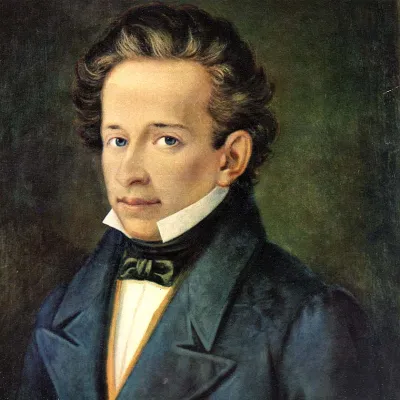
Giacomo Leopardi
Human Design Chart
Biography
At the age of 16 he independently had mastered Greek, Latin, and several modern languages, had translated many classical works, and had written two tragedies, many Italian poems, and several scholarly commentaries. Excessive study permanently damaged his health: after bouts of poor vision, he eventually became blind in one eye and developed a cerebrospinal condition that afflicted him all his life.
Leopardi created a remarkable and renowned poetic work, related to the Romantic era.
He died during the cholera epidemic on 14 June 1837, Naples.
The Human Design of Giacomo Leopardi: Manifesting Generator 5/1
Manifesting Generator 5/1 — Design at a Glance
Giacomo Leopardi was someone who worked with hybrid energy: He had the constant power of a Generator but also possessed the ability to act swiftly and skip steps. This design tended towards handling multiple things simultaneously and quickly drawing them into his life, giving him a unique creative force.
As an Manifesting Generator, however, he was vulnerable to two specific challenges. First, his speed often led to skipping important intermediate steps. When this happened, he frequently had to backtrack and fill in these gaps, which quickly resulted in frustration – the classic non-self theme of this type. Second, he tended to attract multiple projects simultaneously due to reacting to many different impulses. Without clear internal consent, this parallel activity could shift from satisfaction into overwhelm.
His strategy was not to initiate himself but to react to life and only proceed when his Sacral Center gave a clear “yes”. With proper application of this reaction, he found deep fulfillment in creation. He needed variety and a playful approach to work; the pressure to finish one thing before starting another stood against his nature. Instead, his energy flourished when he remained in play mode and his authority accompanied him.
Emotional Authority
Giacomo Leopardi showed an internal decision-making structure that arose not from logical analysis but from emotional waves. His inner authority lay in the defined Emotional Center. This meant he was subject to constant mood swings; his perception of the world was always colored by his current emotional state. What seemed absolutely right or inspiring at one moment could appear negative and repelling the next. This emotional wave generated a perpetual on-off rhythm of his feelings.
Since his immediate feeling was only a snapshot and not necessarily reflective of deeper truth, spontaneous decisions made from emotion were often misleading or harmful to him. Therefore, his design mechanics required patience: He had to give himself time for decisions to mature. Only through multiple sleepovers and waiting out the emotional high could the initial intensity subside. In this calm phase, he gained the necessary distance so that clarity and composure entered. This process of delay was essential for him to make long-term life decisions that would shape his path sustainably. Without this wait time, he risked listening to transient mood reactions rather than his true inner truth.
The 5/1 Profile — Heretic / Investigator
Giacomo Leopardi emerged as someone who underwent deep individual processes of insight before offering these insights to others for problem-solving. His design as a 5/1er, the Hero-Researcher, established a fundamental structure: Line 1 drove him to initially look inward and precisely explore knowledge, while Line 5 used this foundation to provide solutions for the collective. This configuration gave him almost magnetic appeal; others instinctively sought answers from him regarding their own questions.
However, this dynamic carried a risk: Without clear boundaries, he threatened to be drained by constant queries from others, similar to an expert exhausted after long consultations. The energy of Gate 52 promoted precise, concise communication, especially in crisis times where restraint and focus were crucial. Simultaneously, Gate 21 brought the theme of control and respect; it was about knowing when he should lead and when he should step back to avoid tensions. His challenge lay in maintaining balance between his intense research drive for himself and the expectations of his environment by learning to say no sometimes too. Thus, he could optimally utilize his gifts without being overwhelmed by others' demands.
Triple Split Definition — Defined & Open Centers
Giacomo Leopardi's Human Design shows a tendency towards constant mental activity and deep emotional processing. He was someone who constantly asked questions and formed concepts, driven by defined Head and Ajna centers. This connection created an ongoing internal pressure to understand things; however, without direct energy available for implementing these thoughts, he tended to turn this mental stress inward, which could foster confusion or doubt.
His willpower and vitality were given through defined Heart and Sacral centers. He had a constant source of energy for action and the ability to keep promises. Yet, this physical availability stood in tension with his emotional nature: The defined Solar Plexus center challenged him not to make decisions impulsively but to wait out the emotional wave until clarity emerged. Without waiting, spontaneous actions from euphoria or depression could later be regretted.
This internal friction was amplified by two open centers. His open G Center meant a lack of fixed identity; he was prone to orienting himself towards his environment and seeking love or direction rather than owning them. This could create the feeling of being lost or not knowing who he is. Parallel to this, his open Spleen Center acted as a source of existential fears. It made him sensitive to health and well-being but also prone to clinging to insecure structures for a false sense of security. Spontaneous decisions from this center were risky, often based on conditioned fear rather than intuitive truth. His challenge lay in using mental inspiration and emotional depth without falling into the traps of identity search or excessive worry.
Channels for charisma, success, emotional depth and abstraction.
Giacomo Leopardi showed a fundamental disposition marked by an intense inner drive to process experiences and translate them into expression. His design inclined him towards understanding the world through mental abstraction while simultaneously having a strong physiological impulse to act in the present moment.
The Channel of Charisma 34-20 connected his Sacral Center with his Throat Center, creating a powerful generative energy that pushed for immediate expression. The urge to manifest met the ability to speak or act in the moment, often leading him to struggle with sitting still. His vitality was best expressed when he focused on activities that gave him inner satisfaction rather than being driven by external expectations.
Parallel to this, the Channel of the Money Line 21-45 between Heart and Throat Centers brought a tension between wanting control and the necessity of serving the collective. Leopardi faced the challenge of using his will in such a way that he protected his own interests while also being useful to others. Success came from maintaining independence and following his natural rhythm rather than pressing into hierarchical structures.
Emotionally, he experienced waves of joy and melancholy driven by the Channel of Emotions Freeing 39-55 between Root and Solar Plexus Centers. This moodiness was not a disturbance but a transformative force that encouraged him to live authentically and use his emotional depth as a source for creativity and truth.
Mentally, he operated under the pressure of the Channel of Abstraction 47-64 between Head and Ajna Centers. His mind constantly searched through mental images and possibilities to draw meaning from experiences. Although this often led to confusion, patience rewarded him with moments of clear insight that he could share as unique stories or perspectives.
Additionally, Gates like 58 (Experiment), 48 (Depth), and 61 (Inner Truth) helped him recognize patterns and seek inner peace while Gates like 37 (Friendship) and 22 (Openness) enabled social connections on an organic, non-intrusive level.
Individual Circuitry — Circuit Signature
Giacomo Leopardi's Human Design shows a tendency towards emotional wave movements that swing between intense internal processing and the need for concrete material anchoring. As a Triple Defined individual, he possessed three separate, not directly connected energy groups.
The Knowledge Circuit in him linked the Solar Plexus Center with the Root Center via the Channel 'Emotions Freeing'. This created pulsating emotional impulses often manifesting as melancholy or creative inspiration and promoted an original path for transforming new knowledge.
Parallel to this, the Meaning Finding Circuit connected his Head Center with his Ajna Center through the Channel 'Abstraction', where he sought meaning in past events. The energy worked cyclically and visually reflecting insights from the past and abstractly processing them.
The third group formed a connection between Throat and Heart Centers in the Ego Circuit (Channel 'Money Line') as well as between Throat and Sacral Centers in the Integration Circuit (Channel 'Charisma'). This configuration supported the joint creation of resources through mutual support, channeling power from reacting to life in the present moment. Without direct connections to the other groups, these forces remained isolated: emotional waves, abstract meaning finding, and resource-oriented cooperation existed as parallel, independent streams in his system.
Left Angle Cross of Demands 1
Giacomo Leopardi's Human Design indicated a tendency towards internal tensions arising from the conflict between personal expectations and external demands. This configuration is known in Human Design as 'The Left Authority Cross 1'. It marks a life dynamic where the individual is constantly confronted with the question of whether to prioritize their own needs or yield to the demands of others.
For Giacomo Leopardi, this meant that he often felt torn between the desire for self-determination and the pressure to conform to societal or familial norms. This inner conflict shaped his approach to challenges: He tended not to address conflicts directly but rather internalize them, which could lead to deep, often unspoken frustration.
The mechanics of this cross show that such tensions were not a sign of weakness but a structural feature of his design. They forced him to constantly renegotiate the boundary between what he wanted for himself and what was expected of him. This ongoing negotiation significantly shaped his identity and made him particularly intense in situations where clear demands were placed on him.
Saturn Return — Life Cycles
At age 28, in 1826, Giacomo Leopardi was marked by a one-sided infatuation with Countess Teresa Carniani Malvezzi – an experience without mutual feelings that felt like a crisis. This coincided with his first Saturn Return, a cycle demanding structural maturity and confrontation with the limits of self. Instead of mere romance, this period revealed the harsh test of his position in the world. The Saturn Return often marks the transition from youthful illusions to a painful but sustainable reality. For Giacomo Leopardi, this mechanical necessity crystallized into an emotional ordeal: Expectations met the hard fact of rejection or distance. This was not a random stroke of fate but the typical effect of this astrological passage, which stabilizes inner structures by breaking weak foundations. The one-sided love served as a catalyst for profound self-reflection and confrontation with his vulnerability to external circumstances. This moment laid the groundwork for a deeper understanding of human conditionality, born not from comfort but through direct encounter with the unalterable. The crisis of 1826 was thus an integral part of his inner development, driven by the unavoidable dynamics of the Saturn Return, which demands distance and clarity rather than closeness and affirmation.
Manifesting Generator · Emotional Authority — Synthesis
He lived a life marked by a profound drive for knowledge and expression. The combination of sacral energy (Manifestor Generator) and defined Head Center created an unceasing quest for understanding that propelled him to acquire knowledge and make it available to others (5/1 Profile). However, this ability to inspire others came with an internal pressure intensified by constant questioning and comprehension. He responded to impulses, yet emotional authority required the maturation of decisions, occasionally slowing down the rapid energy flow of the Manifestor Generator – a continuous interplay between immediate reaction and deep reflection.
Central to his essence was the tension field between the desire for expression and the experience of unfulfilled longing. The Channel of Charisma points to a power to set things in motion, yet experiences (such as 1826) also showed moments where desires were not reciprocated. This created an inner contradiction: He was destined to act and shape, but he found himself confronted with limitations and the imperfection of the world – a melancholy deeply rooted in his knowledge circuitry that fed his creative energy.
4 Defined Channels
Incarnation Cross - Left Angle Cross of Demands 1
Solar Return
The Solar Return shows the moment when the sun returns to its exact birth position - your personal solar year.
Life Cycles
Discover the life cycles with a detailed triple view (birth chart, cycle chart, composite).
Human Design Profile
- Strategy
- To respond - wait for something to respond to
- Authority
- Emotional Authority
- Profile
- 5/1 - Heretic / Investigator
- Definition
- Triple Split
- Incarnation Cross
- Left Angle Cross of Demands 1
- Date of Birth
- 29.06.1798 15:00
- Place of Birth
- Recanati, Italy
Frequently Asked Questions
What was Giacomo Leopardi's Human Design type?
What profile did Giacomo Leopardi have in Human Design?
Which authority determined Giacomo Leopardi's decisions?
What incarnation cross did Giacomo Leopardi carry?
When was Giacomo Leopardi born?
Discover your own Human Design
Are you also a Manifesting Generator? Find out in a personal reading how to unfold your multi-talents and direct your energy wisely.
More Personalities
Back to overviewAlain-Fournier
Aldair

Alizée

Angeli

Arletty

Artus