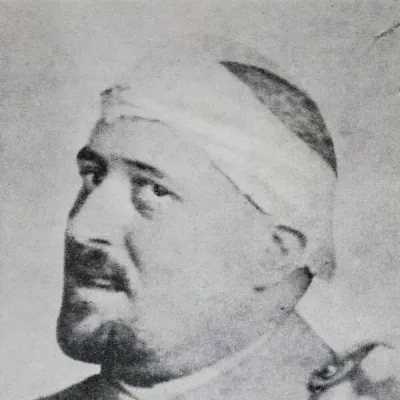
Guillaume Apollinaire
Human Design Chart
Biography
Apollinaire is considered one of the foremost poets of the early 20th century, as well as one of the most impassioned defenders of Cubism and a forefather of Surrealism. He is credited with coining the term "Cubism" in 1911 to describe the emerging art movement, the term Orphism in 1912, and the term "Surrealism" in 1917 to describe the works of Erik Satie. He wrote poems without punctuation, in his attempt to be resolutely modern in both form and subject. Apollinaire wrote one of the earliest Surrealist literary works, the play The Breasts of Tiresias (1917), which became the basis for Francis Poulenc's 1947 opera Les mamelles de Tirésias.
Influenced by Symbolist poetry in his youth, he was admired during his lifetime by the young poets who later formed the nucleus of the Surrealist group (Breton, Aragon, Soupault). He revealed very early on an originality that freed him from any school of influence and made him one of the precursors of the literary revolution of the first half of the 20th century. His art is not based on any theory, but on a simple principle: the act of creating must come from the imagination, from intuition, because it must be as close as possible to life, to nature, to the environment, and to the human being.
Human Design Analysis: Guillaume Apollinaire as Manifesting Generator 4/6
Manifesting Generator 4/6 — Design at a Glance
Guillaume Apollinaire revealed himself as someone who combined constant energy with motoric speed. His Manifesting Generator design created a hybrid dynamism: He possessed the enduring power of the sacral center, but also had the ability to skip steps and achieve results at lightning speed. This velocity offered him the potential to quickly draw things into his life, yet it carried risks too. Often he acted too hastily, skipped necessary intermediate steps, and found himself compelled to backtrack to fill gaps – a process that caused frustration. Additionally, he tended to pursue multiple projects simultaneously rather than completing them one after another.
To sustainably harness this creative power, it was crucial not to initiate things himself but instead respond to external impulses. Only when his sacral center gave a clear “yes” could he enter into a productive play mode. Regular checks of this inner approval were necessary to ensure that parallel activities continued to foster satisfaction rather than leading to exhaustion. With the correct application of this strategy – responding rather than initiating, while validating through the Sacral – Guillaume Apollinaire drew deep satisfaction from his work. The variety then became fuel for his creativity instead of a source of stress or failure.
Emotional Authority
Guillaume Apollinaires design established a specific decision-making structure: He could not draw final conclusions as long as emotional waves coursed through him. His inner authority resided in the defined Solar Plexus Center, meaning that his perception of the world was always marked by constant emotional fluctuations. In moments of intense enthusiasm, something appeared absolutely right; shortly thereafter, the same situation under a different mood influence could seem completely negative. However, this emotional wave only represented a fleeting snapshot, not the deeper truth of his nature.
For Guillaume Apollinaire it was therefore essential to avoid spontaneous decisions. An immediate reaction to an initial emotional impulse would often lead him astray as the first impression was still immature. The mechanics of his design instead required patience and conscious hesitation. By “sleeping on” important questions for several nights, he gained the necessary emotional distance. Only when intense feelings subsided and clarity and calm set in could he recognize his true direction. This process of waiting until emotional tranquility was achieved was not a sign of weakness but rather the necessary path to arrive at a well-founded, long-term decision that aligned with his innermost essence.
The 4/6 Profile — Opportunist / Role Model
Guillaume Apollinaire revealed himself during his youth as someone who intensely sought brotherhood and non-sexual intimacy. His design inclined him to prioritize friendship over sexuality in order to build deeper connections. This dynamic matched the Line 4 of his Profile 4/6, which dominated during the first thirty years and promoted an experimental joy in relationships.
With the transition into the second half of life, Line 6 activated. Consequently, an inner conflict emerged: The desire for community (Line 4) clashed with the need for distant meaning-making (Line 6). Guillaume Apollinaire lived this tension between heart and head, which often appeared confusing. In later years, he was expected to act as a wise role model and stand out through cooperation. His mechanics described an evolution towards authenticity in the role model, where the big heart always had to be cautious to avoid injuries from misplaced trust. The Venus elevation in both line phases underscored the focus on values and benefit for society, while Mercury used intellectual challenges as motivation for the ego.
Single Definition — Defined & Open Centers
Guillaume Apollinaire revealed himself as someone whose ability to act was based on a deep, internal resonance. His design indicated a tendency towards enduring work if he waited to be asked. The defined Sacral energy provided the power for satisfaction and endurance not through initiation but through reaction. This energy flowed into his defined G-Center, giving him a reliable identity and direction; he knew who he was and where it pulled him without having to control it.
However, his decisions were not made impulsively but filtered through his defined Solar Plexus Center. Here the rule was: truth reveals itself over time. Guillaume Apollinaire had to wait for the emotional wave to clear before gaining clarity and taking action or speaking. Only then did this clarity flow into his defined Throat, a consistent expression point for communication and transformation through interaction. His voice thus became a reliable instrument that spoke from identity, emotional truth, and sacral power, not mental concepts.
In contrast, his open centers acted as mirrors of the environment. His open Heart Center lacked persistent willpower; he tended to question whether he had enough value or needed to make promises to be recognized – a trap he could avoid through deconditioning. His open Head and Ajna Centers did not mean permanent mental focus. Instead of his own, firm concepts, he took inspiration from the environment; he was prone to being influenced by others' doubts or seeking answers that were not his own.
His open Spleen Center also required discernment. It absorbed fears and well-being from the environment. Guillaume Apollinaire was vulnerable to clinging onto people who radiated a sense of security, even if this relationship wasn't healthy for him. Spontaneous decisions here were risky as they often relied on absorbed impulses. Additionally, his open Root Center took in external stress; he could amplify the pressure of the environment and thus fall into cycles of hyperactivity and burnout when trying to control this non-own adrenaline rush. The mechanics of his design therefore required patience: waiting for the sacral answer and emotional clarity to conserve energy and express authentically, rather than falling into mental or stress-induced spirals.
Channels for intimacy, authentic action and powerful presence.
Guillaume Apollinaire revealed a deep tendency towards merging and the need for intense intimacy. His design indicated a strong impulse to form relationships and penetrate the aura of others, primarily driven by the Channel of Union 59-6. This channel connected the sexual energy of Gate 59 with the emotional wave of pleasure and pain from Gate 6. This configuration created a powerful source for personal, penetrating connections that were potentially fruitful – whether creatively or interpersonally.
However, this channel's mechanics required patience. As his Solar Plexus served as internal authority, Guillaume Apollinaire had to trust the emotional wave and wait until clarity about a relationship emerged. This helped avoid misunderstandings; his inviting aura could otherwise easily be misinterpreted as flirting even without such intent. By waiting for the wave cycle, he could discern whether there was a true connection or if the wave would reunite him later.
Alongside this relational dynamic, other channels influenced his self-understanding. The Channel of Awakening 10-20 promoted a state of awakened self-love and acceptance in the here and now, while the Channel of Exploration 34-10 encouraged following his own convictions and acting independently. Additionally, the Channel of Charisma 34-20 endowed him with charismatic presence but required sacral reaction to guide it, lest he fall into obsession or chaotic action. This combination marked him as someone who sought deep emotional bonds while also being a strong, self-determined individual expressing his uniqueness.
Individual Circuitry — Circuit Signature
Guillaume Apollinaire revealed himself through his design as someone with profound inner strength and robust self-worth. This stance stemmed from the Centering Circuit, which in him connected the Identity and Sacral Centers. Through Channel 10-34 (Exploration), this energy acted individualistically and courageously; he knew who he was, yet lacked a direct connection to his Throat Center within this circuit, making external articulation of these inner convictions challenging. Parallel to this, the Archer Circuit shaped his nature with primal protective instincts. Here, he linked the Sacral with Solar Plexus Centers through Channel 6-59 (Union). This brought emotional waves and a deep need for care as well as preservation of the self, driven by instinctive loyalty. A third aspect was integration, which united Throat, Sacral, and Identity Centers in a group. Through Channels 20-10 (Awakening) and 20-34 (Charisma), he knew how to draw power from reacting to life and make it work in the present moment. This configuration created a person whose identity and life force were closely intertwined but often could not directly express their deep convictions, instead working through inner presence and instinctive action.
Right Angle Cross of the Sleeping Phoenix 3
Guillaume Apollinaire's Human Design featured the signature of the right cross of the sleeping Phoenix 3. This configuration established a specific inner dynamics that shaped his experience and actions. The name of this cross points to a process associated with rest, gathering oneself together, and a deep internal sleep before new forces can unfold. It was not about constant activity or external commotion but rather a phase of preparation and waiting.
In Apollinaire's case, this meant that his design inclined him towards periods of restraint and inner orientation. The 'sleeping Phoenix' symbolizes potential that is not yet fully burned out or activated but rests in a kind of hibernation. This energy was present but it needed time and the right conditions to become effective. Apollinaire lived with the tension between the urge for expression and the necessary phase of holding back. His Human Design showed that his strength did not lie in constant movement, but rather in the ability to withdraw so as to emerge later with renewed intensity. The right cross emphasized the emotional and intuitive side of this development. Apollinaire had to learn to trust this inner rhythm even when outwardly he appeared calm or inactive. This structure shaped how he dealt with challenges: not through immediate action, but through a deeper, often invisible processing.
Saturn Return — Life Cycles
Guillaume Apollinaire's design indicated a tendency towards profound internal upheavals in early adulthood that acted as catalysts for a new identity. This was evident in 1907, at the age of 27, during his first Saturn return. During this period, he became involved in the theft of two Iberian stone masks from the Louvre by Géry Pieret and their subsequent sale to Picasso through Apollinaire himself. For his design, this incident was not just a mere anecdote but marked the characteristic crisis of the first Saturn return: the painful transition from youth to responsibility. The mechanics of this cycle demand a realignment of self-perception and compel one to question old structures in order to find a more sustainable foundation for further life. Apollinaire did not experience this phase as a harmonious development, but rather as a confrontational moment where the necessity of clear positioning and its associated consequences – here legal and ethical in nature – stood before him immediately. This experience shaped his understanding of loyalty, risk, and his role within the artistic network of that time. The Saturn return thus served as a litmus test challenging his inner alignment and forcing him to confront the real implications of his decisions rather than remaining in the irresponsibility of youth. This process of identity formation through confrontation was decisive for his further development.
Manifesting Generator · Emotional Authority — Synthesis
Guillaume Apollinaire was a person deeply rooted in his sacral authority while also possessing a strong inner direction (G Center). This combination led to a lifestyle characterized by reaction and authentic action. He did not live out of his head but followed his gut feeling and inner voice – a process often accompanied by emotional depth (emotional authority). The connection between sacral energy and defined direction created a force that propelled him to express himself and realize his creative vision, always guided by the present moment.
A central paradox in his design lay in the interplay between the need for individuality and the ability for deep connection (Channel 34-10 & 59-6). He was an independent spirit who wanted to actualize himself, yet also felt a strong longing for intimacy and exchange with others. This tension led to a dynamic lifestyle where he oscillated between the desire for solitude and the need for community, with the sacral response being crucial in determining when he engaged with others or followed his own path.
4 Defined Channels
Incarnation Cross - Right Angle Cross of the Sleeping Phoenix 3
Solar Return
The Solar Return shows the moment when the sun returns to its exact birth position - your personal solar year.
Life Cycles
Discover the life cycles with a detailed triple view (birth chart, cycle chart, composite).
Human Design Profile
- Strategy
- To respond - wait for something to respond to
- Authority
- Emotional Authority
- Profile
- 4/6 - Opportunist / Role Model
- Definition
- Single Definition
- Incarnation Cross
- Right Angle Cross of the Sleeping Phoenix 3
- Date of Birth
- 26.08.1880 05:00
- Place of Birth
- Rome, Italy
Frequently Asked Questions
What was Guillaume Apollinaire's Human Design type?
Which Profile did Guillaume Apollinaire have in his Human Design?
What Authority guided Guillaume Apollinaire's decisions?
What incarnation cross did Guillaume Apollinaire have?
When was Guillaume Apollinaire born?
Discover your own Human Design
Are you also a Manifesting Generator? Find out in a personal reading how to unfold your multi-talents and direct your energy wisely.
More Personalities
Back to overviewAlain-Fournier

Aldair

Alizée

Angeli

Arletty
Artus