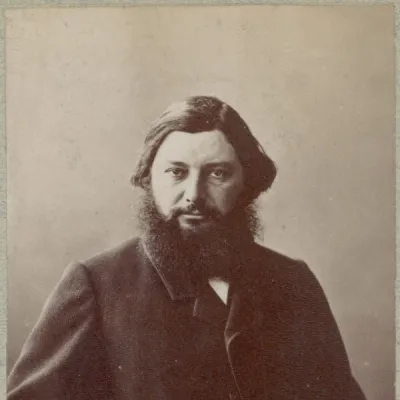
Gustave Courbet
Human Design Chart
Biography
Courbet's paintings of the late 1840s and early 1850s brought him his first recognition. They challenged convention by depicting unidealized peasants and workers, often on a grand scale traditionally reserved for paintings of religious or historical subjects. Courbet's subsequent paintings were mostly of a less overtly political character: landscapes, seascapes, hunting scenes, nudes, and still lifes. Courbet was imprisoned for six months in 1871 for his involvement with the Paris Commune and lived in exile in Switzerland from 1873 until his death four years later.
Human Design Analysis: Gustave Courbet as Projector 2/4
Projector 2/4 — Design at a Glance
Gustave Courbet revealed himself as someone with a focusing aura, like a bright flashlight that immediately identified system errors in others. This intense perception could be uncomfortable for his surroundings when it pointed out flaws directly. Instead of openly criticizing – which triggered defensiveness – his more effective approach was to attract through his own harmony. When he set an example of harmony himself, people sought him out and asked for his perspective because his shining example was attractive. His strategy involved waiting for honest, appreciative invitations rather than forcing his presence.
This behavior stemmed from his design as a Projector. Since Gustave Courbet had an undefined Sacral Center, he did not have a constant internal source of life energy. Instead, he experienced phases of high productivity followed by mandatory rest periods to prevent burnout. The traditional system with continuous work demands did not fit this rhythm. If Gustave Courbet lived according to his design and respected his energy cycles, he was rewarded with success. Deviating from it and ignoring the need for a break or the strategy of waiting for invitations led sooner or later to feelings of bitterness, his specific Non-Self theme. His path therefore was not constant striving but targeted shining at appropriate moments.
Splenic Authority
Gustave Courbet demonstrated decision-making based on a fine physical instinct. His design indicated that the defined Spleen Center carried his inner authority – a mechanism possible only for Projectors or Manifestors and requires the Emotional as well as Sacral Centers to remain open. This configuration endowed him with pronounced survival intelligence: His first spontaneous impulse served as a reliable compass for health and wellbeing. He knew in the moment whether a situation or environment was beneficial.
This Spleen impulse, however, was subtle and occurred only once. Therefore, it required high vigilance to distinguish this fine signal from other influences and not to drown it out. Gustave Courbet had to learn rigorously to shield himself against harmful factors and use his body as a truthful indicator. Since his inner truth became clear only in the concrete moment, long-term commitments often hindered him. His design favored flexibility and spontaneous actions over rigid plans. He needed space to react to these short-term directives. A retreat sometimes helped him find the silence where this first impulse could be heard clearly. His strength lay in deciding for what was right here and now rather than limiting himself through future obligations.
The 2/4 Profile — Hermit / Opportunist
Gustave Courbet showed a pronounced tension between his deep need for solitude and his simultaneous drive towards community. His design suggested that he constantly oscillated between two poles: Line 2, which called him to retreat into the
Single Definition — Defined & Open Centers
Gustave Courbet possessed a reliable inner stability that arose from the combination of his defined G-, Heart, and Spleen Centers. His design established a firm self-identity: He knew who he was and where his path led without being dependent on others. This clear direction allowed him to naturally inspire or comfort others by helping them understand the larger context of their existence. At the same time, he had a constant willpower through his defined Heart Center. He controlled his resources and boundaries confidently, kept promises, and acted from a strong sense of his own worth. This ego-expression potential was not mere arrogance but a healthy necessity for his well-being; he needed recognition for his work and space to make independent decisions about when to work and rest.
This mental and emotional stability was complemented by the defined Spleen Center, which gave him a deep intuitive body awareness. Courbet lived in the present moment and trusted his spontaneous intuition to recognize what was healthy or harmful for him. He did not have a constant source of mental inspiration or emotional waves because Head, Ajna, and Solar Plexus Centers were open. Instead, he tended to absorb the mental pressure and doubts of others when he wasn't mindful of his inner authority. In his non-self, he might have questioned whether he had the right answers or if his ideas were irrelevant, but these uncertainties did not stem from him but reflected those around him. His open Throat Center also meant that he didn't constantly need to force attention; his communication was spontaneous and situational when invited, rather than through compulsive talking. The open Sacral and Root Centers showed in a variable energy availability: He was susceptible to the stress and adrenaline of his environment but could not sustain these energies as his own power. His design called on him to take breaks and not be drawn into others' hectic pace, so he wouldn't lose his intuitive clarity and willpower through overexertion.
Channels for intuitive elegance and spiritual pioneering.
Gustave Courbet exhibited a mechanism that combined intuitive survival with competitive breakthroughs. Channel Perfect Form 57-10 linked the Spleen and G Centers: Gate 57's acoustic sensitivity to tonal qualities rather than words guided spontaneous actions in the present, while Gate 10 perfected self-behavior. This created an interaction beauty based on self-love that dissolved future anxieties. Courbet acted not from reflection or emotion but from a deep, acoustically steered intuition that secured his physical well-being and served as a model for others without seeking recognition.
Parallel to this, Channel Initiation 51-25 between the Heart and G Centers worked. Gate 51's competitive ego, always wanting to be first, met Gate 25's ability to see the beauty of both animate and inanimate objects. This configuration generated a 'shock' that initiated individualization. Courbet crossed boundaries to prove his uniqueness and spur others through personal example – but only on invitation. This process was mystical and uncontrollable; it served to lead the collective from 'we' to 'I'.
The prioritized gates added nuances: Gate 45 emphasized collective willpower and hierarchy, while Gate 26 showed the ability to move the tribe to new paths through innovations. Gate 22 brought a shamanic calm by waiting rather than pushing forward, and Gate 47 helped bring collective past into coherent meaning. Together these streams formed a personality that shaped life as an artwork of survival, marked by spontaneous aesthetics and mutative breakthrough.
Individual Circuitry — Circuit Signature
Gustave Courbet appeared as a person with strongly inward-focused, individualistic energy. His design connected the Identity Center directly to the Heart Center through the Centering Circuit (Channel 25-51). This connection created a firm inner conviction and solid self-worth. Courbet had the strength to reinforce himself in his uniqueness and radiated this attitude. However, since this circuit did not connect to the Throat Center, his deep inner certainties often remained hard to articulate verbally; the energy worked more silently and present than verbally expressed.
Parallel to this, the Integration Circuit (Channel 10-57) connected his Identity Center with the Spleen Center. This allowed him to gain strength through intuitive perception and correct action patterns. This connection supported survival through a sensitive adaptation to the environment while maintaining his inner structure at the same time.
As a simple definition, these two circuits existed as separate, side-by-side systems. The Centering Circuit provided internal stability and courage in individuality. The Integration Circuit delivered an intuitive foundation for handling everyday life. Both streams colored his entire design, with the pulsating energy of the first circuit playing a dominant role. Courbet lived under the pressure to carry strong inner convictions without always clearly expressing them. His personality was marked by this dual nature: on one hand, unshakable internal firmness; on the other, sensitive intuitive adaptability to each situation.
Right Angle Cross of Rulership 2
Gustave Courbets Human-Design legte eine Tendenz zu einer strukturellen Autorität fest, die weniger auf persönlicher Willkür als auf der Fähigkeit beruhte, Ordnungen zu schaffen und aufrechtzuerhalten. Er zeigte sich als jemand, der in der Lage war, komplexe Situationen durch klare Rahmenbedingungen zu stabilisieren. Diese Haltung entsprang dem rechten Kreuz des Regierens 2, einer Konfiguration, die die Mechanik des Führens nicht als dominierenden Impuls, sondern als notwendigen strukturellen Rahmen definierte.
In diesem Design geht es darum, Autorität aus der Fähigkeit abzuleiten, Systeme zu organisieren und andere darin zu unterstützen, ihre eigene Rolle innerhalb dieser Struktur zu finden. Es handelt sich um eine Form des Regierens, die auf Integration und Kohärenz abzielt, anstatt auf bloßer Machtentfaltung. Gustave Courbet verfügte über das Potenzial, in Gruppen oder Projekten jene zentrale Instanz zu sein, die Klarheit schafft, wenn Unsicherheit herrscht. Seine Energie wirkte dabei nicht als auferlegter Befehl, sondern als stabilisierende Kraft, die es anderen ermöglichte, sich auf ihre Aufgaben zu konzentrieren, weil der übergeordnete Kontext gesichert war. Diese Mechanik betonte stets den Rahmen selbst: Ohne klare Strukturen bleibt Führung chaotisch; mit ihr wird sie zum Fundament für kollektives Wirken. Gustave Courbet lebte diese Dynamik, indem er Autorität als Dienst an der Ordnung verstand, nicht als Privileg des Einzelnen.
Saturn Return · Uranus Opposition · Chiron Return · 2nd Saturn Return — Life Cycles
Gustave Courbets Human-Design legte eine Tendenz zu strukturierten Lebensphasen fest, die durch wiederkehrende astrologische Zyklen markiert waren. Diese Mechanik zeigt sich in der Verdichtung von Vorarbeit und dem Erreichen neuer Reifungsstufen. 1847, im Alter von 28 Jahren, vollzog er seinen ersten Saturn-Return. In diesem Jahr reiste er nach Holland und fertigte Studien von Rembrandts Gemälden sowie venezianischen und spanischen Meistern an. Dieser Zyklus verdichtete oft jahrelange künstlerische Vorarbeit zu einem tragfähigen Ergebnis und prägte seine Karriereentwicklung durch intensives Lernen und Auseinandersetzung mit den Meistern der Vergangenheit.
Der Chiron-Return, ein Erfüllungszyklus zwischen dem 49. und 51. Lebensjahr, brachte die Blüte des eigenen Zwecks. 1869, im Alter von 50 Jahren, wurde Gustave Courbet zum Präsidenten der Republikanischen Kunstkommission gewählt. Dieses Ereignis markierte den Höhepunkt seiner Anerkennung und das Sichtbarwerden seines Lebenszwecks in einer führenden Position innerhalb der Kunstwelt. Es war kein Moment der Heilung alter Wunden, sondern die Entfaltung dessen, was er durch konsequentes Leben gemäß seiner Strategie erreicht hatte.
Der zweite Saturn-Return um das 58. Lebensjahr schloss diesen Bogen ab und bedeutete oft das Ende einer großen Lebensphase. Gustave Courbet starb am 31. Dezember 1877 an Herzinsuffizienz und Wassersucht. Dieser Zyklus beendete nicht nur sein Leben, sondern symbolisierte den Abschluss der von ihm geschaffenen Strukturen und Werke. Die drei Zyklen strukturierten seinen Weg von der intensiven Studienphase über die öffentliche Anerkennung bis hin zum natürlichen Ende, wobei jeder Schritt eine spezifische Reifung seiner künstlerischen Identität widerspiegelte.
Projector · Splenic Authority — Synthesis
Er war ein Projektor, der durch die Verbindung von Spleen Center und G Center (Channel 57-10) eine ausgeprägte Fähigkeit besaß, das Potenzial in anderen zu erkennen und intuitiv zu verstehen, was für sie richtig ist. Diese Qualität verband sich mit einer inneren Sicherheit bezüglich der eigenen Richtung (definiertes G Center), wodurch er andere auf neue Wege lenken konnte – stets geleitet von einem feinen Instinkt für das Wohlbefinden und die Würde des Einzelnen. Das Profil als Naturtalent und Netzwerker deutet darauf hin, dass er zwischen dem Bedürfnis nach Rückzug in interne Prozesse und der Sehnsucht nach Austausch mit einer ausgewählten Gemeinschaft schwankte, um aus dieser Dynamik Klarheit zu gewinnen.
Ein zentrales Paradox lag darin, dass seine Fähigkeit, Fehler im System zu erkennen (Projektor), durch die Notwendigkeit geprägt war, diese Einsichten vorsichtig zu kommunizieren, um nicht Widerstand hervorzurufen. Gleichzeitig deutet der Zentrieren-Schaltkreis auf eine gefestigte Persönlichkeit mit starken Überzeugungen hin, was ein Spannungsverhältnis zwischen dem intuitiven Erkennen von Problemen und einer potenziell direkten Art ihrer Ansprache erzeugte. Die belegten Karriereereignisse – die Wahl zur Kunstkommission und der Tod nach einem Saturn-Return – könnten als Ausdruck dieser inneren Spannung interpretiert werden, in der das Bedürfnis nach Anerkennung mit dem eigenen Rhythmus und den Grenzen des Körpers kollidierte.
2 Defined Channels
Incarnation Cross - Right Angle Cross of Rulership 2
Solar Return
The Solar Return shows the moment when the sun returns to its exact birth position - your personal solar year.
Life Cycles
Discover the life cycles with a detailed triple view (birth chart, cycle chart, composite).
Human Design Profile
- Type
- Projector
- Strategy
- Wait for the respectful invitation
- Authority
- Splenic Authority
- Profile
- 2/4 - Hermit / Opportunist
- Definition
- Single Definition
- Incarnation Cross
- Right Angle Cross of Rulership 2
- Date of Birth
- 10.06.1819 03:00
- Place of Birth
- Ornans, France
Frequently Asked Questions
What was Gustave Courbet's Human Design type?
Which Profile did Gustave Courbet have in Human Design?
What Authority guided Gustave Courbet?
What incarnation cross was assigned to Gustave Courbet?
When was Gustave Courbet born?
Discover your own Human Design
Are you also a Projector? Find out in a personal reading how to unfold your leadership qualities and recognize the right invitations.
More Personalities
Back to overviewSissy Spacek

Alain-Fournier

Anémone

Ann-Margret

Baekhyun

Balthus