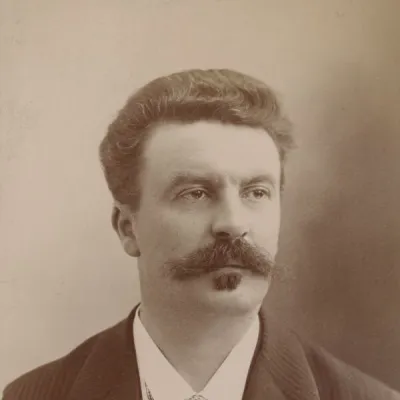
Guy de Maupassant
Human Design Chart
Biography
Maupassant was a protégé of Gustave Flaubert and his stories are characterized by economy of style and efficient, seemingly effortless dénouements. Many are set during the Franco-Prussian War of the 1870s, describing the futility of war and the innocent civilians who, caught up in events beyond their control, are permanently changed by their experiences. He wrote 300 short stories, six novels, three travel books, and one volume of verse. His first published story, "Boule de Suif" ("The Dumpling", 1880), is often considered his most famous work.
Human Design Analysis: Guy de Maupassant as Projector 6/2
Projector 6/2 — Design at a Glance
Guy de Maupassant's Human Design profile indicated a tendency towards a dense, focused aura that immediately recognized system errors in others. He was someone destined to bring light into the darkness for other people and illuminate their path. His mechanics worked like a bright flashlight: it shone directly on the areas of others that were not functioning well or still in the dark. Guy de Maupassant could instantly see what was wrong and quickly pinpoint the system error.
If he addressed these errors directly, his surroundings often reacted with defensiveness, as if he were shining an uncomfortable bright light into their faces. A more elegant approach for him was to simply shine pleasantly by living in harmony himself. Others would then naturally come to him and ask about his insights, since a glowing projector is highly attractive. His best strategy involved waiting for a respectful and sincere invitation from others rather than directly criticizing.
Since Guy de Maupassant had no defined Sacral Center as a Projector, he lacked a constant intrinsic energy source. He experienced phases of high energy and rapid productivity but needed mandatory rest periods to avoid burnout. Living according to this design rewarded him with success. Deviating from it led sooner or later to his Non-Self theme: bitterness.
Emotional Authority
Guy de Maupassant's design imposed a strict necessity for time and distance in every significant decision. He appeared as someone who did not find his inner truth in the first emotional wave but only after it had subsided. This attitude resulted from his emotional authority: His defined Emotional Center carried the responsibility for his inner "yes" or "no," independent of other defined centers.
This center was subject to a constant ebb and flow of emotions. The world always appeared colored by his current mood – sometimes enthusiastically, sometimes negatively. However, an emotion in the moment was merely a snapshot, not yet the deep truth. Quick, spontaneous decisions made from this emotional heat often had negative consequences as they were based on fleeting fluctuations.
The only way to gain clarity was to let decisions "sleep" multiple times over. Guy de Maupassant had to exercise patience and allow himself to be delayed. Only with time did the intense emotions subside, an emotional distance emerged, and calmness set in. This filtering process was essential for making long-term life decisions on a solid foundation, not on fleeting impulses.
The 6/2 Profile — Role Model / Hermit
Guy de Maupassant's Human Design presented a clear developmental trajectory: from an experimenting young person to a reflective role model. In his early years, before the age of 30, the dynamics of Line 6 as Line 3 dominated. This was a phase of active experimentation and learning through experience. Trial and error were driving principles; after mistakes, he withdrew to process them.
Around thirty years old, this attitude fundamentally changed with the activation of his actual Line 6. Guy de Maupassant now showed a strong desire for distance and withdrawal – metaphorically a "cave on the mountain." Here he found the necessary time for intensive reflection on his previous experiences. This retreat served not only for healing but also for deep self-knowledge and achieving an all-encompassing overview.
Simultaneously, Line 2's passive natural talent was at work within him. This ability to find the right direction was unconscious; he could neither actively control nor force it. Instead, he had to wait for correct calls from outside to activate this gift. A defined ego supported the realization of these natural abilities better than an open one.
Once the phase of inner clarification was complete, Guy de Maupassant emerged from his withdrawal. He now appeared as a wise person whose introspection and life wisdom attracted others. They came to him to learn from his ability for deep self-reflection. The tension between the necessary retreat for wisdom and passive waiting for the right call shaped his path from experimentation phase to role model.
Triple Split Definition — Defined & Open Centers
Guy de Maupassant's Human Design showed a consistent internal structure characterized by defined Head, Ajna, and Throat Centers. This created a constant mental pressure to ask questions and conceptualize answers, which directly manifested in reliable communication. His energy source lay in the defined Solar Plexus as an inner authority: emotional clarity only emerged after waiting out the wave of feeling, not in the moment of impulse. The also defined Root Center provided physical pressure for forward movement and stress processing.
In contrast to this stable foundation stood open Heart, Sacral, and Spleen Centers as areas of situational conditioning. In his open Heart Center, there was a lack of consistent willpower; Guy de Maupassant tended to give himself away in the non-self through promises or trying to prove himself under competitive pressure, often leading to frustration because this energy was not sustainably available. The open Sacral Center made him vulnerable to foreign vital energies; he could easily be overextended by orienting towards others' work capacity rather than relying on his own generative power. Here it was important to learn when rest is necessary and set boundaries.
The open Spleen Center brought a fundamental survival fear with it, as well as the tendency to make spontaneous decisions out of uncertainty or cling to people who gave a false sense of security. The challenge lay in not taking these fears as his own truth but recognizing them as conditioned signals. While the defined centers shaped his unique way of thinking and feeling, the open centers offered space for deconditioning: by letting go of compulsions, taking on energy from others, and resisting impulsive reactions, he could develop wisdom and detach from the environment. His strength lay in patience with his emotional wave and acceptance of mental pressure without immediately acting it out.
Channels for reflection, emotional principles and mental abstraction.
Guy de Maupassant's design established a basic disposition of the patient observer who collected life stories to share their deeper meaning only after careful reflection. This tendency was marked by the Lost Son Channel 13-33: Gate 13 in the G Center functioned as a listener for secrets and memories, while Gate 33 created the need to withdraw to digest these experiences. The challenge lay in timing – not revealing too early or isolating so much that wisdom was lost.
Additionally, the Channel of Synthesis 19-49 between Root and Solar Plexus Centers played a role. It connected the pressure for tribal belonging (Gate 19) with emotional principles of acceptance or rejection (Gate 49). This created a sensitive awareness of one's position in the community, where loyalty and emotional waves decided on belonging.
Mentally, the Channel of Abstraction 64-47 drove an active mind that filtered experiences through a kaleidoscope of mental images (Gate 64) to eventually find clarity and a narratable story (Gate 47). This process required patience as the mind never offered final certainty but only made sense in retrospect.
Additional nuances came from prioritized gates: Gate 2 emphasized receptivity as the foundation for evolutionary directions, while Gate 1 highlighted uniqueness and creative mutations here-and-now. Leadership patterns (Gate 7) stood in contrast to self-imposed pauses for pattern correction (Gate 52). Logical formulations for future security (Gate 4) and recognizing emotional illusions (Gate 30) rounded out the profile. Gate 20 promoted authentic action in the present, while Gate 62 created structures through detailed logic and fact clarification. Finally, Gate 37 connected organic community structures with mystical elements of support.
Collective Circuitry — Circuit Signature
Guy de Maupassant's design established a tendency towards cyclical emotional reflections driven by past experiences. As someone with Triple Definition, three separate energetic blocks worked parallel alongside each other without direct exchange between them. The Seeker Circuit dominated the right side of his chart. It visually connected the Head and Ajna Centers as well as the Throat and Identity Center in two isolated segments. This configuration promoted reflecting on the past to find hidden meaning within it. Energy flowed wave-like – with a beginning, middle, and end – more illogically than rationally. The aim was to share these emotional insights with the collective to enable communal learning from history. Parallel existed a separate block through the Ego Circuit, which connected the Solar Plexus and Root Centers. This emphasized the need for rest pauses for resource generation as there was no connection to the Sacral Center. Guy de Maupassant thus emerged as someone who visually and emotionally processed past events to pass them on in a distilled and understandable form while living through waves of emotional intensity that required clear phases of recovery.
Left Angle Cross of Refinement 1
Guy de Maupassant's design carried the structure of the left Refinement Cross 1. This configuration formed the fundamental architectural framework of his energetic map, even though it did not prescribe specific behavioral patterns or character emphases. It was a purely structural element within his Human Design chart that served as a frame without offering content through defined mechanisms.
As there was no mechanical description for this cross, no specific pattern of life task or energetic quality could be derived from it. It merely functioned as a named structural element that was part of the overall composition but did not allow further elaboration on how Guy de Maupassant used his energy or reacted to circumstances. The naming of this cross remained limited to identifying the structure itself. There were no indications that this specific cross configuration influenced particular tendencies in his perception or action. Instead, it stood as an isolated factor, a piece of the puzzle that could exist without further interpretive filling. Guy de Maupassant lived with this structure, yet it dictated no special duties or character traits beyond its mere existence in the chart.
Saturn Return · Uranus Opposition — Life Cycles
Guy de Maupassant's design showed a cyclical dynamics defined by two marked crisis points. These cycles did not appear as positive developmental steps but led to acute life crises involving physical and psychological destabilization. The first Saturn return around 1877, at age 27, marked such a turning point. In this year, Maupassant contracted syphilis. This timepoint highlighted the harsh reality of the cycle: Instead of a stable condensation of previous life work, it brought about severe physical strain that seriously impaired his health.
The Uranus opposition around 1892, at age 42, brought the second major destabilization. On New Year's Eve of this year, Maupassant collapsed and attempted suicide. This event underscored the intensity of the crisis: The inner tension led to an acute psychological breakdown. Both points – 1877 and 1892 – served as critical moments where the underlying mechanical dynamics showed severe strain. They were not phases of growth in the traditional sense but times of acute vulnerability that seriously endangered physical and mental stability. Analysis of these chart data suggests that these specific astrological-mechanical cycles at Maupassant were associated with drastic health and psychological breaks.
Projector · Emotional Authority — Synthesis
He was a projector who, through his defined emotional authority and the Lost Son Channel (Gate 13-33), developed a deep capacity for perception and reflection. This constellation shaped a character focused on recognizing underlying patterns in his environment – both in others as well as in his own experiences. He lived by taking in information, processing it internally, and eventually passing on wisdom after experiencing it himself. The defined Head Center strengthened this process further by creating a constant pressure towards inspiration and understanding that drove him to question the world around him and develop new perspectives.
A central paradox in his design lay in the interplay of emotional depth and the need for withdrawal. The emotional wave required time for decision maturation, while the Lost Son Channel brought a natural tendency towards reflection and retreat with it. This led to an internal tension between the desire to share insights with others – as a projector destined to bring light into darkness – and the simultaneous need for distance to fully process and understand collected experiences. Crisis experiences in Saturn Return (1877) and Uranus opposition (1892) clearly showed this dynamic.
3 Defined Channels
Incarnation Cross - Left Angle Cross of Refinement 1
Solar Return
The Solar Return shows the moment when the sun returns to its exact birth position - your personal solar year.
Life Cycles
Discover the life cycles with a detailed triple view (birth chart, cycle chart, composite).
Human Design Profile
- Type
- Projector
- Strategy
- Wait for the respectful invitation
- Authority
- Emotional Authority
- Profile
- 6/2 - Role Model / Hermit
- Definition
- Triple Split
- Incarnation Cross
- Left Angle Cross of Refinement 1
- Date of Birth
- 05.08.1850 08:00
- Place of Birth
- Dieppe, France
Frequently Asked Questions
What was Guy de Maupassant's Human Design type?
What profile did Guy de Maupassant have?
What authority did Guy de Maupassant have?
What incarnation cross did Guy de Maupassant have?
When was Guy de Maupassant born?
Discover your own Human Design
Are you also a Projector? Find out in a personal reading how to unfold your leadership qualities and recognize the right invitations.
More Personalities
Back to overviewSissy Spacek

Alain-Fournier

Anémone

Angeli

Ann-Margret

Bourvil