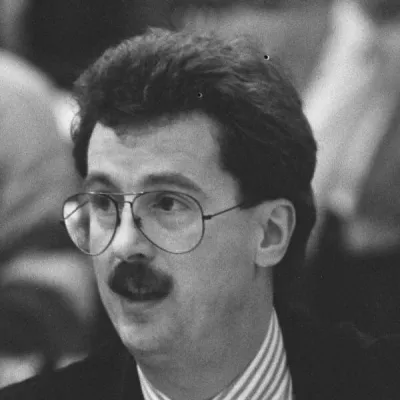
Hans Alders
Human Design Chart
Biography
Hans Alders was National Coordinator Groningen from 1 June 2015. On 30 May 2018 he made it known to resign.
Alders was PvdA Member of Parliament, minister and director. He did not complete any secondary school education and developed through self-study . He was soon a prominent member of the PvdA party in the House of Representatives . He was spokesperson for, among other things, civil servants and later secretary of the PvdA party and confidant of Wim Kok . Alders came as Minister for Housing, Spatial Planning and the Environment in the Lubbers III cabinet with notes on spatial planning (Vinex ) and environmental policy ( NMP-plus) . He moved to an international position after his ministry.
Alders was Commissioner of the Queen in the province of Groningen from 1996 to 2007. On 1 September 2007 he was succeeded by Max van den Berg .
After his period as a politician, he held a large number of positions. On 1 October 2007, Alders became Chairman of the Board of the Energy Netherlands. He is also chairman of the Supervisory Board of the University Medical Center Groningen .
Alders was discredited by his many well-paid side positions. In 2005 Alders came in the news after researching a national weekly magazine, because he had the highest income from additional positions of all Queen's commissioners. He received 48,000 euros from the Health, Mental and Social Interest Pension Fund (PGGM) and over 17,000 euros per year from Gasunie. Alders managed - as far as is known to be the only one - to almost double his income as a former Queen's Commissioner with additional income.
Hans Alders as a Generator 3/5 in Human Design
Generator 3/5 — Design at a Glance
Hans Alders revealed himself as someone with remarkable inner endurance that was not fueled by constant initiative. His design indicated a tendency towards great energy capacity, comparable to a workhorse ready to provide power – provided it is used for fitting tasks. This energy source, the sacral center, did not function as an engine for self-starting initiative but responded to external impulses.
The mechanics of his design required a clear strategy: do not initiate, but wait and react. Hans Alders’ path involved waiting for signals from life and then acting only when his inner voice gave a clear “yes.” This was the key to utilizing his strength without self-exploitation.
If he followed this principle of reacting “from the gut,” it resulted in deep satisfaction and a sense of fulfillment. Ignoring this inner guidance – whether by forcing actions against his will or suppressing his desire for a heart project – inevitably led to frustration, energy depletion, or burnout. His strength thus lay not in pushing forward but in powerfully responding to what he encountered.
Sacral Authority
Hans Alders’ decision-making was based on an internal, bodily resonance rather than cognitive analysis. His design featured sacral authority, a mechanism exclusive to the Generator type that merges with its strategy of authority, simplifying the process. A prerequisite for this was an open emotional center. The signals appeared as gut feelings or bursts of energy in response to external stimuli – concretely as grunts, hums, or vocal sounds like “Mhm” or “Hmm.”
When his sacral motor responded, Hans Alders felt vital and alive, equipped with seemingly inexhaustible energy. He tackled his tasks with great enthusiasm, born to go through life with joy and immerse himself in activities without being bound by purpose.
Additionally, a supportive spleen activation was at play. This connection allowed particularly quick, spontaneous reactions and decisions. Hans Alders had immediate access to his physical well-being and instinctive perception. He could trust this reliable inner guidance that helped him respond with the right energy at the right moment, without thinking or planning.
The 3/5 Profile — Martyr / Heretic
Hans Alders exhibited a fundamental attitude of radical self-experimentation: he believed nothing given but had to test everything personally. This approach from Line 3, characterized by “trial and error,” served adaptation through direct experience. Mistakes were not obstacles but necessary steps towards understanding. From these practical experiences, his role as a hero (Line 5) developed. When others faced crises, Hans Alders offered solutions based on proven practice rather than theoretical correctness. His value lay precisely in this authenticity: he was the adventurer who had walked the path of failure and now knew what worked.
This combination made him attractive to others; people sought his wisdom because it was concrete and tested. Yet, this public role harbored a tension. While Line 3 accepts mistakes as learning processes, Line 5’s hero role expects competence in crisis moments. If Hans Alders failed before others’ eyes, it deeply affected him since it undermined his authority as a rescuer. Nevertheless, the core of his design remained clear: through personal adventures and enduring failures, he gathered a treasure trove of life experience that he then humorously and pragmatically shared with others. His strength was not in avoiding conflicts or theoretical perfection but in the ability to pave functioning paths for others from the chaos of experimentation.
Single Definition — Defined & Open Centers
Hans Alders showed himself to be driven by a constant, vital energy source that unfolded not through his own initiative but rather in response to life's questions and situations. His defined Sacral Center generated a reliable daily supply of power, felt as an inner hum, urging him towards activity. This energy was only fully available when he waited for queries or circumstances and responded with spontaneous "yes" or "no". Initiating actions without prior inquiry often led to exhaustion and frustration because the connection to his source was broken.
Parallel to this, Hans Alders possessed a sharp, momentary intuition through his defined Spleen Center. It provided trustworthy impulses for health and well-being in the here-and-now that he could not or should not rationalize. This spontaneous body intelligence was his authority for survival and thriving in every single moment.
In contrast, almost all other centers were open in Hans Alders, making him a sensitive mirror of his environment. His open Head Center lacked consistent inspiration; he tended to engage with foreign questions or doubts and often sought mental pressure to focus, though this wasn't his own task. Similarly, his open Ajna Center did not have fixed conceptual thinking. He absorbed ideas and opinions from the surroundings without identifying them as his truth, granting him flexibility but also the risk of confusion.
His open G Center meant that Hans Alders lacked a firm identity or life direction. He adapted to people and places he was with and did not actively seek meaning or love but waited to be initiated. At the wrong place, he felt lost; at the right one, he flourished without having to steer it himself. An open Heart Center led him to be unable to prove his self-worth through willpower or promises. He tended to overextend himself to appear valuable, which always ended in disappointment as he lacked consistent energy for this.
Emotionally, Hans Alders was vulnerable to the mood swings of others due to his open Solar Plexus Center. He absorbed and amplified foreign feelings without recognizing them as his own, making him emotionally unstable if he did not withdraw to calm down. Finally, his open Root Center took on the adrenalized stress from the environment. Often feeling an uncontrollable urge to act quickly or achieve something, though this pressure didn't originate with him. This external drive could push him into a cycle of frenzy and burnout when trying to escape it rather than recognizing and letting go of its foreign nature.
Channels for intuitive survival power and individual authority.
Hans Alders revealed himself through a constant, intuitive survival intelligence that directed his actions directly from the body. This stance primarily resulted from Channel of Power 34-57, which connects the Sacral Center with the Spleen. Here, the generative life force of Gate 34 strengthens the existential awareness of Gate 57. Gate 57 continuously checks the environment for vibrations and dangers while Gate 34 provides the energy to actively engage or withdraw. This combination generates a deep fight-or-flight instinct that prompted Hans Alders to strictly prioritize his own vitality and security – often independent of others' needs.
To react clearly and quickly, a constant connection to body awareness was necessary. This manifested in selective perception: Hans Alders always listened with the right ear to grasp the true message behind words. The intuition of the Spleen responded immediately, free from mental delay, protecting him through spontaneous reactions to vibrations in his environment. Since this energy is purely focused on self-preservation, it does not involve others; instead, it serves to affirm individual existence.
Additionally, other gates played a role: Gate 11 promoted visual assessment of ideas before acting, while Gate 12 enabled creative mutations and poetic expression forms. Gate 6 steered emotional waves and protective reflexes, Gate 36 used crises as developmental impulses. Gate 32 sought material continuity for the clan, Gate 18 discriminated between necessary corrections in the collective. Gate 5 valued firm rhythms and habits to build energy. When inclined towards melancholy, it was important to accept these moods without mentally correcting them to maintain healthy vitality.
Individual Circuitry — Circuit Signature
Hans Alders showed a tendency to draw his strength directly from reactions to life circumstances and anchor it through intuition in the present moment. His design indicated a high degree of individuality where auditory perception plays a role. This results from the Integration Circuit, specifically the Channel of Power between Sacral and Spleen Centers.
The mechanics describe a process for securing survival through personal power. Energy is gained by reacting to life (Gate 34 in the Sacral Center). This strength is then guided by intuitive knowledge (Gate 57 in the Spleen Center) and anchored in the now. Although the circuit generally also includes Gates 10 and 20, only Gates 34 and 57 are active for Hans Alders. Therefore, this channel connects exclusively the Sacral with the Spleen Center. There is no direct energetic connection to other centers within this circuit.
The simple definition confirms that these two centers form a cohesive unit. Thus, Hans Alders utilized the ability to draw strength from direct life reactions and guide it through inner intuition. This promoted self-reinforcement and highest individuality. The energy flows between Sacral and Spleen Centers as a closed loop without spilling over into other areas of his design. This configuration underscores the importance of authentic action based on inner resonance rather than external validation.
Right Angle Cross of Eden 4
Hans Alders' design establishes a fundamental orientation defined by the right cross of Eden 4. This configuration marks a specific archetypal quality: the search for life's meaning through direct experience and spiritual clarity. It is an existential alignment where the individual strives to look beyond the surface, grasping deeper truths not through abstract theory but through lived practice and inner resonance.
The right cross of Eden 4 connects the energy of recognition with the necessity of rooting this insight into daily life. It's about integrating spiritual insights so they form a stable foundation for one's existence. Hans Alders was shown by this mechanism to be someone whose focus lay on the authenticity of internal experience. The challenge and task of this design is not to remain in illusions or mere beliefs but to find a clear, personal truth that guides action. This orientation shapes how Hans Alders dealt with uncertainties: by reflecting on what proved true and reliable within him rather than conforming to external doctrines. It's a path of continuous refinement of self-understanding through experience.
Saturn Return · Uranus Opposition · Chiron Return · 2nd Saturn Return — Life Cycles
Hans Alders showed a tendency towards sudden, unexpected breaks in established structures. His design suggested that his life did not develop linearly but was marked by shock events breaking the status quo and forcing new paths. This mechanism of the Uranus opposition acts as a cyclical trigger for revolutions in personal or professional environments. It demands no gradual adaptation but abruptly brings the system to a point where old forms are no longer sustainable.
This process became concretely active in 1989 when Hans Alders, at age 37, was appointed Minister of Housing, Spatial Planning and Environment. This event did not mark a gradual ascent but a clear breakout from previous structures into a new revolutionary level of responsibility. The appointment functioned as the concrete moment where the dynamism triggered by the Uranus opposition unfolded its full power. It was a break with the known and entry into a field demanding profound changes that had to be accepted rather than chosen. The design shows here how external circumstances suddenly impose a new reality that must be embraced, often surprisingly but necessarily for the design's potential to unfold. Hans Alders found himself at this moment precisely where the old framework broke down, making way for an entirely new orientation.
Generator · Sacral Authority — Synthesis
Hans Alders' life seems marked by a profound dynamic arising from the connection between his Generator energy, sacral authority, and the Profile of the Explorer/Hero. He is designed to respond to life and release energy through action – a process authenticated by his physical reaction (sacral center). This ability to learn from experience and pass on knowledge appears to drive him continually to explore new paths and provide solutions for others. The openness of his centers points to high adaptability and the capacity to perceive and integrate other people's energy into his own actions.
Central, however, is a paradox between the urge to act and the necessity to wait for the right signal from life. His sacral center demands reaction while open centers may make him vulnerable to external influences. This tension manifests in an ongoing interplay between initiation and waiting, between wanting to effect change and needing to find his own inner truth to act authentically. The ability to use this internal compass and apply energy correctly seems key to his well-being and success.
1 Defined Channel
Incarnation Cross - Right Angle Cross of Eden 4
Solar Return
The Solar Return shows the moment when the sun returns to its exact birth position - your personal solar year.
Life Cycles
Discover the life cycles with a detailed triple view (birth chart, cycle chart, composite).
Human Design Profile
- Type
- Generator
- Strategy
- To respond - wait for something to respond to
- Authority
- Sacral Authority
- Profile
- 3/5 - Martyr / Heretic
- Definition
- Single Definition
- Incarnation Cross
- Right Angle Cross of Eden 4
- Date of Birth
- 17.12.1952 04:30
- Place of Birth
- Nijmegen, Netherlands
Frequently Asked Questions
What is Hans Alders' Human Design type?
What Profile does Hans Alders have in Human Design?
What authority does Hans Alders possess?
What incarnation cross does Hans Alders have?
When was Hans Alders born?
Discover your own Human Design
Are you also a Generator? Find out in a personal reading how to use your sacral energy correctly and discover deep satisfaction.
More Personalities
Back to overviewAaliyah

Alexia

Angèle

Anne-Marie

Arcángel
Arno