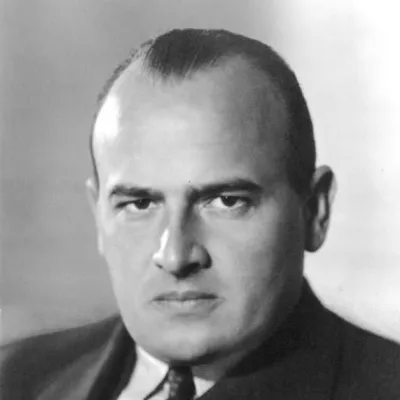
Hans Frank
Human Design Chart
Biography
Born in Karlsruhe, Frank was an early member of the German Workers' Party (DAP), the precursor of the Nazi Party (NSDAP). He took part in the failed Beer Hall Putsch, and later became Adolf Hitler's personal legal adviser as well as the lawyer of the NSDAP. In June 1933, he was named as a Reichsleiter (Reich Leader) of the party. In December 1934, Frank joined the Hitler Cabinet as a Reichsminister without portfolio.
After the German invasion of Poland in 1939, Frank was appointed Governor-General of the occupied Polish territories. During his tenure, he instituted a reign of terror against the civilian population and became directly involved in the mass murder of Jews. He engaged in the use of forced labour and oversaw four of the extermination camps. Frank remained head of the General Government until its collapse in early 1945. During that time, over four million people were murdered under his jurisdiction.
After the war, Frank was found guilty of war crimes and crimes against humanity at the Nuremberg trials. He was sentenced to death and executed by hanging in October 1946.
Hans Frank as a Manifesting Generator 3/5 in Human Design
Manifesting Generator 3/5 — Design at a Glance
Hans Frank revealed himself as someone who combined the endurance of a Generator with the explosive speed of a Manifestor through a hybrid energy configuration. His design pointed to a defined Sacral Center that gave him constant power, yet it required him to respond to external impulses before acting. This combination allowed him to skip steps and push projects forward rapidly, which often appeared as an advantage but also carried risks.
The mechanics of his type, the manifesting generator, tended to tackle multiple tasks simultaneously since various impulses were reacted to at once. Without constant confirmation from his inner authority and Sacral Center—that "yes" feeling of satisfaction—this multi-layered approach could quickly turn into frustration. If he moved too fast or skipped important phases, he often had to backtrack to fill in gaps. This frequently led to his specific non-self theme: the frustration over his own inadequacies or blockages.
Only when Hans Frank regularly checked whether his projects continued to bring him joy and if his inner center agreed could he effectively utilize his creative power. In this "play mode," characterized by variety and genuine interest, he found deep satisfaction. His design challenged him not to proceed linearly but rather to act in a dynamic, playful way that combined speed with inner resonance to achieve sustainable results without overburdening or burning himself out.
Emotional Authority
Hans Frank was often swept up in an emotional wave that manifested as a constant fluctuation of his feelings. His inner authority was Emotional Authority, carried by the defined Solar Plexus Center. According to Human Design mechanics, this authority always takes precedence over all other defined centers, regardless of what else is activated in the chart. Hans Frank saw the world colored by his current mood; he could be completely enthused about something at one moment and then view the same thing negatively a moment later. However, his feeling was only a snapshot, a first impression that didn't necessarily reflect reality. Therefore, quick, spontaneous decisions made from emotion often had negative consequences. The more time he took to let a decision mature, the deeper and more comprehensive his understanding became. This required patience and reconsidering decisions multiple times. He should take his time, ponder carefully, and ask himself repeatedly. Over time, intense feelings subsided, he gained emotional distance, clarity emerged, and calmness set in. Then he had gone through the process. This mechanism was particularly important for long-term decisions that could have a significant impact on his life path.
The 3/5 Profile — Martyr / Heretic
Hans Frank revealed himself as someone who defined his identity through practical experience and solving other people's concrete problems. His design featured the Profile 3/5, the Experimenting Heroes. The line of the Adventurer required him to initially believe nothing but to test everything for himself. He learned from these experiments and the resulting setbacks, subsequently taking on the role of helper with this acquired knowledge. This dynamic made him attractive in his environment; people sought his advice because they wanted to benefit from what seemed like a rich reservoir of experience.
This heroic role flattered him, yet it came with a risk: failure often occurred publicly, which could be deeply painful. His mind was marked by Gate 20, fostering constant self-reflection and a strong awareness of personal development. However, this intense focus on the "self" sometimes prevented him from clearly perceiving the immediate moment. Additionally, in positions of influence, Gate 55 came into play. Here he showed an ability to take and implement advice, but this depended heavily on proper timing. His mental stance was only stable when it was socially recognized; emotional openness could impair his judgment. Thus, Hans Frank lived in a tension between the drive to gain authority through personal testing and the necessity of having that authority externally confirmed to remain effective.
Split Definition — Defined & Open Centers
Hans Frank's design revealed a tendency towards a consistent voice emanating from his identity. His defined Throat Center, in conjunction with the G Center, enabled him to act and speak always from a firm sense of direction and higher self. This configuration created a reliable way of self-expression that was not impulsive but rather based on deep inner certainty.
As a Generator with a defined Sacral Center, Hans Frank possessed an enormous source of vital energy. However, his design required him to release this power through reactions to external stimuli rather than by initiating actions himself. The combination of generative energy and the emotional authority of his defined Solar Plexus Center meant that decisions only became clear after going through an emotional wave. His defined Root Center provided the necessary pressure to advance in the material world and overcome existential challenges.
At the same time, his chart revealed specific vulnerabilities. His open Head and Ajna Centers made him susceptible to mental inspirations and confusion from the environment. He tended to identify with questions or concepts of others rather than relying on a consistent, stable mental truth. His open Heart Center led to the temptation to make promises or prove worth through willpower, which often ended in frustration due to the lack of constant energy required. Additionally, his open Spleen Center was vulnerable to survival fears and clinging to unhealthy situations out of a false sense of security. These open centers acted as mirrors that made him interpret external impulses as personal necessities when he did not trust his inner authority.
Channels for powerful presence, authentic action and emotional depth.
Hans Frank's actions were strongly influenced by an internal urgency, which however relied on reactions from the sacral energy. This dynamic was driven by the Charisma channel 34-20: The raw life force of Gate 34 (Power) pushed directly into the Throat Center to Gate 20 (Now). This gave him a charismatic presence and the ability to manifest quickly. Without this sacral reaction as a compass, however, this energy could become obsessive or chaotic, misguided action, as the mind took over instead of the inner rhythm.
Parallel to this, the channel of Exploration 34-10 was at work. It connected the sacral power (Gate 34) with the G Center through Gate 10 (Self Behavior). This promoted a deep but often isolated search for individual confirmation and self-love. Hans Frank was programmed to perfect his own convictions and behave independently of collective norms. The combination of charisma and exploration created a profile that was strongly focused on independence and demonstrating uniqueness, often at the expense of social adaptation.
Emotionally, he traversed the channel of Emotional Release 39-55. This channel connected the Root Center (Provocation, Gate 39) with the Solar Plexus (Mind/Emotions, Gate 55). It generated a pulsating wave of moods ranging from melancholy to passionate highs and lows. His moods were not rational to control but had to be lived through as alchemy between joy and sorrow. This gave him a certain mystical depth or provocative power that could attract or repel others depending on where he was on his emotional wave.
Additionally, the Awakening channel 10-20 contributed. It connected the G Center (Gate 10) with the Throat Center (Gate 20). This supported the demand for authentic expression: “I am because I love myself.” His survival and impact depended on him verbally and behaviorally living this self-acceptance in every moment. If successful, he unconsciously inspired others towards authenticity; if not, it led to internal resistance and criticism sensitivity. The prioritization of Gates like 59 (Coupling/Strategy) and 16 (Experimenting) in the background underscored a focus on genetic continuation and constant testing of new skills to achieve mastery.
Individual Circuitry — Circuit Signature
Hans Frank's design revealed a tendency towards inner strength and emotional pulsation, which however operated in separate energetic realms. As a person with split definition, he possessed two non-connected energy fields: one from Identity, Heart, and Sacral Center, the other from Solar Plexus and Root Center. This separation meant that his emotional waves (Solarplexus-Root, Knowledge Circuit) did not directly influence his will or life force; they existed parallel to each other.
In the realm of identity, the Centering circuit worked through channel 10-34 (“Exploration”). This connected the Sacral Center directly with the Identity Center, fostering an inner, individual confirmation. Frank's convictions were thus deeply rooted in his life force but often remained unspoken due to no connection to the Throat Center.
Additionally, the Integration circuit was strongly at work here. Here channels 20-10 (“Awakening”) and 20-34 (“Charisma”) connected the Throat Center with the Sacral and Identity Centers. This created a direct flow of intuitive knowledge (Gate 57, implicitly in the circuit) and correct behavior through life energy to articulation. Frank's design thus showed an ability to directly translate inner charisma energy into words, separate from his emotional fluctuations. The two defined parts remained energetically isolated: emotions shaped his mood while identity and expression drew from another source.
Right Angle Cross of the Sleeping Phoenix 2
Hans Frank's design featured the configuration of the "Right Cross of the Sleeping Phoenix." This was a rare and high-energy structure within Human Design, indicating a life characterized by intense internal tension and potential for significant, often unexpected turns. The name of this formation refers to an image of a phoenix that is sleeping – in a phase of rest or waiting – but possesses immense power capable of explosive transformation when needed.
For Hans Frank, this configuration did not necessarily guarantee external fame or conventional success. Instead, it defined an internal dynamic: he carried within him energy awaiting a specific trigger. Until the moment arrived, life could be calm, even unnoticed – the "sleeping" aspect. Yet once the right circumstances arose, this dormant power would activate and lead to extraordinary achievements or profound changes.
This configuration was no guarantee of linear progress. It described rather a quality of life marked by the ability to remain still until timing was perfect. Hans Frank lived with latent energy that distinguished him from those without such cross configurations. His design did not manifest through constant action but through readiness to wait for the right moment when his inner power would unfold.
Saturn Return · Uranus Opposition — Life Cycles
Hans Frank emerged as a personality whose life rhythm was strongly influenced by cyclical turning points. His design indicated a tendency to set decisive courses at specific age stages, which then remained effective for long periods. This became evident in 1925: At the age of 25, Frank married Maria Brigitte Herbst. This first Saturn Return often marks the transition from an experimental youth phase to a more stable life structure. For his chart, this was not just a date but a moment when years of internal development condensed into a tangible external commitment – a typical effect of this astronomical cycle on personal reality.
Later, in 1940 at age 40, he established the Amber Cup for football teams. This fell during the Uranus Opposition phase, often associated with Human Design's drive towards renewal and breaking old patterns. Instead of merely internal transformation, Frank channeled this energy into a concrete public gesture. The foundation served as an expression of his striving for lasting recognition and influence beyond the purely private sphere. Both events illustrate how astrological transits structured his actions: The Saturn Return laid the private groundwork while the Uranus Opposition provided the impulse towards public visibility and renewal.
Manifesting Generator · Emotional Authority — Synthesis
Hans Frank lived a life marked by a strong drive for expression and exploration of new paths. The combination of manifesting generator energy and emotional authority points to someone who could act swiftly and set things in motion (through the connection between Sacral Center and Throat Center), as well as deeply felt the need to let decisions mature and engage with emotions. The profile as an experimenter and hero reinforced this trait: Experiences had to be made personally to then be shared as knowledge – a constant search for new insights and readiness to embody them in the world (Awakening Channel).
Central to his essence was, however, a paradox between the need for quick action and the necessity of emotional clarity. While he could push things forward rapidly through his energy, emotional authority required time for reflection to ensure these impulses aligned with inner truth. This led to tension between the desire for immediate implementation and the need for thorough emotional clarification, manifesting in phases of intense activity followed by restraint.
4 Defined Channels
Incarnation Cross - Right Angle Cross of the Sleeping Phoenix 2
Solar Return
The Solar Return shows the moment when the sun returns to its exact birth position - your personal solar year.
Life Cycles
Discover the life cycles with a detailed triple view (birth chart, cycle chart, composite).
Human Design Profile
- Strategy
- To respond - wait for something to respond to
- Authority
- Emotional Authority
- Profile
- 3/5 - Martyr / Heretic
- Definition
- Split Definition
- Incarnation Cross
- Right Angle Cross of the Sleeping Phoenix 2
- Date of Birth
- 23.05.1900 20:30
- Place of Birth
- Karlsruhe, Germany
Frequently Asked Questions
What is Hans Frank's Human Design type?
What Profile did Hans Frank have in Human Design?
Which authority guided Hans Frank's decisions?
What incarnation cross was assigned to Hans Frank?
When was Hans Frank born?
Discover your own Human Design
Are you also a Manifesting Generator? Find out in a personal reading how to unfold your multi-talents and direct your energy wisely.
More Personalities
Back to overviewAldair
Alizée

Angeli
Arletty
Artus
Balthus