
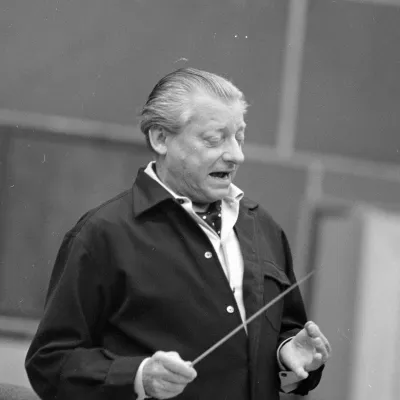
Hans Schmidt-Isserstedt
Human Design Chart
Biography
Schmidt-Isserstedt's compositions included songs, the opera Hassan gewinnt (Rostock, 1928), and works for orchestra. His son was the British record producer Erik Smith. Hans Schmidt-Isserstedt died in Holm, Pinneberg, West Germany, on 28 May 1973, aged 73.
What does Manifesting Generator 2/4 mean for Hans Schmidt-Isserstedt?
Manifesting Generator 2/4 — Design at a Glance
Hans Schmidt-Isserstedt was someone who possessed hybrid energy: the constant power of a Generator paired with the lightning-fast effect of a Manifestor. His design suggested that he didn't just react but could draw things into his life by skipping steps and pushing multiple projects forward simultaneously. This speed, however, was a double-edged sword; often he would overlook important stages, forcing him to backtrack and fill in gaps – a potential source of frustration when inner consent was lacking.
His strategy involved waiting for impulses before acting. Only when his Sacral Center gave a clear 'yes' could he effectively utilize his creative power. If this confirmation didn't come or if he tried to go against his internal rhythm, initial enthusiasm quickly turned into exhaustion. When this process worked harmoniously, Hans Schmidt-Isserstedt entered a 'play mode'. In this state, variety was not an obstacle but fuel. He drew deep satisfaction from what he did as long as he maintained the freedom to switch between different tasks and apply his energy where it remained vibrant. The demand to fixate on one thing stood in opposition to his nature; only through this dynamic diversity did he find the consistent fulfillment that his design allowed.
Emotional Authority
Hans Schmidt-Isserstedt showed himself to be someone who always took an inner pause at important life decisions. His design carried emotional authority, meaning his defined Emotional Center was the sole source of his internal guidance – regardless of whether other centers were also defined. This configuration subjected him to a natural wave of emotional ups and downs. The world appeared colored by his current mood: in one moment he could be enthusiastic about something, in the next see it negatively. His immediate feeling was only a snapshot, not yet the final truth. Quick, spontaneous decisions from this emotional heat would have been risky for him. Instead, his nature required patience and conscious hesitation. He gave himself time to let decisions mature, often over several nights. Over time, intense feelings subsided, he gained emotional distance, and deep clarity and calmness set in. Only then, when this process was complete, did he act. This mechanism served to protect long-term decisions that significantly shaped his life by ensuring they were based on a stable internal truth rather than fleeting excitement.
The 2/4 Profile — Hermit / Opportunist
Hans Schmidt-Isserstedt was marked by tension between the need for withdrawal and the desire for connection. His Profile 2/4 described someone constantly oscillating between the Lone Wolf Line (2) and the Community Line (4). This required creating a safe environment where he could clearly communicate: when he sought company and when he wanted to be undisturbed. During his 'Me-Time', he immersed himself in internal processes to gain clarity. Satisfying this need for solitude, he returned from his 'cave' to spend time with his favorite people.
The second line endowed him with a natural talent for the right direction without conscious control. It was important to be correctly called upon and not actively interfere to foster this talent. A defined Ego supported its realization better than an open one. Simultaneously, the fourth line, particularly through Gate 13, acted as an exhaustion zone. He attracted people who told him stories, emotionally taxing and exhausting him. This receptivity led to a heavy burden. After phases of renewal often came fatigue and a pressing need for silence for reflection. Through this balance, he could reflect on his network's knowledge during his alone time, evaluate it, and develop brilliant ideas from it.
Single Definition — Defined & Open Centers
Hans Schmidt-Isserstedt's Human Design profile indicated a tendency towards consistent, trustworthy expression of strength. His defined Throat Center served as a focal point for messages originating from other energy sources, manifesting in the world as clear communication or action. This ability to articulate reliably aligned with his defined G Center, which gave him a firm sense of self-identity and direction. He had a deep sense of belonging without relying on others.
As a Generator, Hans Schmidt-Isserstedt also possessed a defined Sacral Center, the motor of his vital energy. His life force was not expressed through initiated actions but rather reactive affirmation: he waited for questions or invitations to respond with an inner 'yes' or 'no'. This sacral response determined whether he had the energy for a task and found satisfaction in it. Simultaneously, his defined Solar Plexus Center shaped his emotional depth; he was designed not to make impulsive decisions but to wait out the waves of his feelings until emotional clarity emerged. This patience allowed him to navigate complex emotional landscapes and gain deep insights.
In contrast, his open Head Center revealed a receptivity to external inspirations that should not be interpreted as personal mental truth. Without constant internal questioning, he tended to identify with others' thoughts, leading to confusion when he projected this mental pressure outward. His open Ajna Center amplified this mental flexibility; it was open to concepts and theories absorbed from the environment rather than constantly generated internally. This required vigilance to avoid mistaking foreign ideas for personal certainties.
Additionally, his open Heart Center and spleen, along with an open Root Center, influenced him. The open Heart Center meant he lacked a consistent willpower to keep promises or prove himself continuously; he was vulnerable to the pressure of demonstrating worth through performance. His open Spleen made him sensitive to the well-being of his surroundings and prone to absorbing others' fears, which should protect him from spontaneous decisions often driven by conditioned insecurity. Finally, his open Root Center absorbed external stress; he was not designed for constant adrenal-driven work but needed to learn to distinguish between personal and foreign stress to avoid overload. This constellation showed a person finding strength in patient reaction, emotional clarity, and authentic communication while learning not to take the noise of the mind or environmental pressure as their own burden.
Channels for rhythm, logical leadership and emotional openness.
Hans Schmidt-Isserstedt's Human Design profile indicated a tendency towards deep biological connection with life's natural flow. The Rhythm Channel 5-15 linked his sacral energy to universal magnetism, integrating him into a continuous flexible energy flow based on firm habits while also incorporating societal diversity, drawing others unconsciously into his rhythm.
Parallel to this, the Alpha Animal Channel 7-31 showed a structure of logical leadership. This was not about authoritarian rule but collective leadership based on trust and understanding existing patterns. Hans Schmidt-Isserstedt naturally sought influence by acting as a representative figure whose voice led when recognized by the community.
Emotionally, he operated through the Openness Channel 22-12, binding his expressions to the ebb and flow of his emotional wave. His communication was marked by passion and caution; he spoke with full impact only when his mood allowed it, aiming to trigger transformative impulses.
Additionally, Gates like Gate 2 (Receptivity) and Gate 1 (Uniqueness) promoted a creative mutation in the present moment. Gate 13 supported reflection within time context, while Gate 45 represented tribal belonging and willpower in his design. This configuration marked him as someone influencing their environment through authentic flow, trust-based leadership, and mood-dependent emotional articulation, always dependent on staying true to his inner rhythm or being distracted by external distortions.
Collective Circuitry — Circuit Signature
Hans Schmidt-Isserstedt's Human Design profile indicated a tendency towards emotionally colored individual expression closely tied to strategic structure. As a simply defined type, he had an uninterrupted energy flow between Sacral, Identity, Throat, and Solar Plexus Centers. This direct connection allowed him to seamlessly translate inner impulses into words.
The Understanding Circuit worked through the Channels 'Alpha Animal' (Gates 31-7) and 'Rhythm' (Gates 15-5). This current linked his Throat Center directly with Identity and Sacral Centers, giving Hans Schmidt-Isserstedt a focused rational power to share logical insights free from conditioning. His expressions were not just emotional but carried strategic weight aimed at future-oriented improvement.
Parallel to this, the Knowledge Circuit shaped his essence, activated by the Channel 'Openness' (Gates 12-22). This channel connected his Throat Center with Solar Plexus. Here it was about the pulsating energy of the present moment and expressing individuality. New insights were transformed through emotional waves and carried acoustically into the world.
Both circuits converged in the Throat Center, where rational strategy met emotional creativity. Hans Schmidt-Isserstedt thus emerged as someone who not only understood complex connections but articulated them with a unique authentic voice – a synthesis of clear mind and deep feeling.
Right Angle Cross of the Sphinx 2
Hans Schmidt-Isserstedt's Human Design profile featured the right cross of the Sphinx, a configuration often associated with a profound, almost mythical connection to collective processes and the preservation of knowledge. This structure shaped his inner stance not through external aggression or obvious leadership but through a quiet, steady presence that felt like a foundation. He was someone capable of embodying great currents and changes without needing to be at the center himself. The energy of this cross promoted a kind of wisdom that did not stem from intellectual analysis but from an intuitive understanding of what has endured over long periods. For Hans Schmidt-Isserstedt, this likely meant a life task of establishing and stabilizing connections where others felt uncertainty. His role was to serve as a reliable anchor during times of change by keeping values and traditions alive and relevant for the collective rather than holding them rigidly in place. This configuration does not demand loud actions but deep authenticity in dealing with what is truly important. Hans Schmidt-Isserstedt lived this quality through his ability to understand complex interconnections and integrate them in a way that offered guidance to others without being overbearing.
Saturn Return · Uranus Opposition · Chiron Return · 2nd Saturn Return — Life Cycles
In 1948, at the age of 48, Hans Schmidt-Isserstedt experienced a pivotal turning point: The military government certified him as having a clean past. This marked the beginning of his Chiron Return, a cycle of fulfillment and blooming. During this phase of life, one's incarnation cross increasingly unfolds if they have lived according to their strategy and authority up until that point. Meaning and purpose become tangible; it is not about healing old wounds but realizing innate potential. For Hans Schmidt-Isserstedt, this inner development was made visible by the external act of rehabilitation. The official confirmation of his integrity served as a catalyst that reordered and stabilized his professional career path. This moment showed how long-term alignment with one's design manifests in concrete life circumstances. The Chiron Return here acts as a fulfillment phase where previous development matures and the individual path becomes clearer. The certification by the military government was not an isolated event but an expression of how deeper patterns of the design manifested—or more precisely: became effective—in external life. It was a period when inner structure came to light and gained recognition, shaping his further journey.
Manifesting Generator · Emotional Authority — Synthesis
He lived a life marked by an internal drive for rhythm and transformation. The connection between a manifesting generator (with constant sacral energy) and defined throat center pointed towards someone who reacted impulsively but also quickly communicated and carried these impulses into the world (Channel Rhythm). This ability was strengthened by emotional authority, which required letting go of decisions—a process that allowed him to gain deeper insights and use his energy purposefully. His profile as a natural talent and networker indicated a natural aptitude for integrating these insights into community processes while balancing between the need for withdrawal and social interaction.
A central tension lay in the combination of his fast, almost exuberant energy (Manifesting Generator) and the necessity of emotional clarity (emotional authority). He could seize opportunities and accelerate things but simultaneously, his design required thorough emotional processing to ensure that these steps were truly aligned with his inner truth. This dynamic led to a dance between initiation and reaction, between the desire for progress and the need to take time for internal maturation.
3 Defined Channels
Incarnation Cross - Right Angle Cross of the Sphinx 2
Solar Return
The Solar Return shows the moment when the sun returns to its exact birth position - your personal solar year.
Life Cycles
Discover the life cycles with a detailed triple view (birth chart, cycle chart, composite).
Human Design Profile
- Strategy
- To respond - wait for something to respond to
- Authority
- Emotional Authority
- Profile
- 2/4 - Hermit / Opportunist
- Definition
- Single Definition
- Incarnation Cross
- Right Angle Cross of the Sphinx 2
- Date of Birth
- 05.05.1900 21:45
- Place of Birth
- Berlin, GER
Frequently Asked Questions
What was Hans Schmidt-Isserstedt's Human Design type?
What profile did Hans Schmidt-Isserstedt have in Human Design?
What authority did Hans Schmidt-Isserstedt have?
What incarnation cross was decisive for Hans Schmidt-Isserstedt?
When was Hans Schmidt-Isserstedt born?
Discover your own Human Design
Are you also a Manifesting Generator? Find out in a personal reading how to unfold your multi-talents and direct your energy wisely.
More Personalities
Back to overviewAaliyah

Aldair

Alexia

Alizée

Angèle

Angeli
