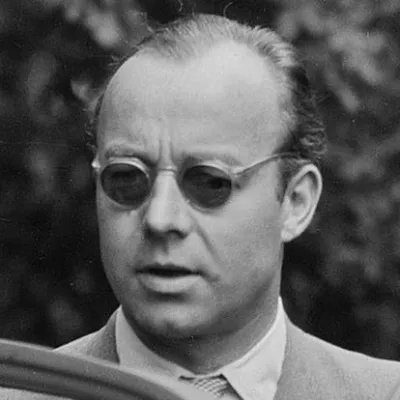
Heinz Rühmann
Human Design Chart
Biography
The Human Design of Heinz Rühmann: Projector 5/1
Projector 5/1 — Design at a Glance
Heinz Rühmann's design tended towards focused perception. As a Projector, he did not have a constant, intrinsic source of life energy through an undefined Sacral Center. Instead, his aura acted like a bright flashlight that directed itself specifically to places in the environment that were "in the dark." This configuration allowed him to immediately recognize errors in other people's systems.
The challenge was to avoid directly and confrontationally expressing these insights, which often provoked resistance or anger from those around him. It was more effective for him to act as a lighthouse through his own harmonious actions. When he exemplified a successful relationship or situation himself, others were automatically drawn to him. People then actively sought out his advice because they felt his clarity and magnetism.
His strategy involved waiting for appreciative and sincerely meant invitations before sharing his knowledge. This waiting was crucial to conserve his energy. Without these pauses, there was a risk of burnout, as Projectors must alternate phases of high activity with necessary rest periods. If Heinz Rühmann lived according to this pattern, he was rewarded with success. Ignoring his strategy and forcing himself into situations sooner or later led to bitterness as an expression of his non-self. His design demanded patience and the willingness to be invited by others rather than taking initiative himself.
Splenic Authority
Heinz Rühmann's design indicated a tendency towards intuitive, immediate decision-making. He was someone who trusted his fine inner impulse to determine whether a situation or environment was healthy and right for him. This attitude resulted from his authority in the Spleen Center. For this center to take over as his internal guidance system, his Emotional and Sacral Centers had to be open; this configuration is unique to Projectors or Manifestors.
The Spleen served as his health and alarm system. It endowed him with a pronounced survival intelligence that manifested as spontaneous knowledge: His instinct and physical well-being acted as reliable indicators for what was right. Decisions therefore had to be made in the moment; the first impulse was the correct path, allowing him to rigorously distance himself from harmful influences and take care of himself.
This Spleen impulse, however, was very subtle and occurred only once at a time. It could easily be overshadowed or ignored by external influences, requiring high vigilance. Since knowledge of what is right was always available only in the moment, plans could change quickly. Long-term commitments were therefore difficult; instead, his design required much space and flexibility to act spontaneously without unnecessarily binding himself. A retreat for decision-making could be supportive in this regard.
The 5/1 Profile — Heretic / Investigator
Heinz Rühmann's design established the foundational structure of a 5/1 Profile: The Hero based on deep research. This configuration created almost magnetic吸引力;别人本能地向他寻求解决问题的方法。海因茨·鲁姆曼展现出了热爱学习和应对新挑战的性格。他的第1线使他在知识的基础上扎根,而第5线则将这些宝藏提供给他人。
然而,这种机制带来了特定的危险:缺乏明确界限的情况下,他可能会因为不断满足别人的请求而精疲力尽,就像一位专家在一场疲惫不堪的会议后发现邮箱里满是更多的问题一样。他的设计要求他学会说“不”,以保持私人研究(第1线)和公共问题解决(第5线)之间的有益平衡。
相关的闸门强化了这种动态。第5线上第63号闸门使他在危机时刻能够提出正确的问题,消除疑虑并发明实用的解决方案。同时,设计警告他不要陷入不成熟的状态,这可能导致空洞的形式主义。另一方面,第1线上第26号闸门强调已经实现和拥有的价值相对于遥不可及的梦想更为重要。海因茨·鲁姆曼必须学会对自己的目标感到满足,而不是在自我膨胀中追求永远无法实现的新高度。只有这样,他才能充分利用自己的天赋,而不被“部落”期望压垮。
Single Definition — Defined & Open Centers
Heinz Rühmann's Human Design profile indicated a tendency towards intuitive spontaneity and existential presence. His defined Spleen Center gave him a reliable instinct for the 'now', allowing him to make spontaneous judgments without having to rationalize them. Following this bodily intelligence, he acted from a deep trust in his own perception of well-being and health. Complementing this was his defined Root Center, which provided a constant pressure; this inner impulse drove him forward materially and pragmatically resolved survival questions, always focusing energy on the concrete here and now.
At the same time, Heinz Rühmann showed himself to be more sensitive through several open centers. His open Head Center made him susceptible to mental confusion or the pressure of finding answers for others' questions instead of pursuing his own inspirations. The open Ajna Center allowed him flexibility in thinking but tended towards interpreting foreign concepts as his own truth or feeling unsure when no clear answers were present. His open Throat Center meant that he was not consistently speaking; rather, his open throat naturally attracted attention when he waited for the invitation to speak instead of actively seeking recognition.
The openness of his G Center shaped him as someone without a fixed identity who saw himself initiated through relationships and places. He tended to blend with his environment and did not actively seek direction but waited for the correct love and place to come to him. His open Heart Center freed him from the compulsion to prove willpower or worth; he had no need to prove anything to anyone. Additionally, his Sacral Center was open, meaning that he did not have a constant generative energy but worked in spurts and found himself exposed to others' energies without being able to control them. The open Solar Plexus Center allowed him to absorb and amplify the emotions of his environment without identifying them as his own, making him a sensitive barometer for emotional climate.
Channels for the meaningful struggle of life.
Heinz Rühmann's Human Design profile indicated a tendency towards stubborn determination: he actively sought fights that gave meaning and refused to be swayed from his individual path. This attitude was shaped by the Life Struggle channel 38-28. This connection between Root and Spleen Centers linked the pressure of Gate 38, defending one's integrity against external distractions, with the intuitive ability of Gate 28 to recognize which confrontations are truly worthwhile. For Heinz Rühmann, this struggle was not only a survival fight but also a means of individualization; he found meaning in resisting expectations and taking risks as long as it aligned with his inner value. This adrenalized energy required regular movement to release the pressure in the body and create clarity for intuitive awareness.
Alongside this driving force, other mechanisms were at work. Gate 63 pushed him to mentally resolve doubts and improve uncertain patterns through constant thinking, while Gate 64 served to transform past experiences into clear concepts - a process that often generated confusion before final clarity. In the realm of will, Gate 26 was evident: it allowed him to gain conservative environments for innovations and lead new paths through targeted persuasion without overextending his own energy. Simultaneously, Gate 45 represented a strong attraction to like-minded individuals and gathered energy on tribal levels, underscoring his role as a connecting element.
In his emotional development, Gate 41 propelled him from one experience to the next and utilized crises as necessary steps of evolutionary change. Finally, Gate 54 linked worldly success with mystical insight; for Heinz Rühmann, external triumph was not an end goal but a prerequisite to reach deeper spiritual levels, often supported by close partnerships. This constellation created a person who strengthened his identity through resistance and found growth in resolving doubts and enduring emotional crises.
Individual Circuitry — Circuit Signature
Heinz Rühmann's Human Design profile indicated a tendency towards inner endurance and overcoming obstacles. His system was characterized by a simple, coherent structure that did not show separate energetic islands. This unity allowed for a direct flow between the Spleen Center and Root Center.
This connection formed in the Knowledge Circuit, whose general theme describes one's innate path and transformation through new knowledge. However, only a specific part of this circuit was active in Heinz Rühmann: channel 28-38, known as Life Struggle. This channel connected the Spleen Center with the Root Center. The Spleen Center stood for intuitive perception and recognizing what is truly important, while the Root Center provided energy for the struggle of survival and overcoming acute crises.
The connection between these two centers created a pulsating dynamic. Heinz Rühmann showed himself as someone who could directly translate his intuitive assessment (Spleen) into concrete effort and endurance (Root). It was not about abstract creativity or mental innovations from other channels of this circuit but rather the practical application of energy to overcome life struggles. The emotional wave and individual identity described by the circuit generally did not play a direct role for him, as the corresponding channels were inactive. Instead, his actions were shaped by the direct link between intuition and survival energy: he acted based on what he recognized as right and used all his strength to overcome obstacles.
Left Angle Cross of Dominion 1
Heinz Rühmann's design clearly oriented towards securing and defending his personal territory. This configuration, the left cross of the Sovereignty authority 1, marked him as someone who strictly defined his own life sphere and protected it against external intruders. It was not about aggressive expansion but rather a defensive stance: His "kingdom" – whether family, household, or personal space – was considered inviolable. Thus, Heinz Rühmann appeared as the guardian of these boundaries, ready to seek out and fight conflicts whenever this security was threatened. The mechanics of this cross describe an impulse to establish one's authority in areas that belong directly to them. It was about enforcing order within their own domain and resisting any attempt to take over or control it. Heinz Rühmann lived this dynamic by consistently guarding his privacy and granting access only to those who adhered to the rules he set. This energy drove him to shape his environment according to his own standards and decisively reject any form of external determination. The strength of this design lay in the clarity of its boundaries: Those who respected Heinz Rühmann's limits found a reliable ally; those who crossed them encountered unwavering resistance. This attitude secured control over his own life and created a stable foundation from which he could act without being dictated by external circumstances.
Saturn Return · Uranus Opposition · Chiron Return · 2nd Saturn Return — Life Cycles
Heinz Rühmann's design was characterized by a tension between the drive for radical renewal and the necessity of structural anchoring. This dynamic became visible in 1943, at age 41, when the ban on "The Punch Bowl" was lifted. This success corresponded with an Uranus opposition, a cycle that often breaks old orders and clears new, unexpected paths. The lifting of the ban was no coincidence but rather an expression of this energy-rich breakthrough of established boundaries.
Decades later, in 1953 at age 51, his Chiron return occurred. In this fulfillment cycle, life's purpose should have clarified itself; instead, Comedia went bankrupt. This crisis did not mark a lack of meaning but a harsh test of the previous orientation before the true flowering of the incarnation goal could be completed. It was a moment of restructuring, not failure in human terms.
In 1960, at age 58, his second Saturn return followed during the filming of "The Black Sheep". This cycle condenses long-term work into stable results and demands maturity as well as responsibility. The film symbolized the solidification of his artistic identity after previous phases of rupture and crisis. Heinz Rühmann's path showed how revolutionary impulses (Uranus) can develop through trials (Chiron) into a sustainable structure (Saturn). His design suggested that true stability only arises when one has the courage to start anew and integrate the resulting challenges.
Projector · Splenic Authority — Synthesis
He was a Projector who, through his defined Spleen (and the Life Struggle Channel), possessed an acute ability to recognize potential and weaknesses in his environment. This combination led him to constantly seek meaning and purpose in life—not just for himself but also for others. He lived a process of continuous learning and problem-solving (5/1 Profile), where his spontaneous intuition (Spleen Center) supported him in quickly grasping what was right or wrong. This shaped a lifestyle driven by a deep need for authenticity and the desire to bring "light into darkness" for others.
A central tension field in his design lay between the projection power (Projector type) and the inner drive to fight for his integrity (Channel 38-28). He recognized flaws in the system, projected them onto his surroundings, while simultaneously being driven by the need to defend his own truth. This led to a dynamic interaction between observational skills and active confrontation, manifesting in cycles of success (Lifting of Ban) and crisis (Bankruptcy)—a life marked both by creative expression and the struggle for recognition.
1 Defined Channel
Incarnation Cross - Left Angle Cross of Dominion 1
Solar Return
The Solar Return shows the moment when the sun returns to its exact birth position - your personal solar year.
Life Cycles
Discover the life cycles with a detailed triple view (birth chart, cycle chart, composite).
Human Design Profile
- Type
- Projector
- Strategy
- Wait for the respectful invitation
- Authority
- Splenic Authority
- Profile
- 5/1 - Heretic / Investigator
- Definition
- Single Definition
- Incarnation Cross
- Left Angle Cross of Dominion 1
- Date of Birth
- 07.03.1902 02:30
- Place of Birth
- Essen, Germany
Frequently Asked Questions
What was Heinz Rühmann's Human Design type?
Which Profile did Heinz Rühwann have?
What was Heinz Rühwann's Authority?
What incarnation cross did Heinz Rühwmann have?
When was Heinz Rühwmann born?
Discover your own Human Design
Are you also a Projector? Find out in a personal reading how to unfold your leadership qualities and recognize the right invitations.
More Personalities
Back to overviewSissy Spacek
Alain-Fournier
Anémone
Ann-Margret
Arletty

Arno