
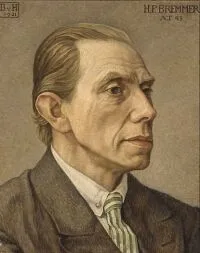
Henk Bremmer
Human Design Chart
Biography
Bremmer was called the "kunstpaus" (art pope) of the Netherlands. He was one of the fist influential persons to recognise the value of Vincent van Gogh. He arranged long lasting stipends for Bart van der Leck (1912-45)and others in the hope that he could make a more secure living of his art.
Bremmer advised his student Helene Kröller-Müller, (11 February 1869, Essen – 14 December 1939, Otterlo), then the richest woman of the Netherlands, in establishing her art famous collection. Helene donated in 1935 her collection to the Dutch state, on condition that a large museum be built in the gardens of her park in Otterlo. The Kröller-Müller Museum was opened in 1938.
In 1951 Bremmer received a honorary Doctorate in Groningen.
He died 10 January 1956 in Den Haag.
Personal.
On 2 October 1895 he married Aleida Magdeltje Beekhuis (20 April 1866, Buitenpost - 26 July 1945, Den Haag). They got three sons and a daughter. His son Rudolf Bremmer (16 April 1900, Den Haag - 26 October 1993, Laren) became a painter and Henk Bremmer (23 March 1904 - 6 February 1996) a physicist.
The Human Design of Henk Bremmer: Generator 3/5
Generator 3/5 — Design at a Glance
Henk Bremmer revealed himself as someone with immense, enduring strength, comparable to a powerful workhorse. His design indicated a tendency to release energy not through self-initiated action but through quick responses to life impulses. As a Generator, he had a lot of sacral energy, which only became free when he reacted to signals from his environment. The motto was clear: not to initiate but to react. When his inner self gave a clear 'yes', he could respond with consistent action and thus experience deep satisfaction and a sense of fulfillment.
This way of functioning was closely linked to the avoidance of two specific pitfalls. First, his energy suffered when he engaged in tasks that did not give him inner pleasure for long periods; this often led to a waste of his strength and a tendency towards burnout. Second, it was frustrating for him when he was prevented from working on his heart projects, even though he still had plenty of power to continue. If Henk Bremmer did not live according to the principle of reacting from the gut, he likely faced a feeling of persistent frustration or a lack of energy. In harmony with his design, however, he was unstoppable, as he used his enormous endurance precisely where his inner self urged him to.
Emotional Authority
Henk Bremmer revealed himself as someone who did not make decisions immediately but let them ripen within him. His design carried emotional authority, meaning that his defined emotional center formed the inner compass for his life – independent of other defined centers. This authority was subject to a natural emotional wave, a permanent up and down of feelings. The world appeared to him always colored by his current mood; enthusiasm could turn to skepticism in the same moment.
This mechanism was not a weakness but a filter. The immediate feeling was often only a snapshot, a first, still immature impression. A spontaneous decision out of this emotional heat would often have proven false. Instead, his path required patience. Henk Bremmer used time to sleep on decisions and ask himself several times. Only when the initial emotional heat had subsided and he had gained emotional distance did true clarity set in. This process of calmness was crucial for all long-term turning points that shaped his life trajectory. Through waiting and inner condensation, he found the truth behind the transient mood flood.
The 3/5 Profile — Martyr / Heretic
Henk Bremmer revealed himself as someone who learned through personal experimentation and then provided these practical experiences as solutions for others. His design as Profile 3/5, the experimenter and hero, established this dynamic: Line 3 required him to initially not accept given truths but to test everything himself. This path of trial and error served to accumulate a rich trove of life experience.
Line 5, the hero line, then used this knowledge to solve other people's problems. Bremmer's attractiveness to his environment resulted from others wanting to learn from his accumulated insights. This role of the rescuer flattered him, but it also carried the risk of public failure if experiments in front of all eyes did not succeed.
In Line 3, the question of style versus content played a role; the true nature was sometimes hidden to find acceptance, while Saturn demanded discipline and limitation to avoid hypocrisy. Line 5 brought irony and realism to expectations. Bremmer recognized the transience of goals and offered practical solutions to ensure progress despite setbacks. Jupiter supported trust in the process, while Pluto represented frustration over the limits of the life cycle. His life was marked by this tension field between the necessary failure in learning and the need to be perceived as a competent hero.
Split Definition — Defined & Open Centers
Henk Bremmer revealed himself as someone with a fixed, reliable self-identity and a clear sense of direction. His defined G Center gave him the ability to love himself and show this security to others without being dependent on them. He possessed a natural authority that helped him understand the evolution of the species and offer comfort to others in uncertainties.
This inner stability was fueled by his defined Sacral Center with vital energy. As a guardian of this power source, he generated an enormous amount of life force daily, which manifested as a constant hum or restlessness. His strategy was not to initiate but to respond to questions to ensure that his energy was available for the task at hand. This protected him from exhaustion and frustration, which arise when mental decisions override the sacral response.
Emotionally, Henk Bremmer moved in a wave, guided by his defined Solar Plexus Center. His inner authority lay in waiting for these emotional cycles before making decisions. Only through patience did he achieve emotional clarity, rather than acting impulsively. His defined Spleen Center complemented this with spontaneous, intuitive body awareness in the present moment, helping him instinctively recognize what was correct for his well-being and health. Additionally, he had a fixed way of dealing with stress through his defined Root Center, which provided the pressure to move forward and master existential challenges.
In contrast, his Head, Ajna, and Heart Centers were open. The open Head Center meant he did not have a constant mental inspiration and was vulnerable to the pressure of finding answers to questions that were not his. His open Ajna Center allowed for a flexible mind that tended to adopt concepts and opinions of others without identifying them as his own truth. The open Heart Center lacked consistent willpower; he was not designed to make promises or prove his worth through competition, but learned not to get caught in a cycle of self-proof and disappointment.
Channels for rhythm, critical judgment and emotional recognition.
Henk Bremmer was someone who propelled new directions with a powerful, mutative energy while maintaining a sharp eye for what was right and necessary. His design featured the Channel of the Beat 14-2, connecting the Sacral Center with the G Center. This configuration conveyed the ability to set innovative impulses through skillful handling of material resources (Gate 14) and higher knowledge (Gate 2). Henk Bremmer was called to strengthen others in their direction through his own example and authentic response to life, without actively chasing his fate.
Simultaneously, the Channel of Judgment 58-18 shaped his approach. It linked the dynamic endurance of the Root Center (Gate 58) with the corrective logic of the Spleen (Gate 18). This gave him a deep sense of which patterns in the collective were functional and where corrections were needed to maintain joy in life. His task was to offer this critical assessment only when requested, to provide constructive solutions rather than mere criticism.
The Channel of Recognition 30-41 added a layer of intense emotional longing. The pressure from the Root (Gate 41) for new experiences was fueled by the emotional wave of the Solar Plexus (Gate 30). Henk Bremmer had to learn to trust this restlessness and take the time for emotional clarity before jumping into new adventures.
Additionally, Gates like Gate 8 marked him as a creative role model for group goals, and Gate 29 emphasized the importance of saying a proper “yes” and persistence. Gate 15 brought an understanding of collective rhythms and humility, while Gate 10 shaped his complex identity and integration capability in the G Center. Gate 42 challenged him to complete processes to take on new commitments, and Gate 52 urged him to take a focused pause for pattern correction.
Collective Circuitry — Circuit Signature
Henk Bremmer's design featured a split structure, resulting in two independent, parallel operating energy blocks. This separation did not produce a continuous, unified experience but rather the coexistence of different impulses that did not directly communicate with each other.
The first block connected the Identity with the Sacral Center through the Knowledge Circuit. Here, the Channel 'The Beat' was active, representing a pulsating, acoustic rhythm. This connection promoted a creative, individual expression based on one's unique path. It was about manifesting a unique identity through rhythmic, innovative energies directly drawn from the life force of the Sacral Center.
The second block included the Spleen, the Root, and the Solar Plexus Centers. Here, two separate circuits were active. The Understanding Circuit linked the Spleen and the Root Center through the Channel 'Judgment.' This provided a focused, visual perception of logical structures and strategic future perspectives, free from emotional influence. Parallel to this, the Meaning Circuit connected the Solar Plexus with the Root Center through the Channel 'Recognition.' This area was characterized by cyclical, wave-like emotions that referred to the past. Henk Bremmer reflected on past experiences to understand their meaning and share these emotional insights with others. Both strands in the second block – the cool logic of the future and the emotional reflection of the past – existed side by side without directly overlapping.
Right Angle Cross of Contagion 2
Henk Bremmers Human Design shows the signature of the right Cross of Infection, which shaped a specific life dynamics. This configuration described a path marked by a deep connection to one's own truth and often a fateful encounter with external circumstances. In Human Design, this cross represents an intense confrontation with one's identity, often triggered by challenges or 'infections' with the beliefs of others.
For Henk Bremmer, this meant that his life was not free of friction, but that he sharpened his own essence through this friction. The mechanics of this cross suggest that he learned to distinguish between what was impacting him from the outside and his inner compass. It was a process of differentiation, where he had to assert himself against the pressure of the environment to find his own voice.
This dynamic did not manifest as passive suffering, but as an active clarification. Henk Bremmer often had to check whether a situation or idea truly came from him or if he had unconsciously adopted it. This constant filtering was central to his development. His design indicated that he found strength in not simply following the flow of opinions but critically questioning what was authentic. Thus, the 'infection' became a catalyst for a deeper self-discovery, leading him to define his own reality more clearly rather than losing himself in the masses.
Saturn Return · Uranus Opposition · Chiron Return · 2nd Saturn Return — Life Cycles
Henk Bremmers design featured a structure that often led to a sudden, profound change in external circumstances in mid-life. This was evident in 1912, at the age of 41, when he made contact with Bart van der Leck. This encounter marked the beginning of long-term financial support that lasted until 1945, securing his artistic existence.
This period coincided with the Uranus Opposition phase. In Human Design mechanics, this aspect signals a turning point where old, often unconscious structures of youth become brittle. The energy does not push for gradual development but for a radical cut or a new orientation. For Henk Bremmer, this meant the end of the previous life phase and the beginning of a new reality supported from the outside. The support from van der Leck was not only material but also enabled the unfolding of a new creative space that escaped old patterns.
The Uranus energy acts here as a catalyst for freedom from earlier bindings. It forces adaptation to new conditions, often unexpectedly. Henk Bremmers chart shows that he mastered this challenge not through resistance but through acceptance of the new structure. The long-term sponsorship underscores that the change was lasting. It was not a short-term event but a fundamental shift in life circumstances that shaped his further development. This mechanism describes how external forces can unlock inner potentials when the right time in the design is reached.
Generator · Emotional Authority — Synthesis
Henk Bremmer lived deeply in the experience of his sacral energy (Generator Type, Channel of the Beat), which drove him to try things out and gain knowledge through practical experience (Profile 3/5). He shared this knowledge willingly and found a direction through his authentic identity (defined G Center) that inspired others. However, emotional authority required time for decisions to mature, a process that strengthened his inner authenticity but also led him through the natural emotional wave.
A central paradox lay in the combination of the urge to experience and transform new things (Knowledge Circuit) with the need to surrender to the emotional wave to gain clarity. He was an adventurer who learned through experimentation, but also a person who needed patience to understand the depth of his own feelings. This tension was also evident in the long-term financial support he received only at the age of 41 – a result of his actions that needed time to unfold.
3 Defined Channels
Incarnation Cross - Right Angle Cross of Contagion 2
Solar Return
The Solar Return shows the moment when the sun returns to its exact birth position - your personal solar year.
Life Cycles
Discover the life cycles with a detailed triple view (birth chart, cycle chart, composite).
Human Design Profile
- Type
- Generator
- Strategy
- To respond - wait for something to respond to
- Authority
- Emotional Authority
- Profile
- 3/5 - Martyr / Heretic
- Definition
- Split Definition
- Incarnation Cross
- Right Angle Cross of Contagion 2
- Date of Birth
- 17.05.1871 21:30
- Place of Birth
- Leiden, Netherlands
Frequently Asked Questions
What was Henk Bremmer's Human Design type?
What profile did Henk Bremmer have?
What authority did Henk Bremmer have?
What incarnation cross did Henk Bremmer have?
When was Henk Bremmer born?
Discover your own Human Design
Are you also a Generator? Find out in a personal reading how to use your sacral energy correctly and discover deep satisfaction.
More Personalities
Back to overviewAaliyah

Alain-Fournier

Alexia

Angèle

Angeli

Anne-Marie
