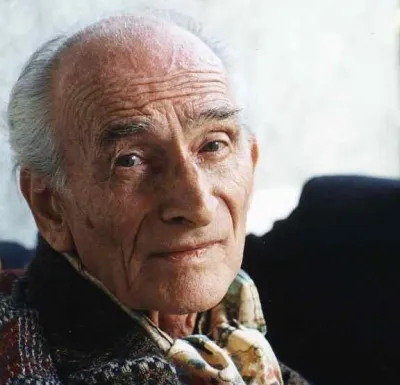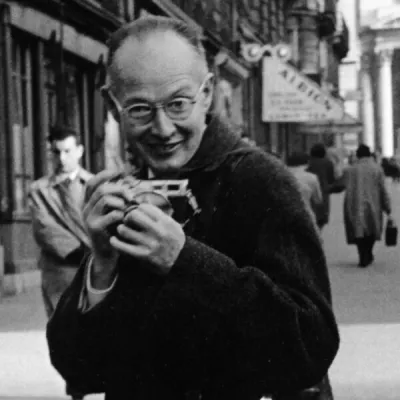
Henri Cartier-Bresson
Human Design Chart
Biography
A member of an old French family who had a textile firm, he trained as a painter. After a year-long stay on Africa's Ivory Coast, he returned, dissatisfied with the slowness of painting. Recuperating from a case of black fever contracted while in Africa, he bought a Leica, a small 35mm camera. He called it "my other eye." His travels in the early 30s took him through Eastern Europe, Africa, France, Spain and Italy. He also dabbled in filmmaking, working with French director Jean Renoir. In 1937 he directed one of several documentaries about medical aid to the Loyalists during the Spanish Civil War. While serving with the French Army in WW II, he first entered photojournalism for the Resistance, then for the Press. He was captured in June of 1940, spending the next 35 months in a German POW camp. He was just in time to go to New York in 1946 to work on what was to have been a posthumous exhibit at the Museum of Modern Art. Three hundred images had been organized while he was imprisoned and presumed dead. In 1954, the Louvre showed his photographs in its first photo exhibition. He showed once again in 1966, becoming the only photographer to have two one-man shows in the Louvre. Over many travels, his work developed most markedly in Mexico. He had great vision, a sense of surrealism mixed with simplicity, allowing the picture to tell the story. "Henri Cartier-Bresson Photographer" Photographs by Henri Cartier-Bresson with an introduction by Yves Bonnefoy was published in 1993.
He was married with one daughter; a lifelong Parisian.
The world-famous photographer died on August 2, 2004 at his home in l’Ile-sur-Sorgue in the Vaucluse region of France. Cartier-Bresson was three weeks shy of his 96th birthday.
Human Design Analysis: Henri Cartier-Bresson as Manifesting Generator 5/2
Manifesting Generator 5/2 — Design at a Glance
Henri Cartier-Bresson revealed himself as someone who possessed an unusual speed in action without losing the fundamental energy source of a Generator. His design as an Manifestor Generator combined constant access to sacral power with the ability to skip steps at Initiative. This allowed him to quickly draw things into his life and push projects forward where others still hesitated.
This hybrid nature, however, brought specific challenges with it. Due to the inclination towards speed, there was a risk of skipping important intermediate steps, which would have forced him later to backtrack and fill in gaps – a process that, if ignored, led to frustration. Additionally, he reacted to multiple impulses, leading him to pursue several things simultaneously. This simultaneous engagement with different projects was for him not a sign of lack of concentration but an expression of his nature seeking variety and entering into a playful mode.
The prerequisite for this creative force to work satisfactorily lay in the correct application of his strategy: Henri Cartier-Bresson had to react to life rather than initiate himself. Only when his sacral center gave a clear "yes" to an impulse and inner authority agreed, could he effectively use his energy. Under these conditions, he drew deep satisfaction from his work. The requirement to finish one thing before starting the next stood against his way of working; instead, his creativity flourished when he surrendered to the variety of impulses and experienced the process as play.
Sacral Authority
Henri Cartier-Bresson's decision-making was based on a direct physical reaction. As a Generator, he had sacral authority, meaning his strategy and inner guidance were identical: He reacted to external stimuli rather than initiating actions himself. This mechanism greatly simplified his process.
His responses came from the gut – as a surge of energy or as loud signals like grunting. When his sacral motor kicked in, he felt vital and energized. Then he worked with great enthusiasm, fully immersed in the activity without questioning an external purpose. Joy and satisfaction naturally accompanied his actions.
Additionally, his activated Spleen Center served as a supportive instance. In conjunction with the Sacral Center, this allowed for quick, spontaneous decisions. Henri Cartier-Bresson had immediate access to his instinctive perception and physical well-being. This combination enabled him to reliably be guided by these inner signals without long deliberation or weighing options. The reaction was direct, intuitive, and happened in the moment.
The 5/2 Profile — Heretic / Hermit
Henri Cartier-Bresson revealed himself as someone who initially kept his gifts hidden. His design carried an inner contradiction: on one hand, there was the need to help others and earn admiration (Line 5), while on the other hand, there was a desire to be left alone and spend time in solitude (Line 2). As long as the world had not "discovered" him, he worked hard on himself. He used his reclusiveness to prepare for a possible public role.
This dynamic resulted from the constellation of Line 5 and Line 2. Gate 29 on Line 5 represented social expectations and projections. It was expected that he would be persistent and strongly committed. At the same time, Gate 20 on Line 2 worked with selective concentration in the here and now. This position promoted an ascetic withdrawal based on personal choice. The difference between this withdrawal and the state when he was "called" could be explosive.
Did Henri Cartier-Bresson merely wait to be discovered, bitterness and frustration threatened as heroism did not work as a lone wolf. Instead, he had to look where his expectations of himself were too high. Once he dared to step out of his "cave," others appreciated his presence and clear insights. It was always important for him to set clear boundaries and have enough alone time for regeneration. His ambition could fail if he overextended himself and exceeded his own means; an open ego otherwise led to over-stress.
Single Definition — Defined & Open Centers
Henri Cartier-Bresson was someone who acted from a deep inner security and a clear sense of his own direction. His defined G Center gave him a reliable self-identity; he knew where his place was without needing the approval of others. This internal compass served as a stabilizing force in a world full of uncertainties.
This consistency was fueled by his generative energy from the defined Sacral Center. As a Generator, Henri Cartier-Bresson had a constant source of vital energy that flowed effectively only when he responded to life rather than initiating it. His strategy involved waiting for life to ask him – through an inner yes or no response – so as to correctly apply his energy and avoid frustration.
His defined Throat functioned as a direct channel for expressing these energies. What he communicated or did was not just conceptual thinking but an authentic voice that spoke from his identity (G Center) and life force (Sacral). This allowed for honest and clear presence in interacting with the world.
In contrast, his design revealed several sensitive areas. His open Head and Ajna Centers made him vulnerable to mental confusion and pressure to find answers to questions that were not his own. He tended to be swept away by intellectual whirlpools of others rather than trusting his inner authority.
Additionally, his Heart Center was open, which could lead him into the trap of proving worth through willpower or competition since he lacked a constant energy for this. His open Solar Plexus absorbed foreign emotions; he had to avoid personalizing these moods to remain emotionally stable. Finally, his open Spleen Center reflected fears about survival and well-being that made him cling to uncertain situations while the open Root Center amplified external stress he did not generate.
Channels for presence, self-acceptance and powerful implementation.
Henri Cartier-Bresson radiated a quiet but effective presence through authentic being and reactive action. His design connected the power of the Sacral Center with expression in the Throat and G Centers, making self-love the foundation of his interaction.
The Channel of Exploration 34-10 provided inner strength (Gate 34) to hold onto personal convictions and live them as individual behavior (Gate 10). This fostered an attitude of independence where he was not distracted by external conditioning but acted from deepest inner truth.
Simultaneously, the Awakening Channel 10-20 connected his G Center with Throat Center. It allowed Henri Cartier-Bresson to be awake in every moment and recognize principles (Gate 10) to express them here and now (Gate 20). This was not an intellectual concept but a living experience of "I am", radiating self-confidence and acceptance.
The combination of these energies found expression in the Channel of Charisma 34-20. Here, the generative power of reaction (Gate 34) met immediate expression (Gate 20). This created a charismatic dynamic where he inspired others through his actions and presence without needing to directly address them. His vitality showed in an ability to be present in the moment, bringing clarity that kept resistance at bay.
Additionally, Gates like 29 (Persistence) and 30 (Feeling Recognition) deepened his experience while Gate 59 supported his genetic strategy of connection. Henri Cartier-Bresson lived this mechanism by trusting himself and using his uniqueness as a means of leadership, allowing him to act in the world without having to oppose it.
Individual Circuitry — Circuit Signature
Henri Cartier-Bresson's design inclined towards inner firmness and strong self-worth. His energy worked little outwardly but was centered on his own individuality. This resulted from the Centering Circuit, which through the Channel of Exploration directly connected his Sacral Center with his Identity Center. This connection created a closed loop between life force and divine identity, fostering resilient personalities with clear convictions. However, lacking an attachment to the Throat Center, these inner certainties did not always translate clearly into verbal expression.
Parallelly, the Integration Circuit worked through Henri Cartier-Bresson's Throat, Sacral, and Identity Centers as a single continuous flow. The Channels of Awakening and Charisma enabled him to draw power from reacting to life and make it effective through intuitive knowledge and proper behavior in the present moment. As Henri Cartier-Bresson had a Simple Definition, all his defined centers – including G Center and Throat Center – flowed together in one coherent energetic system. This marked him as someone who secured survival by integrating inner strength with outer expression, where energy pulsed and resonated acoustically here and now.
Left Angle Cross of Industry 2
Henri Cartier-Bresson exhibited a pronounced tendency towards tireless, often repetitive effort. His design suggested that he delved deeply into his work through constant doing and repetition, where diligence was not seen as a single act but rather as an ongoing process. This attitude stemmed from what is known as the "left cross of diligence 2." In Human-Design mechanics, this configuration describes a specific energy distribution in the lower body area that manifests as physical or mental endurance. It was not about sporadic enthusiasm but rather a deeply rooted discipline that drove Henri Cartier-Bresson to pursue tasks with great persistence. The energy of this cross acted like an inner motor propelling him to continue even when faced with monotonous or challenging obstacles. Instead of seeking quick solutions, he lived in the rhythm of constant work. This mechanical structure shaped his way of experiencing the world: through continuous presence and unceasing engagement. The focus was less on immediate results and more on the quality and constancy of the action itself. Henri Cartier-Bresson thus embodied a lifestyle where the process of working itself became the central expression of his existence, driven by an inner necessity for ongoing activity.
Saturn Return · Uranus Opposition · Chiron Return · 2nd Saturn Return — Life Cycles
Henri Cartier-Bresson's Human Design indicated a tendency towards structural turning points where inner maturity met external recognition. In 1936, at the age of 28, he created the documentary film "The Life Is Ours" – a typical expression of his first Saturn Return. This cycle condensed years of groundwork into a solid result and marked the transition from experimentation to established position. Later, in 1947 at the age of 39, he founded Magnum Photos in New York. This corresponded with his Uranus opposition, a phase often characterized by a need for autonomy and the establishment of new, free structures. Here, there was a desire to transcend existing boundaries and set one's own rules. The peak of this development occurred in 1956 at the age of 48: The exhibition "Henri Cartier Bresson" at the Applied Arts Museum Zurich fell during his Chiron Return. This fulfillment cycle did not signify healing but rather the blossoming of his purpose. If Henri Cartier-Bresson had lived according to his strategy up until then, his incarnation purpose was now visible and tangible. The recognition by the museum confirmed not only his work but also the culmination of a long journey towards self-actualization. His design indicated that such milestones were no accidents but logical consequences of his inner architecture, which worked towards maturity, freedom, and ultimately the embodiment of one's essence.
Manifesting Generator · Sacral Authority — Synthesis
He was a Generator who possessed a unique speed and initiatory power through his connection to the Throat Center (Manifesting Generator). This ability to react swiftly to impulses (sacral energy paired with Manifestor traits) shaped his work. The Profile as Hero/Natural Talent (Line 5/2) suggests that he felt at home in the role of an observer and documentarian – an inner drive to accomplish something special, coupled with a need for withdrawal and self-discovery. The defined Throat (communication and manifestation) amplified his ability to capture moments and express his own vision, while the Centering Circuit nourished a strong internal foundation and firm convictions.
A central paradox lay in the tension between the desire for recognition as a Hero (Line 5) and the natural inclination towards isolation of the Natural Talent (Line 2). This was evident in how he collaborated with others and founded agencies (documented event 1947), but also pursued phases of intense self-reflection and personal projects (exhibition 1956). The tendency to skip important steps (Manifesting Generator) could lead him to dive headfirst into work, yet simultaneously required a conscious return to his inner authority to find balance.
3 Defined Channels
Incarnation Cross - Left Angle Cross of Industry 2
Solar Return
The Solar Return shows the moment when the sun returns to its exact birth position - your personal solar year.
Life Cycles
Discover the life cycles with a detailed triple view (birth chart, cycle chart, composite).
Human Design Profile
- Strategy
- To respond - wait for something to respond to
- Authority
- Sacral Authority
- Profile
- 5/2 - Heretic / Hermit
- Definition
- Single Definition
- Incarnation Cross
- Left Angle Cross of Industry 2
- Date of Birth
- 22.08.1908 15:00
- Place of Birth
- Chanteloup, France
Frequently Asked Questions
What was Henri Cartier-Bresson's Human Design type?
What profile did Henri Cartier-Bresson have?
What authority did Henri Cartier-Bresson have?
What incarnation cross did Henri Cartier-Bresson have?
When was Henri Cartier-Bresson born?
Discover your own Human Design
Are you also a Manifesting Generator? Find out in a personal reading how to unfold your multi-talents and direct your energy wisely.
More Personalities
Back to overviewAldair

Alizée

Angeli

Arletty

Artus

Balthus