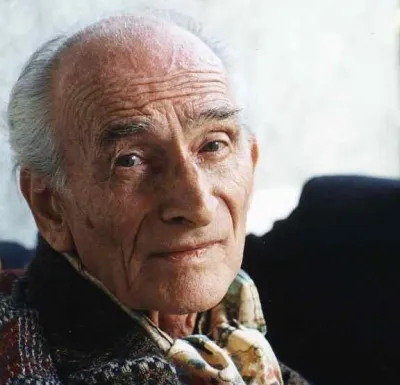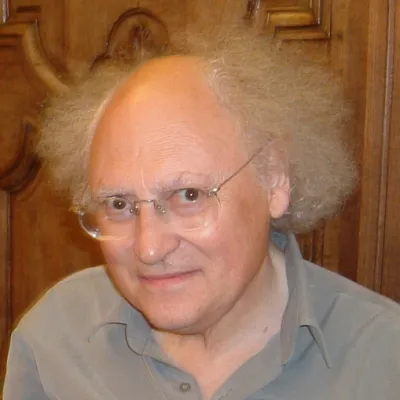
Henri Meschonnic
Human Design Chart
Biography
He died on 8 April 2009.
Henri Meschonnic as a Manifesting Generator 3/5 in Human Design
Manifesting Generator 3/5 — Design at a Glance
Henri Meschonnic was characterized by a hybrid energy configuration: he possessed the constant power of a Generator, yet also had the ability to skip steps and quickly draw things into his life. As a Manifesting Generator, he combined the need to respond to inner impulses with an unique speed.
This design tended to pursue multiple projects simultaneously. When his inner authority was involved and the sacral center agreed, he found in this variety a productive 'play mode'. The strategy was to not initiate himself but to wait until life gave him an impulse, which he could then respond to with his characteristic speed.
However, this configuration carried specific risks. If he moved too quickly, he often skipped important intermediate steps, which later required him to return and fill these gaps. This could lead to frustration, his specific 'non-self' theme. Concurrently handling many tasks also became problematic if he did not continuously check whether his inner approval still held. With correct application - that is, by consistently responding to impulses and regularly checking his inner resonance - Henri Meschonnic drew deep satisfaction from his work. His effectiveness depended on not playing his speed against the necessity of step-by-step anchoring but using it in harmony with his inner confirmation.
Emotional Authority
Henri Meschonnic did not make decisions in the first impulse but subjected them to a temporal test. His design tended to go through emotional waves before clarity emerged. This resulted from his emotional authority, carried by the defined Solar Plexus Center. In Human Design mechanics, this authority always takes precedence over all other defined centers, regardless of further configurations. Henri Meschonnic was subject to constant emotional fluctuations; the world appeared colored by his current mood. A moment of enthusiasm could quickly be replaced by negative evaluation. Since this first impression did not represent the final truth, spontaneous actions were risky. Instead, his system required patience. Henri Meschonnic let decisions mature, slept on them multiple times, and sought emotional distance. Only when the intense feelings subsided did calmness set in. This process of delay was essential for him to gain deeper insights and make long-term life decisions. His inner authority challenged him to hesitate and question repeatedly until the emotional wave subsided.
The 3/5 Profile — Martyr / Heretic
Henri Meschonnic was someone who first had to try everything himself before he would embrace a truth. His design tended to collect practical knowledge through his own experiments and associated failures, which he later made available to others. This attitude stemmed from Profile 3/5, the combination of Explorer and Hero.
The third line of his profile drove him to actively seek and test connections. Through the process of building and dissolving these connections, he learned to adapt to his environment. Loyalty and adaptation were central themes, but also the experience of rejection shaped this path. He believed nothing given, but validated everything through his own experience.
The fifth line transformed these accumulated experiences into a form of wisdom that attracted others. Henri Meschonnic became a rescuer or storyteller, offering solutions from practice. However, this role also carried the burden of failing in front of others. The pragmatic attitude of line 5 helped him find the right moments for social interactions and withdraw when necessary. Deep emotional experiences and the memory of pain led him to avoid certain people or situations. His caution was an expression of learned social dynamics. Thus, a person emerged who learned through his own actions and then, often with a certain distance, passed on this knowledge.
Single Definition — Defined & Open Centers
Henri Meschonnic was someone who constantly questioned and sought to understand connections under an internal pressure. His design linked the Head Center and Ajna Center, creating a specific, trustworthy mental function. He was not easily influenced in his thinking but continuously generated concepts. This mental energy flowed directly into his defined Throat Center, allowing him to express his thoughts and theories verbally. His voice served as a focal point to bring these intellectual processes into the world.
Despite this clear mental and communicative structure, he lacked a fixed identity. His open G Center meant he did not have a rigid direction but rather blended with his environment and was initiated by it. He tended to question where he belonged or what role he played instead of taking a firm position. Instead, he gathered directions through encounters and places.
His energy source lay in his defined Sacral Center. As a Generator, he possessed a vital force that was only activated through reaction. He had to wait for life to speak to him to use his energy correctly. This contrasted with his open Heart Center, which made him vulnerable to the pressure of proving his worth through willpower or promises. Since he did not possess this constant energy, attempting to compete often led to frustration.
Furthermore, his Solar Plexus Center was defined, giving him emotional authority. He needed time to go through his emotional wave before gaining clarity. At the same time, his open Spleen Center made him sensitive to health and well-being but also vulnerable to fears and spontaneous, conditioned decisions. His defined Root Center provided the necessary pressure to move forward in the world and master existential challenges.
Channels for change, intimacy, search, feeling and abstraction.
Henri Meschonnic experienced evolutionary change not as linear progress but as a pulsating, often melancholic force. His design tended to accept limitations to create space for unexpected mutations.
The Mutation Channel 60-3 connected his Root Center with his Sacral Center. Gate 60, the focal point of evolutionary possibilities, met Gate 3, which constantly sought to realize new, potentially valuable orders. This combination generated a powerful, pulsating energy that fluctuated between chaos and order. Henri Meschonnic had to learn to endure the inner tension and the accompanying melancholy during the phases of silence without wanting to rationalize it. The change came suddenly, like music in the gaps between the notes, and demanded adaptability from him and his environment.
Parallel to this, the Pairing Channel 59-6, connecting his Sacral Center with his Solar Plexus Center, was at work. Through Gate 59 (Sexuality) and Gate 6 (Friction), he sought intimacy as the core of creative essence. This connection required patience, as the emotional wave of the Solar Plexus needed time to gain clarity. Henri Meschonnic quickly penetrated the aura of others, making relationships intense and fruitful, but also required waiting for the right emotional timing to avoid misunderstandings.
In the mental realm, the Abstraction Channel 64-47 shaped his perception. Gate 64 (Confusion) in the Head Center drove him to sift through every experience through a kaleidoscope of mental images, while Gate 47 (Comprehension) in the Ajna Center tried to make sense of it. This process often generated mental unrest, which was necessary to discover inspiring stories or new perspectives that he could then share.
Additionally, the Channel of Curiosity 11-56 connected his Ajna Center with his Throat Center. Gate 11 (Ideas) constantly sought new perspectives, which Gate 56 (Inspiration) then articulated as stories. Henri Meschonnic was less interested in dry facts than in how stories could influence others and stimulate their imagination. His creativity was evident in his ability to weave ideas into life parables that invited further storytelling and reflection.
Finally, the Channel of Openness 22-12 modulated his social interaction. Gate 22 (Openness) in the Solar Plexus Center expressed passion and drama, while Gate 12 (Caution) in the Throat Center regulated this openness. Henri Meschonnic knew when to use his warmth and voice to move others, but he had to wait for his emotional wave to avoid being abrupt or misunderstood. This patience allowed him to create a receptive environment for his mutative potential.
Individual Circuitry — Circuit Signature
Henri Meschonnic's design exhibited a clear, coherent energetic structure. His energy flowed directly from the Head and Ajna Centers, where thoughts and concepts originated, to the Throat Center, where they found expression. This flow in the Meaning Circuit connected intellectual comprehension with the ability to share insights. Parallel to this, two separate energy fields were at work: On one hand, the Knowledge Circuit connected the Throat with the Solar Plexus Center (emotional waves) and the Sacral with the Root Center (instinctive life force), without these two segments directly overlapping. On the other hand, the Archer Circuit created a direct connection between the Sacral and Solar Plexus Centers, generating a primal energy of protection and care. Although all these centers were defined, they did not form a single continuous chain but functioned as specific, side-by-side mechanisms. Henri Meschonnic lived in a stream of consciousness of meaning, embedding his thought world in a collective context. His design shaped him through these specific connections: the clear articulation of meaning, paired with separate fields for emotional innovation and instinctive protection.
Right Angle Cross of Eden 3
Henri Meschonnic's Human Design carried the imprint of the right cross of Eden 3. This configuration combined a deep, almost mythic connection to one's own identity with a strong drive to carry this inner truth outward. It was not merely about self-presentation but an existential necessity to set one's essence into the world and thereby strike a bridge between the individual and the collective.
In Human Design mechanics, this cross represents the integration of personal authority and universal mission. The person who carries this pattern often experiences life as a process of revelation. What happens within them is not private but has an archetypal quality. They were designed to live and formulate their own story in a way that could serve as a mirror or guide for others. Authenticity was always at the core. Any deviation from their inner voice would have felt profoundly false.
This structure fostered a kind of leadership that did not rely on power but on the intensity of their own presence. Henri Meschonnic showed himself as someone who did not hide his unique perspective but used it as a tool to make deeper connections visible. The energy of this design is transformative. It demands expression, not to attract attention but to affirm one's existence and help others find their own truth. It was a dynamic that embedded the personal in something greater without diluting the individual note.
Saturn Return · Uranus Opposition · Chiron Return · 2nd Saturn Return — Life Cycles
Henri Meschonnic was someone whose creative power was structured by clear cycles of maturation and public recognition. His design indicated a tendency to externalize inner developments into concrete, measurable results. This became evident in 1972, at the age of 40, with the publication of his first poetry collection and the receipt of the Prix Max Jacob, marking the peak of the Uranus opposition. This cycle often promoted a breakthrough, where long-held ideas suddenly became socially impactful.
Later, in 1981, the Chiron return occurred. At 49 years old, he published 'Traduire la Bible, de Jonas à Jona'. In Human Design mechanics, this phase does not signal healing but the bloom of the incarnation purpose. Here, it was clear how his specific life purpose – if he followed his strategy – came into full expression and revealed deeper connections.
The second Saturn return in 1990, at the age of 58, with the publication of 'Le langage Heidegger', underscored this structure. Saturn cycles condense groundwork into substantial, lasting results. Meschonnic's path illustrates how these astrological-mechanical windows did not act as random events but as rhythmic phases of maturation and consolidation of his work. His design did not know a diffuse search but clear moments where inner clarity translated into outer, recognized forms.
Manifesting Generator · Emotional Authority — Synthesis
Henri Meschonnic was a Manifesting Generator, whose life was marked by a dynamic interplay between sacral energy and mental pressure. The constant sacral availability (sacral center) created a foundation for quick action and the implementation of ideas, while the defined Head Center generated an unceasing drive for understanding and inspiration. This interplay led to a lifestyle where experimenting (Line 3) and sharing insights (Line 5) played central roles – a constant search and discovery of new paths, coupled with the need to share these experiences further. The repeated professional successes (1972, 1981, 1990) showed how this process manifested in concrete achievements.
A central paradox in his design lay in the tension between the impulse to act quickly and move things forward (Manifesting Generator) and the emotional authority that required a mature engagement with topics. The mutation (Channel 3-60) points to a tendency towards change and deviation from conventions, while the emotional wave brought a certain melancholy and the need for inner clarity. He lived in a field of tension between the drive to initiate new things and the necessity to anchor decisions in the depth of his feelings.
5 Defined Channels
Incarnation Cross - Right Angle Cross of Eden 3
Solar Return
The Solar Return shows the moment when the sun returns to its exact birth position - your personal solar year.
Life Cycles
Discover the life cycles with a detailed triple view (birth chart, cycle chart, composite).
Human Design Profile
- Strategy
- To respond - wait for something to respond to
- Authority
- Emotional Authority
- Profile
- 3/5 - Martyr / Heretic
- Definition
- Single Definition
- Incarnation Cross
- Right Angle Cross of Eden 3
- Date of Birth
- 18.09.1932 01:00
- Place of Birth
- Villejuif, France
Frequently Asked Questions
What was Henri Meschonnic's Human Design type?
What Profile did Henri Meschonnic have in Human Design?
What Authority guided Henri Meschonnic?
What incarnation cross did Henri Meschonnic have?
When was Henri Meschonnic born?
Discover your own Human Design
Are you also a Manifesting Generator? Find out in a personal reading how to unfold your multi-talents and direct your energy wisely.
More Personalities
Back to overviewAldair

Alizée

Angeli

Arletty

Artus
Balthus