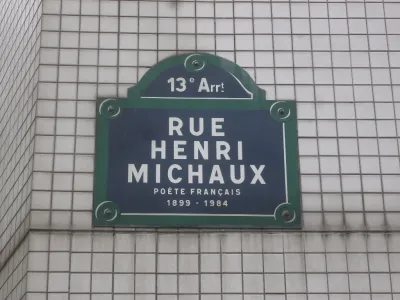
Henri Michaux
Human Design Chart
Biography
What does Manifesting Generator 4/6 mean for Henri Michaux?
Manifesting Generator 4/6 — Design at a Glance
Henri Michaux's Human Design configuration shows a tendency towards hybrid energy: He possesses the constant power of a Generator but also has the ability to skip steps in action and quickly draw results into his life. This setup connects him with Manifestors, while his defined sacral energy requires the same advice as for pure Generators: Do not initiate things himself but react to external impulses.
His speed brought two specific challenges. First, he tended to overlook important stages, which forced him later to go back and make up missed steps – a process that could cause frustration because it aligned with his Non-Self theme. Second, he often reacted to many different impulses simultaneously and started several projects at once. If strategy and inner authority were not in harmony during this time, his creative drive quickly turned into disappointment.
To use this dynamic constructively, it was crucial for him to start only when his sacral center had clearly given its approval after a 'test'. Regularly checking whether the projects still had his internal consent was necessary. With correct application of this strategy, he drew deep satisfaction from his work; then it wasn't an issue for him to work on different tasks simultaneously; rather, variety and playful mode were essential for his energy. The compulsion to complete one thing before starting another would have hindered more than helped his power.
Sacral Authority
Henri Michaux's decision-making was characterized by direct physical resonance. As a Generator, he had sacral authority, meaning that his strategy and inner guidance were the same: reacting to external stimuli and then acting accordingly. This configuration greatly simplified his process as no cognitive analysis preceded action.
His reactions showed up as an immediate gut feeling or surge of energy, often audible through grunting, humming, or a confirming 'Mhm'. As long as his emotional center was open, this sacral response served as a reliable compass. When the engine started, he felt vital and energized; the resulting activity filled him with enthusiasm and satisfaction without external purpose constraints.
Additionally, his activated spleen center acted as a supportive instance. In conjunction with the sacral center, it enabled quick, spontaneous decisions based on instinctive perception and physical well-being. Henri Michaux could thus reliably guide himself from these inner signals, allowing him to immerse deeply in his activities and experience profound inner joy.
The 4/6 Profile — Opportunist / Role Model
Henri Michaux's design unfolded as a tension field between the deep need for connection and the later call of distance. In his first three decades, he was experimental, especially in relationships and friendships, with the sixth profile line still acting like a third one. This phase was marked by diverse social contacts and testing various roles within a community.
With Saturn's return, this dynamic fundamentally shifted. Henri Michaux now experienced an internal conflict between the heart seeking belonging (line 4) and the head yearning for solitude and existential questioning (line 6). This contradiction shaped his further life: He faced the task of integrating these two poles.
Parallel to this, Gate 20 influenced him in the fourth line. This marked the beginning of a transpersonal process where intuition and power themes became central. Henri Michaux showed the ability to convey knowledge not only theoretically but through concrete action. He supported others within his community while seeking validation through their growth.
Simultaneously, he carried the potential of Gate 55 in the sixth line. This emphasized an individual development process that could only unfold once material needs were covered. For Henri Michaux, it was therefore essential to first take care of himself and create a basis of security before he could share his spiritual insights. Over time, expectations grew for him to be wise role models who stood out through cooperation with others, always with the necessary caution to protect his heart from false bonds.
Single Definition — Defined & Open Centers
Henri Michaux revealed himself as someone with a deeply rooted, unshakeable identity and a clear inner compass. His defined G Center provided him with a stable self-esteem and the ability to find his own direction without being dependent on others. This inner security was connected to his willpower: The defined Heart Center gave him the energy to fulfill promises and determine his own resources. He possessed a natural authority that allowed him to actively shape and assert himself when necessary.
His life force was fueled by the defined Sacral Center. As a Generator, he had a constant supply of vitality, which however only flowed correctly if he responded to external impulses rather than initiating them himself. This energy found its expression through the defined Throat Center. His voice and actions were not arbitrary thoughts but a direct translation of his inner truth – whether from the heart, sacral energy, or intuition. His defined Spleen Instinct also provided him with a fine sense for what was healthy and correct in each moment, while the defined Root Center supplied the necessary pressure to advance and survive in the material world.
At the same time, Henri Michaux was vulnerable to external influences due to his open centers. His open Head and Ajna Centers meant that he did not have a fixed mental structure. He tended to identify with foreign questions or doubts if he didn't stop applying mental pressure. Instead of seeking answers in his mind, his mind was an open field for inspiration and ideas from the environment. Particularly challenging was his open Solar Plexus: He absorbed the emotions of others like a sponge. If he interpreted these foreign feelings as his own, he would fall into emotional turbulence and confrontation fears. His health depended on recognizing that these waves did not belong to him and temporarily withdrawing to find emotional neutrality.
Channels for powerful action, focus and deep devotion.
Henri Michaux's design tended towards extreme focus paired with a charismatic presence dependent on inner resonance. This configuration was shown through the Channel of Concentration 52-9, connecting the Root Center with the Sacral Center. Gate 52 provided passive pressure for stillness and withdrawal from distractions, while Gate 9 focused attention on details and facts. This formative energy required logical step-by-step processes; only through sacral reaction could Michaux precisely apply his energy to perfect or refute patterns. Without a correct anchor point for this focus, restlessness often occurred.
Simultaneously, the Channel of Charisma 34-20 shaped his actions by connecting the generative power of Gate 34 in the Sacral Center with the expression of Gate 20 in the Throat Center. This created a fast, manifesting energy that had to wait strictly for external stimuli and internal reactions to avoid chaos. The raw physiological power became charismatic effect when guided by sacral authority.
The Channel of Exploration 34-10 supported this dynamic by linking the Sacral Center with the G Center. Gate 34 provided inner strength for self-acceptance, while Gate 10 initiated self-behavior. This allowed Michaux to act independently and authentically, inspiring others to live their unique qualities without him needing to teach them directly.
Additionally, the Channel of Devotion 44-26 between Spleen and Heart Center as well as the Channel of Preservation 27-50 were at work. The first connected instinctive vigilance (Gate 44) with ego strength (Gate 26), promoting a sense for tribal needs and entrepreneurial tactics. The second channeled care (Gate 27) into defense of traditional values (Gate 50), making Michaux appear as a natural caregiver who took responsibility as long as his own energy was confirmed through reaction.
Individual Circuitry — Circuit Signature
Henri Michaux's design leaned towards a solidified individuality characterized by inner confirmation and direct life force. The Centering Circuit connected his Identity with the Sacral Center via the Channel of Exploration (Gates 10–34). This created pulsating energy in the present, linking his self-esteem directly to his vital power. Although this circuit generally also involves the Heart Center, Michaux lacked this connection; thus, his convictions were strongly individualistic but without the emotional component of the heart.
Parallel to this, the Understanding Circuit connected his Sacral with the Root Center (Channel Concentration, Gates 9–52). Here a focused visual energy aimed at developing logical structures and strategies for the future was shown. This rational clarity contrasted with the emotional distance of this circuit as the Solar Plexus Center was not involved.
In the realm of resources, the Ego Circuit created a connection between Heart and Spleen Centers (Channel Devotion, Gates 26–44). This promoted a traditional understanding of support and value exchange, where the Spleen stood for intuitive selection and the Heart for willpower. Another piece was formed by the Archer Circuit connecting Sacral and Spleen Centers (Channel Preservation, Gates 27–50), giving him ancient power to protect and preserve his genetics as well as his immediate surroundings.
Finally, he integrated Throat, Sacral, and Identity Centers through two channels: Awakening (Gates 20–10) and Charisma (Gates 20–34). This allowed him to express inner strength acoustically in the present and strengthen his individuality by directly reacting to life. As a simply defined person, he had a coherent energetic flow in these areas, appearing as a cohesive yet strongly individualized presence.
Right Angle Cross of the Sleeping Phoenix 2
Henri Michaux's design carried the signature of the right cross of the sleeping phoenix. This configuration set a specific tension between the desire for inner peace and the necessity to assert oneself in an often hostile or misunderstood environment. The 'sleeping' element pointed towards periods where his energy was withdrawn, while the 'phoenix' aspect signaled the ability to renew after crises. Henri Michaux emerged as someone who sought this dynamic balance: he withdrew to gather strength and stepped forward when transformation was necessary. The mechanics of this cross describe a process in which external pressure moments were not experienced merely as obstacles but as catalysts for profound inner changes. Henri Michaux lived this logic by protecting his sensitivity while simultaneously using the power to rise anew from difficult situations. It was a cycle of withdrawal and rebirth that shaped his experience. Without external stimuli, potential remained latent; through challenges, it became effective. Henri Michaux's path was marked by this recurring movement: waking up from sleep to transform, then returning to rest until the next wave came.
Saturn Return · Uranus Opposition · Chiron Return · 2nd Saturn Return — Life Cycles
Henri Michaux's design set a tendency towards intense, structural turning points that often coincided with external successes or profound inner upheavals. His life course showed cycles in which internal maturity and external recognition met. In 1927, at age 28, he published his first books and embarked on a journey to Ecuador – a typical moment of the first Saturn return, where years of groundwork condensed into a solid result. This cycle marked the beginning of his public presence.
Ten years later, in 1937 at age 38, he had his first exhibition at Galerie Pierre in Paris. This fell on the Uranus opposition, a time when the need for individual freedom and visibility often leads to breakthroughs. The chart mechanics showed here a dynamic where internal tensions emerged outwardly and opened new spaces.
In 1948, Michaux experienced the Chiron return at age 49. In this fulfillment cycle, his incarnation cross unfolded as his wife died after an accident with severe burns. This crisis interrupted the bloom phase and demanded deep reorientation. Finally, the second Saturn return in 1956 at age 57 led to his first mescaline experiments. Here it showed how structural maturity also enabled the courage for radical inner explorations that profoundly changed his creative practice.
Manifesting Generator · Sacral Authority — Synthesis
Henri Michaux lived an internal drive that was shown in a constant interplay between action and reflection. As a Manifesting Generator (MG), he possessed a constant sacral energy (sacral center defined) that enabled him to act quickly – skipping steps (design excerpt). This tendency towards acceleration was, however, complemented by the profile as networker/role model, which nourished his desire for connection and deep engagement with the world. Line 4 sought stable ground while line 6 reached for meaning and overview (profile role), leading to an internal tension field. Through the defined throat center, he communicated these transformed energies outwardly (centers).
A central paradox in Henri Michaux's design lay in the interplay of fast, sacral-driven initiation and the need for deep reflection. The channel of concentration (52/9) pointed towards a capacity to focus supported by the sacral center – yet simultaneously, his profile 4/6 challenged him to grapple with contradictions between community and individuality (centering circuit). Successes and crises in his cycles reflected this inner conflict: phases of intense activity (1927, 1937) alternated with moments of personal crisis (1948), before he sought new paths of experience (1956).
6 Defined Channels
Incarnation Cross - Right Angle Cross of the Sleeping Phoenix 2
Solar Return
The Solar Return shows the moment when the sun returns to its exact birth position - your personal solar year.
Life Cycles
Discover the life cycles with a detailed triple view (birth chart, cycle chart, composite).
Human Design Profile
- Strategy
- To respond - wait for something to respond to
- Authority
- Sacral Authority
- Profile
- 4/6 - Opportunist / Role Model
- Definition
- Single Definition
- Incarnation Cross
- Right Angle Cross of the Sleeping Phoenix 2
- Date of Birth
- 24.05.1899 14:15
- Place of Birth
- Namur, Belgium
Frequently Asked Questions
What was Henri Michaux's Human Design type?
What Profile did Henri Michaux have in Human Design?
What Authority did Henri Michaux possess?
What incarnation cross did Henri Michaux have?
When was Henri Michaux born?
Discover your own Human Design
Are you also a Manifesting Generator? Find out in a personal reading how to unfold your multi-talents and direct your energy wisely.
More Personalities
Back to overviewAlain-Fournier
Aldair

Alizée

Angeli

Arletty
Artus