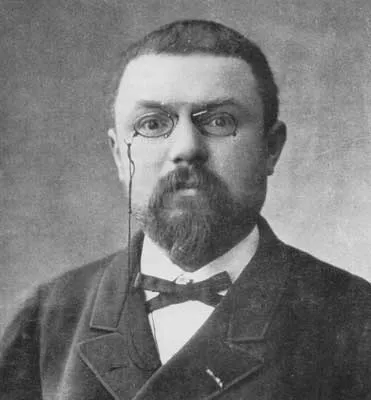
Henri Poincaré
Human Design Chart
Biography
He was appointed the Professor of Mathematical physics and calculus in 1886 and ten years later succeeded Tisserand in the Chair of Celestial Mechanics. Achieving a Doctorate degree in Science in 1879, he resided in Paris and soon became well known at the University. He received many prizes for his work and wrote 13 volumes, "Cours de Physique."
Poincare died on 17 July 1912, aged 58, in Paris.
The Human Design of Henri Poincaré: Manifesting Generator 1/3
Manifesting Generator 1/3 — Design at a Glance
Henri Poincaré was someone who combined the endurance of a Generator with the lightning-fast action of a Manifestor through his hybrid energy configuration. His defined Sacral Center provided constant power, while his connection to Motor Centers allowed him to skip steps and draw things into his life at great speed. This quickness was a double-edged sword: Often he reacted to numerous impulses simultaneously and started several projects at once. When his inner authority wasn’t in sync, this creative drive quickly turned into frustration as important intermediate steps were overlooked and had to be laboriously made up for later.
Henri Poincaré’s strategy was not to initiate himself but to react to life. Only when his Sacral Center responded with a clear “Yes” and his inner authority agreed should he act. Under these conditions, he could carry the parallelism of his projects without getting distracted. Instead of completing one thing after another linearly, he found his deepest satisfaction in the “Play Mode,” where variety and spontaneous reaction to impulses best promoted his creative power. Thus, the potential source of frustration – rushing or multitasking without consent – became a source of great fulfillment, provided he remained sensitive to feedback from his body and authority.
Sacral Authority
Henri Poincaré was someone whose decision-making relied on direct physical resonance. As a Generator, his strategy was also his inner authority: Sacral Authority. This greatly simplified his process as he did not oscillate between external advice and inner truth. A prerequisite for this was an open Emotional Center, meaning that he did not make impulsive decisions but reacted to the first impulse. This showed up as gut feeling or a surge of energy – often audible through grunting or a nodding “Mhm” – when an external opportunity spoke to him. When his sacral motor kicked in, he felt vital and energized; he accomplished his work with great enthusiasm and immersed himself entirely without needing to question a higher purpose. Additionally, an activated Spleen Center acted as a supportive instance. It gave him quick, spontaneous reaction capability and immediate access to instinctive perception of his physical well-being. Henri Poincaré could thus reliably guide himself from this combination of sacral confirmation and spleen-based intuition, which allowed him to make decisions quickly and safely based on what actually made him alive in the moment.
The 1/3 Profile — Investigator / Martyr
Henri Poincaré was someone who had to validate theoretical knowledge through practical experience. His design as Profile 1/3 – the Researcher and Experimentor – set a tendency to not only study but actively test the world. For him, learning was a process of trial and error; pure theory never sufficed.
This pattern was shaped by specific energetic configurations. Gate 24 on Line 1 brought with it the need to rigorously scrutinize inspirations: Was an idea truly new or just a variation of the known? Here it was about delineating one’s individuality from collective knowledge and the will to mutate concepts into new contexts. Uncertainty in thinking could lead to prematurely rejecting new thoughts until their quality was proven.
Simultaneously, Gate 19 on Line 3 worked to foster vigilance in handling resources and relationships. Here stood the question of who productively contributes to the “clan” and how mutual dependencies are shaped. The increased Venus energy in this area promoted a natural ease in exchange, yet the learning process always required verifying the productivity of partners.
The result of this mechanism was a judgment one could trust: When Henri Poincaré labeled something as good, he had previously intellectually penetrated it and practically tested it to his heart’s content. His life revolved around this synthesis of individual research and communal validation, where errors were not seen as failure but as necessary steps towards understanding.
Single Definition — Defined & Open Centers
Henri Poincaré revealed himself as someone with a constant internal energy source and clear communication. His defined Sacral Center provided him with vital energy that felt like a steady hum; however, this energy was available only for responses, not for initiatives. Simultaneously, his defined Throat Center shaped his expression: he spoke and acted reliably from this source, allowing him to express his truth clearly if he waited for the correct sacral response. His defined Root Center also contributed by providing a steady pressure to move forward in the world and master existential challenges.
These stable internal resources contrasted with his open centers, making him vulnerable to external influences. His open Head Center meant that he did not have a consistent way of processing mental information; he tended to get entangled in others' doubts and confusion or seek inspiration to relieve mental pressure. Similarly, his open Ajna Center lacked a firm conceptual structure, which made him flexible for new ideas but also conditioned him to interpret other people's opinions as his own truth or feign uncertainty.
His open G Center showed dependence on the environment for identity and direction; he often adapted to those around him due to lacking an inner orientation. The open Heart Center led him not to consistently muster willpower or keep promises, causing him to spiral into self-proving cycles. Furthermore, his open Solar Plexus absorbed the emotions of his surroundings, amplifying and personalizing foreign moods. Finally, his open Spleen Center made him vulnerable to survival fears and tempted him to make spontaneous decisions or cling to unhealthy sources of well-being. These opennesses required Henri Poincaré to trust his inner authority rather than react to mental or emotional conditioning.
Channels for powerful manifestation and profound change.
Henri Poincaré's design set a tendency for sudden, profound transformation processes accompanied by strong internal drive. This configuration showed someone capable of not only sensing innovative impulses but also quickly and effectively bringing them into the world.
This dynamic resulted from the interplay of two defined channels. The Channel of Mutation 60-3 connected the Root Center with the Sacral Center. Through Gate 60 of Limitation and Gate 3 of Order, a pulse emerged from chaos and structure. This energy brought about evolutionary change but was marked by mechanical moodiness. Henri Poincaré had to learn to accept that this mutative process is unpredictable and cannot be steered through logical argumentation. In phases of silence felt as melancholy, new developments grew underground before suddenly surfacing.
Simultaneously, the Channel of Charisma 34-20 connected the Sacral Center with the Throat Center. Gate 34 of raw physiological power met here with Gate 20 of Now. This endowed him with the ability to immediately transform generative energy into manifesting action. The speed of this reaction was so high that it almost occurred without delay, making it difficult to sit still. This combination enabled Henri Poincaré not only to internally process his unique insights but also to carry them outward with impressive self-reinforcing vitality. His focus lay on using this energy for things that truly fulfilled him, thereby naturally inspiring others without sacrificing himself.
Individual Circuitry — Circuit Signature
Henri Poincaré's design set a tendency towards impulsive creative outbursts. As a simply defined type, he possessed a continuous energetic flow between the Sacral, Root, and Throat Centers. This connection linked his inner life energy directly to the ability to carry it outward acoustically or through action.
The Knowledge Circuit worked through him via the Channel of Mutation (3-60), which connected the Sacral with the Root Center. This promoted an energy aimed at deviation from the known and new insight. The pulsating format-energy of this channel supported strengthening one's individuality through concrete steps.
Parallel to this, the Integration Circuit worked through the Channel of Charisma (20-34), which connected the Throat with the Sacral Center. This flow utilized power from reacting to life and channeled it in the Now moment. The combination of these two circuits within his single definition group created a coherent structure: new impulses from the Root were fueled by sacral energy and directly expressed through the Throat Center. Henri Poincaré thus showed himself as someone who not only thought innovative flashes but also immediately brought them into the world, driven by an inner rhythmic life force.
Right Angle Cross of the Four Ways 1
Henri Poincaré's Human Design indicated a tendency towards a deep, often unspoken inner order characterized by the 'right cross of four paths.' This configuration did not describe an external joy of action but rather an intense focus on internal clarity and structural integrity. Henri Poincaré was someone whose energy was directed at understanding complex connections and bringing them into a coherent, logically sustainable form. The right cross of four paths connected various aspects of his perception and thinking into a closed system that sought stability. It was a mechanism aimed at resolving internal contradictions and drawing a clear line through the chaos of impressions. Henri Poincaré lived with this inner architecture, which helped him find footing in uncertainty by relying on proven structures and deep analysis. This configuration shaped his way of processing information: not superficially but delving to the root of the matter to uncover fundamental truth. The focus was always on the quality of internal understanding rather than quick external implementation. Henri Poincaré used this energy to create a safe space within himself from which he could act or judge without being distracted by external disturbances.
Saturn Return · Uranus Opposition · Chiron Return · 2nd Saturn Return — Life Cycles
Henri Poincaré's Human Design showed a structure where external recognition and institutional anchoring were central driving forces. This configuration shaped his life path through phases of intense affirmation. In 1881, at the age of 27, he married Louise Poulain d'Andecy. This first Saturn Return marked the transition into a phase of reliability and firm commitment, with marriage serving as a stabilizing factor for further development.
The dynamics shifted with the Uranus Opposite in 1894 (age 40). Here there was a need for broader visibility, which manifested in his acceptance as a Foreign Member of the Royal Society and the awarding of the Sylvester Medal in 1901. These events underscored his role as a bridge between different intellectual streams and confirmed his status beyond national borders.
The Chiron Return around 1904 (age 50) functioned as an achievement cycle, where his incarnation purpose crystallized. The introduction of the concept 'Postulate of Relativity' was no mere coincidence but the bloom of long-term work: His deep insights were now the foundation of a new paradigm. The second Saturn Return in 1911 (age 57) crowned this path with the Bruce Medal. This award confirmed the sustainability of his impact and anchored his life's work definitively in history, making visible the cumulative power of his previous steps.
Manifesting Generator · Sacral Authority — Synthesis
Henri Poincaré was a Manifestor Generator whose life was marked by an ongoing interplay between the urge for quick implementation and the necessity of deep scrutiny. The defined sacral energy (Sacral Center) provided a constant driving force, channeled directly into expression and action through the connection to Throat Center (Communication and Manifestation) – a pattern that was particularly evident in the Researcher/Experimentor Profile (Line 1/3). He lived out testing and experimenting with ideas, supported by a theoretical foundation he tirelessly expanded. This process was not linear but marked by the Channel of Mutation (Gate 60-3), which constantly forced him onto new paths and connected him to a fundamental melancholy.
The central paradox in his design lay in the tension between the impulsive action of a Manifestor and the reactive nature of a Generator. He could quickly realize ideas, but occasionally skipped necessary steps (Manifesting Generator), forcing him into renewed scrutiny. The cycles showed this: Successes in career and recognition often followed phases of intense research and experimentation – a pattern of rapid progress followed by consolidation, reinforced by the Knowledge Circuit and making him a trailblazer for new insights.
2 Defined Channels
Incarnation Cross - Right Angle Cross of the Four Ways 1
Solar Return
The Solar Return shows the moment when the sun returns to its exact birth position - your personal solar year.
Life Cycles
Discover the life cycles with a detailed triple view (birth chart, cycle chart, composite).
Human Design Profile
- Strategy
- To respond - wait for something to respond to
- Authority
- Sacral Authority
- Profile
- 1/3 - Investigator / Martyr
- Definition
- Single Definition
- Incarnation Cross
- Right Angle Cross of the Four Ways 1
- Date of Birth
- 29.04.1854 01:00
- Place of Birth
- Nancy, France
Frequently Asked Questions
What was Henri Poincaré's Human Design type?
What Profile did Henri Poincaré have in Human Design?
What Authority did Henri Poincaré have?
What incarnation cross did Henri Poincaré have?
When was Henri Poincaré born?
Discover your own Human Design
Are you also a Manifesting Generator? Find out in a personal reading how to unfold your multi-talents and direct your energy wisely.
More Personalities
Back to overviewAldair

Alizée

Angeli

Arletty
Artus
Balthus