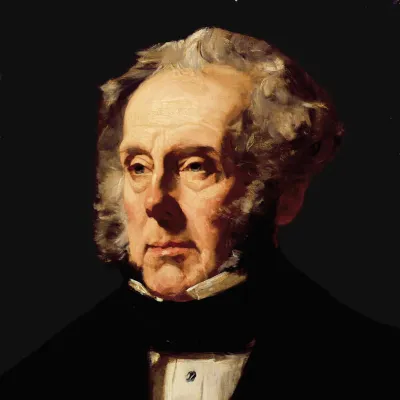
Henry John Temple
Human Design Chart
Biography
Temple's resignation was forced in December 1851 when he supported Napoleon. However, a year later, Queen Victoria made him Home Secretary and then Prime Minister in 1855. Nationalistic, insensitive and penurious, he despised and feared the American democracy as being deeply threatening.
Temple caught a fever on 12 October 1865 and died within the week, on 18 October 1865, London.
What does Generator 2/4 mean for Henry John Temple?
Generator 2/4 — Design at a Glance
Henry John Temple had a massive, sacral energy base that made him a persistent workhorse. As a Generator, his design dictated that his effectiveness did not stem from initiative but from reacting to external signals. This configuration worked like an engine that only started with a spark—an impulse from the environment. The central mechanics of his system required him to wait for these signals and then act once his inner center gave a clear confirmation. This process of 'reacting from the gut' was the key to his efficiency. When Henry John Temple followed this strategy by only doing what resonated with him internally, he was rewarded with a deep sense of fulfillment. His energy then flowed freely, and he was able to materialize projects with great endurance. Conversely, ignoring this principle led to two specific dangers. Initiating actions without an internal impulse or forcing himself to tasks that found no resonance wasted his energy. This resulted in persistent frustration and a noticeable energy deficit that could lead to burnout. Similarly, it blocked him when he was prevented from his actual work, even though his system was still full of power. His success thus strictly depended on maintaining the distinction between self-motivation and external pressure and only responding to what truly resonated with him.
Emotional Authority
Henry John Temple showed himself to be someone who did not make decisions on impulse but consciously let them rest. His inner authority was the Emotional Authority, carried by the defined Emotional Center. In Human Design mechanics, if the Emotional Center is activated, it determines decision-making, independent of other defined centers. Temple was subject to an emotional wave, a permanent up and down of feelings. The world appeared to him always colored by the current mood; enthusiasm could quickly turn into negativity. A feeling in the moment was, however, only a snapshot, not a final claim of truth. Quick, spontaneous decisions from this emotional excitement often had negative consequences. Instead, he took the time to let decisions mature. This process required patience and the multiple reconsideration of important questions. Through delaying and repeatedly questioning, the intense feelings subsided. Over time, he gained emotional distance, leading to clarity and calmness. Only then was the decision-making process complete. This strategy of delay was particularly essential for long-term, life-defining decisions, as it secured the depth and scope of the insight. Temple lived this necessity of emotional distancing to emerge from the flood of feelings to the true inner truth.
The 2/4 Profile — Hermit / Opportunist
Henry John Temple showed himself to be someone who oscillated between the deep need for withdrawal and the urge for social connection. His Profile 2/4 set a tension: On one hand, he sought the solitude of the 'hermit' to gain inner clarity, on the other hand, he longed for the community of 'favorite people'. This dynamic required him to clearly communicate when he sought company and when he wanted to be left alone. Only then could he reflect on the knowledge of his network during solitary times and process it into brilliant ideas. His way of presenting ideas was marked by determination but often projected values not yet fully solidified outwardly. This could elicit resistance, as his intelligence was brilliant, but the foundation was still in development. When he encountered rejection, he withdrew decisively to protect or let these values mature. Friends helped him overcome this resistance. At the same time, he used the skill of the storyteller to convey messages. Here, it was necessary to apply clever calculation and self-interest by waiting for or seizing appropriate opportunities to communicate his stories effectively. This shift between isolated reflection and strategic, community-oriented communication shaped his lifestyle and his way of interacting with his environment.
Single Definition — Defined & Open Centers
Henry John Temple was someone who drew his strength from reacting to life, not from initiating it. His defined Sacral Center generated a constant vital energy, but this only had a lasting effect when he waited for a request and responded with an instinctive 'Yes' or 'No'. This sacral response was his compass for availability and fulfillment; if he ignored it in favor of mental planning, frustration would ensue.
Parallel to this, his defined Solar Plexus Center served as his inner authority. Temple tended to avoid making decisions in emotional highs or lows, instead waiting for the emotional wave to pass until clarity emerged. This patience allowed him to recognize deeper truths rather than acting impulsively. His defined Spleen Center complemented this by providing spontaneous, intuitive alarm signals in the present moment, protecting his well-being and health. Together with his defined Root Center, which provided a steady pressure towards material existence and survival, these centers formed a foundation of bodily intelligence and emotional depth.
In contrast, his Head Center was open. Temple did not have a consistent access to inspiration or clear questions. Instead, he tended to absorb mental pressure from others and get entangled in their confusion or doubts if he did not trust his inner authority. His Ajna Center was also open, giving him a flexible mind that reflected ideas from the environment but tended to interpret answers as his own opinions or simulate uncertainty to be accepted.
His open G Center meant he did not have a fixed identity or direction. He was prone to falling in love with the identities of others or pursuing false directions to find love or belonging. The right environment was crucial for him as it reflected the correct identity. Finally, his open Heart Center made him prone to wanting to prove his worth through promises or competition, rather than trusting the natural commitments that arose from his strategy and authority.
Channels for change, intimacy, ambition and emotional depth.
Henry John Temple operated through a mechanism aligned with evolutionary change and intense connection. His energy did not follow a linear plan but pulsed in waves of innovation and emotional exchange.
The Channel of Mutation 60-3 connected his Root Center with his Sacral Center. This configuration brought a potential for unexpected change, but it depended on the ability to accept limitation and move beyond the confusion of a new beginning. The energy of this channel was adrenalized and generative, often accompanied by melancholy when the pulse stalled. Henry John Temple had to learn not to rationalize this mechanical moodiness but to patiently wait for the reaction from his Sacral Center to set new mutations in motion. This channel also conditioned his environment, demanding adaptation or change from those close to him.
Parallel to this, the Channel of Partnership 59-6, connecting his Sacral Center with his Solar Plexus Center, was at the core of his creative essence in intimacy. The sexuality of Gate 59 and the emotional wave of pleasure and pain from Gate 6 brought him into relationships that were personal, penetrating, and potentially fruitful. This connection required patience, as the emotional wave needed time to gain clarity. By waiting for this wave movement, he could discern whether a deep, intimate connection could form beyond mere attraction.
The Channel of Transformation 54-32 propelled him through ambition and the desire to improve his position. Driven by the fear of failure and the desire to be seen, he used his talents to move upwards. This ambition was closely tied to the support of the tribe; he worked hard to prove his worth and in return received recognition and advancement. His instincts helped him recognize the right moment for support to secure prosperity and success.
Additionally, the Channel of Emotional Release 39-55 shaped his emotional landscape. It connected his Root Center with his Solar Plexus Center and set a pulsing wave of moods in motion. This mechanism allowed him to provoke and perceive the minds of others. By embracing his own emotional depth, he could influence others with a spiritual passion for life, provided he acted authentically and not out of compulsion.
Individual Gates like Gate 50 (Values, Traditions) and Gate 56 (mental narrative) rounded out his profile by adding a conservative protective reflex and the ability for abstract representation of mental processes. Gate 30 (Recognizing Feelings) and Gate 29 (Saying Yes) emphasize the importance of persistence and recognizing illusions. Gate 37 (Friendship) and Gate 19 (Resources) underscore the necessity of community and secure territory. Gate 48 (Depth, Pattern Recognition) and Gate 53 (Freedom, Pioneer Spirit) added aspects of logical refinement and the beginning of new cycles.
Individual Circuitry — Circuit Signature
Henry John Temple was characterized by a design centered on the protection and preservation of his genetic heritage. His simple definition connected the Sacral, Root, Spleen, and Solar Plexus Centers into a cohesive energetic flow. In the Guardian Circuit, the Channel of Partnership (59-6) linked the instinctive life force of the Sacral Center with the emotions of the Solar Plexus, creating a primal energy aimed at nourishing and defending family and offspring. Parallel to this, the Knowledge Circuit shaped his mode of expression. Here, he connected the Sacral and Root Centers with the Solar Plexus. The Channel of Mutation (3-60) promoted deviations from the known, while the Channel for Emotional Release (55-39) channeled this through the body. This allowed him to transform new knowledge and express it emotionally colored, pulsing, and acoustically effective. A third aspect was the Ego Circuit, which in him appeared isolated. The Channel of Transformation (32-54) connected the Spleen and Root Centers. Since this circuit was not connected to the Sacral Center, the constant life force was missing. This required pauses to gather resources and maintain the balance of give and take in cooperation. Overall, these separate but internal connections formed a pattern oscillating between the drive to protect and mutate genetically and the need to withdraw to recharge.
Right Angle Cross of Laws 3
Henry John Temple was marked by the right cross of Law 3. This configuration combined a profound, often painful experience with the necessity of developing a new order or truth from it. It was not mere suffering but a catalytic process that compelled him to question existing structures and formulate his own, sustainable principles.
The right cross of Law 3 marks a turning point in Human Design where outdated beliefs or systems are recognized as inadequate or false. For Henry John Temple, this process of realization was not optional but a compelling life task. He had to go through the experience of disappointment or failure to arrive at a more authentic, personal truth. This new understanding then served as the foundation for his further actions and decisions.
The mechanics of this cross demand that one does not cling to outdated doctrines but is ready to change and adapt. For Henry John Temple, this meant that his authority and influence rested on his ability to derive a clear new directive from the crisis. He was dependent on integrating his own experiences to become a leadership figure based on lived truth rather than inherited conventions. This path was challenging but necessary for his development.
Saturn Return · Uranus Opposition · Chiron Return · 2nd Saturn Return — Life Cycles
Henry John Temple's life was marked by clear, repeating cycles of structuring and transformation. His design indicated a tendency to experience significant career shifts at certain age phases, not randomly but as expressions of internal developmental stages.
In 1827, at the age of 43, he received a cabinet seat after George Canning became Prime Minister. This step fell into a phase often correlated with an opposition to Uranus in Human Design – a time when external circumstances change rapidly and new, unexpected roles are forced or enabled. It was a moment of sudden ascent, driven by external forces.
Three years later, in 1830, he switched to the Whig Party and joined the cabinet of Charles Grey as Secretary of State for Foreign Affairs. At 46, he was in his Chiron Return, a cycle of fulfillment and bloom. Here it was shown that his previous path, lived according to his strategy, now coalesced into a coherent whole. The change was not merely a career shift but the realization of his incarnation purpose in a new, stable form.
In 1841, at 57, he had to step back and took the lead of the opposition. This marked his second Saturn Return, a phase of maturation and building long-term structures. The withdrawal from active government leadership to lead the opposition highlighted the need to take responsibility on a deeper, strategic level, away from the daily political grind.
Generator · Emotional Authority — Synthesis
Henry John Temple was a Generator whose life was marked by deep, sacral energy. This energy, combined with emotional authority, led him through a wave of feelings that needed time to mature before decisions could be made. The profile as a natural talent and networker revealed a constant pendulum swing between the need for withdrawal and the desire for community, an inner rhythm that allowed him to gain clarity and then reconnect with others. The Channel of Mutation (3-60) points to a capacity for transformation and the acceptance of limitations, guiding him through phases of evolutionary change, always seeking new possibilities.
A central paradox in his design lay in the tension between the pulsating, creative potential of the Knowledge Circuit and the turning points in his career dictated by cycles (Uranus Opposition, Chiron Return, Saturn Return). While he could initiate new paths and changes through his energy, the external circumstances and setbacks (such as stepping back) required adaptation and letting go of previous notions. This dynamic between inner drive and external necessity shaped his life path.
4 Defined Channels
Incarnation Cross - Right Angle Cross of Laws 3
Solar Return
The Solar Return shows the moment when the sun returns to its exact birth position - your personal solar year.
Life Cycles
Discover the life cycles with a detailed triple view (birth chart, cycle chart, composite).
Human Design Profile
- Type
- Generator
- Strategy
- To respond - wait for something to respond to
- Authority
- Emotional Authority
- Profile
- 2/4 - Hermit / Opportunist
- Definition
- Single Definition
- Incarnation Cross
- Right Angle Cross of Laws 3
- Date of Birth
- 20.10.1784 19:00
- Place of Birth
- London, UK
Frequently Asked Questions
What was Henry John Temple's Human Design type?
What Profile did Henry John Temple have in Human Design?
What Authority guided Henry John Temple?
Which incarnation cross determined Henry John Temple's design?
When was Henry John Temple born?
Discover your own Human Design
Are you also a Generator? Find out in a personal reading how to use your sacral energy correctly and discover deep satisfaction.
More Personalities
Back to overviewAaliyah

Alexia

Angèle

Anne-Marie

Arcángel

Arno