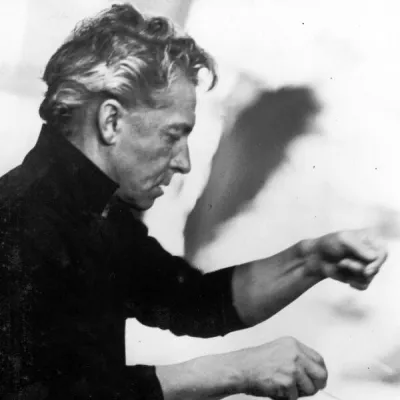
Herbert von Karajan
Human Design Chart
Biography
Herbert von Karajan — Manifestor with Profile 1/3
Manifestor 1/3 — Design at a Glance
Herbert von Karajan revealed himself as someone who actively steered the world into new directions. His design marked him as a pioneer and visionary whose task was to lead others without having to fight every battle personally. Similar to an emperor in ancient Rome, he had great plans but delegated their implementation to his surroundings. This style of leadership inevitably polarized: While some people were drawn to his vision and followed him, it met with rejection or even hatred from others. The central pain point of this design lay in frequent disregard; as he often thought ahead of his environment, he was not always understood. To minimize these frictions and find the right followership, it was crucial for him to inform others timely and precisely about his intentions. This strategy of informing formed the key to his inner state. When he followed this approach, his design rewarded him with a deep sense of peace. If he lived against this nature, however, he felt persistent anger instead. His life energy thus worked most effectively when he communicated clearly before acting, thereby creating the necessary resonance in his environment.
Emotional Authority
Herbert von Karajan lived with an inner authority that manifested in wave-like emotional fluctuations. His defined Emotional Center carried this authority – a mechanism that takes precedence over all other defined centers for every type except Reflectors. This configuration shaped a perception world that was always colored by the current mood: At one moment, there was total enthusiasm for a project; at another, the same thing appeared in negative light. Such feelings were merely snapshots, first impressions, not necessarily his deeper truth yet. Quick, spontaneous decisions from such an emotional state often had negative consequences.
Instead, his design required patience and conscious hesitation. Herbert von Karajan let decisions mature, slept on them multiple times, and sought emotional distance. Only when the intense emotions subsided did clarity and calm set in – then the inner process was complete. This mechanism primarily served long-term life decisions with significant impact. Through waiting, he gained a broader understanding that went beyond fleeting affect. His strategy involved taking time to reflect and asking himself multiple times before acting. Thus, the initial emotional impulse transformed into a well-founded, calm decision that aligned with his inner structure.
The 1/3 Profile — Investigator / Martyr
Herbert von Karajan revealed himself as someone whose life path was marked by Profile 1/3 – the Researcher and Experimenter. This design laid out an approach based on trial and error: Knowledge was not only acquired theoretically but had to be practically tested to be valid. Line 1 demanded time for development and handling shocks through willpower, while Line 3 emphasized experimentation. Karajan thus learned primarily through personal experience; his judgments were trustworthy because they had been rigorously tested both theoretically and practically.
Especially relevant was the aspect of the third line: Ambition here was often strengthened by secret interactions or hidden paths when official channels seemed blocked. This did not necessarily mean disloyalty but a pragmatic willingness to use alternative means to achieve goals – behavior that can be understood as persistent belief in overcoming obstacles. When Karajan believed something to be right, it was the result of this intensive testing process. The energy of Line 1 could sometimes lead to fear of implementation because there was a feeling of not knowing enough yet, but Line 3 constantly drove him to try and learn from mistakes. Thus, self-earned insights coalesced into a solid foundation for his actions.
Single Definition — Defined & Open Centers
Herbert von Karajan revealed himself as someone who possessed a constant inner direction and clear willpower. His defined G Center gave him a reliable sense of self and the ability to provide guidance to others without becoming dependent on them. Enhanced by his defined Heart Center, he had permanent access to his willpower; he could make promises and keep them, which strengthened his self-esteem and helped him use his resources in a self-determined manner.
This structural stability contrasted with the dynamism of his defined Solar Plexus Center. This center functioned as his inner authority, but it did not rely on immediate clarity. Instead, he was designed to wait for the emotional wave before making decisions. Emotional impulses were not immediate instructions for him, but indicators whose meaning would reveal itself over time. Patience was crucial here to move from emotional arousal to true clarity.
His communication was shaped by his defined Throat Center. It served as a pivot point that transformed messages from various energy sources of his design—especially the Heart and Solar Plexus—into the world. Thus, his voice was an expression of his reliable identity and willpower, combined with the deep sensitivity of his emotional nature.
At the same time, his design revealed specific vulnerabilities through several open centers. His open Head Center made him receptive to external inspiration but also susceptible to mental pressure and confusion; he tended to get entangled in questions that were not his own. The open Ajna Center allowed for a flexible mind that absorbed concepts from the environment without identifying them as personal truth. However, his open Sacral Center meant that he did not have constant generative energy and was vulnerable to absorbing the life force of others, which could lead to overexertion. Additionally, his open Root Center absorbed external stress while his open Spleen Center made him sensitive to questions of health and well-being in his environment.
Channels for emotional drama, reflection and pioneering spirit.
Herbert von Karajan revealed himself as someone whose expression and social presence were strongly determined by the rhythm of his emotional wave. This dynamic resulted from Channel 22-12, which connected the Solar Plexus Center with the Throat Center. Through Gate 22, "Openness," his passion and romance flowed into his expression, while Gate 12, "Cautiousness," maintained a necessary restraint. His ability to achieve emotional impact through voice and articulation depended on whether he felt right in the moment; forced interactions often led to harshness or misunderstandings, while he could deeply touch others with his mood.
Parallel to this, Channel of the Lost Son 13-33, which linked the G Center with the Throat Center, was influential. Here, Gate 13, "Listener," gathered information and secrets, while Gate 33, "Withdrawal," offered time for reflection. Herbert von Karajan withdrew to process experiences and discover deeper truths before sharing them. This process of patience and listening allowed him to sort life stories and collective wisdoms to pass on as lessons later, rather than reacting impulsively to events.
Another defining aspect was Channel of Initiation 51-25 in the Heart Center. Gate 51, "Shock," drove a competitive energy that always wanted to be the best, while Gate 25, "Spirit of Self," connected this ambition with universal love and beauty. Herbert von Karajan used this combination to encourage others through his authentic lifestyle and successes, introducing them into deeper levels of self-awareness. His competitiveness served not only material success but also as a mystical process of individuation that transformed him and his environment.
Additionally, Gates like 57 (intuitive clarity), 53 (freedom for new cycles), and 54 (connection between worldly success and spirituality) contributed to his complex personality by linking intuitive survival strategies with the drive for development and synthesis of power and mysticism.
Individual Circuitry — Circuit Signature
Herbert von Karajan's Human Design shows a tendency towards deeply rooted inner strength, paired with the need to express emotional waves rhythmically. As a simple defined person, he was someone whose energies flowed in a connected structure through Throat, Solar Plexus, G, and Heart Centers. This unity created a coherent internal compass.
His Centering Circuit linked Identity and Heart Centers via the Initiation Channel, giving him a stable personality with strong individual convictions and high self-esteem. However, without a connection to the Throat Center, these firm stances often remained unspoken; they shaped his essence from within, without being directly verbalized.
Parallel to this, the Knowledge Circuit worked through the Openness Channel between Solar Plexus and Throat Centers. Here, the emotional wave from the Solar Plexus found expression in the throat. This allowed him to articulate new impulses and individual identity acoustically and in the present moment, driven by a pulsating creativity.
A third aspect was the Seeker Circuit connecting Throat and Identity Centers. This "lost son" channel focused on the past. Herbert von Karajan reflected on past experiences to understand their meaning and share these emotional insights with others. The combination of inner stability (Heart/Identity) and the expression of emotional waves (Solar Plexus/Throat) defined his way of initiating transformation through authentic, rhythmic communication.
Right Angle Cross of Penetration 1
Herbert von Karajan's Human Design profile indicated a tendency towards deep, penetrating perception. His inner nature was marked by the so-called right cross of penetration. This configuration did not merely describe intuition but rather a specific mechanism: the ability to look beyond the visible surface of situations and people to perceive their true nature or intent. It was not superficial judgment but direct grasping of the essence of an event.
For Herbert von Karajan, this meant that he often accepted what he perceived as self-evident. Penetration for him was not a conscious act of analysis but rather a natural way of being. When encountering something or someone, this understanding happened automatically and immediately. This gave him a certain directness in dealing with reality; what remained hidden to others became clear to him.
However, this inner clarity could also lead to expectations towards his environment that were not shared by others. Since perception was so natural for him, he sometimes assumed the same transparency in others. The right cross of penetration thus created a life dynamic where authenticity and recognizing the essential stood at the forefront. Herbert von Karajan lived this mechanism as an ongoing, direct encounter with the truth of things without having to construct or interpret them.
Saturn Return · Uranus Opposition · Chiron Return · 2nd Saturn Return — Life Cycles
Herbert von Karajan's Human Design profile shaped a life path marked by clear phases of building up and reorientation. His first Saturn Return around 1935 signified the moment when years of groundwork condensed into a solid result: He was appointed as Germany's youngest General Music Director. This showed the typical function of this cycle, taking on structures and responsibility.
The Uranus Opposition in 1948 brought an essential expansion of his horizon. In that year, he debuted at La Scala in Milan and took leading roles in Vienna. This transition broke old patterns and created new international perspectives for his work.
With the Chiron Return around 1957, Karajan entered a phase of flourishing where his incarnation purpose increasingly fulfilled itself. As an artistic director of the Vienna State Opera, he brought important singers to the house, living out his deepest sense as a shaper of musical excellence.
His second Saturn Return in 1964 led to a crisis when established structures showed their limits. After conflicts with administration, he stepped down from opera direction. This withdrawal was not a failure but a necessary release from non-functioning conditions to make space for the next phase of life.
Manifestor · Emotional Authority — Synthesis
He was a Generator type whose life was marked by a profound drive towards transformation. The defined Throat (paired with open channel 22/12) points to strong expressive power, yet always colored by emotional waves – a creative impulse that unfolded in interaction with others and triggered mutative processes. The profile as Researcher/Experimentator (line 1/3) reinforced this process by establishing a continuous cycle of deep investigation and practical experimentation. Through the right cross of penetration, energy was focused on external goals to gain knowledge and bring about changes in the world – an aspiration underscored by key moments like appointments and successes (marked by Saturn Returns and Uranus Oppositions).
A central paradox lay in the combination of emotional authority and the manifesting impulse of the Generator type. On one hand, he needed time to let decisions mature and fully exploit the emotional wave; on the other hand, his defined Throat pushed him to immediately express these insights and bring them into the world. This tension between inner maturation and outer expression led to phases of intense creativity but also conflicts (such as stepping down from opera direction) when the urge for manifestation clashed with the need for emotional clarity.
3 Defined Channels
Incarnation Cross - Right Angle Cross of Penetration 1
Solar Return
The Solar Return shows the moment when the sun returns to its exact birth position - your personal solar year.
Life Cycles
Discover the life cycles with a detailed triple view (birth chart, cycle chart, composite).
Human Design Profile
- Type
- Manifestor
- Strategy
- To inform others before acting
- Authority
- Emotional Authority
- Profile
- 1/3 - Investigator / Martyr
- Definition
- Single Definition
- Incarnation Cross
- Right Angle Cross of Penetration 1
- Date of Birth
- 05.04.1908 22:30
- Place of Birth
- Salzburg, Austria
Frequently Asked Questions
What was Herbert von Karajan's Human Design type?
What Profile did Herbert von Karajan have in Human Design?
Which Authority guided Herbert von Karajan?
What incarnation cross determined Herbert von Karajan?
When was Herbert von Karajan born?
Discover your own Human Design
Are you also a Manifestor? Find out in a personal reading how to use your initiation power peacefully and dissolve resistance.
More Personalities
Back to overviewAaliyah

Alexia

Alizée

Angèle

Anne-Marie

Arcángel