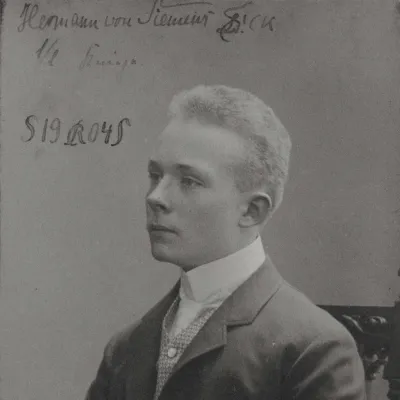
Hermann von Siemens
Human Design Chart
Biography
He was the eldest son of Arnold von Siemens who himself was the eldest son of Werner von Siemens, the famous inventor and founder of Siemens & Halske, later to become the present-day Siemens AG. Hermann's mother Ellen, née von Helmholtz, was a daughter of Werner's close friend Hermann von Helmholtz, after whom his grandson was named. He was the eldest of five children.
Before 1933 he was a member of the German National People's Party, a rival and opponent of Hitler's National Socialist German Workers' Party. From 1941 until 1946 he succeeded his uncle Carl Friedrich von Siemens as chairman of the Supervisory Boards of Siemens & Halske AG and Siemens-Schuckertwerke AG and thus became head of the German electrical and electronics company.
Arrested on 5 December 1945 by Allied Forces, he temporarily ceded the chairmanships to his father's first cousin Friedrich Carl Siemens (1877-1952). He was brought to the Nuremberg trials as a prisoner to deal with war crime charges, but finally no prosecution was filed, as there were no personal misdeeds traceable. The charges were dropped, so he could return as head of company in 1948.
He again served as chairman of the supervisory boards of Siemens & Halske AG and Siemens-Schuckertwerke AG until his retirement in 1956.
In 1917, he married Charlotte von Maltzan, Baroness zu Wartenberg und Penzlin; they had six children and 12 grandchildren. He died on 13 October 1986 in Munich, aged 101.
Hermann von Siemens — Manifesting Generator with Profile 4/6
Manifesting Generator 4/6 — Design at a Glance
Hermann von Siemens was a person with a hybrid energy structure: He had the constant power of a Generator but also possessed the ability to act swiftly due to an active connection to Motor Centers. This design tended to pull things rapidly into his life and skip steps. Often, this speed led him to pursue multiple projects simultaneously in response to various impulses.
The challenge was that such an approach sometimes omitted important stages. When this happened, he had to backtrack and make up for missed steps, which could lead to frustration – the specific non-self theme of his configuration. To effectively use his creative power, it was crucial not to initiate himself but to respond to external impulses. Only when his Sacral Center responded with a clear “Yes” and inner authority agreed could he successfully start.
With this correct application, he fell into a productive play mode. Then it wasn’t a problem for him to handle tasks in parallel; on the contrary, variety promoted his satisfaction. The requirement to finish one thing before starting another stood against his natural work style. Instead, he drew deep satisfaction from his creation as long as he regularly checked whether ongoing projects still had his inner approval. Thus, his speed served him rather than plunging him into frustration.
Sacral Authority
Hermann von Siemens showed a decision-making stance based on direct physical resonance. As a Generator, he possessed Sacral Authority that also formed his strategy and simplified his decision-making process. This internal guidance did not act as an abstract reflection but as an immediate reaction to external stimuli. His design suggested that he responded to stimuli with a palpable “gut feeling” – often audible through grunts or affirming hums. Such signals marked the moment when his sacral motor rose, granting him inexhaustible energy and great enthusiasm for the task at hand. He lived by fully engaging in tasks driven by joy and satisfaction rather than purposefulness.
Central to this was the condition that his Emotional Center be open; this created the necessary space for this clear physical response. Additionally, his activated Spleen Center acted as a supporting authority. Through this connection, Hermann von Siemens had quick, instinctive access to his well-being. He could spontaneously and reliably listen to his inner perception, allowing him to make decisions directly in the moment of impulse without falling into hesitant deliberation. His vitality thus showed as a direct consequence of this harmonious alignment between Sacral and Spleen Centers.
The 4/6 Profile — Opportunist / Role Model
Hermann von Siemens was someone whose life path was strongly influenced by the tension field between the desire for community belonging and the need for detached wisdom. In his first thirty years, he intensely experimented with relationships and friendships, as the sixth line of his 4/6 Profile still felt like a third – open to trial and error. With maturity, however, an inner conflict emerged: The Heart (Line 4) sought connection while the Head (Line 6) searched for overview and pondered higher sense questions. This dynamic led him later often to be expected as a role model that stood out through cooperation but carefully guarded his large heart so as not to open falsely and get hurt.
At the same time, the seventh line shaped his attitude towards leadership: He understood authority as something only effective when recognized by the environment. When this recognition was withdrawn, he withdrew because influence without resonance seemed meaningless. The sixth line also challenged him to choose between mutation and rigidity – a rationalization often stemming from the need for material security and preservation of his individuality. His life thus was an ongoing balancing act between seeking hidden connections and the necessity to convey these insights in a form actually accepted by others, without losing his own substance.
Single Definition — Defined & Open Centers
Hermann von Siemens was a person who possessed a reliable inner direction and profound self-love. His defined G Center gave him a fixed understanding of his own identity and mission. He had the ability to show others new paths or comfort them without becoming dependent on their approval. This stable foundation allowed him to act from a secure inner place, rather than being driven by external expectations.
At the same time, he was equipped with a Generator's defined Sacral Center. This center generated an enormous daily vital energy source that pushed him towards activity. However, his strength did not lie in impulsiveness but in reacting to life. When asked or offered something, his Sacral Center responded with a clear yes-no tone. This sacral response was the key to his satisfaction and endurance; only through affirming reactions could he sustainably use his energy for tasks that brought him joy without falling into frustration or exhaustion.
His defined Throat Center also determined how he expressed himself. His communication was steady and clear, as it flowed directly from his motoric centers. He did not just speak thoughts but manifested his truth through a reliable voice that united action and word.
In contrast, his Head, Ajna, and Heart Centers were open. This meant that he did not have constant mental inspiration or willpower. He tended to absorb the mental pressure and uncertainties of his environment without identifying them as his own. Instead of getting lost in endless questions or trying to prove his worth through promises – a trap of an open Heart Center – he relied on being guided by his inner authority. His open Solar Plexus, along with the open Spleen and Root Centers, made him vulnerable to absorbing foreign emotions, fears, and stress factors. Here lay his challenge: not personalizing these external vibrations as his own reality but perceiving them as transient information to maintain his internal clarity and health.
Channels for inspiring presence and persistent determination.
Hermann von Siemens was someone who attracted attention through his mere presence and individual radiance. This effect did not come from explanatory words, but from living his unique identity. The Channel of Inspiration 1-8 connected the G Center with the Throat Center via the Gate of Self-expression (1) and the Gate of Contribution (8). This created a public outlet for creative potential and leadership. His presence served as an example that encouraged others to express their own uniqueness. He inspired through exemplary living by courageously demonstrating his individual direction.
Parallel to this, Hermann von Siemens had deep persistence in experience. The Channel of Discovery 29-46 connected the Sacral Center with the G Center via the Gate of Saying Yes (29) and the Gate of Self-Determination (46). This configuration required letting go of expectations and fully immersing oneself in the process. Through proper yes-saying, he remained persistent even when the significance of his steps only became clear at the end. His life force propelled him to be at the right place at the right time to make discoveries that changed collective understanding.
Additionally, other energies were present in his design: Gate 7 projected patterns for future leadership hierarchies and tested them through experiments. Gate 13 collected experiences as part of collective memory, promoted continuity, and enabled reflecting stories within a temporal context. Gate 2 reacted sensitively to external changes to derive new evolutionary directions from them. In the mental realm, Gate 56 abstracted processes into figurative representations and narratives. Spiritually, Gate 25 brought an attitude of innocence and mystical centering. Gate 27 provided nurturing warmth for survival, while Gate 23 enabled amoral communication to assimilate otherness. Gate 3 sought new orders through mutation from confusion, Gate 12 expressed individual creativity and poetic mood, and Gate 20 focused on authentic action in the here and now.
Individual Circuitry — Circuit Signature
Hermann von Siemens acted upon inspired impulses and connected these with a deep, cyclical life energy. His design was simply defined, meaning a clear, coherent energetic structure: The G Center (Identity), the Throat Center (Expression), and the Sacral Center (Life Force) formed an uninterrupted flow.
The Knowledge Circuit worked through him via the Channel of Inspiration (Gates 1-8). This connected his Identity Center directly with the Throat Center. It was not about logical planning but translating spontaneous ideas and inner impulses immediately into words or actions. This energy was pulsating and acoustically marked, driven by the need to express individuality in the present moment.
Parallel to this, the Meaning Circuit worked through him via the Channel of Discovery (Gates 46-29). This connected his Identity Center with the Sacral Center. Here lay the power in reflecting past experiences and emotions. This cyclical, wave-like energy served to learn from the past and use these insights as a basis for one's life force.
Since all three centers – identity, expression, and life force – were directly linked through channels, a closed circuit emerged: Inspirational impulses flowed into expression while simultaneously past experiences fueled the underlying energy. Hermann von Siemens lived this connection by manifesting his unique identity both through spontaneous expressions as well as reflective emotional depth – without external logic or cold rationality taking precedence.
Right Angle Cross of the Sphinx 3
Hermann von Siemens carried the design of the right cross of the Sphinx. This configuration shaped his inner attitude through a deep connection with life itself and a strong urge to engage in the world. The right cross of the Sphinx marks individuals whose energy is oriented towards nurturing and supporting life. Hermann von Siemens demonstrated himself as someone who took this task seriously, using his strength to promote others and advance projects for the benefit of the community. His actions were often guided by an intuitive understanding of what was truly needed in a specific situation to enrich or stabilize other people's lives. This energy is not geared towards personal fame but serves the greater good. Hermann von Siemens lived these principles by continuously putting himself at the service of others and using his resources to create sustainable structures. The right cross of the Sphinx bestows special endurance and dedication, which allowed him to endure difficult times with a fundamental optimism. His presence was calming and supportive as he had the ability to give others space to unfold their own potentials. This life task of nurturing and supporting formed the foundation of his existence and influenced all his decisions.
Saturn Return · Uranus Opposition · Chiron Return · 2nd Saturn Return — Life Cycles
Hermann von Siemens lived a lifestyle that was oriented towards structural stability and long-term responsibility. His design promoted an attitude of endurance and systematic buildup, where short-term impulses were subordinated to sustainable outcomes. This inclination towards consolidation became evident in his middle years: In 1928, at the age of 43, he was appointed to the board of Siemens & Halske AG. This step marked a phase of Uranus opposition, a time when new authority structures often establish themselves and existing roles are redefined.
Later, this structural orientation intensified further. In 1941, at the age of 56, he succeeded his deceased uncle Carl Friedrich von Siemens as chairman of the supervisory boards of both parent companies, Siemens & Halske and Siemens-Schuckertwerke. This occurred during his second Saturn return, a phase in Human Design that signifies the maturation of responsibility and the assumption of highest institutional leadership. Here it was shown how years of groundwork culminated into a position of final confirmation where he not only participated but also significantly influenced strategic direction. His path was thus marked by a continuous increase in structural power and responsibility, always based on solid ground.
Manifesting Generator · Sacral Authority — Synthesis
Hermann von Siemens lived a life path characterized by a dynamic interaction between inner reaction and external drive. His design as an Manifesting Generator with sacral authority points to a person whose energy springs from the present moment (sacral center), yet does not lie in constant initiation. Rather, he reacted to the world, where a defined throat channel (channel of inspiration) enabled him to communicate these reactions quickly and concisely – a capability that occasionally caused imbalance through skipping necessary steps. This combination of reactive energy and potential for rapid implementation formed the core of his actions.
A central paradox in his design lay in the tension between individual expression and the desire for belonging. The profile as Networker/Role Model (Line 4/6) points to a deep-seated longing for connection, while Line 6 simultaneously intensified the urge towards isolation and reflection. This inner conflict between the need to be part of a community and the search for deeper meaning shaped his decisions, particularly regarding professional responsibility (documented event: appointment to the board, assumption of supervisory board chairmanship), and revealed itself as an ongoing balancing act between heart and head.
2 Defined Channels
Incarnation Cross - Right Angle Cross of the Sphinx 3
Solar Return
The Solar Return shows the moment when the sun returns to its exact birth position - your personal solar year.
Life Cycles
Discover the life cycles with a detailed triple view (birth chart, cycle chart, composite).
Human Design Profile
- Strategy
- To respond - wait for something to respond to
- Authority
- Sacral Authority
- Profile
- 4/6 - Opportunist / Role Model
- Definition
- Single Definition
- Incarnation Cross
- Right Angle Cross of the Sphinx 3
- Date of Birth
- 09.08.1885 09:15
- Place of Birth
- Berlin, GER
Frequently Asked Questions
What was Hermann von Siemens' Human Design type?
Which Profile did Hermann von Siemens have in Human Design?
What Authority guided Hermann von Siemens?
What incarnation cross did Hermann von Siemens have?
When was Hermann von Siemens born?
Discover your own Human Design
Are you also a Manifesting Generator? Find out in a personal reading how to unfold your multi-talents and direct your energy wisely.
More Personalities
Back to overviewAldair

Alizée

Angeli

Arletty

Artus
Balthus